
A zero-hours contract does not automatically prevent a mortgage. Lenders may consider your application with as little as 3 to 6 months of income history, although others commonly require 12 months and some may ask for up to 2 years.
Could your mortgage application fail because of the contract wording, even when your actual earnings are dependable? That’s the gap in the usual yes-or-no answer. A lender isn’t only asking whether you’ve worked enough hours recently. It’s testing whether your income is continuous, affordable and sustainable after completion.
💡 Top tip: Build your application around income continuity, not the label on your contract. Payslips, bank statements, P60s, employment history, deposit size, credit conduct and your ability to manage a quiet period all matter. I’ll explain how lenders test those points, what documents to prepare and how to choose the right route later in this article.
Table of contents

Getting a Mortgage on a Zero-Hour Contract
Can you get a mortgage on a zero-hour contract? Yes, as long as your income history supports the loan and your budget remains affordable when shifts fall. The contract label is only one part of the assessment. Lenders focus on continuity of work, average earnings, the size of your deposit, future affordability and the emergency buffer you would retain after completion.
Zero-hours work is now a regular underwriting issue. The Office for National Statistics recorded over 1 million people employed on a zero-hours contract between April and June 2024 in its employment dataset. The House of Commons Library also reported that the share of workers on these contracts rose from around 2.5% to 3.5% since 2012, with the sharpest increase between 2012 and 2016. That wider use means lenders regularly assess applications involving variable hours, including those from first-time buyers.
Practical rule: Do not lead with the phrase “zero-hours contract”. Lead with a clear record of work, earnings and affordable borrowing.
Prepare written employment terms, recent payslips, bank statements, P60s and evidence of continuous work. A larger deposit can reduce the lender’s risk, but it does not replace proof that the income is repeatable. Your credit profile also matters. Build the budget around an ordinary or quieter month, not your strongest month, and keep a realistic emergency reserve for reduced shifts, higher household costs or a gap in work.
Use the eligibility guidance for a mortgage to organise the basic questions before approaching a lender. A whole-of-market adviser can then match your evidence, income pattern, and borrowing plans to suitable criteria, rather than relying on contract wording alone.
How Lenders Assess Zero-Hours Income
Think of variable earnings as a stream. Some months bring a strong flow of shifts and higher pay. Other months have fewer hours, gaps or seasonal dips. An underwriter usually doesn’t base affordability on the highest point in the stream. They look for a dependable middle ground that can support the mortgage payment over time.
That normally means averaging eligible earnings across a defined period. UK guidance for zero-hours applicants commonly refers to averaging income over 6 to 12 months, while tougher cases may require a longer record. Other lender guidance says providers commonly want at least 12 months of continuous income evidence, with some asking for up to 2 years where hours vary sharply, or borrowing is close to the maximum affordability limit, as explained in this zero-hours mortgage guide.
What the underwriter checks
The calculation is only the starting point. The lender will also examine:
Regularity: Similar payment dates and a recognisable working pattern make earnings easier to validate.
Gaps: Long periods without shifts can reduce the income figure or prompt questions about continuity.
Peak months: A large recent payment may not be accepted in full if it appears exceptional rather than repeatable.
Employment connection: A continuing relationship with the employer can support the case, particularly where the applicant has worked under the same arrangement for a meaningful period.
Future sustainability: The lender considers whether the role, sector and expected hours provide a credible basis for future repayments.
Payslips and bank statements are normally reconciled. The payslip shows what the employer calculated, while the bank statement shows what reached your account. A P60 provides an annual employment-income cross-check. Where self-assessment income supplements the contract, tax records such as an SA302 or tax year overview may also be relevant.
Affordability is then tested against the lender’s wider model. That includes existing commitments, household costs and the possibility of higher mortgage rates. The lender applies its own income multiple, and irregular income may be treated more conservatively than a straightforward salary.
For a practical explanation of the wider calculation, see this guide on how to calculate mortgage affordability. The important distinction is that a strong recent month can help evidence capacity, but it won’t automatically become the income figure used for lending.
Key Factors Behind the Mortgage Decision
The same zero-hours contract can produce very different outcomes for two applicants. A longer record of stable average earnings may support more borrowing than a short record with higher recent income, because lenders assess dependable income rather than headline potential.
England’s housing-cost pressure makes that distinction important. The median home in England cost 7.6 times median annual earnings in 2025, according to the affordability discussion in this lender-criteria guide. A modest change in the income a lender accepts can therefore significantly alter the available budget.
| Factor | What the lender reviews | Why it matters |
|---|---|---|
| Employment history | Time in the role and continuity | A longer record supports confidence in future earnings |
| Averaged income | Payslip and bank-credit pattern | Averages reduce reliance on unusually strong months |
| Income multiple | Borrowing compared with accepted income | A conservative multiple limits the loan size |
| Commitments | Finance, cards, loans and household costs | Existing payments reduce disposable affordability |
| Deposit and resilience | Loan-to-value, savings and budget buffer | Lower borrowing risk and stronger post-completion stability |
Employment history and income
A worker with a long, unbroken record can give the underwriter more evidence than someone who has only recently started. Guidance indicates that some flexible providers may consider 12 months’ work history with different employers, where the latest P60, 3 months of payslips, and 3 months of bank statements support the pattern, according to contractor mortgage guidance.
A lender may average earnings, apply a haircut or exclude some variable pay. The contract wording remains relevant, but the evidence usually carries more weight.
Commitments, credit and deposit
Committed outgoings reduce the income available for the mortgage. Credit utilisation, missed payments, defaults or other adverse markers can narrow the lender pool and affect the rate or amount available. A larger deposit can compensate for some income uncertainty by reducing the loan-to-value ratio. Guidance gives examples of deposits from 5% to 10% for some cases, while noting that many lenders prefer 15% to 20% for applicants with perceived income risk in this zero-hours mortgage guide.
No single factor guarantees approval. A balanced application, combining continuity, sensible borrowing, manageable commitments, sound credit conduct and a credible buffer, is what makes an irregular-income case persuasive. For lower earnings or a tight deposit, review the options discussed in this guide to mortgages for low-income applicants.
Documents to Prepare for Your Application
A zero-hours application should arrive organised. Missing evidence creates questions, delays and sometimes an avoidable decline because the lender can’t verify the income pattern quickly enough.
Start with the written contract or terms letter. It confirms the employment arrangement and helps the lender understand the relationship with the employer. It doesn’t prove affordability on its own, so pair it with actual earnings evidence.
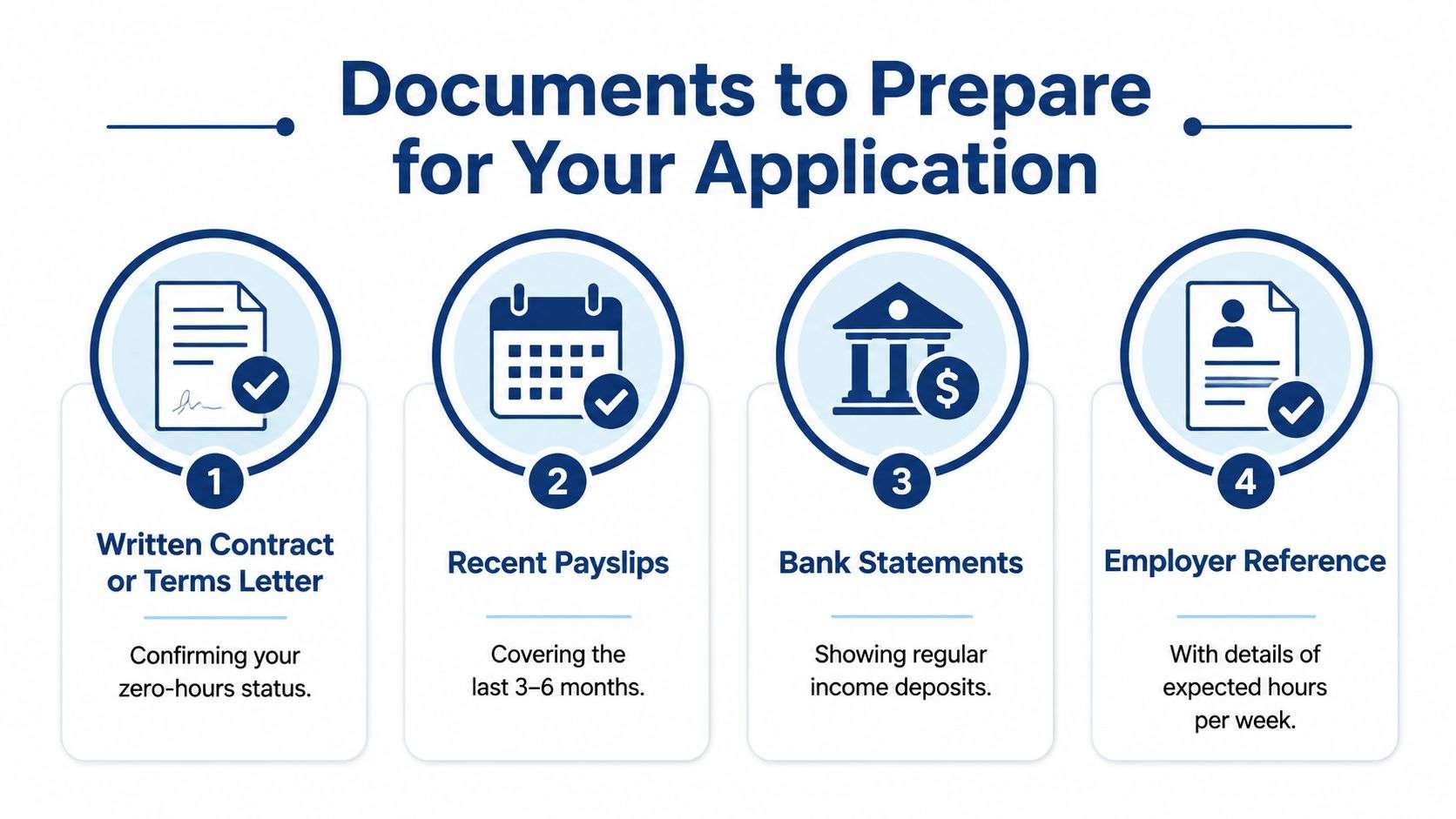
Build the evidence pack
Recent payslips: Several UK mortgage guides state that at least 3 months of payslips are typically requested. They show hours worked, gross pay, deductions and the pattern of variable earnings as outlined in this contractor lending criteria guide.
Bank statements: Lenders commonly request 3 months of bank statements to confirm salary credits and understand the account’s wider conduct.
P60 history: A P60 helps verify annual earnings and may support the income trend over the relevant employment period.
Contract details: Include the current terms and any letter confirming the role remains active.
Tax records: If self-assessment income supplements the employment income, provide the relevant SA302 or tax year overview.
Employer reference: The lender may ask for confirmation of employment, expected hours or the likelihood of continued work.
Additional income information: Declare a second job, benefits or Universal Credit top-ups if they form part of the affordability picture. The lender decides whether and how to use them.
The exact list varies. Don’t download a random bundle of documents and assume it fits every lender. An adviser should confirm the required period and format before submitting the application, particularly where earnings include holiday pay, bonuses, or multiple income streams.
You can also review related documentation expectations through this guide to self-employed mortgage requirements, especially if your income isn’t limited to PAYE employment.
Realistic Borrower Examples
Contract wording alone doesn’t tell the full story. Consider three illustrative profiles. They’re composite examples, not promises of acceptance, because each lender applies its own criteria and the final decision depends on full underwriting, credit checks and the property valuation.
| Borrower profile | Income evidence | Likely lender route | Key constraint |
|---|---|---|---|
| Care worker with four years on the same contract | Consistent 38-hour weeks, established payslip trail | Standard high-street assessment may be possible | Variable contract still needs averaging |
| Warehouse operative six months into a new role | Strong recent earnings but limited history | Flexible-income or specialist route may be needed | Short employment record |
| Hospitality worker with 18 months of seasonal dips | Earnings rise and fall sharply across the year | Lender willing to assess seasonal income | Lower averaged income and need for a buffer |
Profile A, established continuity
The care worker has four years under the same zero-hours arrangement, consistent 38-hour weeks, a clean credit file and a 15% deposit. That combination gives the lender a substantial record of actual work and a meaningful deposit against the property value. Standard high-street underwriting may be realistic, provided the accepted average income supports the requested loan.
Profile B, strong earnings but short history
The warehouse operative earns well but has only six months in the new role. A lender may regard the recent income as insufficiently tested, even if the payslips look impressive. The borrower could face a flexible-income or specialist route, a lower income multiple or a request for a larger deposit.
Profile C, seasonal volatility
The hospitality worker’s income is rising overall, but the 18-month history contains sharp seasonal dips. A lender may average the earnings down rather than rely on the latest improvement. The borrower needs a budget based on the accepted average and savings to cover weaker periods.
Practical Ways to Improve Your Chances
The best time to strengthen a zero-hours mortgage application is before you submit it. A lender can only use the evidence available at the point of assessment, so rushing after one strong run of shifts often creates a weaker case than waiting for a clearer pattern.
Improve the financial record
Where possible, extend your payslip history. 12 months of payslips gives the lender a more complete view of peaks, troughs and gaps than a short snapshot. Ask your employer for a reference confirming the role, your work history, and any realistic expectation of regular hours. It can’t guarantee future shifts, but it can help explain continuity.
Timing matters as well. Apply after a sustained period of sound earnings, not immediately after an unusually quiet spell or a single exceptional month. The lender will still average the income, but a complete and coherent record is easier to defend.
Reduce pressure on affordability
A deposit of at least 10% to 15% can put the application in a stronger position, although the appropriate amount depends on the lender, property and full circumstances. A larger deposit reduces the loan-to-value ratio and may give the underwriter more comfort where income varies.
Review discretionary spending before applying. Clear or reduce credit cards and finance where practical, because committed payments reduce the amount available for the mortgage. Check your credit file for errors, register on the electoral roll and avoid unnecessary new credit searches while preparing.
Budget discipline: Your mortgage should remain manageable during a quiet period, not only during your busiest month.
Build a post-completion emergency buffer covering 3 to 6 months of mortgage payments. That reserve doesn’t replace affordability evidence, but it demonstrates sensible planning and protects you against temporary falls in shifts. Before choosing a broker, read this guide on how to choose a mortgage broker and look for advice that considers the whole market rather than one bank’s policy.
Specialist Lenders and Mortgage Advice
There are three broad routes for a zero-hours application. A high-street lender may accept the income where the history is strong, and the average is clear. A flexible-income lender may apply different rules to recent employment or variable pay. A specialist lender may consider a more complex case, but the trade-off can include stricter evidence requirements, a smaller accepted income figure or less favourable pricing.
The right route depends on the evidence, not on the most attractive headline product. Sending an application to a bank that doesn’t accept your income pattern can create an unnecessary hard search and a refusal. That’s why lender research should happen before the agreement in principle, not after a rejection.
What a whole-of-market adviser does
A whole-of-market adviser can compare criteria across lenders rather than relying on a single bank’s policy. The adviser should:
Interpret the income: Separate basic pay, variable hours, holiday pay, overtime and any second income.
Check the history: Establish whether the lender wants 3 to 6 months, 12 months or a longer record.
Test the borrowing: Model the accepted average against commitments, deposit and stressed payments.
Seek clarity: Request lender feedback where published criteria don’t fully explain how zero-hours income will be treated.
Present the case: Put the evidence in an order that allows the underwriter to follow the income story.
The adviser’s work continues beyond the initial recommendation. They can help respond to underwriter questions, manage document requests, coordinate with the solicitor and deal with conditions before completion. They should also explain where the case is strong, where it is exposed and what a lender is unlikely to accept.
For borrowers whose working arrangement sits between employment and contracting, Umbrella Company’s contractor mortgage guide offers useful context on how to present complex income. It isn’t a substitute for a case-specific assessment, but it can help you understand why lender interpretation matters.
The priority is a lender whose underwriting fits your income history. A specialist label doesn’t automatically make a product suitable, and a high-street name doesn’t automatically make it unavailable.
Your Next Step Towards a Mortgage
Treat the application as an evidence exercise, not a test of whether zero-hours contracts are acceptable. Your immediate checklist is straightforward:
Gather the file: Collect payslips, bank statements, P60s, your contract and any employer reference.
Review the credit record: Correct errors before an adviser or lender runs a full search.
Calculate realistic affordability: Use the averaged income, current commitments and a payment that remains manageable if rates rise or hours fall.
Protect the budget: Build a reserve covering 3 to 6 months of mortgage instalments and avoid stretching the purchase price to the maximum theoretical figure.
Choose the route: Decide whether you need whole-of-market advice before applying, particularly if your employment history is short, seasonal, or supported by other income.
A lender’s criteria, the property valuation and full underwriting ultimately determine the result. Good preparation reduces delays and helps avoid unnecessary applications to lenders that aren’t suited to your income.
Saving for a deposit also requires control over small recurring costs. Practical guidance on how to stop surprise subscription charges for a deposit can help you identify payments that reduce your monthly surplus.
EHF Mortgages can assess your zero-hours income, review the supporting evidence and match your circumstances with suitable whole-of-market lending options. If you’re buying in Chelmsford, Braintree, Colchester or elsewhere in the UK, visit EHF Mortgages to arrange case-specific mortgage guidance before making an application.





