
💡 Top Tip: Getting your documents in order early is half the battle won when securing a mortgage. Don’t worry, we’ll explain exactly what you need later in this guide.
Table of Contents
Understanding if you’re eligible for a mortgage is the very first, and most important, step on the road to owning a home. It’s how lenders decide whether they can trust you with what is, let’s face it, a massive loan. Think of it as a financial MOT. They will look at your income, spending habits, and credit history to assess how reliable you will be with repayments.
This check does not just determine if you can get a mortgage. It also decides how much you can borrow and the interest rate you will be offered. For anyone looking in competitive Essex hotspots like Chelmsford, Braintree, or Colchester, being “mortgage-ready” gives you a real edge when you finally find that perfect property.

We’re here to demystify the whole process. This guide breaks down everything you need to know about qualifying for a mortgage in the UK, without the confusing jargon.
Our aim with this guide is to give you the confidence to start your mortgage application, knowing you’ve put your best foot forward. By the time you’re done reading, you’ll have a much clearer idea of what lenders are looking for and how to show them you’re a strong candidate.
Ready to take control? Let’s dive into the core elements of mortgage eligibility.
The Four Pillars of Mortgage Eligibility
When a lender looks at your mortgage application, they are not making a gut decision. They are methodically building a picture of you as a borrower, focusing on four key areas to gauge the risk and affordability of the loan.
Think of these as the four pillars holding up your application: your income, your credit history, your deposit, and your overall affordability. Getting these four elements right is the foundation for securing the property you want.

Each pillar tells a lender something crucial about your financial health. A high income shows you have the cash flow for repayments, a clean credit history proves you are reliable, and a solid deposit reduces their risk. The final piece, affordability, shows you can handle the loan even if your circumstances change. Let’s break down what each one really means for you.
Pillar 1: Your Income
Your income is the engine of your mortgage application. It’s the first thing a lender looks at to see if you can consistently meet your monthly payments. But how they assess it depends entirely on how you are employed.
PAYE (Pay As You Earn): If you are on a company payroll, lenders will typically want to see your basic salary confirmed by your last three to six months of payslips and your most recent P60. If you earn overtime, bonuses, or commissions, this can often be included, but do not be surprised if lenders accept only a percentage of it.
Self-Employed: For sole traders or limited company directors in Essex, there are no payslips to show. Instead, lenders will analyse your last two to three years of finalised accounts and HMRC tax calculations (your SA302s) to work out an average profit or income. They need to see a stable, long-term picture of your earnings. Normally, we look at the HMRC Self-Assessment returns that show the declared income, rather than the monthly income. That can include salary, dividends, and any other declared income. We can also check the limited company’s retained profits, if any.
Lenders use this income figure to get a rough idea of your borrowing potential, applying what’s known as an income multiple. As a general rule of thumb, most high street lenders might offer around 4.5 times your annual income. It’s a simple starting point, but a critical one.
Pillar 2: Your Credit History
Think of your credit history as your financial CV. It’s a detailed log of how you have handled borrowing in the past, covering everything from credit cards and loans to your mobile phone contract. Lenders will pull your credit report from agencies like Experian, Equifax, or TransUnion to look for any red flags.
What they want to see is a track record of responsible borrowing. This means making payments on time and in full. Any slip-ups, such as late payments or defaults, or more serious issues, such as County Court Judgements (CCJs), can hurt your chances. A high credit score signals that you are a low-risk borrower, making you a much more attractive applicant.
Pillar 3: Your Deposit
Your deposit is the money you put down towards the property’s purchase price. It’s your personal stake in the investment, and it directly impacts the mortgage you will need. The bigger your deposit, the smaller the loan and the lower your Loan to Value (LTV) ratio.
Having a larger deposit works in your favour for a few reasons:
It reduces the Lender’s Risk: A good-sized deposit proves you are financially disciplined and lowers the lender’s potential loss if anything goes wrong.
It Unlocks Better Deals: Lenders save their best interest rates for borrowers with lower LTVs. A deposit of 25% or more often opens the door to the most competitive deals on the market.
It Strengthens Your Application: A larger deposit can make all the difference, especially if you have a minor weakness in another area, like a slightly imperfect credit score.
While 5% deposit mortgages are out there, aiming for 10% or more will put you in a much stronger position. You can learn more about how this is calculated in our guide to calculating Loan to Value.
Pillar 4: Your Affordability
This is the final, and arguably most crucial, pillar. Affordability goes way beyond a simple income multiple. Lenders are legally required to conduct a detailed affordability assessment to be absolutely sure you can afford the repayments alongside all your other financial commitments.
To do this, they run a “stress test”. They meticulously analyse your income against all of your fixed outgoings, including:
| Expense Category | Examples of What Lenders Check |
|---|---|
| Existing Debt | Credit card balances, personal loans, and car finance |
| Household Bills | Council tax, utilities, and insurance policies |
| Financial Dependants | Costs associated with children or other dependants |
| Lifestyle Spending | Travel, subscriptions, socialising, and pension payments |
After tallying everything up, they will calculate if you could still afford your mortgage if interest rates were to rise significantly, for example, by 2-3% above the current rate. This is designed to protect both you and the lender from future financial shocks, ensuring your home remains affordable in the long run.
Navigating Common Hurdles for First-Time Buyers
Getting your first foot on the property ladder is a huge moment, especially in vibrant Essex communities like Colchester. It’s an exciting time, but for many first-time buyers, the path to getting the keys can feel a bit like an obstacle course. The three biggest eligibility hurdles that first-time buyers in Essex face most often are being able to show that the mortgage is affordable, having a sufficient deposit, and gathering the necessary documentation.
Getting these right is the key to turning your homeownership dream into a reality.
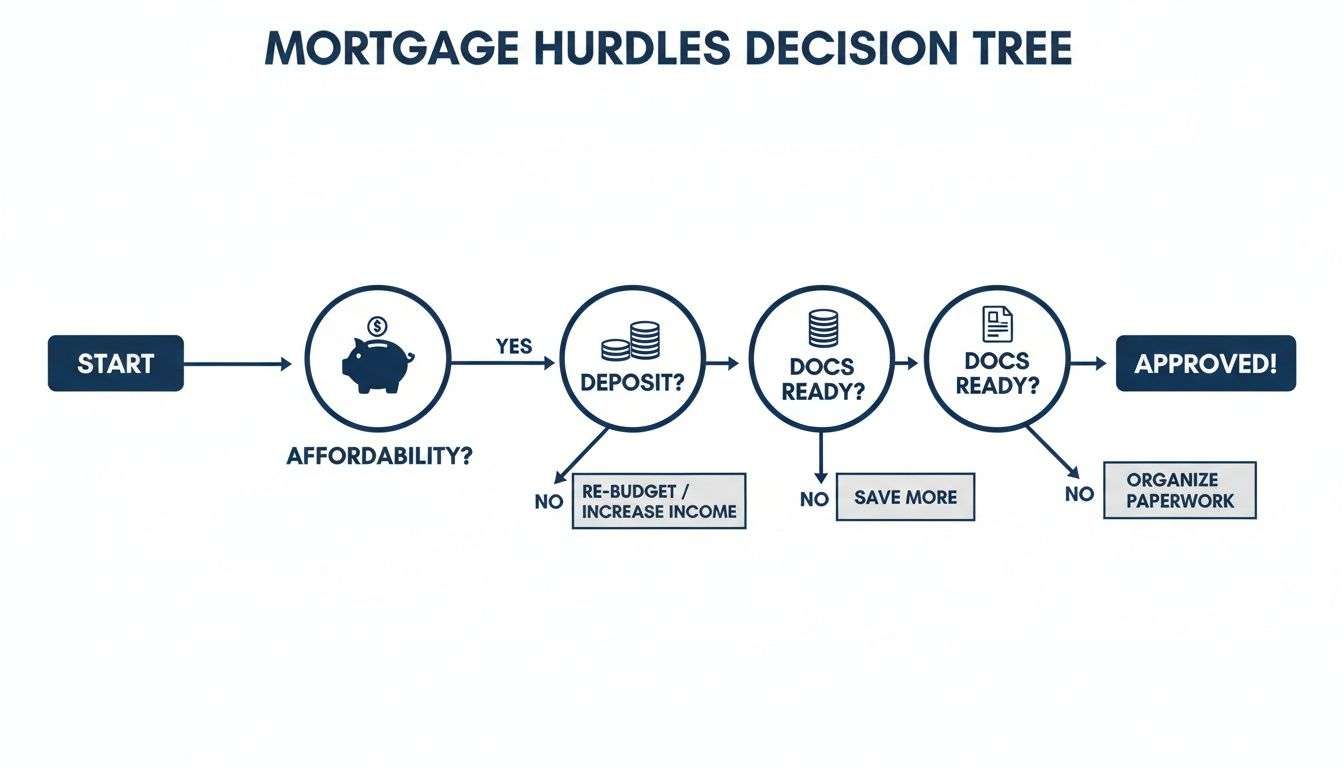
Hurdle 1: Showing the Mortgage is Affordable
As we have mentioned, affordability isn’t just about what your payslip says. Lenders need to feel confident that you can comfortably manage your monthly mortgage payments on top of all your other financial commitments. For first-time buyers, this level of financial scrutiny can feel pretty intense.
The best thing you can do is start getting your finances in shape a few months before you even think about applying. Lenders will want to see your bank statements, so now’s the time to show them you’re a responsible borrower.
Trim Your Outgoings: Take a look at non-essential spending. This could be anything from cutting back on subscriptions you do not use to reducing frequent takeaways or pausing large, one-off purchases.
Get a Handle on Debt: Focus on paying down any high-interest debt, such as credit card debt or personal loans. Lenders calculate your debt-to-income ratio, and a lower number here will seriously boost your chances.
Hold Off on New Credit: Whatever you do, do not take out a new car finance deal or apply for other loans in the months leading up to your mortgage application. This can be a major red flag for lenders.
By giving your finances a bit of a spring clean, you paint a clear picture of responsible money management. It just makes it so much easier for a lender to say “yes”.
Hurdle 2: Having a Sufficient Deposit
Saving a deposit is often the single biggest financial mountain for first-time buyers to climb. And while mortgages with a 5% deposit are out there, pulling together a larger deposit does two things: it makes your application much stronger, and it usually unlocks better interest rates, which could save you thousands over the life of the loan.
Don’t forget to look into government schemes like the Lifetime ISA (LISA), which offers a 25% bonus on your savings toward your first home.
Hurdle 3: Gathering the Necessary Documentation
One of the most frustrating and common reasons a mortgage application stalls is missing or incorrect paperwork. Lenders need a whole stack of documents to check your identity, income, and financial position. Being disorganised here can cause a lot of stress and could even put your purchase at risk.
To sidestep any last-minute panic, start gathering everything you need well in advance. Turning up with a complete file shows the lender you’re prepared and serious about the application. Here’s a simple checklist covering the essential documents most lenders will ask for.
| Category | What You Need | Why It’s Important | Pro Tip |
|---|---|---|---|
| Proof of Identity | Passport or driving licence | To verify you are who you say you are and prevent fraud. | Make sure your documents are valid and up-to-date. |
| Proof of Address | Recent utility bills or council tax statements | To confirm where you currently live. | Use bills dated within the last three months. |
| Proof of Income | Last 3-6 months’ payslips and latest P60 | To prove your earnings and ability to repay the loan. | If you get bonuses, gather a two-year history. |
| Bank Statements | Last 3-6 months’ statements for all accounts | To show your spending habits and affordability. | Tidy up your spending before providing these. |
| Proof of Deposit | Savings account statements showing the funds | To prove the deposit is yours and not a loan. | If gifted, you will need a letter from the donor. |
Nailing these three things is the foundation of a successful mortgage application. It takes a bit of prep work, but clearing these hurdles puts you in the best possible position to secure the keys to your very first home.
Specialist Mortgages Your Bank Might Not Offer
What happens when your financial situation does not fit neatly into the boxes on a high street bank’s application form? It’s a common worry, and many people assume a ‘no’ from their bank is the end of the line. Thankfully, that’s rarely the case.
Beyond the well-known high street lenders, there’s a whole market of specialist mortgages designed for people with more complex circumstances. As independent brokers, we have access to this entire market. This is our territory: finding solutions with lenders who take a more individual, flexible approach, especially for clients who are self-employed, have past credit issues, or are borrowing later in life.
Mortgages for the Self-Employed
If you’re a sole trader, contractor, or limited company director in Essex, you will know your income does not arrive in a tidy monthly payslip. Mainstream lenders can often get stuck on this point, but specialist lenders get it. They understand the realities of self-employed earnings.
Rather than just glancing at a salary figure, they will dig into the details. We assess self-employed applicants differently from PAYE clients. Normally, we look at the HMRC Self-Assessment returns that show the declared income, rather than the monthly income. This allows us to see the complete picture, which can include:
Salary and Dividends: The standard way most company directors pay themselves.
Retained Profits: This is a big one. Some lenders are willing to consider the net profit left in your business. If you have had a strong year but reinvested the money, this can massively boost your borrowing power.
This detailed, more human approach gives a much fairer assessment of what you can actually afford, opening doors that might have seemed firmly shut.
Navigating Adverse Credit History
A past financial hiccup, like a missed payment or a County Court Judgement (CCJ), can feel like a permanent black mark. The automated scoring systems used by many high street banks often reject these applications outright, without a second glance. Specialist lenders, however, are more likely to listen to the story behind the numbers.
“We had a client with an old CCJ from around 3 years ago for around £2000, a disputed business invoice. As the CCJ will show for at least the next 6 years on your credit file, the high street lenders declined this case, but one of our specialist lenders was able to help quite easily, once they understood what caused the problem, and were satisfied that it was a one-off issue.”
As this real-life case shows, context is everything. These lenders are run by people, not just algorithms. If they can see that an issue was a one-off, has been sorted, and is not part of a wider pattern, they are often perfectly willing to offer a mortgage. They look at the person, not just the score.
Sometimes, having a guarantor can also help strengthen your case. You can find out more in our article about getting a mortgage with a guarantor.
Lending into Later Life
Your age should never be a barrier to getting the right finance for your home. Yet many borrowers over 55 find that high-street options become surprisingly limited, mainly because lenders get nervous about a mortgage term that extends past retirement age. Specialist lenders have stepped in to create products that address this exact situation.
These mortgages are built for flexibility, whether you’re still working, semi-retired, or fully retired.
| Mortgage Type | How It Works | Best For |
|---|---|---|
| Standard Mortgage | A typical repayment or interest-only mortgage with a term that fits your plans. | Those with a clear income and a strategy to repay before a certain age. |
| Retirement Interest-Only | You only pay the interest each month. The loan itself is repaid when the property is eventually sold. | Borrowers with a reliable retirement income to cover the interest payments. |
| Equity Release | A loan secured against your home that does not require any monthly payments. | Homeowners who want to access a tax-free lump sum from their property’s value. |
These products recognise that your financial life does not just stop at 55. They offer practical ways to manage your property wealth, whether you want to move house, make home improvements, or gift money to family. Your eligibility for mortgage products like these is about your overall financial health, not your date of birth.
Exploring these specialist routes is where expert guidance really pays off. A broker who knows the ins and outs of these niche lenders can frame your application in the best possible light, unlocking opportunities you would not find on your own.
How Lenders Calculate Your Borrowing Potential
Figuring out how much a lender might offer you can feel like trying to solve a complex puzzle. You see online calculators and hear simple rules of thumb, but the reality of how lenders assess your borrowing power is far more detailed. It is not just a straightforward multiplication of your salary; it’s a careful, holistic assessment of your entire financial picture.

Beyond the Basic Income Multiple
You have probably heard that lenders will offer you around 4.5 times your annual income. While this income multiple is a useful benchmark, it’s really just the first step in a lender’s calculation. The final loan amount is determined by a much more thorough affordability check.
“Multiples are only a guide and not the way lenders agree the amount to lend, but as a rough rule, most lenders offer around 4.5 x income as a mortgage. For first-time buyers, many lenders will stretch this to 6x income, especially when there is a high level of combined income between applicants. For existing borrowers, there are schemes that allow borrowing up to 6x income if income is high and outgoings are low.”
As our experts highlight, certain circumstances can push this multiple higher. High-earning professionals or joint applicants with minimal outgoings are often seen as lower risk, giving lenders the confidence to stretch their lending limits. This flexibility can make a huge difference, particularly for those looking to buy in areas like Chelmsford, where property prices demand a bit more financial firepower.
The Role of Affordability and Debt
After looking at your income, lenders dive deep into your outgoings. Their goal is to make sure you can comfortably afford the mortgage repayments alongside your existing financial commitments, both now and in the future if interest rates were to rise.
A crucial metric in this assessment is your debt-to-income (DTI) ratio; you can use a Debt-to-Income Ratio Calculator to get a rough idea of where you stand. This figure shows lenders what percentage of your monthly income is already earmarked for paying off debts like credit cards, car loans, and student loans. A lower DTI ratio signals you have more disposable income available, which is exactly what they want to see.
How Your Age Affects Borrowing
One of the most important, but often overlooked, factors in a lender’s calculation is your age. Lenders need to be confident that the mortgage will be fully repaid before you reach your planned retirement age, which they typically assume to be between 65 and 70.
This means a 50-year-old applicant might only be offered a 20-year mortgage term, whereas a 30-year-old could easily secure a 35-year term. A shorter term results in higher monthly payments, which directly reduce the total amount you can borrow, ensuring those repayments remain affordable. This is a key consideration for your mortgage eligibility.
Ultimately, lenders combine all these elements: income, outgoings, debt, and age, to arrive at a final, responsible lending figure. It’s their way of making sure they are not putting you in a position where you are taking on a debt you cannot manage.
It’s Time to Take the Next Step
Getting to grips with mortgage eligibility is the first, most crucial step on your journey to owning a home. We’ve walked through the core factors every lender scrutinises: the four pillars of income, credit history, deposit size, and overall affordability, and shone a light on the unique challenges facing buyers, particularly here in Essex.
You’ve seen that the classic “4.5 times your income” rule is more of a guideline than a hard-and-fast law. We also pulled back the curtain on the world of specialist mortgages, showing that a ‘no’ from a high street bank is not the end of the road, especially for self-employed professionals or those with a less-than-perfect credit past.
The single most important thing to remember is this: while the basic rules of lending are consistent, how they’re applied is anything but. Every lender has its own appetite for risk and its own unique criteria. A case that is automatically rejected by one bank’s computer system could be a perfect fit for a specialist lender who takes the time to look at the real person behind the numbers.
Trying to navigate this maze of lenders and policies on your own can be overwhelming. Think of an independent, whole-of-market broker as your personal guide. Our job is to understand your story: your finances, your goals, your life, and match you with the lender who is most likely to say ‘yes’. We frame your application to present you in the strongest possible light, saving you an immense amount of time, stress, and potentially thousands of pounds.
You now have a solid understanding of how it all works. The next move is yours.
If you’re ready to find out what’s truly possible for you, we’re here to help. Get in touch for a free, no-obligation chat about your situation and let’s start turning your property goals into a reality.
Frequently Asked Questions
Got a burning question about your mortgage eligibility? You’re not alone. We hear these questions all the time from aspiring homeowners in Essex and beyond, so we’ve put together some clear, straightforward answers to help you get started.
How Is Mortgage Eligibility Calculated For The Self-Employed?
Being your own boss should not be a barrier to owning your home, but lenders do look at your income a bit differently. Instead of relying on monthly payslips, they will want to see a track record of your earnings.
This usually means providing your HMRC Self-Assessment tax returns from the last one to three years. Lenders will look at your declared income, which can include your salary and any dividends you’ve taken. We can also explore using your limited company’s net profits, especially if there are retained profits, which can sometimes significantly boost your borrowing potential.
Can I Get A Mortgage With A Low Credit Score?
Yes, it’s often possible. While a low credit score might mean a “no” from many high street banks, it does not have to be the end of your homeownership journey.
Specialist lenders are often more understanding of past credit issues, especially if a missed payment or CCJ was a one-off event caused by a difficult circumstance. As brokers, our job is to present your application in the best possible light, explaining the full story behind any credit blips to a lender who is willing to listen.
“We had a client with an old CCJ from around 3 years ago for around £2000…the high street lenders declined this case, but one of our specialist lenders was able to help quite easily, once they understood what caused the problem, and were satisfied that it was a one-off issue.”
What Is The Minimum Deposit I Need For A Mortgage?
In the UK, the general minimum deposit for a residential mortgage is 5% of the property’s purchase price. These are often called 95% Loan-to-Value (LTV) mortgages.
However, if you can stretch to a larger deposit of 10% or more, you will find that you become a much more attractive prospect for lenders. A bigger deposit reduces their risk, which often unlocks a wider choice of mortgage products and, crucially, more competitive interest rates.
Ready to get answers tailored to your personal situation? Our team is ready to help.





