Self-Employed Mortgage Requirements UK 2026: A Complete Guide
💡Top Tip: Having at least two full years of finalised accounts is the gold standard for most lenders. We’ll explain exactly why – and what to do if you have less – later in this guide.
Table of Contents
- The Reality Of Securing A Self-Employed Mortgage In 2026
- Gathering Your Essential Mortgage Documents
- How Lenders Calculate Your Self-Employed Income
- Understanding Minimum Trading Periods And Lender Views
- The Role Of Your Deposit Credit Score And Affordability
- Why A Specialist Mortgage Broker Is Your Greatest Asset
- Frequently Asked Questions
The Reality Of Securing A Self-Employed Mortgage In 2026
Getting a mortgage when you’re self-employed can feel like trying to solve a puzzle with half the pieces missing, but it’s far more achievable than you might think. Many business owners worry that fluctuating income or complex accounts will be an instant red flag to lenders.
This anxiety is completely normal. Whether you’re an entrepreneur in Chelmsford or a freelancer in Colchester, it’s a common concern. Lenders, by nature, are cautious and want clear, undeniable proof of a stable income before they’ll approve a large loan.
The good news? The mortgage market has caught up with the reality of modern work and the boom in entrepreneurship. The key is simply preparation and understanding exactly what lenders need to see. They want a clear picture of your financial health, backed up by consistent records and a solid trading history.
“Getting a self-employed mortgage isn’t about trying to fit into a traditional PAYE box. It’s about clearly demonstrating your business’s success and stability to lenders who understand how modern businesses operate.”

Navigating Your Self-Employed Mortgage Journey
For business owners, the timing couldn’t be better. In 2026, the UK mortgage market is brimming with opportunities for self-employed borrowers, with a staggering 7,158 deals available as of early this year. That’s 650 more than in January 2025 and the highest number seen since October 2007.
This surge is a game-changer. All this competition means more lenders are vying for your business, leading to better products and more flexible criteria for people like you. You can read more about the booming mortgage market on Moneyfacts.
What This Comprehensive Guide Covers
Think of this guide as your personal roadmap, designed to demystify the entire process from start to finish. We’ll break down the jargon into simple, actionable steps, showing you that with the right approach, homeownership is well within your grasp.
We’re going to cover:
- The essential documents you’ll need and, more importantly, why they matter so much.
- How different lenders calculate your income depends on your business type.
- The minimum trading periods lenders look for and how they view your profits.
- The crucial role your deposit and credit score play in your application.
By the end, you will have the confidence and knowledge to meet the self-employed mortgage requirements and finally secure the keys to your new home.
Gathering Your Essential Mortgage Documents
Knowing the self-employed mortgage requirements is one thing, but proving your income with the right paperwork is where your application really begins. Lenders need to see a clear, official story of your earnings, and your documents are the chapters that bring it all to life.
Think of your application like a business proposal you’re presenting to the bank. The better organised and more complete your evidence is, the stronger your case will be. For lenders, it’s all about minimising their risk, and a tidy set of documents proves you’re a reliable and well-organised applicant.
“Your paperwork isn’t just a formality; it’s the financial biography of your business. Each document provides lenders with a crucial piece of the puzzle, helping them build a complete picture of your affordability and stability.”
To make sure you have everything you need, we’ve put together a handy checklist. This table breaks down exactly what you’ll need depending on how your business is set up.
Essential Document Checklist for Self-Employed Applicants
| Document | Required For | What It Proves | Where To Get It | Pro Tip |
|---|---|---|---|---|
| SA302 & Tax Year Overviews | Sole Traders & Partnerships | You have declared your income, and that your tax is paid up to date. This is the core proof of your earnings. | Your HMRC online account or from your accountant. | Lenders want to see 2-3 years of these to establish a consistent income history. |
| Certified Accounts | Limited Company Directors | The financial health of your business, including turnover, profit, and any money left in the company. | Your accountant will prepare these for you. | Ensure they are signed and finalised. Draft accounts are rarely accepted. |
| Business Bank Statements | All Self-Employed Applicants | How money flows in and out of your business day-to-day. It shows your trading is active and healthy. | Your business bank’s online portal or app. | Check for any bounced payments or unarranged overdrafts, as lenders will scrutinise them. |
| Personal Bank Statements | All Self-Employed Applicants | Your personal financial management and affordability. Lenders check for spending habits and undeclared debts. | Your personal bank’s online portal or app. | It’s wise to tidy up your spending in the 3-6 months before applying. Avoid gambling transactions. |
| Proof of Deposit | All Self-Employed Applicants | That your deposit comes from a legitimate source and isn’t a loan. | Bank statements showing the funds accumulating over time or a gift letter, if applicable. | If your deposit is a gift, the person giving it will need to provide ID and a signed letter. |
Having these documents ready before you start an application will put you miles ahead and show any lender that you’re serious.
Key Documents For Sole Traders And Partnerships
If you’re a sole trader or in a partnership, lenders will want to see your finalised tax returns submitted directly to HMRC. This gives them the clearest, most accurate view of your net profit, which is the exact figure they use to calculate how much you can borrow.
The two documents they’ll always ask for are:
SA302 Forms: This is HMRC’s summary of your total declared income from your Self-Assessment tax return. Lenders typically ask for the last two to three years of earnings to see a consistent, reliable earnings history.
Tax Year Overviews: This document goes hand in hand with the SA302 and confirms that the tax you owe has been paid. It’s the proof a lender needs that your tax affairs are in good order.
The good news is you can download both of these directly from your HMRC online account in just a few minutes.
Paperwork For Limited Company Directors
For directors of a limited company, the requirements are slightly different. While your personal tax returns are still part of the picture, lenders also need to get under the bonnet of your business and check its financial health as a separate entity.
You’ll usually be asked to provide:
Certified or Audited Accounts: These are prepared by a qualified accountant and show your company’s turnover, net profit, and any profits retained in the business. Most lenders will want to see the last two years of finalised accounts.
Personal and Business Bank Statements: Expect to provide the last three to six months. These statements demonstrate the day-to-day financial management of both your personal life and your business.
To build the strongest case, accurately preparing financial statements is crucial. For a deeper dive into the process, you might find our guide on getting a mortgage when self-employed really helpful.
The Impact Of Making Tax Digital In 2026
It’s also worth knowing that the paperwork landscape is about to change. Self-employed mortgage hunters should get ready for 2026, as lenders will start requiring more rigorous proof, such as two full years of SA302s and Tax Year Overviews, plus the latest three months’ business bank statements.
From April 2026, if your annual income as a sole trader or landlord is over £50,000, Making Tax Digital (MTD) for self-assessment becomes mandatory, which means keeping digital tax records. This will then roll out to those earning over £30,000 by April 2027, which should help streamline the evidence you provide to mortgage lenders.
Getting all your documents in order is the best first step you can take. Being prepared not only speeds up the mortgage process but also shows lenders you’re a serious, organised applicant ready for homeownership, whether you’re in Braintree or anywhere else in Essex.
How Lenders Calculate Your Self-Employed Income
Figuring out how lenders will view your income is probably the single most important hurdle in a self-employed mortgage application. Unlike a PAYE employee with a predictable monthly payslip, your earnings can have peaks and troughs. Because of this, lenders have specific ways of calculating your income to get a stable picture of what you can afford.
Getting this part wrong is a classic pitfall. It can lead to a much smaller mortgage offer than you were counting on, or even an outright rejection.
The main thing to grasp is that lenders are looking for a reliable, average income they can plug into their affordability calculator. They want to smooth out the financial rollercoaster of running a business to land on a figure that represents your consistent earning power. How they do this depends entirely on your business structure – whether you’re a sole trader, a limited company director, or a contractor.
This flowchart gives you a quick snapshot of the documents lenders will zero in on based on how you trade, which in turn dictates how they’ll crunch the numbers.
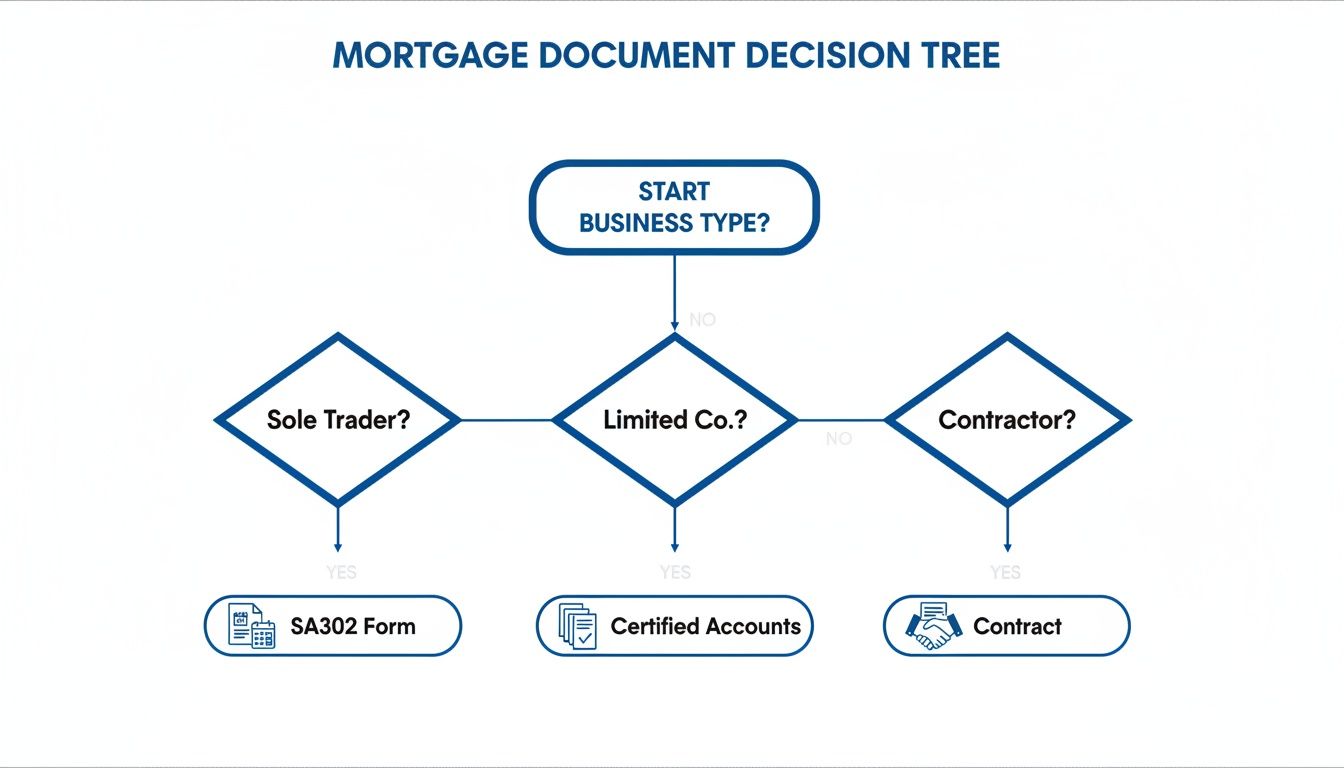
As you can see, the journey to proving your income starts with your business setup. This determines the exact evidence a lender needs to see.
Calculations For Sole Traders And Partnerships
For sole traders and partners in a business, the calculation is usually quite straightforward. Lenders focus on your net profit before tax, which is the figure you declare to HMRC on your SA302 tax calculations. This number is what they consider your true personal earnings from the business.
Most lenders will ask for the last two or three years’ worth of figures and typically use one of two methods:
- An average of the last two years’ net profit. This is the most common route. If you made £40,000 in year one and £50,000 in year two, they’d likely assess your income as £45,000.
- The most recent year’s net profit. A few lenders might do this, but usually only if your profits are on a clear upward trajectory. If your latest year is lower than the one before, they will almost certainly fall back on the average to play it safe.
It’s crucial to remember that your borrowing power is tied to your declared profits. While it’s tempting to maximise your sole trader tax deductions, a history of aggressively minimising your taxable income can seriously limit how much a bank is willing to lend you.
How Limited Company Director Income Is Assessed
If you’re a limited company director, things get a bit more complicated. Your personal income and the company’s profit are two separate legal entities, so lenders have a couple of different ways to look at your earnings.
The most common method is to use your personal salary, combined with any dividends you’ve received from the company. Just like with sole traders, they’ll usually average these figures over the last two years to get a consistent income for their mortgage calculations.
However, a growing number of specialist lenders – and even some high street names – are willing to take a wider view. They might calculate your income based on your director’s salary plus your share of the company’s net profit (before or after corporation tax is deducted).
This second approach can be a game-changer for directors who prefer to reinvest profits in the business to fuel growth, rather than pay out everything as dividends. For an applicant in Braintree or Colchester, finding a lender who uses this method could be the difference between buying their dream home and having to compromise.
“For limited company directors, the calculation method is crucial. One lender might assess your income at £50,000 based on salary and dividends, while another might see it as £80,000 by including retained profit. This difference can change everything.”
Assessing Income For Contractors And Freelancers
Contractors working on a fixed-day rate often get assessed in an entirely different way. Many lenders have specific criteria just for contractors and can calculate borrowing based on an annualised version of their day rate, which is often far more generous.
To do this, a lender will typically take your daily rate, multiply it by five days, and then multiply it by 46 or 48 weeks to allow for holidays. For this to be an option, you will usually need to show:
- A solid track record of contracting in your industry.
- At least 6 to 12 months left on your current contract, or strong evidence of back-to-back renewals.
This can be a fantastic route for contractors, as it often results in a much higher assessable income than using their limited company accounts alone.
The table below provides a clearer view of the different approaches lenders take.
Self-Employed Income Calculation Methods By Lender
This table compares how different types of lenders typically assess income for various self-employed structures, helping you understand your borrowing potential.
| Employment Type | High Street Lender | Specialist Lender | Common Calculation | Key Consideration |
|---|---|---|---|---|
| Sole Trader | Prefers 2-3 years’ history. | May consider 1 year. | Average of the last 2 years’ net profit. | Declining profits are a major red flag. |
| Ltd Co Director | Often uses salary + Dividends. | May use Salary + Net Profit. | Average over 2 years. | Retained profit can boost borrowing with the right lender. |
| Contractor | May have strict criteria on contract length. | More flexible on contract gaps. | (Day Rate x 5) x 46 weeks. | Strong history in the same field is essential. |
| Partnership | Assesses your share of net profit. | Same as High Street. | Average share of profit over 2 years. | The stability of the overall partnership is assessed. |
Understanding these nuances is the first step to presenting your income in the most favourable light, ensuring you get the mortgage you deserve for your Essex home.
Understanding Minimum Trading Periods And Lender Views
When it comes to self-employed mortgages, it’s crucial to understand that not all lenders see things the same way. One bank’s rigid rulebook might lead to a quick ‘no’, while another lender might see the potential in your business and give you a confident ‘yes’. This difference in perspective is one of the biggest hurdles for self-employed applicants.
A common stumbling block is the minimum trading period. Think of this as the business equivalent of a probationary period at a new job. Most high street lenders want to see a proven track record, which usually means they require two to three years of finalised accounts. This history gives them the confidence that your income is stable and reliable.
If a high street bank has knocked you back because you don’t have a long enough history, it can feel like the end of the road. But it’s not. It’s simply a sign that you need to look beyond the usual suspects.
The One-Year Accounts Mortgage: Myth Or Reality?
What if you’ve only been trading for a year? Many people who’ve recently leapt into self-employment, particularly in areas like Chelmsford, assume a mortgage is completely off the table. While it’s true that your options are more limited, securing a mortgage with just one year of accounts is absolutely possible.
This is where specialist lenders come in. These lenders have carved out a niche by understanding that not everyone fits into a neat little box. They’re often more willing to look at your application on its individual merits, rather than just ticking a ‘two-year rule’ box.
To get comfortable with a shorter trading history, a specialist lender might:
- Look at your industry experience: Have you been working in the same field for years as an employee before going it alone? This track record provides a huge amount of reassurance.
- Analyse your projections: A solid business plan, coupled with evidence of future contracts or a healthy pipeline of work, can build a very compelling case for your future success.
- Ask for a larger deposit: Putting down a bigger deposit, often 20% or more, reduces the lender’s risk and makes them more comfortable with your application.
It’s fair to say this flexibility can sometimes come with a slightly higher interest rate to balance out the perceived risk. For many, though, it’s a small price to pay to get onto the property ladder without waiting another year or two.
How Lenders View Your Profit History
It’s not just about how long you’ve been trading; lenders are intensely interested in the *story* your profits tell. A business showing steady, year-on-year growth is the dream scenario for any mortgage underwriter. It screams stability and reliability.
But what if your profits have been up and down? A one-year dip in profits can be a red flag for mainstream lenders. They might average your income over two or three years, or worse, use the lowest year’s figure for their affordability calculation, significantly reducing what you can borrow.
“A single rejection isn’t a reflection of your business’s success. It’s simply a mismatch with one lender’s specific rulebook. The key is finding the lender whose criteria align with your unique financial journey.”
On the other hand, a specialist lender is more likely to listen to the reasons behind the numbers. Did you make a significant investment in new equipment? Did you take some time off for family reasons? Providing a clear explanation, often with a letter from your accountant, can make all the difference.
Thankfully, the outlook is improving. The market in 2026 is set to bring welcome relief for the UK’s self-employed, with signs that lenders are relaxing their criteria and offering more choice than we’ve seen since 2007. For our clients in Essex, this translates into better borrowing power. Self-employed individuals in places like Braintree, for instance, are already finding that lenders are taking a more understanding view. Learn more about the 2026 housing market outlook and what it means for you.
Ultimately, a rejection from one bank means you haven’t found the right partner yet. It highlights why finding a lender that fits your specific circumstances is so important.
The Role Of Your Deposit, Credit Score, And Affordability

While proving your income is a huge part of the puzzle for a self-employed mortgage, it’s only one piece of the puzzle. Lenders also place great weight on your deposit, credit score, and overall affordability.
Nailing these three elements can be the difference between a smooth approval and a frustrating rejection. Think of your application as a three-legged stool: if your income leg is solid but your deposit or credit score legs are wobbly, the whole thing can easily topple over.
The Power Of A Larger Deposit
For anyone self-employed, a substantial deposit is more than just a down payment – it’s a powerful signal of financial discipline and stability. From a lender’s point of view, a larger deposit instantly reduces their risk because they’re lending less against the property’s value. This is what’s known as the Loan-to-Value (LTV) ratio.
A lower LTV doesn’t just make you a more attractive borrower; it can unlock some serious benefits:
- Access to Better Interest Rates: Lenders keep their best rates for applicants with lower LTVs, usually below 75% (which means a 25% deposit).
- Increased Lender Choice: More lenders will consider your application, including those that are typically more stringent.
- Improved Affordability: A larger deposit means a smaller mortgage and lower monthly repayments, helping you pass affordability checks with flying colours.
- Aiming for a deposit of at least 15-20% is a great goal. It shows lenders that you’re a serious, low-risk applicant who manages your finances – a key trait they look for in business owners.
Why Your Credit Score Is Non-Negotiable
Your credit score is essentially your financial CV, and you can be sure lenders will review it meticulously. A strong credit history demonstrates a track record of borrowing responsibly and repaying debts on time.
Because self-employed income can be seen as less predictable, a pristine credit report provides vital reassurance to the lender.
“Your income shows a lender you can afford a mortgage today. Your credit score shows them how reliably you’ve handled your finances in the past. Both are equally vital.”
Before you even think about applying, check your report with all three main UK agencies: Experian, Equifax, and TransUnion. Make sure every detail is correct and look for any red flags, such as late payments, defaults, or high credit utilisation.
If you do find a few blemishes, it’s not the end of the road. You can find out more by reading our guide on home loans for self-employed with bad credit.
Passing The Affordability Assessment
Finally, lenders will run a detailed affordability assessment. This is basically a stress test of your finances where they analyse your outgoings against your proven income. They do this to figure out the maximum loan you can comfortably repay, even if interest rates were to rise in the future.
They’ll scrutinise your bank statements for any committed expenditure, including:
- Credit card balances and personal loans
- Car finance agreements
- Childcare costs and school fees
- Pension contributions and other regular payments
The lender’s goal is simple: to ensure our mortgage won’t overstretch you financially. Reducing your fixed outgoings in the months leading up to your application can make a huge difference to the amount you’re able to borrow.
Why A Specialist Mortgage Broker Is Your Greatest Asset
Trying to navigate the self-employed mortgage market on your own can quickly feel like a second full-time job. It’s a maze of different lender criteria, baffling affordability calculations, and the constant worry that a rejected application will leave a mark on your credit score.
This is where a specialist mortgage broker isn’t just helpful – they’re your most valuable asset.
Instead of you spending countless hours trying to figure out which high street bank might actually understand your accounts, a broker does all the heavy lifting. They have their finger on the pulse of the entire market, including specialist lenders who don’t deal with the public directly. Many of these lenders actively welcome self-employed applicants, so getting access to them is a game-changer.
Expertise That Opens Doors
A specialist broker’s value goes far beyond simply finding a lender. They’re experts in telling your financial story in the best possible light. They know exactly what underwriters are looking for and can anticipate questions about your income, business structure, or those inevitable profit fluctuations.
For business owners in Essex, this local expertise can be invaluable. A good broker knows how to package your application to highlight its strengths, whether you’re a sole trader in Braintree or running a limited company from Colchester. This expert presentation significantly increases your chances of getting a quick, positive decision. For a more detailed comparison, check out our guide on using a mortgage broker vs going direct to a bank
“A broker’s job isn’t just to find a mortgage; it’s to find the right mortgage. They translate your business success into a language that lenders understand, turning potential red flags into points of strength.”
Saving Time, Money, and Your Credit Score
Applying for a mortgage directly and being turned down can leave a hard inquiry on your credit report. If this happens a few times, other lenders get wary, and securing a mortgage becomes even tougher. A broker acts as a shield for your credit score, ensuring you only apply to lenders who are highly likely to say yes.
They also have access to exclusive deals and rates that you simply won’t find on comparison sites. This often means they can save you a serious amount of money over the life of your loan. By managing the entire process from application to offer, they turn what can be a stressful, time-consuming ordeal into a smooth, successful journey to owning your new home.
Frequently Asked Questions
We get it – the path to a self-employed mortgage can feel like it’s full of unique twists and turns. To give you some extra clarity, we’ve put together answers to a few of the most common questions we hear from business owners across Essex.
Think of this section as your quick-reference guide to help you feel more prepared and confident about your application.
Can I Get A Mortgage With Only One Year Of Accounts
Yes, you absolutely can, but your pool of lenders will be smaller. While mosthigh-streett banksrequiree a minimum of two years’ trading history, a number of specialist lenders are happy to consider applications with just one full year of finalised accounts.
Be prepared for a deep dive, though. They’ll scrutinise your business performance, the industry you’re in, and your projections for the future very carefully. You’ll likely need a larger deposit and might be offered a slightly higher interest rate to balance out the lender’s perceived risk. In this scenario, a specialist broker isn’t just helpful – it’s essential for connecting you to the right people.
Does Taking Government Grants Like SEISS Affect My Mortgage Application
It certainly can, and this is an area where lender policies really differ. Some lenders will completely disregard any income from SEISS grants and only look at your trading profits, which could obviously reduce how much you can borrow.
Others take a more flexible view. They might include the grants in their calculations, but only if they can see your business has bounced back and is now trading profitably on its own. The key is to be completely upfront about any grants you received. A good broker will know which lenders have the most favourable and realistic COVID-19 support criteria.
“Sudden, dramatic changes to your remuneration right before an application can be a red flag. Lenders value consistency as it demonstrates financial stability and foresight.”
Should I Pay Myself A Higher Salary Before Applying
This is one of the biggest misconceptions out there, and it can seriously backfire. Lenders are looking for consistency, and a sudden, sharp increase in your salary right before applying for a mortgage is more likely to raise questions than help your case. Remember, they assess your income over a one- to two-year period.
What’s more, some lenders don’t just focus on salary and dividends; their affordability calculation is based on your salary plus any retained net profit. The smartest strategy is to maintain a steady and consistent remuneration plan. Chatting with your mortgage adviser and your accountant well before you plan to apply is the best way forward.
Navigating the self-employed mortgage requirements is what we do day in, day out. We understand the challenges and opportunities you face, and our expert team has the knowledge and whole-of-market access to find the perfect mortgage for your unique circumstances. Don’t let paperwork or lender uncertainty hold you back from your dream home.