Yes, a foreign national can buy property in the UK. There is no blanket nationality ban, but tax treatment and mortgage access depend on residency, income evidence and your UK credit footprint, not your passport.
💡 Top tip: get your tax position and mortgage options checked before you make an offer. You can legally own a UK home and still find that a lender won’t finance it, or that the SDLT bill changes your budget. I’ll explain exactly why later in this guide.
The question “can a foreign national buy property in the UK?” has a straightforward answer, but the buying decision isn’t straightforward. Foreign nationals already own homes across the country, including in London and regional markets such as Chelmsford, Braintree and Colchester. The difficulty usually starts after you confirm eligibility.
The Short Answer and What Comes Next
Foreign nationals can buy property in England, Wales, Scotland and Northern Ireland. There’s no nationality-based ownership ban, and you don’t need a UK visa or UK residency to purchase a home. You can buy in your own name, or through a company, subject to the relevant registration, conveyancing and anti-money-laundering requirements.
That legal answer is only the starting point. In practice, three filters decide whether the purchase is affordable and financeable:
Mortgage access: lenders assess your income, visa status, employment contract, deposit and credit history. A legal right to own property doesn’t automatically create a right to borrow.
Stamp Duty Land Tax: in England and Northern Ireland, non-UK residents usually pay an additional 2% surcharge on top of the standard residential SDLT rates, as set out by GOV.UK’s residential property rates guidance.
Evidence and compliance: solicitors and lenders need to verify identity, source of funds, beneficial ownership where relevant, and the legitimacy of overseas income or deposits.
Practical rule: treat ownership eligibility and mortgage eligibility as two separate decisions. Solve both before you commit to a property.
The rest of this guide covers the parts that affect your decision: ownership law, the mortgage application, residency-based SDLT, required documents, and the main routes available to buyers abroad. It also distinguishes between a cash purchase, buy-to-let borrowing and a primary-home application, because lenders treat those cases differently.
UK Property Ownership Rules for Foreign Nationals
The legal position is clear. A foreign national can hold freehold or leasehold property in the UK, and nationality alone doesn’t prevent registration as the owner. The purchase still follows the ordinary conveyancing process, including title checks, contract exchange and registration with HM Land Registry after completion.
A UK solicitor handles the legal transfer. If you’re unfamiliar with the process, the UK conveyancing process explained by EHF Mortgages gives a useful overview of the searches, contract work and registration stages involved.
Ownership isn’t permission to live in the UK
Buying a home doesn’t grant immigration rights. You’ll still need to comply with the immigration conditions that apply to your nationality and visa status when you enter or remain in the country. Owning a flat in Colchester, a house in Braintree or an investment property in Chelmsford doesn’t create a right to occupy it indefinitely.
The property itself may be freehold or leasehold. Freehold generally means owning the building and land, while leasehold means owning the property for the remaining lease term under the lease conditions. Leasehold flats require careful checks on service charges, restrictions on subletting, repair obligations and the remaining term. Those issues affect both resale and mortgageability.
Corporate ownership has an extra layer
Personal buyers follow the normal identity and source-of-funds process. Overseas companies face an additional requirement through the Register of Overseas Entities, introduced in 2022. An overseas entity that wants to buy, sell or transfer UK land must register its beneficial owners with Companies House.
For new corporate purchasers, an Overseas Entity ID is required before title can be registered. Guidance for corporate buyers confirms that new purchasers had to register from 1 August 2022, and title registration could not proceed without the identifier from 5 September 2022. This makes the ownership structure more transparent, but it also adds preparation time and verification work.
The key distinction is simple: the UK market is open to foreign ownership, but the reporting obligations depend on how you buy.
Getting a UK Mortgage as a Foreign National
A foreign national can apply for a UK mortgage, but lenders don’t assess the application as a standard UK-resident case. They want a reliable way to verify income, employment, deposit funds and repayment affordability. If you’ve only recently arrived, or you still live abroad, the lender pool narrows.
The first issue is your UK credit footprint. A thin or empty file can make an otherwise strong applicant difficult to place. Lenders may also scrutinise the currency of your income, where you earn it, the stability of your employment, and whether your bank statements clearly show the deposit trail.
EHF’s practical guidance for applicants is covered in its UK mortgage guide for non-residents.
What the application usually involves
For a recently arrived applicant, lenders commonly want evidence covering:
Visa status: the lender needs to understand your permission to work and remain in the UK.
Employment: your work contract, role, salary and length of service matter, particularly where you work for an international employer or the NHS.
Income: payslips, tax documents and bank statements must support the declared earnings.
Deposit: money held by relatives overseas needs a clear gift trail and evidence of its original source.
Credit: UK accounts and borrowing history help the lender assess repayment behaviour.
A self-employed applicant normally needs more detailed accounts and tax evidence than an employed applicant. Foreign-currency income may be considered, but lenders can require conversion evidence and additional proof of stability.
Mortgage routes vary sharply
| Criterion | High-Street Lender | Specialist Lender | Private Bank |
|---|---|---|---|
| UK residency | Usually preferred | May consider limited or no UK history | Case-by-case |
| Income | UK employment often simplest | Overseas or complex income may be considered | Strong international income evidence |
| Credit footprint | Typically expected | More flexible, but still assessed | Relationship and overall wealth may matter |
| Deposit | Lower where the profile is standard | Often higher | Depends on the wider case |
| Application style | Automated and policy-led | Manual and evidence-led | Bespoke and relationship-led |
The right approach is to obtain a decision in principle before viewing properties. That tells you whether the lender market supports your case, rather than leaving you to discover the problem after you’ve accepted an offer.
Tax and Stamp Duty Costs Foreign Buyers Face
The largest affordability mistake is treating SDLT as a single headline charge. In England and Northern Ireland, residential SDLT works through bands, then additional charges may apply depending on your residence and whether the purchase is an additional dwelling.
For SDLT purposes, the relevant non-resident test is physical presence. If you were in the UK for fewer than 183 days in the relevant period before completion, you’re generally treated as non-UK resident for that transaction. The rule is based on residence, not nationality, as explained in HMRC’s guidance on the non-resident SDLT surcharge.
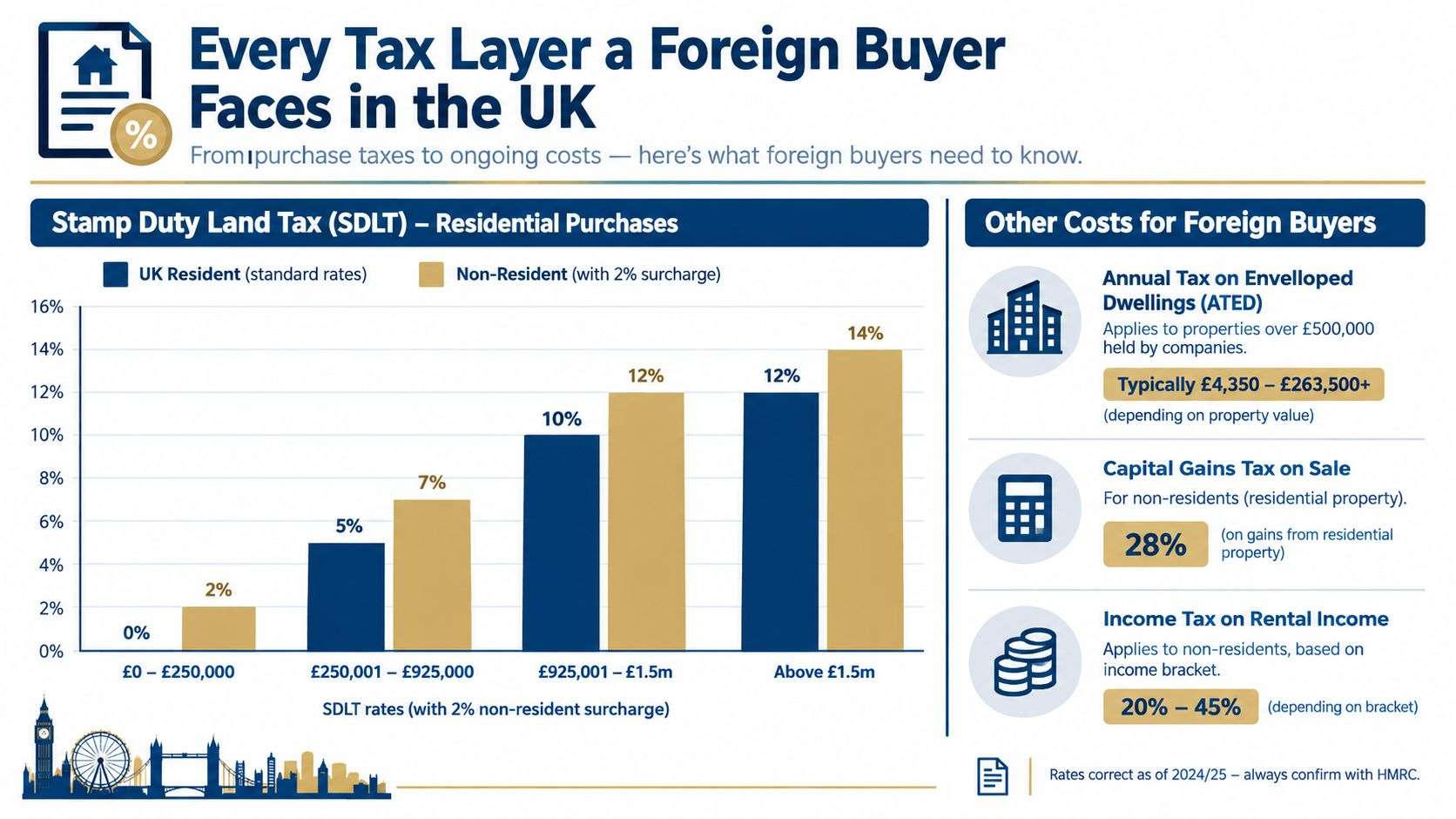
The surcharge stack
The 2% non-resident surcharge is added to the applicable residential SDLT bands. If you’re also buying an additional property, the higher additional-dwelling charge may also apply. A buy-to-let purchase doesn’t remove the non-resident surcharge.
You must model the numbers before exchange. Recent 2025/26 rate tables show that combined residential rates can reach 14% at the top band before additional-dwelling charges, according to the published Stamp Duty Land Tax rates guidance.
Consider two buyers purchasing the same £350,000 flat:
A buyer with 92 UK days in the previous year will generally fall within the non-resident rules and needs to include the 2% surcharge in the budget.
A buyer with 220 UK days may meet the physical presence test and avoid that surcharge, subject to the precise SDLT circumstances.
If the surcharge was paid and the buyer later spends 183 days or more in the UK during the relevant continuous period, a refund may be available. The claim depends on meeting HMRC’s mechanical conditions, not obtaining a visa. Deloitte’s explanation of the refund rules is useful when checking whether a later claim is possible.
Other tax decisions
A corporate structure can introduce ATED and further reporting considerations. Rental income may create UK tax obligations, while a later sale can create non-resident Capital Gains Tax exposure. For a wider explanation of the sale-side position, the Tax Compass non-resident guide is a useful starting point.
Use a cost-of-moving-home calculator to build a first budget, then have a solicitor or tax adviser check the final figure. Don’t exchange contracts using a purchase price that ignores SDLT, legal fees, lender costs and currency movement.

Documents and Proof Lenders and Solicitors Want
Foreign-national applications rarely fail because the buyer lacks the legal right to own property. They stall because the evidence arrives late, doesn’t match across documents or doesn’t clearly explain where the money came from.
A representative NHS worker in Essex may have a straightforward salary, but the lender still needs the employment contract, visa status, payslips and bank statements. If the deposit comes from family overseas, the solicitor will want a clear gift explanation and a traceable source-of-funds record.
EHF Mortgages works with foreign-national clients across Europe and Asia, including people working in the NHS and established international companies such as Shell. That mix is familiar in areas including Chelmsford, Braintree, Colchester and the wider Essex market, but each application still needs to be matched to lender policy.
Separate lender evidence from legal evidence
| Document | Lender Needs It | Solicitor Needs It |
|---|---|---|
| Passport | Identity verification | Identity verification |
| Visa or residence evidence | Eligibility and employment rights | Compliance checks |
| Payslips and contract | Income and affordability | Usually supporting context |
| Bank statements | Income flow and deposit trail | Source of funds |
| Gift letter | Deposit structure | Donor and anti-money-laundering checks |
| Company filings | Where relevant to borrowing | Beneficial-owner verification |
For employed applicants, gather recent payslips, employment evidence and bank statements early. Self-employed applicants should expect tax calculations, accounts and evidence that the business income is sustainable. Documents not written in English may need certified translation.
The solicitor’s anti-money-laundering process is separate from the lender’s affordability assessment. The anti-money-laundering check explained by EHF Mortgages sets out why firms ask about identity, ownership and the origin of funds.
The empty credit file problem
An applicant can have an excellent overseas credit record and still appear unproven to a UK lender. UK accounts, credit commitments and address history help create a file that the lender can assess. They won’t replace income evidence, but they can make the application easier to understand.
Prepare the evidence before submitting. A broker can identify missing documents at the start, rather than allowing a lender to request them weeks into the transaction.
Common Paths for Buying UK Property from Abroad
Your route should reflect how you’ll use the property and how much evidence you can provide. Trying to force a residential application into a buy-to-let structure, or assuming cash makes compliance disappear, creates avoidable problems.

Cash buyer
Cash is the cleanest route for finance, not for compliance. You won’t need an affordability assessment or mortgage valuation, but your solicitor must still verify the source of funds. The SDLT treatment also remains relevant, and non-resident status can still affect the purchase cost.
This suits a buyer with liquid, documented funds who values speed and doesn’t need borrowing to complete.
Buy-to-let investor
A buy-to-let lender focuses on the property’s rental performance, the proposed rent and the applicant’s landlord experience. An investor with rental property overseas may present a stronger case than someone applying for a UK residential mortgage with no UK credit history.
The lender will still examine the deposit, ownership structure and income. Company ownership can be suitable for some portfolios, but it adds registration, tax and reporting considerations rather than removing them.
Non-resident primary-home buyer
This is usually the most demanding route. The lender has to understand where you live now, why you’re buying in the UK, how your employment works, and how you’ll make repayments. A substantial deposit and a clear UK employment or relocation story can materially improve the case.
If you’re searching for a property in London or elsewhere, use the same discipline before viewing. A guide such as this step-by-step home-buying process can help organise the purchase stages, but it won’t replace a lender-specific assessment.
Misconceptions That Trip Up International Buyers
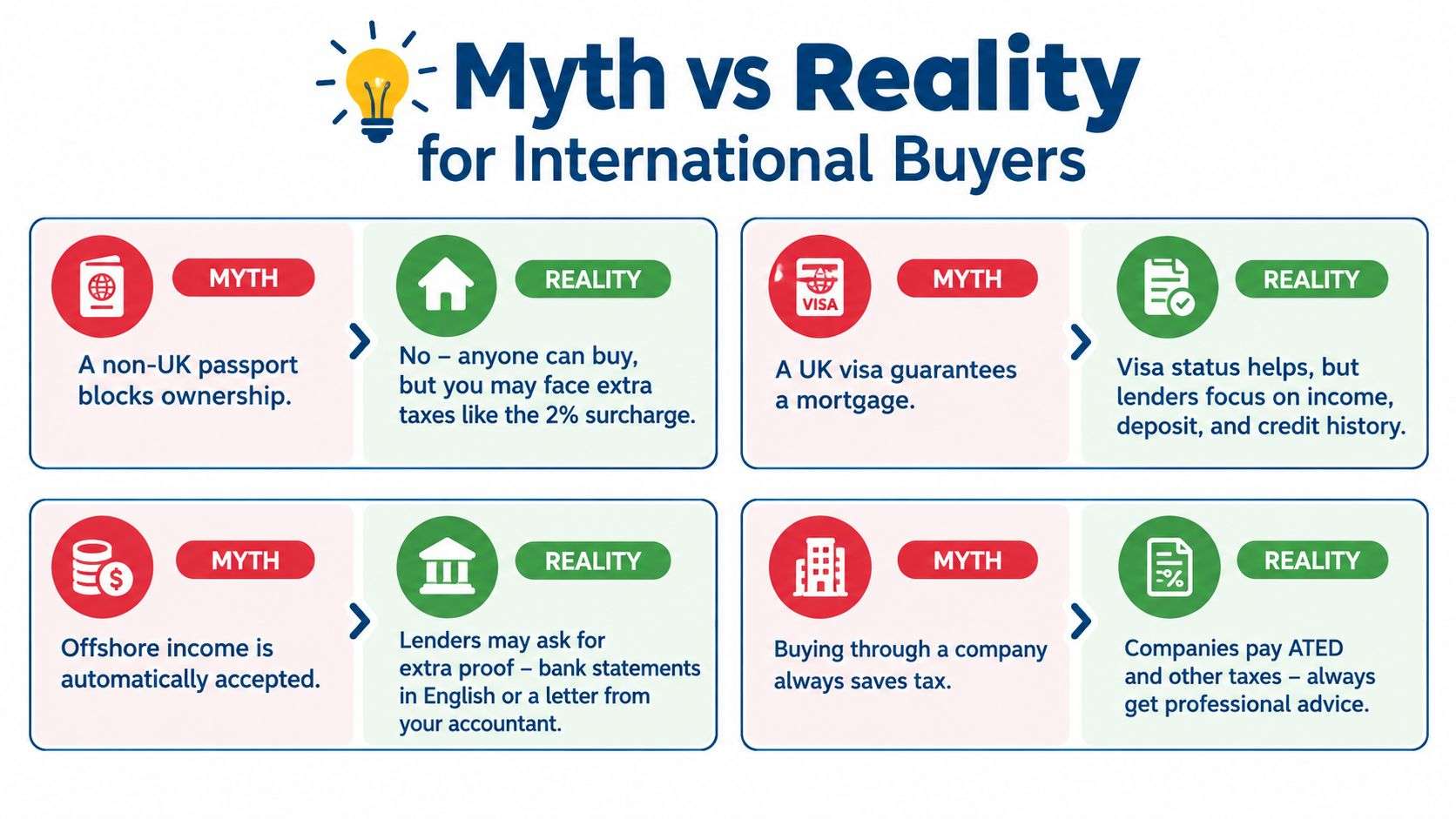
The most expensive mistake is confusing a legal “yes” with a financing “yes”. Four assumptions cause repeated delays.
A non-UK passport blocks ownership. It doesn’t. Foreign nationals can buy, subject to conveyancing, registration and compliance requirements.
A UK visa guarantees a mortgage. It doesn’t. Visa status helps a lender understand your position, but income, deposit and credit history remain central.
Offshore income is automatically accepted. It isn’t. Lenders may ask for foreign tax records, translated documents, currency evidence, and bank statements showing how you receive income.
A company avoids the extra tax. It doesn’t. Corporate ownership can involve the Register of Overseas Entities, ATED and other reporting obligations.
Cash purchases bypass scrutiny. They don’t. A cash buyer avoids mortgage underwriting, but the solicitor still has to complete anti-money-laundering and source-of-funds checks.
The three filters that matter are residency status, verifiable income and a usable UK credit footprint. Your passport identifies you, but it doesn’t tell the lender whether your income is stable, whether the deposit is clean or whether the proposed mortgage is affordable.
Talk to a broker before paying a reservation fee or committing to a survey. The earlier you expose a policy problem, the more choices you retain.
Practical Next Steps for Foreign Buyers
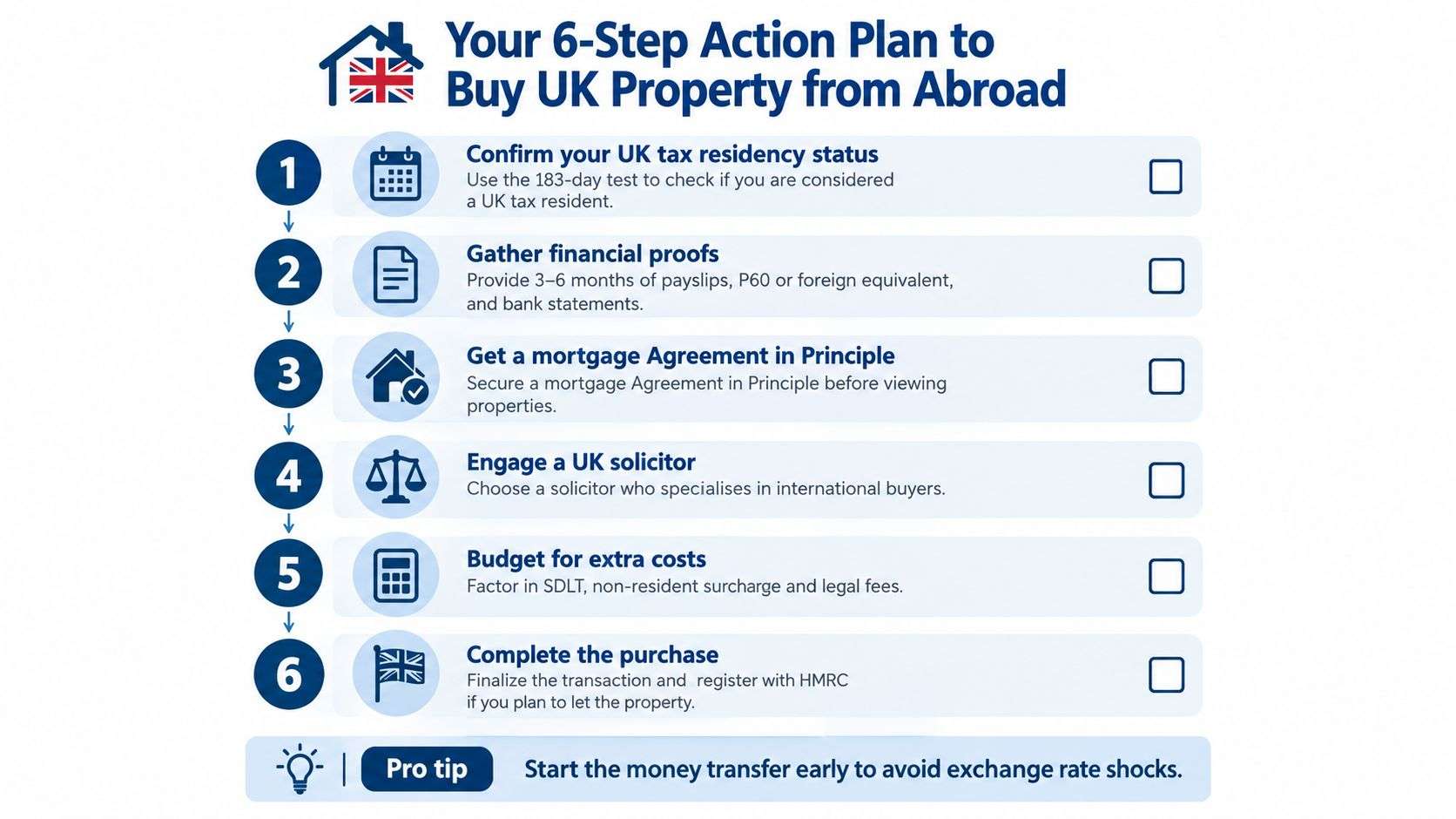
Handle the purchase in this order. It keeps tax, finance and legal work aligned.
Confirm your SDLT residence position. Check whether your physical presence meets the 183-day test for the transaction. Don’t rely on nationality or a general sense that you’re “resident”.
Build the evidence pack. Gather payslips, employment contracts, P60s or foreign equivalents, bank statements, visa evidence and deposit documentation. Translate documents where necessary.
Secure a decision in principle. Do this before viewing seriously. Sellers and agents are more likely to treat an offer as credible when the finance has been assessed.
Choose the solicitor early. Use a solicitor experienced with overseas buyers, corporate ownership where relevant and source-of-funds requirements.
Budget the complete purchase cost. Include SDLT, the possible non-resident surcharge, legal fees, valuation and survey costs, lender fees and exchange-rate movement.
Match the case to the lender market. A whole-of-market broker can assess residential, buy-to-let and specialist routes rather than submitting blindly to a single bank.
If you’re considering prime London property, a specialist prime London property search can help with the property side while your solicitor and broker deal with the legal and finance requirements. Keep those workstreams separate. Finding the right home doesn’t solve an unsuitable mortgage or an underfunded SDLT bill.
EHF Mortgages offers whole-of-market mortgage advice for foreign nationals, including residential and buy-to-let cases involving complex income, overseas deposits and specialist lender criteria. If you’re buying in Chelmsford, Braintree, Colchester, Essex or elsewhere in the UK, EHF Mortgages can assess the evidence and route your application towards suitable lenders.
You’ve got the legal answer. Now get the mortgage, tax and document position checked before you commit to a property.