You’re in Chelmsford, trying to arrange mortgage protection, and the application asks about type 1 diabetes. You’re already expecting a refusal.
Top tip 💡: a recent HbA1c below 58 mmol/mol can put mainstream underwriting firmly on the table, rather than leaving you with specialist-only options. I’ll explain exactly how that works, which figures matter, what evidence insurers request, and when a specialist route makes more sense.
Why Type 1 Diabetes and Life Insurance Aren’t a Closed Door
A 34-year-old primary school teacher in Chelmsford, diagnosed with type 1 diabetes at 19, recently came to us while arranging a mortgage with her partner. They wanted a 20-year mortgage protection policy, but she’d read old forum posts suggesting type 1 diabetes meant an automatic refusal. That assumption could have stopped her from applying at all.
Around 4.6 million people in the UK have been diagnosed with diabetes mellitus, and about 8% of those cases are type 1 diabetes, implying roughly 368,000 type 1 diabetic lives in the UK market segment insurers underwrite. This makes type 1 a meaningful but relatively niche risk pool, not an automatic exclusion. Guardian’s underwriting guide even shows that someone diagnosed 31 years ago, with no related conditions, no tobacco use and HbA1c at 7.0% or below, may still receive standard life cover.
The number I want you to check first
Look at your latest HbA1c and its recent pattern. An HbA1c below 58 mmol/mol usually gives mainstream insurers a sensible starting point, although complications, smoking, diagnosis duration and other medical factors still affect the result. A single good reading helps, but a stable record gives an underwriter more confidence.
Insurers don’t assess the word “diabetes” in isolation. They examine control, treatment, blood pressure, cholesterol, diagnosis date and complications, including eye, kidney and heart conditions. Diabetes UK explains the medical information insurers commonly request, including the latest HbA1c, treatment details and complication history.
Practical rule: A previous refusal doesn’t prove you’re uninsurable. It may show that the application reached the wrong underwriting approach, or that the insurer needed more medical evidence.
What this means for your application
A clean acceptance is possible. So is a premium loading, a postponement or a decline. The outcome depends on the insurer’s rules and the evidence supplied, which is why I’d rather pre-assess a case than send an unprepared application into the market.
The sections below set out which route to consider, what realistic underwriting bands can look like, and how to avoid unnecessary applications that create delays or disappointing decisions.
How UK Underwriters Actually View Type 1 Diabetes
A life underwriter views type 1 diabetes much like a motor insurer reviews a driver. The diagnosis is part of the file, but it isn’t the whole decision. The underwriter wants the equivalent of a claims history and an annual MOT: a record of control, treatment, and complications over time.
Three details carry particular weight:
HbA1c history: The latest result matters, but the direction of travel matters too. A stable pattern is easier to assess than a sudden improvement after a period of poor control.
Duration since diagnosis: Long-standing diabetes creates a longer period for complications to develop, so the diagnosis date forms part of the risk picture.
Complications: Retinopathy, nephropathy, neuropathy and cardiovascular disease can change the available terms sharply.
Type 1 sits in its own underwriting category because the applicant relies on insulin. That doesn’t mean cover is unavailable. It means the insurer looks closely at insulin management, glucose control and the medical consequences of the condition. If you also need information about another diabetes category, EHF’s guide to type 2 diabetes life insurance deals with that separate underwriting pathway.
HbA1c in plain English
HbA1c records average blood glucose over time. UK medical records generally use mmol/mol, while insurers and older medical information may also show the DCCT percentage equivalent. NICE uses 48 mmol/mol as a target reference for many adults with type 1 diabetes, but life insurers may apply different internal thresholds when deciding whether to offer standard terms, a loading, a postponement or no cover.
| HbA1c (mmol/mol) | DCCT % | NICE interpretation | Typical insurer view |
|---|---|---|---|
| Below 58 | Below 7.5% | Above the general target but potentially well controlled | Mainstream terms may be available |
| 58 to 74 | 7.5% to 8.9% | Further from the general target | Loading becomes more likely |
| 75 to 89 | 9.0% to 10.3% | Poorer control requiring careful review | Higher loading, postponement or decline |
| 90 and above | 10.4% and above | Significantly above the general target | Decline is possible with many insurers |
The exact boundaries aren’t universal. One UK protection underwriting guide shows applicants up to age 30 with HbA1c at or below 7.8% potentially receiving a 200% premium, while applicants aged 61 to 70 with the same control may receive a 50% to 75% rating. It also indicates that HbA1c above 8.7% may lead to declines across many age bands.
For broader reading on how to find coverage for pre-existing conditions, focus on the principle rather than generic promises. The insurer needs an accurate, recent picture of your condition.
HbA1c, Age and Premium Loadings Explained
Age and HbA1c interact. The same reading can produce different terms for a younger applicant and someone older with a similar diagnosis history. That’s why a headline statement such as “type 1 diabetes adds a little to the price” isn’t reliable advice.
The table below is a practical discussion framework, not a guaranteed quotation. Real decisions can be more favourable or more severe depending on complications, smoking, treatment, policy length and the insurer selected.
| Applicant age | HbA1c under 58 | HbA1c 58-74 | HbA1c 75-89 |
|---|---|---|---|
| 25-34 | Standard plus may be possible | Around +50% may be considered | Around +100%, postponement or decline |
| 35-44 | Standard or standard plus may be possible | Around +50% may be considered | Around +100% or postponement |
| 45-54 | Standard or loaded terms may be possible | Around +50% to +100% | Higher loading, postponement or decline |
What those decisions mean financially
A standard decision means the insurer charges its ordinary premium for the applicant’s age, cover amount and term. Standard plus is more favourable than ordinary standard pricing. A loaded decision means the insurer adds to the ordinary premium because it has assessed additional risk.
For illustration, a 30-year-old with HbA1c of 52 might pay roughly £13 a month for £150,000 of cover over 25 years, and around £19 a month at a +50% loading. A 50-year-old with the same HbA1c could see the premium roughly double at a +100% loading. These examples show the direction of underwriting rather than a personal quotation, and you should check any numerical illustration against the insurer’s actual terms.
A postponement means the insurer isn’t making an offer today, often because it wants time to see whether a recent spike settles. Postponements of 6 to 12 months can arise after a deterioration in HbA1c or an unresolved medical event. A decline means that the insurer won’t offer the requested cover on its current assessment.
The detailed age bands in UK underwriting guidance support this point. A young applicant with borderline control can receive a much heavier rating than an older applicant with the same HbA1c, while a result above the insurer’s upper boundary may lead to no offer. If you’re preparing for clinical testing or want practical diabetes screening information, Repose Healthcare’s diabetes screening guidance can help you understand what records may be available, but it doesn’t replace medical or insurance advice.
What Evidence Insurers Will Ask You For
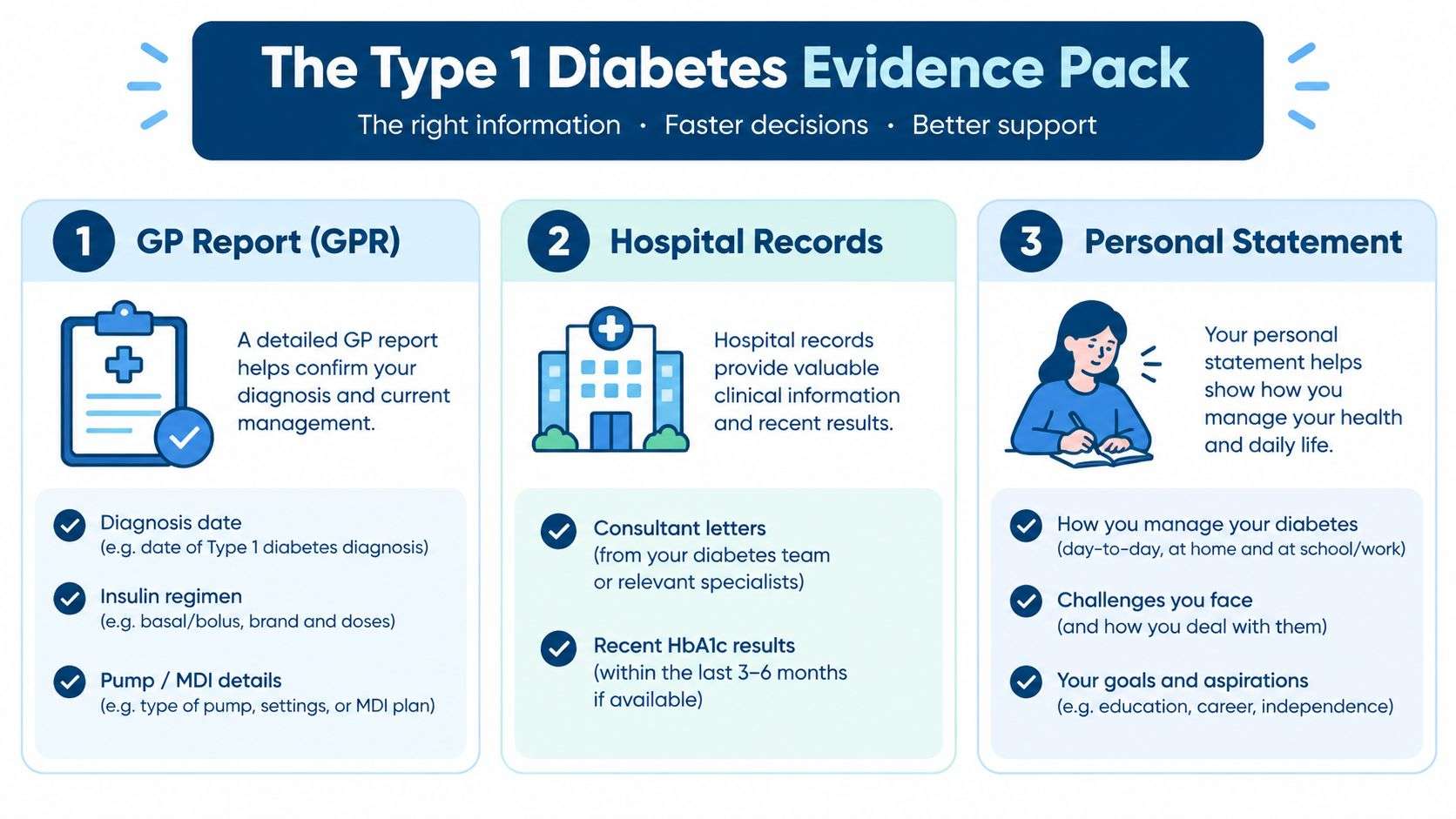
A type 1 application often goes beyond a tick-box declaration. Halifax says applicants may be asked for a medical examination, a recent HbA1c result, treatment details (including pumps or injections), the diagnosis date, and the last diabetic review. Legal & General also explains that an immediate decision may not be possible because it can request further information from the applicant’s GP.
Prepare the evidence before submitting the application. That keeps the file coherent and reduces avoidable chasing.
Build the medical pack properly
GP report: Expect the diagnosis date, insulin regimen, pump or multiple daily injection details, admissions and recorded complications to be reviewed.
Clinic letters: Consultant correspondence can clarify control, treatment changes and specialist observations.
Recent readings: Insurers commonly want the latest HbA1c, usually from within the last year. A result from within six months is particularly useful when available.
Risk markers: Blood pressure, cholesterol, BMI and smoking status may all be relevant to the overall assessment.
Glucose records: Home blood glucose logs and continuous glucose monitor downloads can help explain the context behind the HbA1c.
A PMA, or Private Medical Attendant’s report, may be requested and is normally arranged and paid for through the insurer’s underwriting process rather than by the applicant directly. A GPFS, meaning a General Practitioner Financial Statement in the relevant protection process, can take around 4 to 8 weeks, so don’t promise a mortgage completion date without allowing for medical evidence.
Handle difficult details directly
If a clinic flags travel, driving, diabetic ketoacidosis episodes or hospital admissions, provide a covering letter rather than hoping the point disappears. Advanced cases may also involve a DS1500, which can trigger a longer review and a more sensitive conversation about the purpose and length of cover.
Keep prescription printouts, pump settings and CGM downloads together. For practical lifestyle support, you may also find meal planning for diabetes useful, although an insurer will still rely on formal medical evidence. Protection advice is separate from private healthcare advice, which is why clients sometimes review both their cover needs and private medical insurance at the same time.
Mainstream Cover Versus Specialist Diabetes Plans
The right route depends on three questions: How is your HbA1c controlled? Are there complications? How long must the policy last? Answer those before choosing a product.
Mainstream insurers, including Aviva, Legal & General, Royal London and Scottish Widows, can assess type 1 diabetes through full medical underwriting. A mainstream application may offer standard or loaded terms, but it can also require GP evidence and take longer. Royal London’s diabetes-focused plan, meanwhile, accepts UK residents aged 18 to 88, can last up to 72 years, requires an HbA1c result and has a minimum cost of £10, according to its diabetes life cover information.
Use this decision framework
Choose mainstream underwriting first when your HbA1c is below 58 mmol/mol, your records show good stability, there are no significant complications, and you need a substantial mortgage or family protection policy. This route is usually the one I’d test before accepting a guaranteed plan.
Consider a specialist route where complications narrow the mainstream market, a recent decline makes another direct application risky, or certainty matters more than obtaining the lowest possible premium. Guaranteed acceptance over-50s plans can avoid some medical questions, but they may offer less flexibility or limited benefits. Specialist income protection arrangements can also use exclusions or restricted benefit periods.
| Feature | Mainstream underwriting | Specialist diabetes plans |
|---|---|---|
| Medical assessment | Detailed underwriting and possible GP evidence | May use simplified or guaranteed acceptance |
| Pricing | Can be lower with strong control | Often reflects less medical certainty |
| Cover purpose | Mortgage, family and longer-term protection | Certainty, difficult medical histories or limited needs |
| Complications | Assessed individually | May accept cases mainstream insurers decline |
| Main drawback | Delays, loadings or refusal are possible | Benefit limits, exclusions or higher cost may apply |
For mortgage borrowers, policy suitability matters more than the product label. A specialist plan that cannot provide the required benefit or term may not solve the lender’s protection need. Read EHF’s guidance on mortgage protection insurance before deciding that guaranteed acceptance is automatically safer.

Two Realistic Type 1 Application Scenarios
Sarah, aged 32 and living in Essex, was diagnosed at nine. She uses an insulin pump, recorded an HbA1c of 48 mmol/mol, and had no listed complications. She wanted £250,000 of level-term mortgage cover, so the application needed to reflect the mortgage balance rather than simply seek the easiest product to obtain.

We gathered the latest HbA1c, pump details, prescription information and clinic evidence before approaching insurers. One insurer offered terms with a +75% loading, while another produced a standard-plus offer after multi-aggregator broking. The difference didn’t come from changing Sarah’s health. It came from placing the same well-documented risk with an insurer whose underwriting approach suited it better.
The broker’s pre-shopping reduced the eventual premium by 38% in this example. That isn’t a universal saving, but it demonstrates why sending the first application to a convenient insurer can be an expensive mistake. Sarah also needed to understand how much life insurance was appropriate, rather than selecting a figure without considering the mortgage and household finances. EHF’s guide to how much life insurance is needed covers that wider protection question.
David’s case was more difficult. He was 54, had lived with type 1 diabetes for 22 years, recorded an HbA1c of 75 mmol/mol, and had background retinopathy and hypertension. Two insurers declined the application. Another considered income protection with exclusions, while a specialist over-50s plan was used where guaranteed acceptance was the priority.
The emotional strain was greatest when a DS1500 was mentioned, and the application entered a waiting period. A client can understand the underwriting logic and still find the silence unsettling, particularly when a mortgage deadline is approaching. Clear expectations and accurate evidence don’t remove every delay, but they stop clients mistaking a medical review for an automatic refusal.
A short video can help explain the broad protection conversation before a detailed fact-find:
Getting the Best Outcome With EHF Mortgages in Chelmsford
Applying directly to one insurer gives you one set of underwriting rules. If that insurer rates type 1 diabetes harshly, you may receive a loading or decline without knowing another insurer would have assessed the same evidence differently.
A whole-of-market protection adviser can pre-shop the case, compare mainstream and specialist routes, and decide whether a formal application is sensible now. The adviser can also read the medical story properly. An HbA1c result, insulin regimen, pump use, complication history and policy term need to make sense together.
Bring a clean fact-find pack
Have these items ready for the first call:
Recent HbA1c: Include the date and any preceding results you can access.
Treatment details: Note insulin type, pump or injection routine and any recent changes.
Clinical letters: Bring relevant correspondence from your consultant or diabetes clinic.
Prescription printout: This helps confirm current medication and dosage.
Health context: Include target weight, smoker status, blood pressure issues and known complications.
Medical evidence can still take time. A GPFS turnaround of 3 to 6 weeks is a realistic working expectation in many cases, although the actual timing depends on the practice and the complexity of the records. Clients in Chelmsford, Braintree, Colchester and elsewhere in Essex may value face-to-face fact-finding because it gives them space to explain the history accurately before the application is submitted.
Match the policy to the real need
Mortgage protection, critical illness cover and income protection solve different problems. A death benefit may clear a mortgage, but it won’t replace earnings during a long-term illness. Conversely, an income protection plan may involve exclusions that need to be understood before you rely on it.
That’s why I recommend a free protection review before committing to a product. EHF Mortgages can map your type 1 diabetic life insurance requirements against your mortgage, family responsibilities, and wider protection needs, then source across the market without obligation. Clients who want further guidance on cover during a purchase can also read about life insurance when buying a house.
If you need type 1 diabetic life insurance for a mortgage, family or income protection plan, EHF Mortgages can review your medical evidence and compare suitable mainstream and specialist routes. Visit EHF Mortgages to arrange a protection conversation, or use the contact page below to take the next step.