You may be retired, drawing a reliable pension and sitting on valuable property, yet still wonder whether you can get a mortgage.
💡 Top tip: don’t start with your age. Start with your monthly cash flow, your plans for the property, and how you’ll eventually repay the borrowing. I’ll explain why that matters, how the main options differ and what to prepare later in this guide.
A homeowner in Chelmsford might want to remortgage instead of moving. Someone in Braintree may need to replace an interest-only mortgage as it approaches maturity. A couple in Colchester might want to use property wealth while preserving flexibility for care costs or inheritance. These aren’t automatically last-resort decisions. Used carefully, borrowing can form part of a wider retirement plan.

This guide explains how a mortgage for pensioners works, how lenders assess retirement income, and when a conventional remortgage, retirement interest-only mortgage, lifetime mortgage or downsizing may fit. It also covers the risks, protections, and application steps you should consider before you commit.
For more background on the specialist market, see our guide to mortgages over 55. The aim is simple: to help you replace an age-based yes-or-no question with a practical decision about affordability, ownership and future choices.
How Mortgages for Pensioners Actually Work
A homeowner in Chelmsford may have enough pension income to cover monthly interest, yet still want to protect their home’s value for their family. Another may need borrowing without a regular payment. The suitable mortgage depends on three linked questions: how much cash flow is available, what should happen to the estate, and how the balance will eventually be repaid.
Start with the difference between monthly payments and capital repayment. A repayment mortgage covers interest and part of the original borrowing each month, so the balance should gradually fall, like water leaving a tank. An interest-only mortgage covers the interest while the original capital remains due. It therefore needs a credible repayment plan.
A retirement interest-only mortgage, or RIO, is an interest-only mortgage for older customers above an age set by the lender. Under the FCA definition, repayment usually follows an agreed life event, such as death or moving into long-term care, unless the borrower breaches the contract. The precise terms vary between lenders.
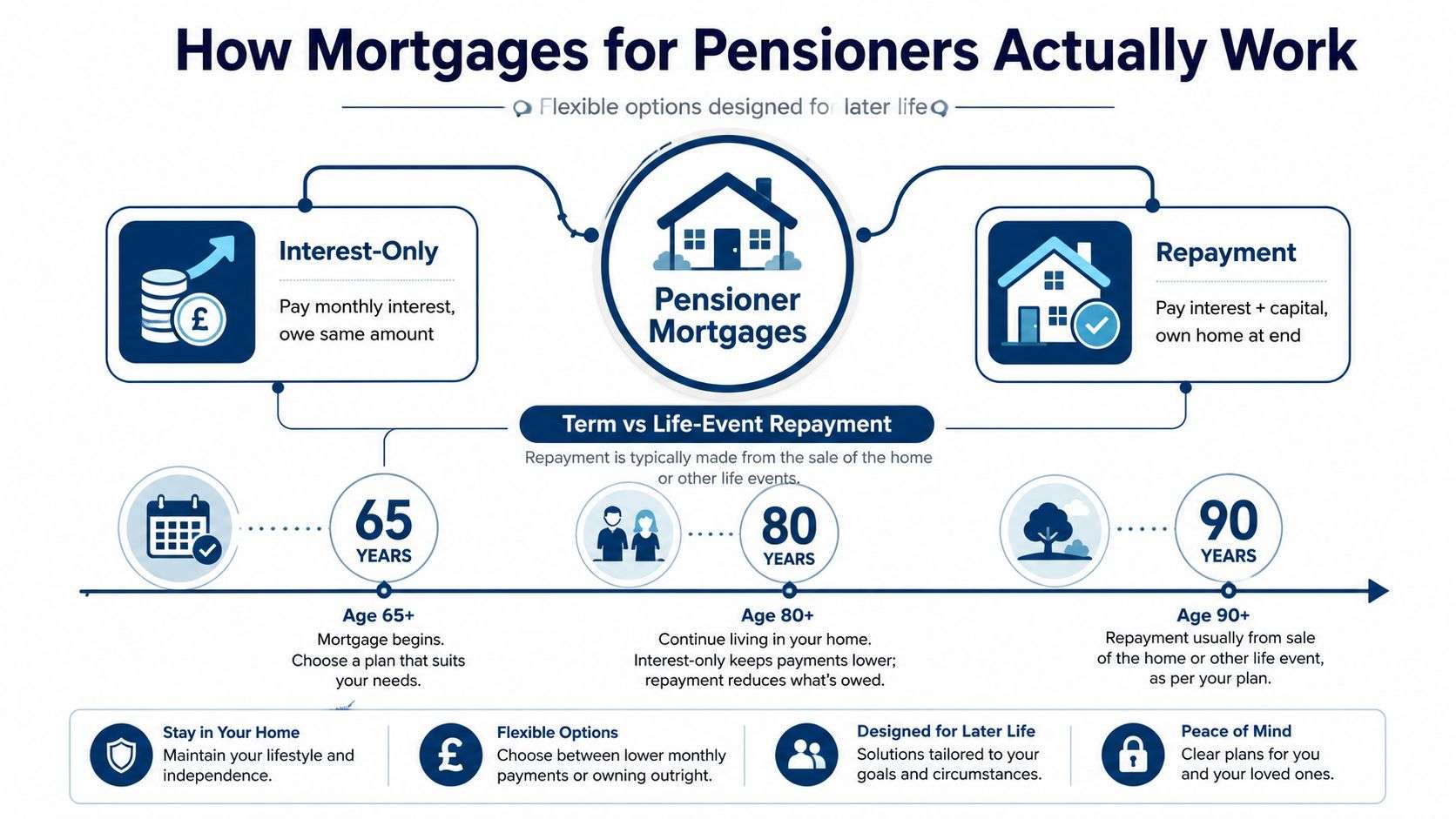
The three routes in simple terms
A conventional remortgage normally has a fixed term and planned capital repayments. It may fit someone whose pension or other income can support the payments, whose loan-to-value position is manageable, and who expects to repay through instalments or a future sale.
An RIO mortgage usually requires evidence that pension income can cover the monthly interest. Those payments do not normally reduce the capital, so the eventual repayment may involve selling the property, moving into care, or another agreed life event. Read this explanation of what a retirement interest-only mortgage is for the product mechanics.
A lifetime mortgage is a form of equity release. Depending on its design, it may require no monthly payments or allow optional payments. Rolled-up interest can increase the balance owed and reduce what passes to your estate.
The State Pension age is currently 66 and is scheduled to rise to 67 by March 2028 for people born after 5 April 1960, according to later-life mortgage guidance on pension timing. Lenders assess when income starts, how much is received, and whether it should continue throughout the proposed arrangement.
Practical rule: Treat pension income like fuel for the mortgage. If it comfortably covers interest, an RIO may fit. If it does not, a payment-free lifetime mortgage may be more realistic, although its long-term cost needs careful review.
Estate planning also matters. Someone who wants to protect dependants may review the mortgage alongside protection, including mortgage life insurance quotes. That resource supports wider protection research, but it does not replace mortgage suitability advice.

Comparing Your Main Options as a Pensioner
The right choice depends less on the label and more on the relationship between monthly affordability, property value and the exit strategy. An RIO mortgage and a lifetime mortgage can both help an older homeowner stay in their property, but they work differently.
The FCA treats an RIO as a regulated mortgage product with monthly interest affordability at its centre. A lifetime mortgage belongs to the equity-release family and may allow payment-free borrowing. That difference affects debt growth, estate value and the evidence a lender or adviser needs.
| Product | Repayment Trigger | Monthly Payment | Age Rule | Best For |
|---|---|---|---|---|
| Conventional remortgage | End of agreed term or planned sale | Capital and interest, or interest only where accepted | Lender’s criteria | Borrowers with sustainable income and a clear term-based plan |
| RIO mortgage | Usually death, long-term care or another agreed life event | Monthly interest | Older customer above lender’s specified age | Pension income that can comfortably cover interest |
| Lifetime mortgage | Usually death, long-term care or voluntary repayment | May be optional, depending on product | Product and lender eligibility rules | Borrowers who can’t support a regular mortgage payment |
| Downsizing | Sale of the existing property | No mortgage payment after purchase, if fully funded | No mortgage age rule | Those willing and able to move home |
| Conventional repayment | End of the mortgage term | Monthly interest and capital | Lender’s maximum age at term end | Borrowers who can clear the balance through regular payments |
When an RIO can make sense
An RIO can preserve home ownership without the compounding roll-up associated with an unpaid lifetime mortgage. You still need to make monthly interest payments, and the original capital remains secured against the property. That makes budgeting essential, particularly if one household income could change after a partner’s death.
This option may suit a pensioner with stable retirement income who wants to avoid downsizing. It may also be relevant when an existing interest-only mortgage is approaching maturity, and a full capital repayment isn’t available.
When lifetime mortgage borrowing may fit
A lifetime mortgage may be more suitable where monthly payments would place too much pressure on pension income. The trade-off is that rolled-up interest can reduce the equity left for beneficiaries, while taking capital may affect tax or means-tested benefits.
The Equity Release Council standards require lifetime mortgage interest rates to be fixed or, if variable, subject to a fixed cap. That protection matters, but it doesn’t remove the need to understand the borrowing rate, future balance and early repayment terms.
Conventional borrowing or downsizing
A conventional remortgage may be the cleanest route where income supports repayment, and the lender accepts the proposed term. Downsizing can remove mortgage debt, but it involves moving costs, practical disruption and a decision about location. For homeowners considering this route, guidance on equity release over 55 can help explain how property wealth fits alongside other choices.
Eligibility and Affordability Checks for Pensioners
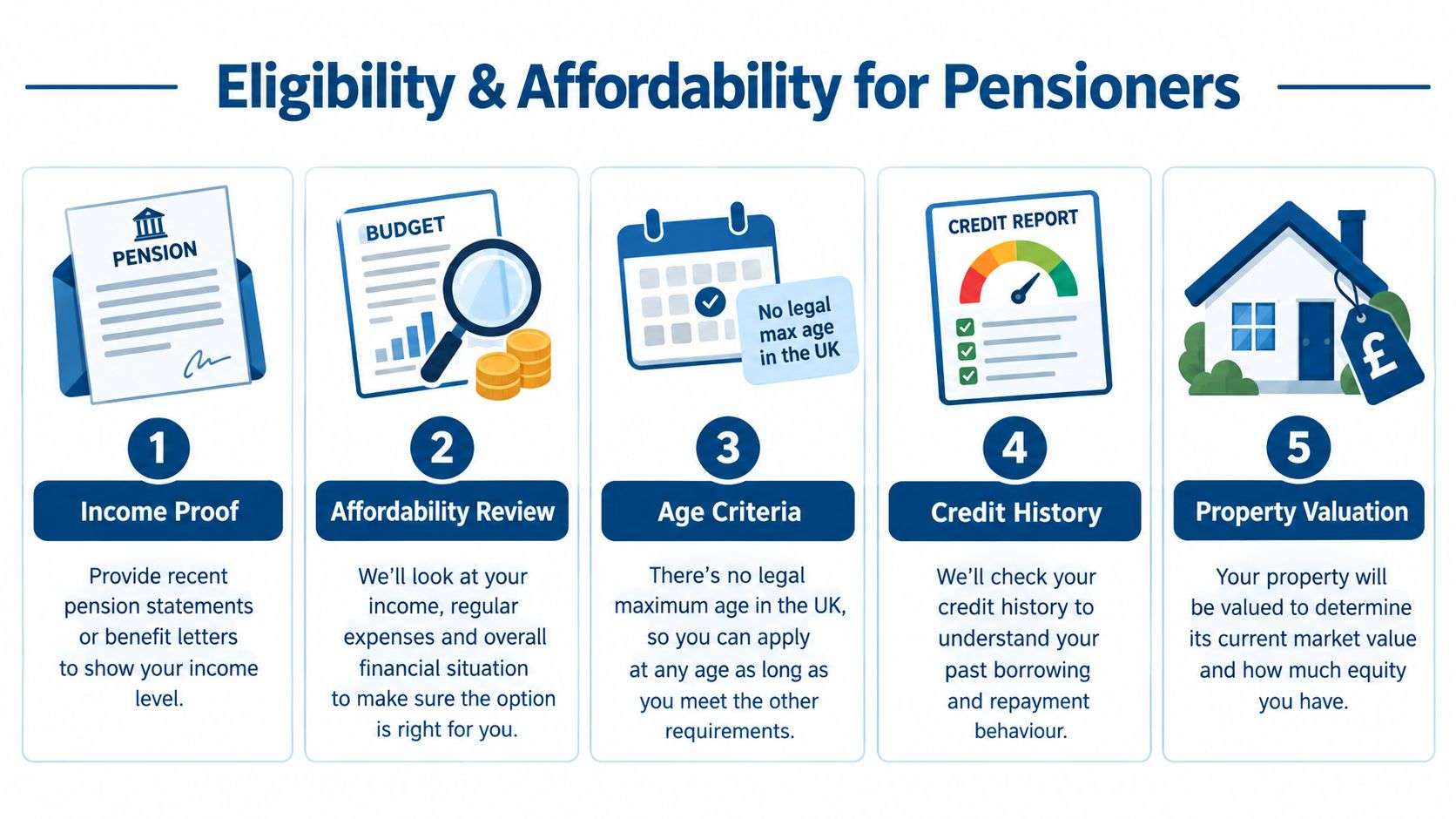
A mortgage decision in retirement starts with the lender’s rules, then moves to your income, spending and plans for the property. There is no legal maximum age for taking out a mortgage in the UK, but each lender sets its own criteria. Mainstream lenders commonly set the maximum borrowing age around 70 to 80. Some specialist lenders accept older applicants or have no fixed upper age limit, as explained by older borrower mortgage guidance.
The key date is often your age at the end of the mortgage term, rather than your age when you apply. A lender might accept the application but offer a shorter term, suggest a different repayment structure or ask how the balance will be cleared. That exit plan should match your pension cash flow, estate goals and whether you expect to stay in the home.
What income evidence matters
Lenders look for income that is stable and likely to continue. For pensioners, this can include State Pension, occupational pension, private pension withdrawals, rental income, investment income or other documented sources. Lenders treat these sources differently, so a refusal from one bank does not rule out a specialist application.
Prepare evidence showing both the amount and regularity of each income stream. Pension statements, bank statements, investment or rental-income records and details of existing commitments help an adviser present an accurate picture.
Your spending matters just as much. Council tax, utilities, insurance, care costs, credit commitments and ordinary household expenses all affect affordability. The question is whether the proposed payment remains comfortable after normal living costs, not whether an income exists.
Existing mortgage commitments
An older borrower with an interest-only mortgage should check the maturity date early. UK Finance reported that pure interest-only homeowner mortgages stood at 445,000 at the end of 2025, down 17.7% from 2024, while part-and-part loans fell 10.3% to 156,000. Higher-risk interest-only lending above 75% loan-to-value fell 26.9% in 2025 and represented 4% of interest-only mortgages, compared with 36% in 2012, according to UK Finance coverage of changing interest-only lending.
These figures do not predict your individual outcome. They do show why it helps to explore refinancing, partial repayment, sale or a later-life borrowing route before the maturity letter arrives.
Use a lender’s affordability method carefully, and review how to calculate mortgage affordability before applying. A realistic budget gives a clearer basis for choosing between an RIO mortgage, lifetime mortgage or conventional remortgage.
Risks, Protections, and What to Watch For
Later-life borrowing can support a well-designed retirement plan, but the consequences last beyond the initial application. The central question is whether you prefer higher monthly certainty or greater payment flexibility, and what each choice could mean for your estate.
With an RIO mortgage, the main risk is payment sustainability. If pension income falls, household circumstances change or rates move at the end of a deal, monthly interest may become harder to maintain. The capital also remains outstanding until the agreed repayment event.
With a lifetime mortgage, the principal concern is debt growth. If you don’t pay interest, it can roll up against the property. That may leave less equity for beneficiaries and could affect future plans involving gifts, care funding or a move.
Taking money from property can also affect tax and means-tested benefits. FCA guidance specifically says borrowers should consider those impacts when capital is drawn. A thorough review matters because the outcome depends on the amount borrowed, how funds are used and the household’s wider finances.
“The cheapest monthly payment isn’t automatically the most suitable later-life option.”
Judge the product by its full effect on cash flow, future repayment, family inheritance and flexibility.
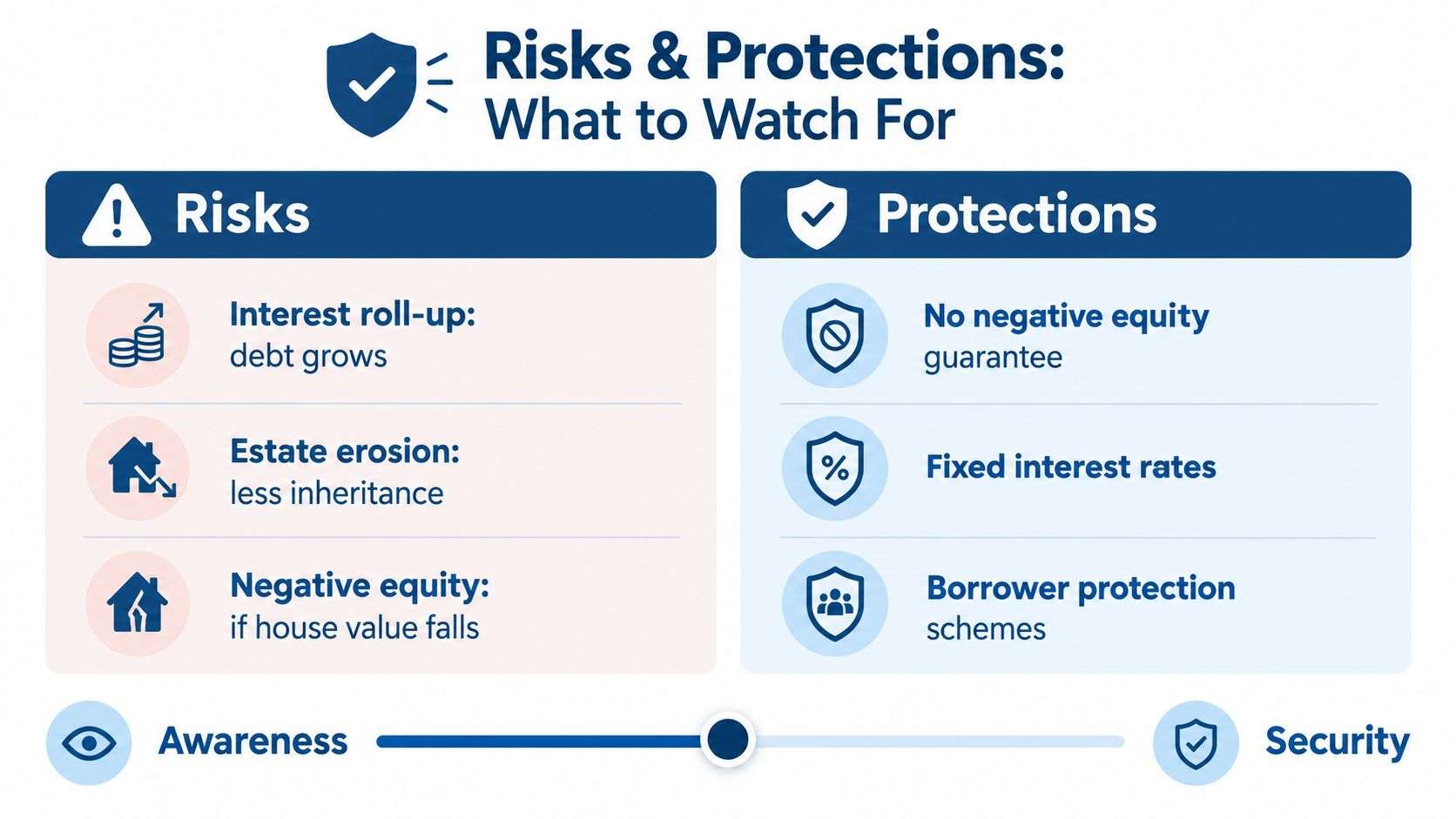
Protections worth checking
The Equity Release Council framework includes important standards, including fixed or capped lifetime mortgage interest rates. Many qualifying products also include a no-negative-equity guarantee, although you should confirm the exact terms and whether the product meets the relevant standards.
The FCA has launched a formal market study into later-life mortgages. That review highlights why clear explanations, useful advice and transparent disclosure matter when borrowers make decisions with long-term consequences.
Families often misunderstand what happens after a borrower dies. The property may be sold, beneficiaries may repay the mortgage, or another arrangement may apply depending on the mortgage terms and estate. A practical overview of five common mortgage outcomes after death can help families begin that conversation.
Protection planning should sit alongside the mortgage decision. Our guide to mortgage protection insurance explains how cover may help manage outstanding borrowing, subject to policy terms and suitability.
Step by Step Application Checklist for Pensioners
A later-life mortgage application is easier to manage when you treat it as part of your retirement plan. The right choice depends on your pension cash flow, estate aims and clear repayment route, rather than on finding the first available product.
1. Review the household budget
List every regular income source and outgoing commitment. Include pensions, mortgage payments, household bills, insurance, care-related costs and financial support for family members.
Ask what would happen if one income stopped. A joint application may depend on both pensions, so the surviving borrower needs to know whether the payments would still fit the budget.
Leave room for ordinary changes in retirement spending. A payment that works today may become difficult if care costs, household bills or other commitments rise.
2. Gather evidence before speaking to lenders
Collect pension award letters, recent bank statements, existing mortgage details, proof of other income and information about the property. For any interest-only borrowing, record the balance, interest rate, maturity date and planned repayment method.
Accurate figures are more useful than estimates. They help an adviser assess whether to consider a conventional remortgage, retirement interest-only mortgage, partial repayment, or lifetime mortgage.
3. Define the purpose of the borrowing
Write down what the mortgage needs to achieve. Improving monthly affordability, funding home improvements, helping family, planning an inheritance or keeping a reserve for later-life needs can lead to different recommendations.
Your purpose also clarifies the trade-off between keeping the debt stable and reducing or avoiding monthly payments. It is the difference between choosing a route for a known reason and borrowing because it is available.
4. Compare suitable lenders and structures
A whole-of-market adviser can compare lenders with different age-at-term, income and property criteria. Ask how each lender assesses pension income, whether the proposed term is acceptable and what happens if your circumstances change.
Check the loan-to-value position. A lower balance relative to the property value may give you more options. A higher balance can narrow your options, making the exit strategy and specialist advice more important.
5. Review the offer before completion
Read the interest rate, payment amount, term, early repayment provisions and final repayment trigger. With a lifetime mortgage, check how interest builds up and whether you can make voluntary payments. With an RIO, confirm the life-event conditions and what happens if payments stop.
If an interest-only deal is nearing maturity, start reviewing the options early rather than assuming an immediate sale is required. As noted earlier, changing interest-only lending patterns make preparation particularly important for affected borrowers.
Before signing, test the proposed mortgage against higher spending and household changes. A mortgage can fit the current budget yet leave too little flexibility for later retirement needs. Ask the adviser to explain the repayment route in plain language, including what may happen to the property and estate if the plan changes.
Next Steps and Getting Specialist Advice in Essex
A mortgage for pensioners can be a sensible retirement-planning tool when the purpose is clear, the payment fits the household budget, and the repayment route is understood. It may help you remain in your home, replace an interest-only mortgage, access property wealth or avoid a move that doesn’t suit your plans.
Age alone doesn’t determine the right answer. It depends on pension cash flow, property equity, loan-to-value, health and care considerations, family objectives and the value you place on retaining inheritance.
For homeowners in Chelmsford, Braintree, Colchester and across Essex, specialist advice can bring those factors together. EHF Mortgages provides whole-of-market mortgage and later-life lending advice, including RIO and lifetime mortgage options, subject to lender criteria and suitability. Any recommendation should reflect your own circumstances, and equity release can affect your tax position, benefits and estate.
If you’re approaching retirement, don’t wait until a mortgage deal expires or a payment becomes uncomfortable. Gather your documents, write down your objectives and use the Contact Us page to start a conversation about the routes available.
EHF Mortgages can help you compare conventional remortgages, retirement interest-only mortgages and lifetime mortgage options around your pension income and estate plans. Visit EHF Mortgages to arrange a discussion about your later-life borrowing needs.