
Feeling priced out in Chelmsford, Braintree or Colchester can make home ownership seem like it belongs to other people. It doesn’t. Plenty of buyers on modest wages, part-time income, pensions, or a mix of earnings and benefits still get mortgages, but they usually succeed because they prepare properly.
💡 Top tip: lenders often care less about whether your income looks “traditional” and more about whether you can prove it is stable and likely to continue. That matters even more if part of your income comes from benefits or tax credits. I’ll explain exactly how to show that later.
If you’ve been searching for low-income mortgages, the hard part is often knowing where to start. The rules can feel hidden, the paperwork can feel endless, and one wrong assumption can waste weeks. What helps is breaking the process into simple steps and looking at it the way a careful broker would.
Your Dream Home on a Low Income: Is It Possible
If your pay goes in and out quickly each month, you’re not imagining the pressure. Rent, food, travel, childcare and council tax can leave very little room to save. That’s why many first-time buyers assume a mortgage is unrealistic before anyone has even properly looked at their case.
That assumption is often wrong.
Lenders don’t just ask whether your income is “high” or “low”. They look at whether your monthly budget is manageable, whether your credit record is sensible, whether your deposit is genuine, and whether your income can be evidenced clearly. A buyer with modest income and clean paperwork can look stronger than someone earning more but spending heavily every month.
Practical rule: low income does not automatically mean low chance. Unclear income, patchy paperwork and unmanaged outgoings usually cause more problems than the headline salary.
In Essex, this matters because local prices can make buyers feel defeated early. A first-time buyer in Chelmsford might think they need a perfect salary to stand any chance. In reality, some buyers move forward by adjusting the property type, widening the area, using Shared Ownership, or choosing a lender that understands income beyond a basic full-time payslip.
A good example is someone who works part-time, receives tax credits or benefits, and has built a small deposit over time. That case can be workable if the documents are organised and the income is shown properly. It becomes much harder when the same buyer turns up with missing statements, unexplained cash spending, or benefit awards that don’t show how long the payments will continue.
What matters most at the start is this. Don’t judge your mortgage chances by online chatter, a single bank calculator, or what worked for a friend two years ago. Judge them by your actual affordability, your documents, and the lenders that fit your circumstances.
How Lenders Assess Affordability for Low-Income Applicants
Lenders aren’t guessing. They follow rules and internal policy. Once you understand the moving parts, the process becomes far less mysterious and a lot less stressful.

The two checks that matter most
The first check is income. The lender wants to know what comes in every month, where it comes from, and whether it is likely to continue. The second check is outgoings. They review committed spending such as loans, car finance, credit cards, childcare and regular household costs.
For UK applicants, lenders must stress-test repayments at the Bank of England base rate plus 3%, and they typically cap borrowing at 4.5 times annual income under FCA rules, as outlined in the FCA policy statement on affordability and responsible lending. That sounds technical, but the idea is simple. The lender isn’t only checking whether you can pay the mortgage today. They’re checking whether you could still cope if rates rose.
If a mortgage looks affordable only when everything goes perfectly, many lenders will see it as too risky.
Income multiple is only the starting point
People often fixate on income multiples. They hear “4.5 times income” and assume that’s the amount they’ll get. Sometimes it is close. Sometimes it isn’t.
If you earn a stable salary, have little debt and spend carefully, the result can be stronger. If your monthly commitments are already heavy, the lender may offer less, even if the multiple looks fine on paper.
That’s why affordability calculators can feel inconsistent. One lender may take a kinder view of overtime or benefits. Another may ignore them or use only part of them. A calculator can be useful for a rough first glance, but it isn’t a lending decision. If you want a more practical way to estimate where you stand, this guide on how to calculate mortgage affordability is a useful starting point.
What lenders look for in lower-income cases
A lower-income application usually gets closer scrutiny, not because it’s hopeless, but because there’s less room for error in the monthly budget. Lenders often pay attention to:
Income stability: regular wages are easier to place than changing income that bounces around month to month.
Benefit income evidence: if you receive benefits or tax credits, lenders may want proof of the current award and evidence that the payments will continue after completion.
Existing debt: Even small monthly payments can reduce borrowing power.
Bank conduct: unarranged overdrafts, missed payments, and gambling transactions can raise concerns.
Deposit source: Savings are usually straightforward, while gifted deposits need documenting properly.
A plain-English example
Take a first-time buyer in Colchester with a modest salary, child benefit, and a small personal loan. The lender won’t only ask, “What do you earn?” They’ll ask, “What lands in the account regularly, what must be paid out every month, and what happens if rates rise?”
That’s why some applicants feel confused after getting different figures from different lenders. They aren’t being judged randomly. They’re being measured against slightly different affordability models.
A lower-income mortgage application usually improves when the case is presented cleanly. That means stable evidence, fewer unexplained outgoings, and realistic expectations on purchase price. It’s much easier to solve problems when you know which part of affordability is holding you back.
Building Your Case: The Essential Documentation
The quickest way to weaken a mortgage application is turning it into a paper chase. Lenders like evidence that is recent, consistent and easy to follow. If you’re on a low income, your paperwork carries even more weight because the underwriter is checking whether your budget is dependable.
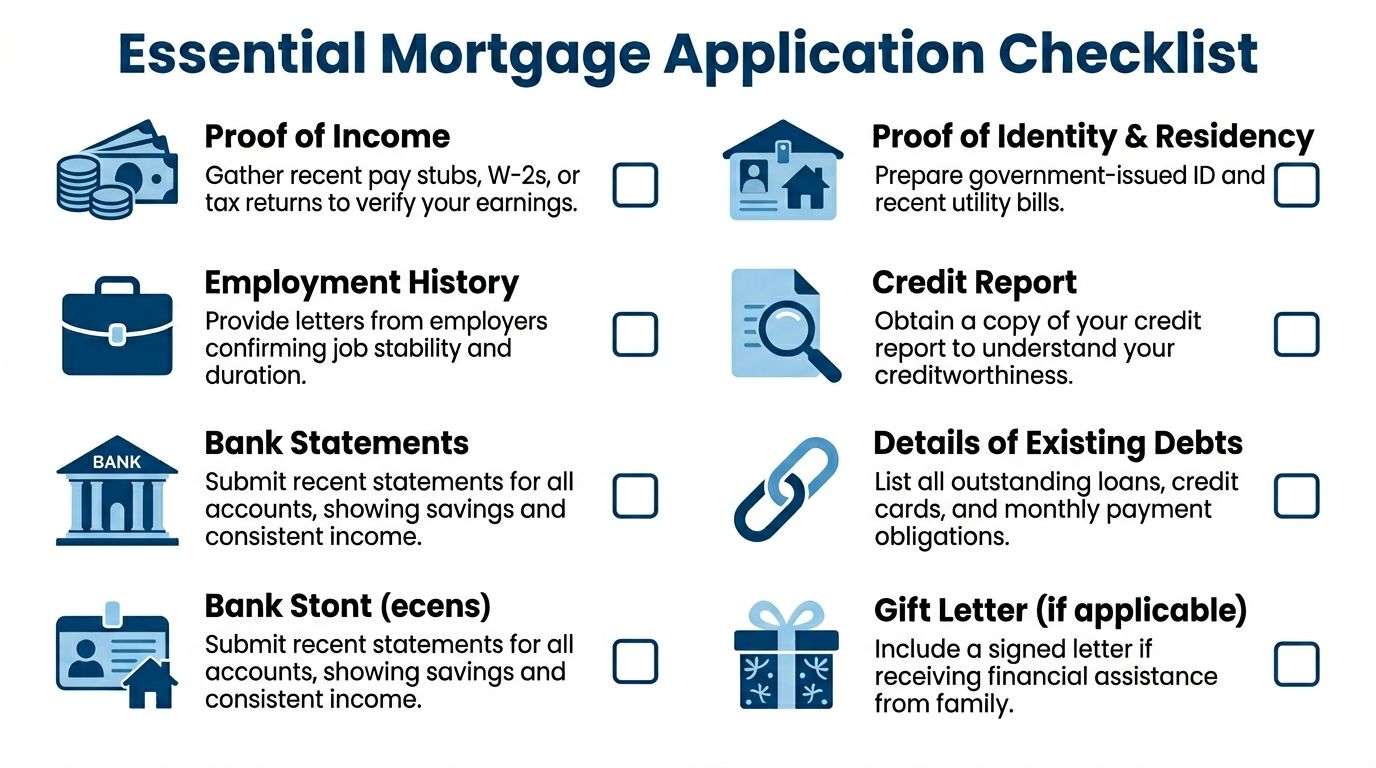
The core documents most buyers need
For many employed applicants, the standard file includes recent payslips, bank statements, proof of ID, and proof of address. The verified guidance for UK low-income applicants also notes that lenders commonly verify income using 3 months’ payslips, P60s, and SA302s for self-employed applicants.
What matters is not just having the documents, but making sure they match. If your payslip says one thing and your bank statement shows another, expect questions. If your address differs across documents, expect delays.
A sensible checklist usually includes:
Proof of income: recent payslips if employed, or SA302s and supporting tax documents if self-employed.
Bank statements: statements that show salary credits, benefit payments, regular bills and day-to-day account conduct.
Identification: passport or driving licence, plus proof of address.
Deposit evidence: savings trail, gifted deposit letter if relevant, and proof of where the money came from.
Credit commitments: details of loans, credit cards, car finance and any regular repayments.
If this blog has helped you understand your options and you are ready to take the next step, click below to speak to EHF today.
Proving benefits and tax credits properly
Many buyers get caught out. If part of your income comes from benefits, tax credits or pension income, don’t assume a lender will accept it just because it appears on your bank statement. Many want evidence of the award itself and reassurance that it will continue after the mortgage completes.
That usually means gathering:
Current award notices: official documents showing what you receive.
Recent bank statements: to show consistent payments.
Continuation evidence: paperwork that supports the likelihood that the benefit will continue post-completion.
Context if needed: if your circumstances have recently changed, be ready to explain why the income remains stable.
Buyers using benefits should think like an underwriter. Don’t just show the money arriving. Show what it is, who pays it, and why it is expected to continue.
That point from the content owner is important. You need current evidence of any benefits or tax-credit income, and that the benefits will continue after the mortgage is completed. In practical terms, that means keeping award letters up to date and not relying on old notices that no longer reflect current entitlement.
How to present your bank statements well
A lender reads bank statements as a story of how you manage money. They aren’t looking for perfection. They’re looking for control.
Try to avoid giving them unnecessary concerns. Before applying, review your statements carefully.
Check regular spending: repeated gambling transactions, heavy use of buy now pay later, and constant overdraft use can undermine the case.
Match your application: your declared income and spending should align with what the statements show.
Flag unusual items early: one-off transfers, family support, or recently cleared debts are easier to explain upfront than later.
Keep documents readable: full statements are better than screenshots or cropped images.
If paperwork feels scattered, tools that help you review files before submission can be useful. Something like an AI Real Estate Mortgage Document Analyser can help you scan a bundle of mortgage documents and spot gaps before a lender does.
Common document mistakes that lead to problems
Many declines don’t begin with affordability alone. They begin with a weak presentation.
Here are common issues:
Outdated benefit evidence
The payment still arrives, but the supporting award document is old or unclear.Incomplete statements
Missing pages or partial downloads make the lender wonder what has been left out.Unexplained cash activity
Frequent cash deposits may trigger extra questions about undeclared income.Self-employed confusion
Using rough figures instead of tax-backed figures makes the case harder to place.Gifted deposit without a paper trail
Lenders usually need that gift documented clearly.
If you can hand over a neat, consistent file, you immediately make life easier for the lender. That doesn’t guarantee an approval, but it does reduce friction, delay and avoidable doubt.
Proven Strategies to Improve Your Borrowing Power
If the first affordability estimate feels too low, don’t treat it as the end of the road. In many cases, borrowing power improves because the buyer changes the shape of the application, not because they suddenly start earning a lot more.

Start with outgoings, not wishful thinking
A modest income can still support a mortgage if your monthly commitments are under control. Lenders look closely at what leaves your account each month, so trimming avoidable spending can help more than people expect.
Focus first on committed costs rather than occasional treats. A credit card minimum payment, a personal loan, a car finance agreement, or a regular subscription all affect affordability more directly than the odd takeaway.
Useful places to start include:
Unused subscriptions: cancel anything that no longer matters.
Expensive debt: where appropriate, reduce balances or simplify repayments before applying.
Account conduct: keep payments on time and stay away from unarranged overdraft use.
New borrowing: avoid taking on fresh finance before a mortgage application.
“The difference between a mortgage approval and a decline often comes down to the small, consistent efforts you make to clean up your finances six to twelve months before applying.”
Deposit size changes the conversation
A larger deposit improves the loan-to-value (LTV). That is the loan amount compared with the property value. A lower LTV can increase lender choice and may reduce a lender’s nervousness about a tighter affordability case.
For some low-income applicants, saving a little longer can make a meaningful difference. The same is true if family help is available and can be documented correctly as a gift.
In some parts of Essex, buyers also consider more flexible options, such as smaller flats, different neighbourhoods, or Shared Ownership, where suitable. Those choices don’t suit everyone, but they can move the numbers into a workable range.
Improve your credit profile before you apply
A lower-income application becomes harder if the credit file also needs to be explained. That doesn’t mean you need a perfect score, but it does mean you should avoid preventable problems.
A practical step is to check what lenders may notice before they do. This guide on the minimum credit score for a mortgage in the UK gives a useful overview of how credit history fits into mortgage decisions.
A lender can work with modest income more easily than they can work with recent missed payments, rising debt and rushed explanations.
If you’re self-employed, structure matters
For self-employed buyers, affordability often depends on how income is recorded and evidenced. Sole traders and company directors can both get mortgages, but lenders may assess them differently depending on salary, dividends, retained profits and tax documents.
If you’re still deciding how to run your business, wider tax planning can affect future mortgage options. A helpful background read is this guide on sole trader vs limited company tax, because the way income is drawn can influence how clearly a lender can assess it later.
Add support where appropriate
Some applicants improve their position with family support. That might mean a gifted deposit, or in some cases a mortgage structure that uses wider household support. The right route depends on the lender, the property and the family’s appetite for involvement.
Later in your research, this video can help you think more broadly about mortgage preparation before you choose a route.
The key point is simple. Borrowing power rarely improves with a single dramatic move. It improves through several smaller moves that make your case look safer, cleaner and easier to approve.
Navigating Specialist Lenders and Government Schemes
High street banks aren’t the full market. For many buyers searching for low-income mortgages, the route that works best sits outside the obvious names on the high street.
Some lenders use tighter automated systems. Others are more comfortable with complex income, part-time earnings, pension income, benefits, or unusual property arrangements. That difference matters a lot in Essex, where buyers may need flexibility just to make a sensible purchase possible.
Shared Ownership can help, but it needs careful handling
Shared Ownership gets talked about as if it is automatically simple. It isn’t. It can be useful, especially for first-time buyers priced out of standard housing in places like Chelmsford or Braintree, but the details matter.
According to the verified data, Shared Ownership completions rose 15% in recent years, with 70% of schemes targeting households with low-to-moderate incomes, and the government’s Shared Ownership information notes the importance of understanding scheme rules and eligibility. The same verified guidance also highlights that, in Essex, limited property availability and high service charges can create real problems, especially when buyers focus only on the entry price rather than the ongoing monthly cost.
A buyer may find that the mortgage payment looks manageable, but the rent on the unsold share, plus the service charge, makes the total monthly budget much tighter than expected. That catches people out.
Shared Ownership can lower the entry point into the market, but it doesn’t remove the need for careful budgeting.
For buyers who want a closer look at how this works in practice, this guide to Shared Ownership mortgage deals is worth reading.
A quick comparison of common routes
| Scheme Name | Ideal For | Main Benefit | Typical Deposit | Availability |
|---|---|---|---|---|
| Shared Ownership | First-time buyers priced out of full ownership | Buy a share of a property instead of the whole home | Lower than many full purchase routes | Available subject to the scheme and property supply |
| Lifetime ISA support with purchase | Eligible savers building a first home deposit | Helps disciplined savers build toward a purchase | Depends on savings built up | Subject to account and property rules |
| Specialist manual underwriting lender | Buyers with non-standard income or more complex paperwork | Human review rather than relying only on a scorecard | Varies by lender and case | Depends on lender criteria |
| Retirement Interest-Only mortgage | Older borrowers with suitable later-life income | Interest-only structure for later-life borrowing | Varies by lender and remortgage needs | Subject to age, property and income criteria |
Manual underwriting can make a big difference
Some lower-income cases fail on a computer when they might pass with a human underwriter. Verified data shows that brokers using whole-of-market access to specialist lenders can achieve a 15% higher success rate via manual underwriting than the automated 62% industry average in suitable cases.
That doesn’t mean every specialist lender says yes. It means some cases deserve a person to review the details properly. A buyer with regular benefit income, clean conduct and a sensible deposit may look much better in manual underwriting than in a rigid automated system.
Later life borrowing deserves more attention
For older homeowners, especially those remortgaging on modest retirement income, Retirement Interest-Only, or RIO, can be relevant. Verified data show that RIO uptake surged 28% year-on-year to 12,500 new deals in FCA Q4 2025, with 62% going to low-income households, while denial rates were higher where adverse credit and pension stress testing created problems.
That trend matters in areas with older populations across Essex. A homeowner may have significant equity but limited monthly income. A standard repayment mortgage may be difficult, while a later-life product might fit better if the affordability and long-term plan make sense.
Still, it is not a magic fix. The same verified data warns that later-life borrowing should be assessed carefully because budget pressure can still emerge over time. In plain terms, if someone chooses a later-life mortgage, the payment must remain comfortable not just this year, but years ahead.
Which route tends to suit which buyer
Rather than asking, “What is the best scheme?”, ask, “What fits my circumstances?”
If deposit is your main barrier: Shared Ownership may be worth exploring.
If your income is mixed or unusual: a specialist lender may be more suitable.
If you are over 55 and remortgaging: a later-life product such as RIO may deserve attention.
If the high street has already said no: that doesn’t automatically mean the whole market has said no.
The right route depends on affordability, property choice, evidence of income, and future plans. A low-income mortgage is often possible. It just needs the right path, not the most obvious one.
If this blog has helped you understand your options and you are ready to take the next step, click below to speak to EHF today.
Protecting Your Mortgage and Your Family
Getting the keys is a huge moment, but keeping the home secure matters just as much. If money is already tight, protection isn’t a luxury add-on. It can be the thing that stops a bad situation from becoming a crisis.

The three covers most people look at
Life insurance is there to help clear or reduce the mortgage if you die during the policy term. If other people rely on you, this is often the first cover to consider.
Critical illness cover pays a lump sum if you are diagnosed with a condition covered by the policy terms. People often use it to protect the mortgage, support recovery time, or reduce financial pressure during treatment.
Income protection is different. It is designed to replace part of your income if illness or injury stops you working. For many lower-income households, this is the most practical type of protection because the monthly budget often has very little spare room.
Why does this matter more on a tighter budget
If you have substantial savings, you may be better able to absorb a shock. If you do not, even a short interruption in income can quickly put mortgage payments under strain.
Think about what would happen if one income stopped for several months. Could the household still cover the mortgage, bills and food without falling behind? If the honest answer is no, protection deserves proper attention.
The aim of protection is simple. It gives your household breathing space when your income is interrupted by real life.
Keep the cover realistic
The best policy is not the most complicated one. It is the one that fits your household and is easy to maintain.
A sensible approach is to look at your fixed monthly commitments first, then decide which risks would do the most damage. For some households, life cover is the priority. For others, income protection is the cornerstone because a long period off work would be harder to absorb than anything else.
Why a Specialist Broker Is Your Greatest Asset
Low-income mortgage applications often fail because the case is matched to the wrong lender, not because the buyer had no chance. Criteria vary. One lender may be uneasy about benefit income, while another may accept it with the right evidence. One may dislike a small credit blip. Another may look at the full story.
That’s where specialist advice earns its place. A broker who understands lower-income cases can identify which lenders are likely to take a sensible view, what paperwork will matter most, and where the application needs tightening before it goes anywhere.
That support helps beyond lender choice. Mortgage applications become legal and administrative processes as well, so understanding the basics of agreements and obligations matters. Even a simple explainer on the elements of a contract can help first-time buyers feel more confident about the formal side of buying a home.
For buyers in Chelmsford, Braintree, Colchester and wider Essex, local knowledge adds another layer. Area pricing, Shared Ownership availability, local property types and service charge issues all shape the recommendation. The right broker doesn’t just look for a deal. They look for a deal that fits your life.
If you want specific advice on low-income mortgages, help with proving benefit income, or guidance on the right lenders and schemes for your situation in Essex, speak to EHF Mortgages. They can help you understand your options clearly and take the next step with confidence.





