Top Tip: A Retirement Interest Only (RIO) mortgage could be the key to unlocking cash from your home without the upheaval of selling, all while keeping your monthly payments surprisingly low.
We’ll unpack exactly how this works throughout this guide.
A Retirement Interest Only (RIO) mortgage is a type of home loan designed for homeowners aged 55 and over. The core idea is simple: it lets you borrow against the value of your property, and you only have to pay interest each month, not the original loan amount.
This approach is designed to keep your regular outgoings manageable and predictable during your retirement years. The loan is usually repaid when a major life event occurs, such as the sale of your home, your (or the last borrower’s) death, or your move into permanent long-term care.
Table of Contents
- How a Retirement Interest Only Mortgage Works
- Checking Your Eligibility for a RIO Mortgage
- RIO Mortgages vs Equity Release
- The Pros and Cons of a RIO Mortgage
- Expected Costs and Interest Rates
- Common Questions About RIO Mortgages
How a Retirement Interest Only Mortgage Works

Getting to grips with how a retirement interest-only mortgage works is the first step in deciding if it’s the right move for you. Unlike a standard repayment mortgage, where each payment chips away at both the capital and the interest, a RIO keeps things much simpler. You only ever cover the interest on the loan.
This is the key difference, and it’s why the monthly payments are so much lower, a massive relief when you’re living on a retirement income. The trade-off, however, is that the loan amount never decreases. If you borrow £100,000, you will always owe £100,000 until the mortgage is fully repaid.
Affordability Based on Retirement Income
For a lender, the number one priority is making sure you can comfortably afford the monthly interest payments for the rest of your life. This means they carry out a very thorough affordability check, but instead of looking at your salary, they focus entirely on your stable retirement income.
Their assessment will typically look at:
- State and Private Pensions: This guaranteed income is the basis for their calculations.
- Annuities: Any regular income you receive from annuity products is included.
- Investment Income: Lenders may factor in reliable dividends or other returns from your investments.
- Rental Income: If you’re a landlord, income from your other properties can be used as well.
Lenders need to be completely satisfied that your income is secure enough to cover the payments, even if interest rates rise in the future. For joint applications, they’ll often stress-test the affordability on a ‘sole survivor’ basis to ensure the remaining partner could still manage the mortgage alone.
The Monthly Payment Structure
The payment structure itself is beautifully simple. Every month, you pay only the interest that has accrued on your loan. For example, if you took out a £75,000 RIO mortgage at 5% interest, your monthly payment would be calculated purely from the interest.
This predictability is a major plus for retirees. You know exactly what your housing costs will be each month, which makes budgeting and managing your finances far easier. Your loan balance stays the same, providing real clarity and avoiding the compounding interest you might see with other later-life lending products.
“The core concept of an RIO mortgage is that the loan balance remains the same. Unlike a standard repayment mortgage where your debt shrinks over time, a RIO is designed to be a lifelong facility repaid at the end.”
The Repayment Event or Exit Strategy
A critical piece of any interest-only mortgage puzzle is the plan for repaying the capital. With a RIO, this is known as the ‘repayment event’ or ‘exit strategy’, and lenders need to see a clear and credible plan for settling the loan.
For the vast majority of RIO mortgages, this repayment event is triggered by a significant life change. The loan is typically repaid in full from the proceeds of selling your property when the last surviving borrower either passes away or has to move into permanent long-term care.
This structure is what allows homeowners in places like Braintree and across Essex to stay in their beloved homes for life, providing invaluable security and stability. The lender’s loan is secured against the property’s value, giving them confidence that they will get their capital back when you or your estate eventually sells the house.
Checking Your Eligibility for a RIO Mortgage

Lenders are rightly cautious when it comes to Retirement Interest-Only (RIO) mortgages, which means they have a very clear checklist you’ll need to satisfy. It’s about more than your age; they’ll take a close look at your entire financial picture to ensure the loan is a sustainable and responsible choice for your retirement years.
Getting to grips with these criteria is the first step in determining whether a RIO mortgage is a realistic path for you. The key factors really boil down to your age, the value of your property, and, most importantly, your proven ability to comfortably afford the monthly interest payments for the rest of your life.
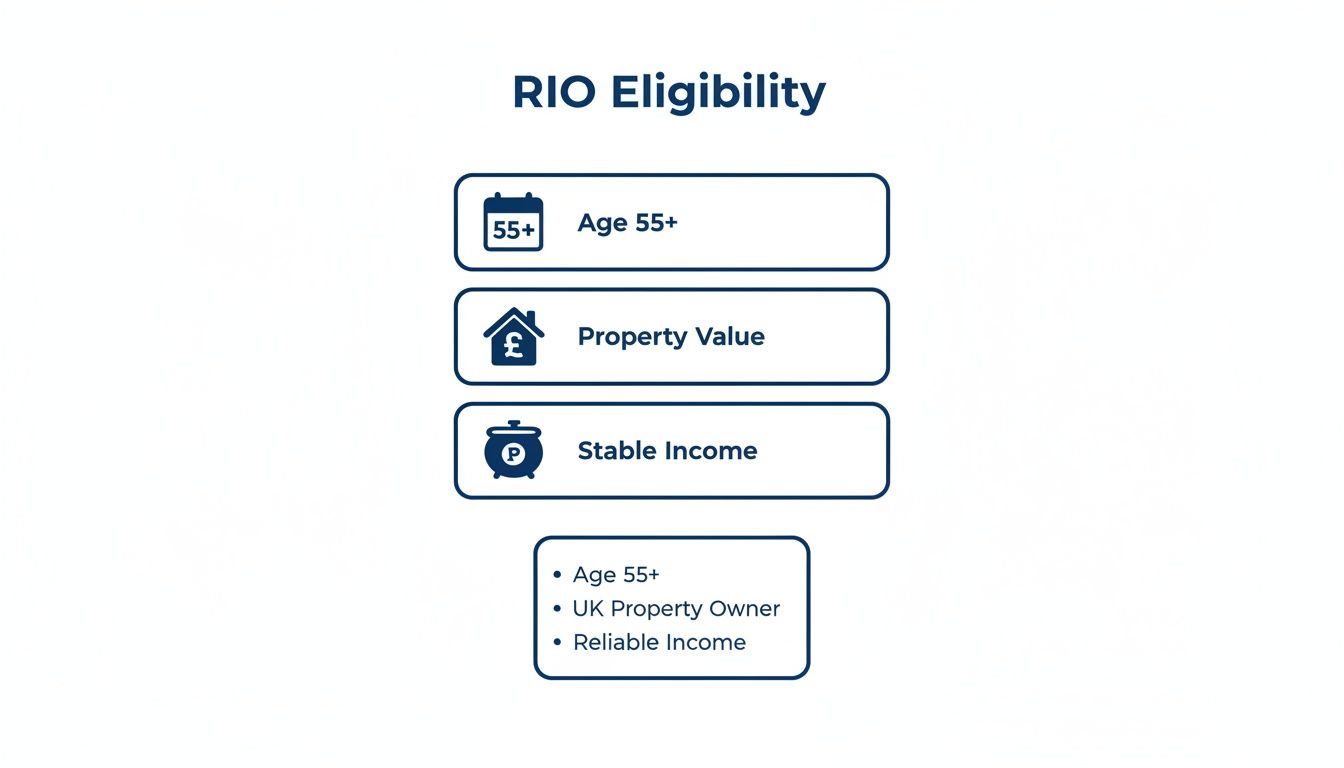
The Main Eligibility Pillars
While every lender has slightly different rules, the core eligibility criteria for an RIO mortgage are pretty consistent. You can think of them as the three main pillars on which your application will be built.
Your application will be assessed against:
- Your Age: Most lenders set a minimum age for RIO applicants, which is typically 55 or older. Some might start at 60, but this product is firmly aimed at those already in or just approaching retirement.
- Your Property: Your home itself must meet the lender’s standards. This covers its value, general condition, and type; for instance, some lenders have specific rules for leasehold properties or unusual constructions.
- Your Income: This is the most critical piece of the puzzle. Lenders need to be certain that you have a stable and reliable retirement income sufficient to cover those interest payments indefinitely.
This intense focus on long-term affordability is what really sets a RIO mortgage apart from other later-life lending options. For anyone weighing up their choices, our guide on mortgages for the over-60s offers further insights into creating financial flexibility in retirement.
A Deep Dive into Affordability Checks
The affordability assessment for an RIO mortgage is incredibly thorough, and for good reason. Lenders will ask for detailed evidence of your retirement income to build a crystal-clear picture of your financial stability.
They need to be confident that you can handle the payments, even on a ‘sole survivor’ basis if you’re applying as a couple. This is a crucial safety net to ensure that if one partner passes away, the survivor won’t be left struggling to keep up with the mortgage.
Lenders will meticulously review sources such as your pension statements, annuity documents, and investment returns. What they’re looking for are guaranteed, reliable income streams that they can count on for the long haul. This rigorous process is ultimately designed to protect both you and the lender from future difficulties.
Retirement Interest-Only mortgages are specialist products, and different lenders will have varying criteria. For example, as of February 2026, NatWest offers competitive RIO mortgage options with fixed rates at 5.19% APRC and a maximum loan-to-value of 65%. These products allow borrowers to use their retirement income to cover monthly interest, making them an appealing option for pensioners seeking financial flexibility without capital repayment burdens. You can discover more insights into NatWest’s RIO mortgage options and compare them.
Typical RIO Mortgage Eligibility Checklist
For homeowners wondering if they might qualify, it helps to see what lenders are looking for in a practical format. The table below summarises the common criteria that lenders use to assess RIO mortgage applicants.
| Criteria | Typical Requirement | What Lenders Look For | Example Document |
|---|---|---|---|
| Age | 55 or older | Proof of age | Passport or Driving Licence |
| Income | Stable & Verifiable | Guaranteed pension, annuity, investments | Annual Pension Statement |
| Property | Min. value (e.g., £75k) | Standard construction, good condition | Property Valuation Report |
| Credit History | Good to excellent | No recent defaults or CCJs | Credit Report from Experian |
| Existing Debt | Manageable levels | Low levels of unsecured debt | Recent Credit Card Statements |
As you can see, your credit history and any existing debts will also be carefully considered. Lenders need to see a solid track record of responsible borrowing to feel confident in your ability to manage this new mortgage commitment over the long term.
Check Your Eligibility With an Expert
RIO Mortgages vs Equity Release
When you start looking into later-life lending, two options nearly always come up for homeowners in Essex: Retirement Interest-Only (RIO) mortgages and Equity Release, particularly lifetime mortgages. They both let you get at the cash tied up in your home, but the way they work is fundamentally different. Getting this decision right is all about understanding what sets them apart.
The biggest difference, without a doubt, is how interest is handled. With a RIO mortgage, you have to make monthly interest payments. Because you’re actively paying down the interest, your loan balance never gets any bigger. This gives you certainty and protects the equity you’ve built up in your property.
A lifetime mortgage, on the other hand, usually gives you the choice to make no monthly payments at all. The interest still adds up, of course, but it’s rolled into the loan balance. This compounding can make total debt grow surprisingly fast over the years, eating into the inheritance you plan to leave behind.
Payments and Debt Growth
This payment structure is the key difference between the two. A RIO mortgage works a lot like a standard interest-only mortgage you might have had before retirement. You must prove you have a stable retirement income that’s enough to cover the monthly interest payments for the rest of your life. It’s important to remember that failing to keep up with these payments could put your home at risk.
A lifetime mortgage is often the go-to for people who can’t commit to, or don’t want, regular monthly outgoings. The freedom of not having to find that money every month is a big draw, but it comes at a cost, a growing debt. As interest compounds, the loan can sometimes double over a number of years, depending on the interest rate.
RIO Mortgage vs Lifetime Mortgage (Equity Release)
To help you get a clearer picture, it’s useful to see these two options side by side. The table below compares the main features of a RIO mortgage with those of a lifetime mortgage, helping you see which might be a better fit for your financial situation.
| Feature | Retirement Interest-Only Mortgage | Lifetime Mortgage (Equity Release) |
|---|---|---|
| Monthly Payments | Mandatory interest payments are required | Optional payments are not usually required |
| Debt Balance | The loan amount remains level and does not grow | The loan amount grows as interest rolls up |
| Affordability Assessment | Based on your proven retirement income | Based on your age and property value |
| Impact on Inheritance | The remaining property equity is preserved | The remaining equity is reduced over time |
This table provides a great snapshot, but if you want to dig deeper into the details, you can learn more about the differences between equity release and traditional mortgages in our dedicated guide. Seeing the nuances can make all the difference when you’re making your decision.
Which Path Suits Your Goals?
So, which one is right for you? It really boils down to your personal circumstances and what you’re trying to achieve financially.
A RIO mortgage is often a good fit for:
- Those with a steady pension income: If you can comfortably manage the monthly interest, a RIO is a brilliant way to protect your home’s equity.
- People wanting to maximise inheritance: Because the debt doesn’t grow, you know exactly what you’ll be leaving for your family.
- Individuals who prefer financial discipline: Making those regular payments gives you a clear, predictable structure to follow.
On the flip side, a lifetime mortgage might be the better choice for:
- Those with a more limited monthly income: With no mandatory payments, you free up cash for day-to-day living.
- Homeowners needing a larger lump sum: The amount you can borrow is often based more on your property’s value, not just your income.
- People for whom inheritance isn’t the top priority: If you’re comfortable with the debt growing, this can be a very flexible way to access your money.
Ultimately, getting your head around what a retirement interest-only mortgage is and how it compares with equity release is vital. Both are complex financial products that really need specialist advice. A qualified adviser can sit down with you, look at everything from your income in Chelmsford to your long-term plans, and help you find the right path for your retirement.
The Pros and Cons of a RIO Mortgage
Like any financial decision, a Retirement Interest-Only (RIO) mortgage has its upsides and its downsides. It’s never a simple case of one-size-fits-all, and getting it right means taking a good, honest look at both sides of the coin.
For the right person, a RIO can be a fantastic way to manage finances in retirement. But it’s a serious commitment, and you must understand what you’re signing up for. Let’s break down the advantages that make them so appealing, and then look at the risks you need to consider.
The Advantages of a RIO Mortgage
The biggest and most immediate benefit of an RIO mortgage is the impact on your monthly budget. Because you only ever have to pay the interest each month, the payments are much, much lower than a standard repayment mortgage. This can make a huge difference to your cash flow, freeing up money to enjoy your retirement without constantly worrying about the bills.
Another major plus is that you keep 100% ownership of your home. Unlike some other later-life lending options, the property is still entirely yours. This means you get the full benefit of any rise in its value over the years, and you have the freedom to make changes or improvements as you see fit.
It’s also a powerful tool for inheritance planning.
- Protecting Your Equity: The loan balance never gets bigger. You’re paying the interest each month, so the amount you originally borrowed is what will be repaid when the house is sold. This gives you a clear idea of what you can leave behind for your family.
- Leaving a Legacy: For many homeowners, especially in areas like Braintree, where property values have grown, leaving a healthy inheritance is a huge priority. A RIO helps you protect that value for your loved ones.
“The ability to keep monthly payments low while preserving home equity for your family is the core appeal of a RIO mortgage for many retirees.”
The Risks and Disadvantages to Consider
Now for the serious part. The biggest risk with an RIO mortgage is that the monthly interest payments are mandatory, not optional. You must be able to afford them for the rest of your life, or for as long as you live in the home.
If your circumstances change and you start missing payments, your home could be at risk of repossession. It’s no different from any other type of mortgage in that respect.
This is exactly why the affordability checks are so tough. Lenders will want to see proof of a stable and reliable retirement income, like pensions, to be sure you can comfortably handle the payments long-term. Not everyone will meet these strict criteria.
The reality is that the interest-only mortgage market has shrunk considerably. Back in 2015, there were twice as many interest-only mortgages in the UK as there are today. Data from December 2022 showed fewer than 1 million remained. While lending quality has improved, it also highlights that these mortgages are for a very specific type of borrower. You can read the full data on interest-only mortgage trends if you want to dig deeper into the numbers.
Finally, think about interest rates. If you take out a variable-rate RIO, your payments could go up if the Bank of England base rate increases, which could squeeze your retirement budget. Locking into a fixed rate for a set period is a great way to give yourself some certainty and sidestep that particular risk.
Expected Costs and Interest Rates
Before diving into a retirement interest-only mortgage, it’s vital to get a handle on the full financial picture. The costs go well beyond the monthly interest payment, and having a clear view of every expense from the outset is key to budgeting effectively and avoiding nasty surprises down the line.
The highest ongoing cost, naturally, is the interest itself. The rate you’ll be offered isn’t pulled out of thin air; your personal circumstances shape the specific criteria, and the wider economic climate. You’ll shape it. Generally, you’ll face two main choices for your interest rate, and your decision here will directly affect how stable your monthly payments are.
Fixed vs Variable Interest Rates
Picking the right type of interest rate is a huge decision, one that will influence your financial planning for years to come.
Fixed Rates: The choice for certainty. A fixed-rate mortgage locks in your interest rate for a set period, usually two, three, five, or even ten years. For anyone on a fixed retirement income, this provides complete peace of mind, as you know exactly what your payments will be during that term.
Variable Rates: This option is a bit more of a gamble. A variable-rate mortgage means your interest rate can fluctuate, typically moving in step with the Bank of England’s base rate. If rates fall, your payments could drop, which sounds great. But the flip side is that they could also rise, potentially putting a real strain on your budget.
For a deeper dive into how these rates work, you can check out our guide on UK interest rates.
The Current Rate Environment in 2026
Looking at the market in February 2026, it’s a mixed bag for retirement borrowers. The Bank of England base rate is currently sitting at 3.75%, but forecasts suggest it could ease to somewhere between 3.0% and 3.5% by the end of the year.
For interest-only retirement mortgages, we’re seeing rates around 5.19% APRC from major lenders like NatWest. That’s a good deal lower than the average Standard Variable Rate (SVR), which is hovering around 7.27%.
Other Potential Costs to Factor In
On top of the interest, there are several one-off fees you’ll need to budget for when setting up a RIO mortgage. It’s really important to factor these in when you’re calculating the total cost of borrowing.
| Fee Type | Description |
|---|---|
| Arrangement Fee | This is what the lender charges to set up the loan. |
| Valuation Fee | The cost for a professional to come out and value your property. |
| Legal Fees | You’ll need a solicitor to handle all the legal paperwork, and this covers their costs. |
| Advice Fee | This is the fee for professional mortgage advice from a broker who guides you through the process. |
These upfront costs are just part of getting a mortgage sorted. A good adviser will give you a clear, itemised breakdown of everything, making sure you are fully in the loop from day one.
Common Questions About RIO Mortgages
We’ve covered a lot of ground, but it’s natural to have questions still. This final section tackles some of the most common queries we hear from clients, giving you that extra bit of clarity on how these mortgages really work.
What Happens If I Can No Longer Afford the Interest Payments?
This is one of the most important questions to ask and a very real concern for many. If your circumstances change and you can no longer afford the monthly interest payments, you risk defaulting on the loan, which could eventually lead to your home being repossessed.
However, it’s not an immediate cliff-edge. Lenders are required to treat you fairly and will have procedures in place to help. They might suggest options like switching to a lifetime mortgage where the interest can roll up, or they may give you a reasonable amount of time to sell the property yourself. The key is to act fast; if you even suspect you might struggle, contact your lender and an adviser straight away.
Can I Get a RIO Mortgage on a Leasehold Property?
Yes, you often can, but lenders will want to take a closer look at the details of your lease. They’ll be particularly interested in how many years are left on it, usually requiring a substantial term remaining to feel comfortable.
They will also factor any ground rent and service charges into their affordability calculations, as these are ongoing commitments. Be aware that some lenders may have restrictions on certain types of leasehold properties, such as ex-council flats or properties above commercial premises in areas like Colchester.
“On a joint RIO mortgage, affordability is assessed on a ‘sole survivor’ basis from the outset, ensuring the remaining person can afford the interest payments alone.”
What Happens to a Joint RIO if One Partner Dies?
For joint RIO mortgages, lenders plan for this sad eventuality from day one. During the application, they assess affordability on what’s called a ‘sole survivor’ basis. This is a crucial safeguard, ensuring that the person left behind can comfortably manage the interest payments on their own.
So, if one partner passes away, the mortgage continues for the survivor. The loan only needs to be repaid when the last remaining borrower either dies or moves into permanent long-term care, providing real peace of mind.
How Can We Help?
Navigating the world of later-life lending can feel daunting, but you don’t have to figure it all out by yourself. As independent, whole-of-market brokers, our job is to guide you through the entire maze, starting with a proper chat about your finances and what you want to achieve.
We’ll lay out all your options in plain English, comparing products from a huge range of lenders to pinpoint the one that’s right for you. We’ll handle the tricky affordability criteria and manage the application from start to finish, making sure you feel confident and in control. We proudly serve clients across Chelmsford, Braintree, Colchester, and all of Essex.