
💡 Top tip: Many people assume equity release means the debt must snowball. That is not always the case. Some modern plans let you pay the interest monthly, which can keep the balance from growing. I’ll explain how that works later.
If you are over 55, own your home, and feel asset-rich but cash-poor, you are not alone. Many homeowners in Chelmsford, Braintree, Colchester, and across Essex sit on substantial property value while trying to stretch their retirement income further.
That is why equity release over 55 has become an important conversation. UK homeowners aged 55 and over hold an estimated £3.7 trillion in property wealth and nearly 70% of the nation’s total private housing equity, according to Mortgage Solutions reporting on ONS-based analysis. For many households, the home is their biggest store of wealth.
You need clear answers, not jargon. You also need to know where the risks sit, how inheritance can be affected, and what alternatives exist before making a decision.
Your 2026 Guide to Unlocking Your Property’s Value
Retirement changes the way people look at their homes. For years, the goal was to pay off the mortgage and protect the property for the future. Then daily life shifts. Income may fall, bills keep arriving, and priorities change.
Some people want to clear borrowing before work stops. Others want to adapt the home, help children onto the ladder, or create breathing space without moving. Equity release can support those goals, but only when it fits the wider picture.
A topic worth taking seriously
Property wealth is concentrated among older homeowners. As noted above, people aged 55 and over hold a large share of UK housing equity. That matters because it means many later-life households have wealth on paper, even if it does not feel usable month-to-month.
Key takeaway: equity release is not about “selling your future short”. It is about deciding whether some of your housing wealth should support your life now.
What usually worries people most
The same concerns come up again and again:
Will I still own my home
Will the debt wipe out everything
Will my children lose their inheritance
Will I be locked into something inflexible
Would downsizing or a RIO mortgage suit me better
Those are sensible questions. They deserve straight answers.
What good advice looks like
A proper later life review should look at:
Your aim
Are you trying to reduce outgoings, create retirement income, or fund a one-off cost?Your family position
If inheritance matters, the structure of the plan matters just as much.Your alternatives
Equity release should be compared with downsizing, other mortgage options, and the use of existing assets.Your long-term comfort
A suitable plan should help life feel easier, not more complicated.
Many people in Essex come to this conversation earlier than they expected. That can be a strength. The earlier you explore the options, the more control you tend to have over the shape of the decision.
What Is Equity Release and Is It Right For You
Think of your home as a savings pot with the lid sealed shut. You may have built up a lot inside it, but under normal circumstances, you cannot spend that value unless you sell the property. Equity release is one way of opening part of that pot without moving out.

The basic idea
Equity release lets homeowners aged 55+ access money tied up in their property while continuing to live there. The money is taken as a lump sum, smaller withdrawals over time, or sometimes a mix of both.
The most common reasons people explore it are practical:
Clearing existing borrowing so retirement income is not swallowed by monthly payments
Improving the home for comfort, accessibility, or maintenance
Helping family when they need support
Creating flexibility so day-to-day life feels less squeezed
If you want a simple self-check before going further, this guide on key questions to ask yourself about whether equity release is the right choice is a sensible starting point.
Who usually considers equity release over 55
In practice, many people start asking about it earlier than the stereotype suggests. A lot of enquiries happen in the 55 to 60 age range, when retirement planning starts to feel real, and household finances are being reshaped.
That early timing matters. It gives you a chance to compare routes rather than making a rushed decision later under pressure.
You may be suitable if
You may be in the right zone to explore equity release if the following sound familiar:
You own a property in the UK and have built up equity over time
You are aged 55 or over
You want to stay put rather than move
You need access to funds but do not want traditional affordability pressure in later life
Practical tip: the best time to ask about later life lending is usually before finances feel tight, not after.
You may need a different route if
Equity release is not always the answer. It may be less suitable if preserving the maximum possible inheritance is the only priority, if moving home would solve the issue more cleanly, or if regular mortgage payments are still affordable and a different product would be cheaper over time.
The right question is not “can I do it”. The right question is “Does this improve my position without creating bigger problems later?”
The Two Main Types of Equity Release Plans
A couple in Chelmsford might come to us with the same goal. They want extra money for retirement, want to stay in the home they love, and want to be fair to their children. Then we explain there are two different ways to do that, and the conversation slows down. Quite right too. The main difference is not the amount of cash. It is what happens to ownership.
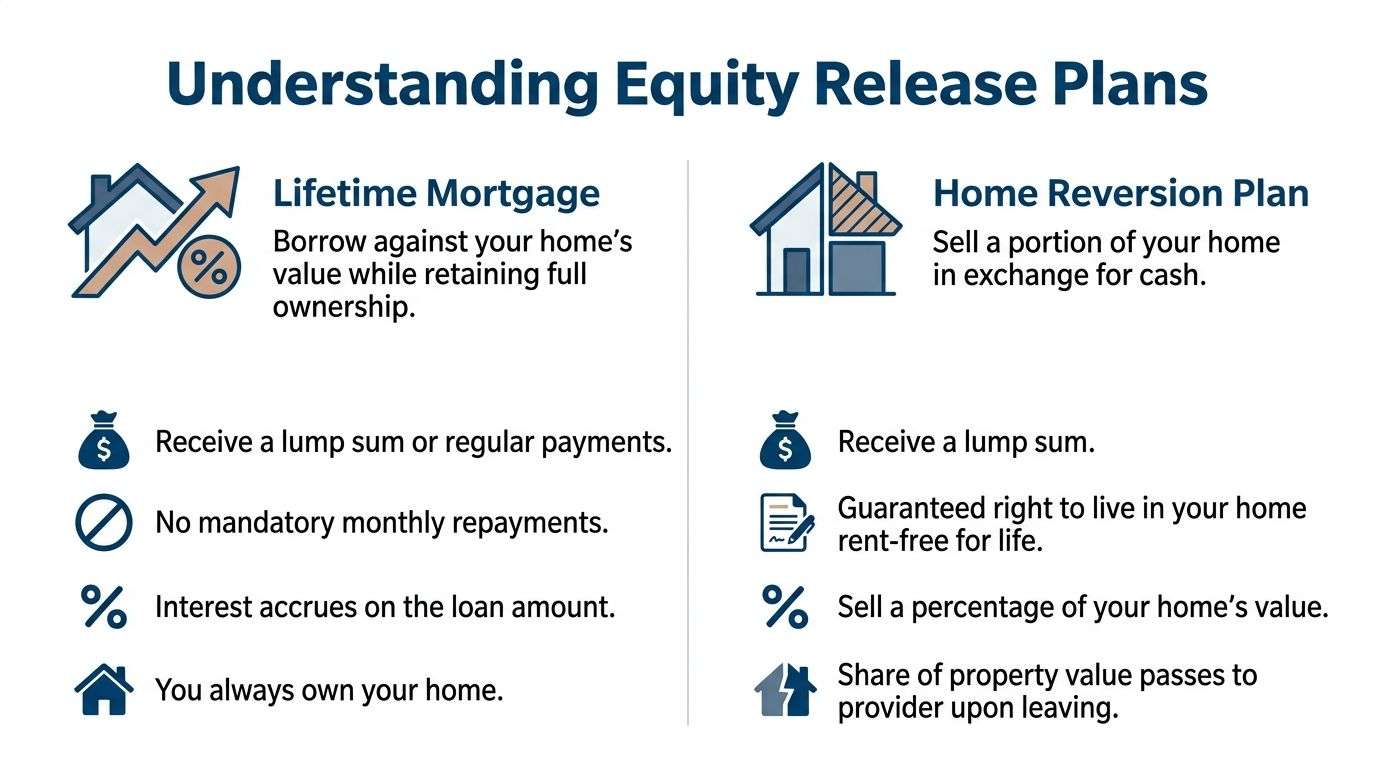
Lifetime mortgage
A lifetime mortgage is the option Essex homeowners ask about most often. It is a loan secured against your property, but the home belongs to you.
You borrow against the value tied up in the property. Interest is then charged on the amount borrowed. If you choose not to pay that interest each month, it is added to the balance, so future interest is charged on a larger figure. Compound interest works a bit like a snowball. If it keeps rolling and nothing is cleared, it grows faster over time.
Modern plans can be more flexible than the old stereotypes suggest. Depending on the lender and product, you may be able to:
Make voluntary interest payments
Make ad hoc overpayments
Take money in stages rather than all at once
That last point matters. Drawing money in stages can reduce the amount of interest building up compared with taking the full amount on day one.
If you want a plain-English explanation of the mechanics, this guide on how equity release works sets it out clearly.
Home reversion plan
A home reversion plan works in a completely different way. You are not borrowing. You sell part, or all, of your property to a reversion company in exchange for cash, while keeping the legal right to live there, usually for the rest of your life.
That gives some homeowners a sense of certainty because there is no loan balance growing over time. The trade-off is ownership. You no longer keep the whole value of the share you sold, so when the property is eventually sold, the provider receives its agreed share of the proceeds.
This is an emotional sticking point. Many families are comfortable with a loan secured on the home. Far fewer feel relaxed about giving away part of the property itself. Neither reaction is wrong. It shows why the detail matters more than the headline.
Lifetime Mortgage vs Home Reversion Plan at a Glance
| Feature | Lifetime Mortgage | Home Reversion Plan |
|---|---|---|
| Ownership | You keep ownership of the home | You sell part or all of the home |
| How money is provided | Loan secured against property | Cash in exchange for an ownership share |
| Interest | Interest applies to the loan | No loan interest because it is not borrowing |
| Inheritance impact | Depends on loan size and repayments | The estate receives a reduced share of the sale value |
| Flexibility | Often more flexible on withdrawals and repayments | Usually less flexible once arranged |
How age affects how much you can release
Age affects how much can be released under a lifetime mortgage. In simple terms, lenders offer a higher percentage of the property’s value to older applicants because the plan is expected to run for a shorter period.
Clients sometimes hear that and assume it is unfair to younger borrowers in their late fifties. It is a pricing and risk decision. The lender is assessing how long interest may build up and setting limits around that.
Property value and age are only part of the picture. The type of property, your health in some cases, and the product rules can all affect what is available. That is why two neighbours in similar houses can receive different illustrations.
An important protection
Many plans meet Equity Release Council standards, including the no-negative-equity guarantee. This means that, provided the plan terms are met, the amount owed will not exceed the property’s sale proceeds.
For many families, that protection brings significant peace of mind. Equity release should be a planned retirement tool, not a gamble with the family home. The right plan can improve later life while keeping clear boundaries around risk and inheritance.
Understanding the Costs and Financial Implications
A couple in Chelmsford came to see us with a simple question. “If we release money from the house, what will it cost us over time?” That is usually the right place to start.
The cash itself is tax-free. The cost sits elsewhere, in the fees, the interest, and the long-term effect on the value left in the property.

The price of equity release is more than the rate
Homeowners focus on the interest rate first. That makes sense, but it is only one part of the full cost.
A proper review should cover:
Advice fees for the recommendation
Valuation fees if the lender applies them
Legal fees because separate legal advice is required
Product fees added by some lenders
Early repayment charges if you repay outside the plan terms
In practice, the right question is not “What is the rate?” It is “What does this plan cost me now, and what could it cost my estate later?”
That distinction matters.
Two plans can look similar on day one and behave differently over ten or fifteen years, especially if one allows flexible repayments and the other does not.
Why the balance can grow faster than people expect
With many lifetime mortgages, unpaid interest is added to the loan. Next year’s interest is then charged on that higher figure. Compound interest works like a snowball rolling downhill. Each year, the balance has more surface area for interest to stick to.
That is the part families underestimate.
As noted earlier, lenders price lifetime mortgages within a fixed-rate range. The exact figure depends on the product and your circumstances. What matters is the direction of travel. If no interest is paid, the balance can grow more than borrowers expect over a long retirement.
Here is the practical lesson we give clients in Essex. Do not judge a plan by the lump sum alone. Judge it by three figures on the illustration: the amount borrowed, the projected balance later, and the estimated equity left in the home.
Small payment options can make a large difference
Some modern plans let you pay some or all of the monthly interest, and some allow penalty-free overpayments within set limits.
That can change the outcome.
A part-payment option is a bit like keeping a saucepan on a low heat instead of letting it boil over. You may not stop the cost, but you can keep it under better control. For homeowners who want to support retirement spending and still protect family wealth, that flexibility can be the difference between a sensible tool and an expensive mistake.
Benefits and care planning need checking early
Released funds can affect means-tested benefits if the money remains in savings. That check should happen before the application goes too far, not after the money arrives.
Care planning also deserves a sober look. We speak to families who are balancing home improvements, gifting, retirement income and possible support later in life. If care may become part of the picture, it helps to understand the significant costs of 24-hour home care, because housing wealth is one of the few large assets available to fund choices.
A short video can also help clarify how later-life borrowing works in practice.
A sensible checklist before proceeding
Ask for a full illustration
You need to see the starting loan, fees, interest rate, and how the balance may change over time.Check the impact on benefits and tax planning
The cash may be tax-free, but holding it can still affect other parts of your finances.Review repayment flexibility
Features such as voluntary payments or drawdown access can reduce long-term costs.Discuss the family objective
Some clients want to maximise retirement comfort. Others want to ring-fence as much property value as possible. The right advice starts with that conversation.
How Equity Release Affects Inheritance and Common Myths
Inheritance is the part that families care about most. It is also the part most clouded in misunderstanding.

Many people think equity release means handing over the house and leaving the family with nothing. That is not a fair description of how many modern plans work.
“Many think that equity release means you give up your property and the family are left with nothing; however, most Lifetime Mortgages allow the borrower to pay some or all of the interest and overpayments, keeping the debt as low as possible.”
Myth one: You lose your home
With a lifetime mortgage, you remain the owner. That is the core distinction from home reversion.
The lender has a legal charge over the property, as with a conventional mortgage, but ownership stays with you unless you have chosen a different product type.
Myth two: There will be nothing left for the family
The amount left to beneficiaries depends on several moving parts:
How much is borrowed at the start
Whether interest is paid along the way
How long does the plan run
Whether any inheritance protection is built in
What happens to the property value over time
That means the outcome is not fixed from day one. Choices made during the life of the plan can shape the eventual estate.
Practical ways people protect family wealth
Some plans allow features that can help preserve more value for loved ones:
Voluntary interest payments
These can stop or reduce roll-up.Ad hoc overpayments
Useful if income varies or spare cash appears later.Inheritance protection options
Some plans let you ring-fence a share of future property value.Lower initial borrowing
Taking only what you need can matter more than people realise.
Family-first rule: if inheritance matters, build that into the recommendation at the start rather than hoping to fix it later.
The no-negative-equity point
Another common fear is that the family could inherit a debt larger than the house value. Plans with a no-negative-equity guarantee are designed to prevent that outcome, provided the product terms are met.
That protection is reassuring, but it should not make anyone casual. A guarantee against owing more than the sale proceeds is not the same as a guarantee of preserving a large inheritance. The borrowing still needs to be handled carefully.
Wider estate planning still matters
Equity release is only one part of the picture. Wills, trusts and powers of attorney can all shape how family wealth is managed and passed on. If you want a plain-English legal overview, Wills vs. Trusts: A Guide to Protecting Your Family is a useful companion read.
For more on the misunderstandings that often put people off too early, this guide to common misconceptions about equity release mortgages is worth reading before you rule it in or out.
Exploring Alternatives to Equity Release
A good adviser should be willing to say, “This may not be the right route”. That is especially true in later life lending.
Equity release over 55 can be helpful, but it is not the only option. Sometimes another route solves the problem more cleanly.
Downsizing
Selling a larger property and buying a smaller one can release capital without taking on a later life lending product.
The upside is apparent. You may reduce bills, simplify maintenance, and free up cash in one move.
The downside is emotional and practical. You may leave a home you love, a familiar area, or nearby support networks in Essex. Moving costs and the stress of relocating also need to be weighed carefully.
Traditional remortgage or later life mortgage
Some homeowners can still qualify for a standard mortgage or remortgage. That can work well if income is strong enough and the term is manageable.
This route may suit people who want a more conventional structure and are comfortable with monthly repayments. The challenge is affordability. Later-life borrowing is less about property value and more about whether the lender is satisfied with the borrower’s ongoing income.
Retirement Interest-Only mortgages
A Retirement Interest-Only mortgage, usually shortened to RIO, sits somewhere between a standard mortgage and equity release.
You pay the interest each month, so the balance itself does not grow as it would with a rolled-up lifetime mortgage. That can be attractive if inheritance is a strong priority and monthly payments are affordable.
The trade-off is commitment. With a RIO mortgage, the monthly interest payments are not optional. You need confidence that the budget can cope not only now but also later.
A simple way to think about the choices
Ask yourself these questions:
Do I want to stay in this home long term
Can I comfortably afford ongoing monthly payments
Is preserving inheritance more important than maximum cash access
Would moving solve the issue with fewer long-term trade-offs
There is no prize for choosing equity release if a simpler option does the job. The best outcome is the one that supports your retirement without storing up avoidable strain.
Your Step-by-Step Application Process with EHF Mortgages
Understanding the application process helps demystify it. Here is the typical path from first enquiry to funds arriving.
A common Essex scenario looks like this. A homeowner in Chelmsford wants to clear an interest-only mortgage before retirement, free up some monthly income, and stay in the family home rather than move. The product matters, but the starting point is the life problem you are trying to solve.
Step one: starts with your aims
The first conversation should focus on why you are considering later-life borrowing and what a good outcome looks like for you.
That might be clearing an existing mortgage, repaying unsecured borrowing, helping with home improvements, or creating more breathing space in retirement. In our experience across Chelmsford and wider Essex, many clients are not looking for a last-resort solution. They want to use housing wealth in a planned, sensible way that improves day-to-day life without losing control of the bigger picture.
An adviser should also ask about your family position, your income, any state benefits, your health, and whether you expect to stay in the property long term. Those details matter because the right recommendation is built around your circumstances, not around a headline rate.
Step two: research and recommendation
Once the fact-finding is complete, the adviser compares the suitable options and recommends a suitable route.
That usually includes questions such as:
Does a lifetime mortgage fit better than a RIO mortgage
Would a lump sum or a drawdown plan match the purpose more closely
Do you want the option to make voluntary repayments
Do you want features that ring-fence part of the property’s value for inheritance
What does the arrangement look like over time, not just on day one
This stage clears up a major misunderstanding. The plan that releases the most cash, or the one with the lowest starting rate, is not always the one that best protects family wealth. Equity release works a bit like opening a tap from the value stored in your home. The important question is not only how much water comes out today, but how the tank looks years from now.
Step three: the formal application
After you decide to proceed, the lender starts the application, the property is valued, and a solicitor handles the legal work.
This part can feel slower than clients expect. That is a good sign. You are making a long-term decision secured against your home, so you should be careful with the checks. Independent legal advice is part of the protection built into the process. Your solicitor explains the documents, confirms you understand the terms, and makes sure there is no pressure or confusion before anything is completed.
Step four: offer and completion
If the lender is satisfied with the valuation and the legal work is finished, a formal offer is issued, and the funds are released on completion.
In many cases, the first use of the money is to repay an existing mortgage or other borrowing. Clients tell us the biggest shift is not only the arithmetic on paper. It is the relief of seeing monthly pressure reduce and retirement start to feel more manageable.
What good support should feel like
A later-life lending case should feel calm, clear, and appropriately paced.
You should be able to ask the same question twice. You should understand who owns the property, what happens to the loan over time, and what choices may still be available later, such as making repayments or moving home under the plan rules. Compound interest can confuse people, and for good reason. It works like a snowball rolling downhill. Interest can be charged on the loan, then future interest can be charged on earlier interest, so small differences early on can lead to larger gaps later. That is why clear illustrations and plain-English advice matter.
EHF Mortgages is one option for homeowners in Chelmsford, Braintree, Colchester, and across Essex who want regulated advice on equity release and RIO mortgages as part of a broader review of later-life borrowing options.
Take Control of Your Retirement Finances Today
For the right homeowner, equity release over 55 can be a practical tool rather than a last resort. It can turn property wealth into usable money while allowing you to stay in the home you know.
The key is fit. You need to understand the difference between lifetime mortgages and home reversion, the effect of interest over time, the potential impact on benefits, and the options available to protect an inheritance.
You also need to compare it fairly against downsizing, a RIO mortgage, or other borrowing routes. Good decisions in later life are seldom about one headline figure. They are about how the full arrangement supports your retirement, your family, and your peace of mind.
If you are weighing up whether to clear borrowing, improve your home, support family, or create more breathing room, a personalised conversation is the sensible next step.
If you would like clear, regulated guidance on your later life lending options, speak to EHF Mortgages and discuss your situation in confidence. Every case is different, and the right answer starts with advice suited to your goals, property, family priorities, and retirement plans.





