
Here’s a top tip for getting a buy-to-let mortgage as a first-time buyer: your salary is as important than the property’s rental income, so ensure you have good personal income, as well as a property that will be good for letting.
Lenders care more about the investment’s profitability than your personal earnings, unless you are a First Time Buyer without your own home in the background. We’ll explain exactly why this is the key to your success later in this article.
Table of Contents
- How a Buy to Let Mortgage Really Works
- What Lenders Look for in a First Time Landlord
- Decoding the True Cost of Your Investment
- Navigating the Current UK Buy to Let Market
- A Step-by-Step Guide to Your Mortgage Application
- Your Buy to Let Questions Answered
Your First Step into Property Investment in 2026

Diving into the property market as an investor before becoming a homeowner might sound backwards, but it’s a savvy path more and more ambitious buyers are exploring. There’s a common myth that you need to be on the property ladder yourself to qualify for a buy-to-let mortgage, but you may be surprised that there are options open for First Time Buyers.
While it’s fair to say some high-street lenders prefer applicants who are existing homeowners a growing number of specialist lenders are open to first-time buyers who can put together a solid convincing case. Think of this guide as your complete roadmap for understanding this specific type of mortgage.
We’re here to demystify the entire process for you. We’ll get into the real challenges and opportunities from saving up a larger deposit to navigating the unique criteria lenders use which is worlds away from a standard residential mortgage application.
“Think of this guide as your complete roadmap. We’re here to take you from an aspiring landlord to a successful property investor with confidence.”
As you start your investment journey, remember that being a landlord comes with ongoing duties. Getting to grips with some useful tools can make life much easier, so exploring the best property management apps could be a very smart move early on.
This article gives you the knowledge to invest with confidence in thriving local markets like Chelmsford, Braintree or Colchester. The principles and steps we’ll outline will help you build a solid foundation for your future as a property landlord. For more great insights you can also explore our other EHF Mortgages buy-to-let mortgage tips.
Begin Your Journey Today
Ready to explore what’s possible with a buy-to-let mortgage as a first-time buyer? Our expert team at EHF Mortgages is here to offer clear straightforward guidance, and connect you with the right lenders for your situation.
Start your property investment journey on the right foot. Visit our Contact Us page to book your free no-obligation consultation.
How a Buy to Let Mortgage Really Works
Getting your head around a buy to let mortgage as a first time buyer requires a total change in thinking. Your typical residential mortgage is all about your personal salary and what you can afford. A buy-to-let loan is a completely different beast. It’s not all about your personal income, but whether the property itself can run as a successful business.
Think of it like this: the property is applying for the loan, not you. Suddenly, the lender isn’t as interested just in your payslip. Their main concern is the property’s potential to generate rental income. Your financial health still matters as a backup, but the real star of the show is the monthly rent the property can pull in whether it’s in Chelmsford, Braintree, or beyond.
Understanding the Rental Stress Test
This business-first approach brings us to the single most important concept in buy-to-let lending: the rental stress test. This is the core calculation lenders use to figure out if a property is a safe bet for them to back. It’s a simple but non-negotiable hurdle you absolutely must clear.
The stress test makes sure the expected rent doesn’t just cover the mortgage payment but leaves a healthy buffer on top. This extra margin is there to account for things like empty periods between tenants, maintenance costs, and all the other expenses that come with being a landlord. It proves the investment can handle financial pressure, without falling behind on the loan.
Most lenders will want to see the projected monthly rent come in at between 125% and 145% of the monthly mortgage payment, depending on your personal income and individual tax status (Basic, Higher or Additional Rate Payer). What’s more this is often calculated using a higher hypothetical interest rate to check the investment would still work, even if rates go up.
“Getting to grips with the rental stress test is the real key to securing your first buy-to-let mortgage. It’s the number one metric that dictates how much you can actually borrow.”
For example let’s say the monthly mortgage payment at the lender’s “stressed” interest rate is £800. They’ll need proof of a rental income of at least £1000 (that’s 125%) to £1160 (145%). This calculation is central to your application’s success and directly decides the maximum loan you can get for a property in Colchester, or anywhere else.
Key Differences from a Residential Mortgage
Because the loan is based on mostly the property’s business potential, a few other things are different too. For a start the deposit requirements are much higher than for a standard home purchase. For a buy-to-let lenders will typically want a deposit of at least 25% of the purchase price.
It’s also important to know that as a first-time buyer you won’t get limited first-time buyer stamp duty relief on a buy-to-let property. And as we’ve covered the property’s rental yield is the main factor in how much you can borrow, thanks to those lender stress tests. You can discover more insights on getting a standard mortgage on our first-time buyer’s essential guide.
Understanding this fundamental shift from personal salary to property profit is crucial. Your ability to prove a property’s income potential through the rental stress test is the key that unlocks the door to your first investment property.
What Lenders Look for in a First Time Landlord
When you’re applying for a buy to let mortgage as a first time buyer lenders are essentially sizing you up as a potential business partner. They need to feel confident that you can handle a property investment, even without a track record as a homeowner. Their checklist dives deep into your personal financial stability. going far beyond just the property’s rental potential.
Think of it this way: your financial health is their safety net. If the property sits empty for a couple of months between tenants, or suddenly needs a new boiler. you still have to cover the mortgage payments. That’s why many lenders set a minimum personal income requirement usually around £25000 per year to make sure you have a reliable buffer.
This rule is often why many high-street banks might say no to first-time investors. They prefer the simpler more rigid criteria of applicants who already own their home. But don’t worry, a specialist broker like us at EHF Mortgages knows exactly which lenders understand, and cater to your situation.
Proving Your Financial Stability
For a lender a pristine credit history is non-negotiable. It’s the clearest evidence you can provide of your reliability, showing them you’ve got a solid history of managing your finances responsibly. Before you even think about applying, it’s a great idea to check your credit report with agencies like Experian or Equifax and sort out any mistakes.
A strong credit score tells a lender you’re a low-risk borrower. This is especially vital when you can’t show them a history of previous mortgage payments. It’s one of the most powerful tools you have to build a compelling case.
The image below breaks down the core of a buy-to-let application showing how the rental income is put through a stress test to figure out the final mortgage amount.
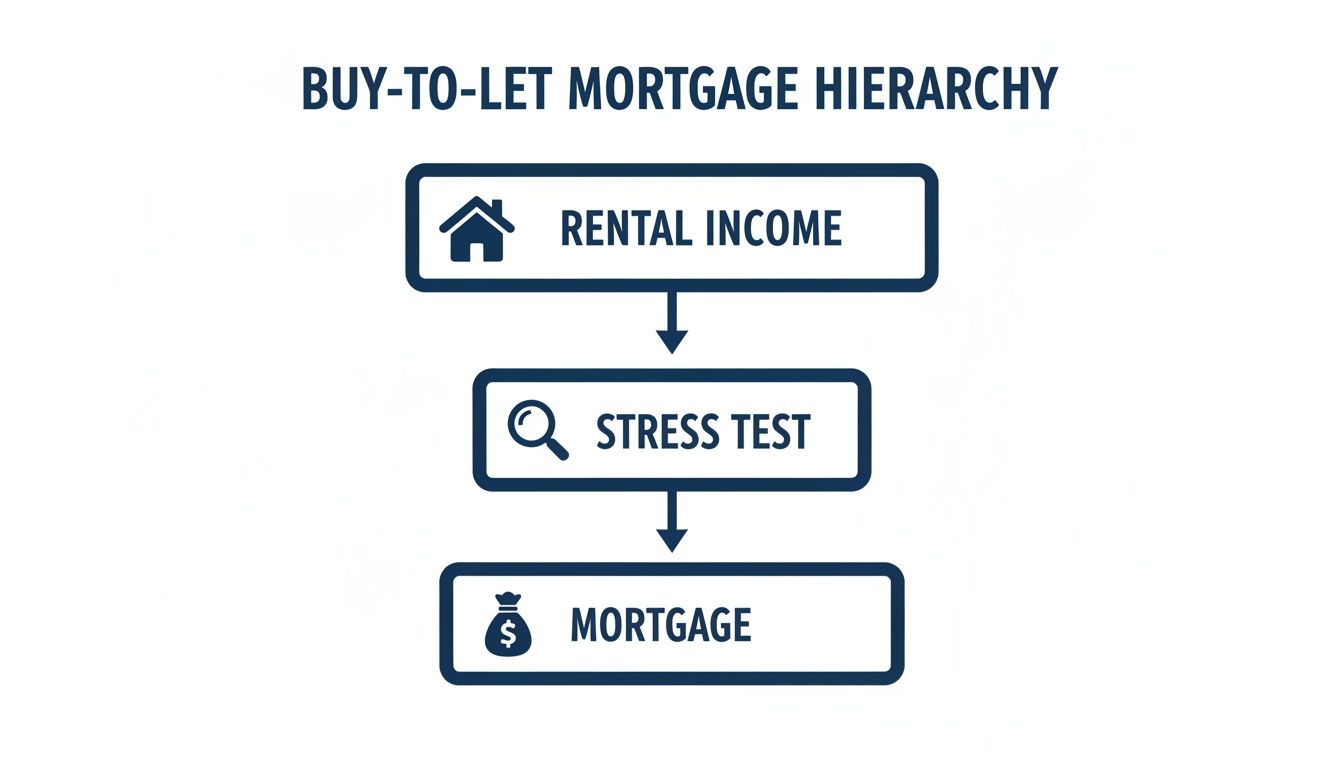
This shows that while your personal finances are key the property’s ability to generate enough rent to pass the stress test is ultimately what gets the mortgage over the line.
Why Being a Homeowner Matters to Lenders
So why do some lenders prefer you to already own a home? From their point of view a homeowner has already proven they can handle the financial weight and responsibility of a big long-term loan. It gives them a pre-verified track record of reliability. Also there is a concern that you may purchase the property to live in it, as you could potentially borrow more via a Buy-To-Let scheme and purchase a more desireable property.
But not being a homeowner doesn’t automatically rule you out. You just need to build a strong case in other ways. This could mean showing a long and stable employment history a chunky savings pot (beyond just your deposit) and a detailed business plan for your investment in areas like Chelmsford Braintree or Colchester.
“For a first-time investor your application is about painting a picture of total financial competence. A strong income and clean credit history act as the foundation for your entire investment case.”
To make the differences crystal clear let’s compare the criteria for a standard residential mortgage with a buy-to-let loan for a first-time buyer.
| Criteria | Residential Mortgage (First Time Buyer) | Buy to Let Mortgage (First Time Buyer) |
|---|---|---|
| Primary Affordability Driver | Personal salary and outgoings | Projected rental income (via stress test) |
| Minimum Deposit | Typically 5-10% | Typically 25% or more |
| Personal Income Requirement | Primary factor for loan size | Often a minimum threshold (e.g. £25000) |
| Interest Rates | Generally lower | Generally higher |
| Stamp Duty Relief | Eligible for first-time buyer relief | Not eligible; higher rate applies |
This table really highlights the fundamental shift in focus from personal affordability to investment viability. Successfully securing a buy to let mortgage as a first time buyer all comes down to meeting these distinct business-focused criteria.
Decoding the True Cost of Your Investment

When you’re mapping out your first property investment, it’s easy to focus on the purchase price alone. But that figure is really just the tip of the iceberg. A truly successful investment depends on knowing every single cost involved from day one. Getting this complete financial picture is crucial for budgeting correctly, and making sure your buy-to-let venture actually turns a profit.
The first major hurdle is always the deposit. Forget the 5% you might see for a residential mortgage; the industry standard for a buy to let mortgage as a first time buyer is a far more substantial 25% of the property’s value. Lenders need to see this larger stake as proof of your commitment, and it helps lower their risk.
It’s also worth remembering that your deposit size directly influences the interest rates you’ll get. If you can push beyond that 25% minimum to 30% or even 40% you can often unlock much better mortgage deals making your investment more profitable in the long run.
Your Stamp Duty Land Tax Obligation
One of the most common and costly mistakes we see first-time investors make is misunderstanding Stamp Duty Land Tax (SDLT). That first-time buyer relief you might have heard about? It simply does not apply to investment properties. Because you’re buying an additional property it automatically falls under the higher SDLT rates.
This means you have to budget for a much larger tax bill right from the start. It’s a non-negotiable upfront cost that has to be paid within 14 days of completion so it’s vital to factor it into your initial sums. To get an exact figure for a property in areas like Chelmsford or Braintree the official government Stamp Duty Land Tax calculator is your best friend.
Forgetting to account for this higher tax rate can derail your purchase before it even gets going so make it one of the very first costs you calculate.
“Forgetting the higher Stamp Duty rate is the single biggest budgeting error a first-time landlord can make. Always calculate this cost upfront.”
The Other Essential Costs You Must Budget For
Beyond the deposit and Stamp Duty your financial plan needs to cover a whole range of other professional and setup fees. These costs are all part of the buying process and can add up surprisingly quickly. For those considering a company structure our guide on Limited Company Buy to Let mortgages is a great resource.
Here’s a quick breakdown of the typical costs you’ll need to anticipate:
- Mortgage Arrangement Fees: These can range from a few hundred to a couple of thousand pounds. Sometimes you can add them to the mortgage loan itself.
- Solicitor Fees: You’ll need a conveyancing solicitor to handle all the legal paperwork from local searches and contracts to transferring ownership.
- Valuation Fees: The lender will insist on a property valuation to confirm it’s worth what you’re paying and that it’s suitable security for the loan.
- Broker Fees: Some mortgage brokers charge a fee for their expertise and service in finding you the right deal.
- Landlord Insurance: Your standard home insurance policy won’t cut it. You need specialist landlord insurance to cover things like property damage liability and even loss of rent.
- Letting Agent Fees: If you plan to use an agent to find tenants and manage your property in a location like Colchester you’ll need to factor in their fees.
On a positive note, current forecasts suggest UK buy-to-let mortgage rates are becoming more favourable. With the Bank of England expected to gradually reduce the Base Rate it’s predicted that average 5-year fixed rates could settle around 4.5%. This is great news as it helps more landlords pass those crucial rental coverage stress tests. You can find out more about the UK buy-to-let mortgage outlook for 2026 on limeconsultancy.net.
Navigating the Current UK Buy to Let Market
To make a smart investment you first need to get a feel for the wider market. For anyone thinking about a buy to let mortgage as a first time buyer the good news is that the UK rental market is buzzing with consistently high tenant demand. This strong ongoing need for quality rental homes provides a solid foundation for new landlords dipping their toes in the water.
A great way to gauge the market’s health is to look at what lenders are doing. Recent figures show the buy-to-let mortgage world is really shifting gears. In 2023 while new property purchases made up nine billion pounds in lending remortgages hit eleven billion pounds. The forecast now is for remortgage lending to jump to a massive £28 billion which tells us that both landlords and lenders are feeling more confident as things stabilise.
So what does this remortgaging boom mean for you? It’s actually great news. It shows that existing landlords are feeling confident enough to lock in new deals often because interest rates are becoming more predictable. This flurry of activity pushes lenders to offer more competitive products to win business which ultimately means more attractive buy-to-let mortgage rates could become available for first-time investors like you.
Translating Trends into Local Opportunities
National trends are a useful starting point but the real magic happens when you apply them locally. In thriving commuter towns like Chelmsford Braintree and Colchester the demand for rental properties is exceptionally strong. These areas have brilliant transport links to London growing local economies and a steady stream of professionals and families looking for high-quality places to rent.
This local demand means a well-chosen property, in one of these Essex hotspots, is very likely to deliver a strong rental yield and have minimal empty periods. For example, a property in a sought-after part of Chelmsford will probably attract reliable tenants quickly helping you sail through a lender’s crucial rental stress tests. It’s this local knowledge that gives you a real strategic edge.
“A strong national market is a good sign but a thriving local rental market is where your investment truly succeeds. Focus on areas with proven tenant demand.”
As you look at different types of properties it’s vital to get your head around the specific legal duties they come with. If you’re tempted by a House in Multiple Occupation (HMO) for its higher potential yields, for instance, a thorough understanding of HMO fire safety regulations is non-negotiable.
Capital Growth and Product Availability
Beyond the monthly rental income, the current market also offers the potential for long-term capital growth. As interest rates settle, and the property market finds its balance, the value of well-maintained properties in high-demand areas is set to grow over time. This is the second key pillar of a successful buy-to-let investment.
This stability also gives lenders the confidence to get creative and launch a wider range of mortgage products. For a first-time buyer this simply means more choice and a better chance of finding a deal that fits your finances perfectly. Sifting through these options is much easier with an expert on your side. You can check out our regularly updated information on current buy-to-let mortgage rates to see what’s out there.
By blending a confident national market with smart local insight you can set up your first investment for both immediate returns and future growth.
A Step-by-Step Guide to Your Mortgage Application

Getting a buy-to-let mortgage as a first-time buyer can feel like a mountain to climb but the best way to tackle it is one step at a time. Breaking the journey down into a simple seven-stage roadmap turns a complex process into a manageable checklist.
Following these steps in order will build your confidence, and demystify what it takes to go from aspiring investor to a proud property owner. Let’s walk through it together from the initial number-crunching, right through to getting the keys.
The Initial Planning Stages
Before you even think about scrolling through property listings you need to get your own house in order financially speaking. These first few steps are all about solid preparation and strategy making sure you start on the strongest possible footing.
- Perform a Financial Health Check: This is your foundation. Get forensic with your bank statements review every outgoing, and check your credit score with a service like Experian. A clean credit history and a rock-solid understanding of your budget are non-negotiable for lenders.
- Research Your Target Investment Area: It’s time to become a local expert. Zero in on a few potential locations like Chelmsford, Braintree, or Colchester and analyse the rental demand. What are the average rents? What types of properties are popular? Strong local demand is what will convince a lender your investment is a safe bet.
- Engage a Specialist Mortgage Broker: This is arguably the most critical move you can make. A whole-of-market broker like us here at EHF Mortgages has direct lines to specialist lenders who are comfortable working with first-time investors. We know their unique criteria inside and out and can frame your application to give it the best chance of success.
From Application to Completion
With all that prep work done you can move forward with real confidence. The next phases are about finding the right property and navigating the formal application and legal hurdles.
- Secure a Decision in Principle (DIP): Think of an DIP as a lender’s seal of approval. It’s a conditional offer stating how much they might be willing to lend you. It proves to estate agents that you’re a serious buyer and gives you a clear realistic budget to work with.
- Find a Property and Make an Offer: Now for the exciting part! With your DIP in hand, you can start viewing properties. Once you find the right one you’ll be ready to make a credible offer.
- Complete the Full Mortgage Application: Once your offer is accepted it’s go-time. You’ll need to submit your full application and your broker will be invaluable here helping you pull together all the necessary documents from payslips and bank statements to proof of your deposit.
- Navigate the Legal Process: Your solicitor takes the lead on the conveyancing. This involves handling local searches exchanging contracts and managing the final transfer of funds. Once that’s all done you’ll get the keys and officially become a landlord.
“Following a structured process removes uncertainty and transforms the mortgage application from a daunting task into a series of achievable steps.”
Each of these steps builds on the last, creating a logical path towards your goal. By tackling them one by one, you’ll stay in control and maintain clarity throughout the entire journey.
For tailored guidance through this process our team is ready to help. Get in touch by visiting our Contact Us page.
Your Buy to Let Questions Answered
As we get towards the end of this guide, it’s time to tackle some of the practical questions we hear all the time from aspiring landlords. These are the kinds of things that pop into your head once the main ideas start to click into place.
Getting a buy to let mortgage, as a first time buyer is a huge decision, and it’s completely natural to have questions about what being a landlord is really like day-to-day. Let’s get them sorted.
Can I Live in My Own Buy to Let Property?
This one’s a firm no ! It’s one of the most black-and-white rules in the mortgage world. A buy-to-let mortgage is a commercial loan, given on the understanding that the property is a rental business.
Living there yourself is considered mortgage fraud, which comes with some pretty severe legal and financial consequences. If your situation changes and you suddenly need to move into the property you absolutely must speak to your lender first. They’ll require you to switch over to a standard residential mortgage which means a whole new application, and affordability check based on your personal income not the potential rent.
This is also the reason is why many lenders will limit what you can borrow,to the equivalent you could borrow to buy a property to live in, to discourage the temptation of living in the Buy to Let property.
What Happens if I Struggle to Find a Tenant?
This is the single biggest risk for any landlord, and it’s exactly why lenders are so strict with their checks. It’s also why having your own income, and a savings buffer, is non-negotiable. Those periods without rent coming in are known as ‘void periods’ but the mortgage payment is still due every single month tenant, or no tenant.
Here’s how you can prepare for that possibility:
- Build a Contingency Fund: Before you even buy aim to have at least three to six months’ worth of mortgage payments and other essential property costs (like insurance and service charges) stashed away in an easy-access savings account.
- Price Competitively: Do your homework. Research the local rental market in areas like Chelmsford or Colchester to make sure your asking rent is realistic and attractive to good tenants.
- Consider Rent Guarantee Insurance: This is a specific type of landlord insurance policy. It can cover your lost rent if a tenant stops paying or if you have a long gap between tenancies.
- Interest-Only Payments – one of the main reasons to pay only the interest is to give you initial surplus income to put aside for emergencies. It also means you have less of your own funds to use if you have a void period (See below).
Should I Choose an Interest Only or Repayment Mortgage?
This choice really boils down to your personal investment strategy. Many landlords lean towards interest-only mortgages, because the monthly payments are lower, which frees up more cash each month. This extra cash flow can be a lifesaver for maintenance costs, or can be put towards a deposit for your next property. The catch? You need a clear plan to repay the original loan when the mortgage term ends which for most people means selling the property.
A repayment mortgage on the other hand means your monthly payments are higher because you’re chipping away at the actual loan amount as well as the interest. It’s a slower more conservative route. But at the end of the term, you’ll own the property outright with no debt. It’s arguably the safer long-term play, but it will eat into your monthly profits along the way.
NB : Where there is any tax efficiencies, the repayment of capital is not tax deductible, it’s only the interest, which is a cost of borrowing.
“Choosing between interest-only and repayment is a core strategic decision. One prioritises monthly cash flow while the other focuses on long-term debt-free ownership.”
Hopefully having these questions answered gives you a clearer picture of the responsibilities that come with being a landlord. For advice that’s tailored to your own financial situation the best next step is to chat with an expert.
At EHF Mortgages we specialise in helping first-time investors navigate the Essex property market with clarity and confidence. If you’re ready to start your investment journey we can help you build a strong application and find the right lender for your goals.
Your first property investment could be closer than you think. Contact our expert team by visiting our Contact Us page to get started.





