
Securing the best buy-to-let mortgage rate is about more than just finding the lowest percentage on a comparison site. Here’s a top tip from the outset: a rock-bottom interest rate often comes with a hefty product fee which can sneakily make the whole deal more expensive. We’ll dive deeper into this crucial trade-off later on.
Table of Contents
- Choosing Your Ideal Mortgage Rate Type
- Key Factors That Influence Your Mortgage Rate
- Why Rental Yield and ICR Are Crucial For Lenders
- Understanding The True Cost Beyond The Headline Rate
- Unlock Better Rates With An Expert Mortgage Broker
- Your Buy To Let Mortgage Questions Answered

Whether you’re a seasoned investor in Chelmsford or a first-time landlord dipping your toe into the Colchester market this guide is your roadmap. We’ll start by explaining what makes these mortgages tick and why lenders see them as a different beast to a standard residential loan.
Getting your head around their perspective is the first step to building a watertight application. From there we’ll explore the different types of rates what drives them up or down and how an expert broker can help you squeeze the best possible return from your investment in the competitive Essex property market.
Why BTL Mortgages Are Different
Unlike a residential mortgage which hinges almost entirely on your personal salary a buy-to-let mortgage is a business deal plain and simple. Lenders are far less interested in your day job and much more focused on one thing: the property’s power to generate a steady rental income. That’s the key distinction.
Over the last twenty years BTL rates have been on a rollercoaster tracking the ups and downs of the wider economy. Take 2008 for instance. During the financial crisis the average rate climbed to a painful 6.00% when the Bank of England base rate was sitting at 5.00%.
Looking Ahead To 2026
The correlation between the interest rate and product fee is a hot potato in the buy to let pricing model. A lot of rates are already lower than expected and there is space for further cuts as the appeal for landlords to buy improves throughout 2026.
For a landlord in Braintree or the surrounding towns this shifting landscape brings both challenges and opportunities. Before anything else though making sure you have a solid grasp of how interest rates work in the UK is your best first move.
Choosing Your Ideal Mortgage Rate Type
Picking the right mortgage rate is a bit like setting out your business plan. Your choice will have a huge impact on your cash flow and overall investment strategy. Some landlords want predictable steady returns while others are happy to ride the market waves for potentially bigger gains. There’s a rate type for every approach.
For many landlords especially those in areas like Chelmsford where consistent rental yields are key knowing your monthly mortgage payment to the penny is non-negotiable. If that’s you a fixed-rate mortgage is almost certainly your best bet. It does exactly what it says on the tin: locks in your interest rate for a set period usually two five or even ten years. Whatever the Bank of England base rate decides to do your payment stays the same.
Fixed-Rate Mortgages: The Route to Stability
There’s a real peace of mind that comes with a fixed rate. When your biggest outgoing is set in stone budgeting for everything else, from a leaky boiler to a potential void period, becomes so much easier. It’s this rock-solid stability that leads many seasoned investors to favour five-year fixed buy-to-let mortgage rates.
But there’s always a trade-off. The main downside is the lack of flexibility. If interest rates plummet you’re stuck paying your higher agreed-upon rate. Trying to get out of the deal early will almost always trigger hefty Early Repayment Charges (ERCs) which can wipe out any potential savings.
Tracker and Variable Mortgages: The Flexible Options
On the other side of the coin you have tracker mortgages. These products offer a more dynamic hands-on approach. The interest rate is directly tied to the Bank of England base rate plus a margin set by the lender (for example Base Rate + 2%). When the base rate goes down so do your monthly payments. But when it goes up your costs will rise too.
This obviously introduces an element of risk but it can be a fantastic option if you believe rates are on a downward trend and you have the financial buffer to handle any unexpected increases. A Standard Variable Rate (SVR) is similar in that it also fluctuates but it moves at the lender’s whim rather than tracking an external benchmark. You’ll typically find yourself on an SVR once your initial fixed or tracker period comes to an end.
Aligning your mortgage product with your risk appetite and market outlook is one of the most critical parts of financial planning for any landlord. A fixed rate is your shield against uncertainty; a tracker is your opportunity to capitalise on economic shifts.
To help you figure out which path best suits your investment goals whether you’re investing in Colchester Braintree or anywhere else in Essex here’s a straightforward comparison.
Fixed vs Tracker vs Variable: A Landlord’s Comparison
Deciding between stability and flexibility is a core part of any landlord’s strategy. This table breaks down the pros and cons of each rate type to help you align your mortgage choice with your investment style and tolerance for risk.
| Rate Type | Best For | Key Advantage | Key Disadvantage |
|---|---|---|---|
| Fixed Rate | Landlords who need predictable monthly costs for stable profit forecasting. | Payment certainty and protection against interest rate rises. | You won’t benefit if rates fall and early exit fees are high. |
| Tracker Rate | Investors who can tolerate risk and believe rates will decrease. | Your payments could decrease if the base rate falls. | Payments will increase if the base rate rises increasing your costs. |
| Standard Variable Rate (SVR) | Short-term situations such as after an initial deal ends. | Flexibility as there are usually no Early Repayment Charges. | The lender can change the rate at any time making it unpredictable. |
Ultimately the best rate depends entirely on your circumstances. A first-time landlord might prioritise the security of a fixed rate while a portfolio landlord with healthy cash reserves might be comfortable with a tracker to potentially lower their overall interest payments.
What Factors Influence Your Mortgage Rate?
Lenders don’t just pull buy-to-let mortgage rates out of thin air. Instead they carry out a detailed risk assessment carefully weighing up every aspect of your application to decide what rate to offer you. If you understand these factors you’ll be in a much stronger position to secure a competitive deal.
At the very top of the list is your Loan-to-Value (LTV) ratio. This is simply the percentage of the property’s value you’re borrowing. The rule here is straightforward: a bigger deposit or more equity means a lower LTV. For the lender that’s less risk which almost always unlocks a lower interest rate. Most lenders look for a minimum deposit of 25% (a 75% LTV) but pushing this to 30% or even 40% can make a real difference to the rate you get.
Your Personal and Property Profile
Next up lenders will take a close look at your personal profile. A major component of this is your credit history as a strong score shows you’re a reliable borrower. Most lenders also have a minimum income requirement often around £25,000 per year just to ensure you have a financial buffer outside of the rental income. Your experience as a landlord also counts for a lot, seasoned investors often get access to better deals than first-timers.
For portfolio landlords the performance of your existing properties will be scrutinised. Lenders want to see that your entire portfolio is profitable and well-managed before they’ll extend any more credit. Some landlords choose to hold their properties in a corporate structure and you can find out more by reading our guide to limited company mortgages.
Lenders are in a way your business partners. They’re investing in both you and your property so they need to be confident their investment is secure. A clean credit history a solid income and a profitable property are the three pillars of a successful application.
The type of property you’re buying also plays a crucial role. A standard terraced house in Colchester is seen as a lower risk than a more complex asset like a House in Multiple Occupation (HMO) in Braintree. Specialist properties require specialist lending and often come with higher interest rates to reflect that perceived increase in risk.
This infographic shows the core mortgage rate types we’ve discussed so you can visualise how they differ.
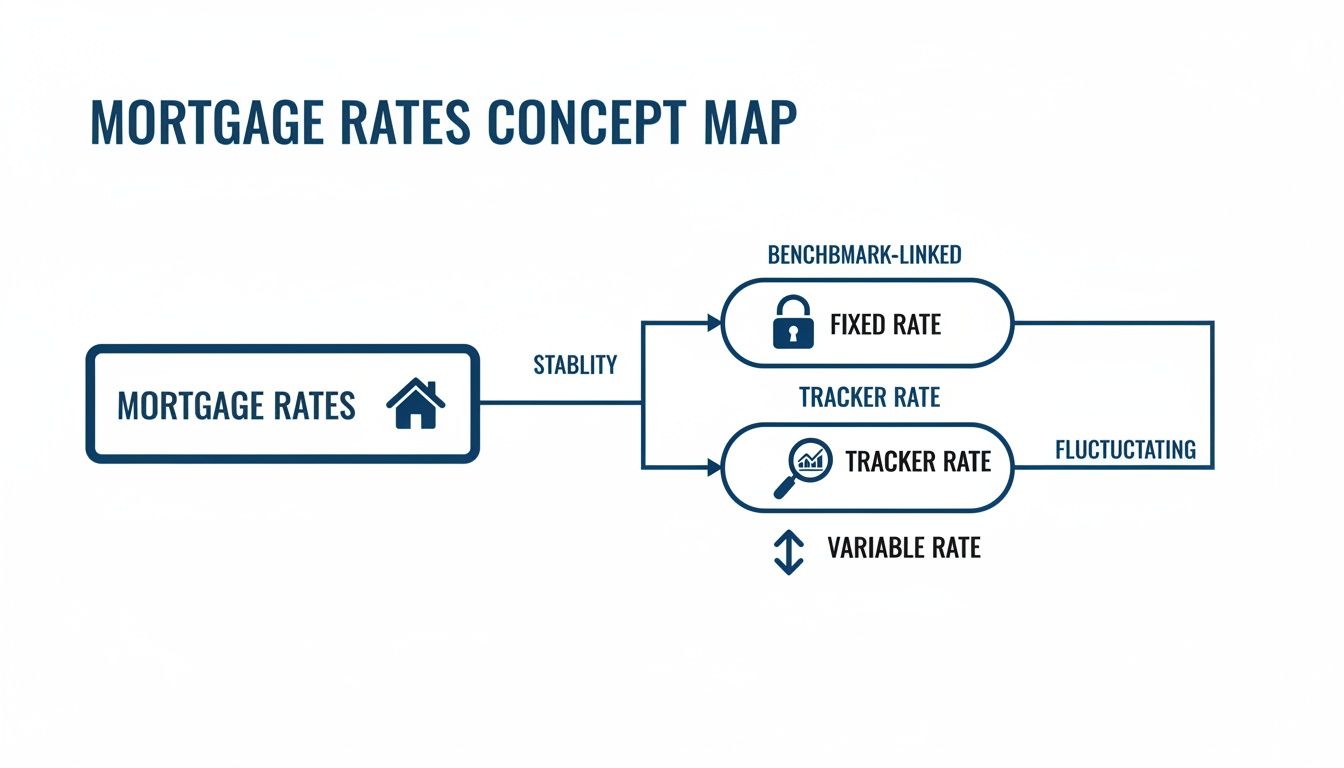
The map clearly illustrates the fundamental choice between the stability of a fixed rate and the potential volatility of tracker and variable rates.
Passing the Lender’s Stress Test
Finally every lender will apply a “stress test” to your application known as the Interest Cover Ratio (ICR). This isn’t as intimidating as it sounds. It’s a simple calculation to make sure the expected rental income can comfortably cover the mortgage payments even if interest rates were to rise in the future.
Lenders typically require the rent to cover the mortgage interest by 125% to 145%. For example if the monthly mortgage interest payment on a property in Chelmsford is £800 a lender using a 145% ICR would need the monthly rent to be at least £1,160. This test is a critical hurdle that directly influences both the loan amount and the interest rates you’re offered.
Why Rental Yield and ICR Are Crucial For Lenders

While your personal finances certainly matter it’s the property’s profitability that really captures a lender’s attention. They need to be absolutely sure your investment can pay for itself and two key metrics give them the confidence they need: the Rental Yield and the Interest Cover Ratio (ICR).
Think of the rental yield as a quick health check on your investment’s earning potential. It’s a simple percentage that shows the annual rental income relative to the property’s value. A strong yield is a powerful signal to lenders that the property is a viable self-sustaining asset.
Calculating Your Rental Yield
Working this out is straightforward and something every landlord should do before even thinking about a mortgage application. The formula is simple:
(Annual Rental Income / Property Value) x 100 = Rental Yield (%)
Let’s say you’re eyeing a property in Chelmsford for £250,000 and expect to bring in £15,000 in rent each year. The calculation would be:
- (£15,000 / £250,000) x 100 = 6% Rental Yield
This single number gives a lender a clear immediate snapshot of the property’s financial performance. A higher yield demonstrates lower risk which can often unlock more competitive buy to let mortgage rates.
Recent market data from UK Finance highlights just how important these figures are. Despite economic headwinds the UK buy-to-let market has shown impressive resilience with average rental yields climbing to 7.26% alongside average interest rates of 5.0%. This strength meant that the average Interest Cover Ratio (ICR) hit 210% showing that rental income was covering interest payments more than twice over. You can read more about these buy-to-let market trends to get a feel for the current landscape.
The All-Important Interest Cover Ratio (ICR)
The rental yield feeds directly into the lender’s most critical stress test: the Interest Cover Ratio. The ICR is designed to ensure your rental income can cover the mortgage interest payments by a specific safety margin even if rates were to rise significantly.
Most lenders will want to see an ICR of between 125% and 145%. Crucially they calculate this using a hypothetical “stress” interest rate often around 5.5% or even higher not your actual mortgage rate. This test is non-negotiable and directly determines the maximum loan you can secure.
Let’s break it down with a practical example for a property in Colchester or Braintree:
- Property Value: £300,000
- Loan Amount (75% LTV): £225,000
- Lender’s Stress Rate: 5.5%
- Annual Interest at Stress Rate: £12,375
- Required Annual Rent (at 145% ICR): £12,375 x 1.45 = £17,943.75
If your projected rent falls short of this figure the lender will simply reduce the amount they are willing to lend until the numbers work. Getting a firm grip on both rental yield and ICR is essential for securing the finance you need to grow your portfolio.
Understanding The True Cost Beyond The Headline Rate

The advertised interest rate is the headline act but it rarely tells the whole story. It’s easy to be drawn in by a low number but lenders are masters at balancing their offers. A temptingly low rate often comes with a sting in the tail: a substantial product fee.
This trade-off is a classic hot potato in buy-to-let pricing and failing to analyse it properly can turn what looks like a great deal into a costly mistake.
For landlords across Essex from Chelmsford to Colchester understanding this dynamic is essential for protecting your profit margins. An attractive low rate might seem like the obvious choice but once you add a hefty arrangement fee the total cost over the initial fixed term could be significantly higher than a product with a slightly higher rate and a lower fee.
The only way to make a true like-for-like comparison is to look past the headline numbers and calculate the total financial commitment over the initial two- or five-year period.
Comparing Two Mortgage Offers
Let’s break this down with a practical example. Imagine we’re comparing two hypothetical mortgage offers for a £200,000 loan. This is the kind of analysis any savvy property investor needs to do to secure the best buy-to-let mortgage rates.
Offer A: Low Rate, High Fee
- Interest Rate: 4.5% (2-year fix)
- Product Fee: £2,999
- Monthly Payment: £750
- Total Cost Over 2 Years: (£750 x 24) + £2,999 = £20,999
Offer B: Higher Rate, Low Fee
- Interest Rate: 4.8% (2-year fix)
- Product Fee: £499
- Monthly Payment: £800
- Total Cost Over 2 Years: (£800 x 24) + £499 = £19,699
As you can see Offer B with the higher interest rate is actually £1,300 cheaper over the two-year term. This simple calculation shows exactly why focusing only on the interest rate can be so misleading. You can use our handy mortgage calculators to run these numbers for your own situation.
Accounting for All Associated Costs
Beyond the rate and product fee several other costs contribute to the total expense of securing your mortgage. It’s important to budget for these right from the outset.
- Valuation Fees: The lender needs to value the property to confirm it provides adequate security for the loan.
- Legal Fees: You’ll need a solicitor to handle the conveyancing and all the legal paperwork.
- Broker Fees: An expert broker can save you thousands by finding the best deal but their fee needs to be factored in.
Historically buy-to-let rates have carried a risk premium over residential mortgages and this trend has continued due to recent base rate changes. This premium just reinforces the need for expert guidance to navigate the market properly.
To get a comprehensive view of your investment’s financial health far beyond just the mortgage rate a specialised buy-to-let investment calculator can be an indispensable tool.
Unlock Better Rates With An Expert Mortgage Broker
Trying to navigate the buy-to-let mortgage market on your own can feel like a maze especially with lender criteria shifting all the time. An independent whole-of-market mortgage broker isn’t just a helper; they’re your single greatest advantage in securing the most competitive buy-to-let mortgage rates out there.
At EHF Mortgages we bring over 35 years of hard-won experience to the table serving property investors across Chelmsford Braintree and Colchester. Our deep-rooted knowledge of the Essex property market gives our clients a real tangible edge.
Access To Exclusive Deals
Our position as a whole-of-market broker means we aren’t tied to just the big high-street banks. We have strong relationships with specialist lenders too. This opens up a much wider range of products allowing us to find competitive deals that simply aren’t available to the general public.
Every client gets a bespoke approach from us. It doesn’t matter if you’re a first-time landlord a seasoned portfolio investor self-employed or have a tricky credit history, we’re here to find a solution that genuinely aligns with your investment goals.
An expert broker does more than just find you a low rate. We look at the total cost of borrowing manage the entire application from start to finish and handle the tricky negotiations with lenders. This leaves you free to focus on your investment strategy.
Expert Guidance For Your Unique Situation
The buy-to-let landscape is certainly not a one-size-fits-all world. Different lenders have different appetites for risk and wildly different criteria for things like property type and an applicant’s personal circumstances. Our job is to match your unique situation to the lender most likely to say “yes” and offer you favourable terms.
This tailored guidance is absolutely invaluable for investors with specific needs such as:
- Portfolio Landlords who need a lender with specialist underwriters capable of assessing an entire property collection.
- Self-Employed Applicants who need a lender that can get to grips with complex or fluctuating income structures.
- Investors with Adverse Credit who need access to lenders that specialise in non-standard cases and look beyond the credit score.
We take care of the complexities and the mountain of paperwork making sure your application is presented in the best possible light to give it the highest chance of success.
Your Buy-To-Let Mortgage Questions Answered
As experienced brokers in Chelmsford Braintree and Colchester we hear a lot of the same questions from landlords. Here are clear straightforward answers to the most common queries designed to give you the confidence to move forward with your investment plans.
What Is The Minimum Deposit For A Buy-To-Let Mortgage?
As a rule of thumb the absolute minimum deposit you’ll need is 25% of the property’s value. In mortgage speak this is known as a 75% Loan-to-Value (LTV).
However the real magic happens when you can stretch that a bit further. Putting down a larger deposit, say 30% or more, doesn’t just look good on paper. It often opens the door to the most competitive buy-to-let mortgage rates and gives you a much wider pool of lenders to choose from. A lower LTV simply means less risk for the lender which makes your application far more appealing.
Can I Get An Interest-Only Buy-To-Let Mortgage?
Yes and in fact interest-only is the standard way most buy-to-let mortgages are set up. This approach is popular for a simple reason: it keeps your monthly outgoings lower which is fantastic for maximising the property’s monthly cash flow and boosting your rental profit.
The catch is that you’re not paying down the loan itself. The capital is typically repaid in one lump sum at the very end of the mortgage term often by selling the property or by using funds from another investment to clear the balance.
Deciding between interest-only and a capital repayment mortgage is a key strategic move. Interest-only is all about boosting short-term profit while a capital repayment mortgage is focused on building equity over the long run.
How Does My Property Portfolio Affect My Application?
Once you own four or more mortgaged rental properties lenders start seeing you as a “portfolio landlord” and the application process gets a bit more involved. The scrutiny increases because lenders aren’t just looking at the single property you’re financing; they’re assessing the profitability and risk profile of your entire portfolio.
This added layer of complexity is exactly why getting professional guidance from an experienced broker is no longer a ‘nice-to-have’, it’s essential. We can help navigate the specialised underwriting process to ensure everything runs smoothly and you secure the best possible terms.
Ready to take your property investment goals to the next level with the right financial backing?
Our expert team is here to help you secure the funding you need starting with a free no-obligation consultation.
Let us handle the details so you can focus on what you do best. Visit our Contact Us page to get started today.





