
You’ve got spare cash left after the bills, and your mortgage is probably the first place you’re tempted to send it.
💡 Top tip: overpay only after you’ve protected your household’s cash resilience, and stay within your mortgage’s fee-free allowance. I’ll explain the savings, the UK rules, the remortgage timing issues and the situations where keeping the money back is the smarter move.
If you’re a homeowner in Chelmsford, Braintree, Colchester or elsewhere in Essex, this isn’t a simple “pay debt as fast as possible” decision. Your mortgage rate, fixed-rate end date, early repayment charge, emergency savings and future plans all matter.
Why Spare Cash and Your Mortgage Deserve a Proper Conversation
You may recognise the situation. You may have roughly £250 left each month after bills, food, transport, and ordinary spending. Your fixed deal ends in 2026, and you’ve started wondering whether to send a lump sum to the lender before the new rate arrives.
That instinct is understandable, but don’t treat overpaying as an automatic win. The same spare cash could shorten the mortgage, strengthen an emergency fund, stay available in an offset account, or be directed toward another financial priority. Once money has reduced your mortgage balance, getting it back usually isn’t straightforward.
The first question, then, isn’t “How much interest can I save?” It’s “Can my household afford to lose access to this cash?”
Top tip: Overpaying is powerful inside the permitted allowance, but it shouldn’t come before basic financial resilience.
UK mortgage guidance commonly defines an overpayment as money paid above the contractual amount. That extra payment reduces the outstanding balance sooner, which can shorten the term and lower the total interest charged. The FCA’s mortgage guidance also requires lenders to disclose whether a regulated mortgage permits overpayments, so your mortgage offer and annual statement should provide the starting point.
Before deciding, check four things:
Your product type: A fixed, tracker, discounted or variable mortgage may have different rules.
Your allowance: Many UK fixed-rate mortgages permit up to 10% of the outstanding balance each year without an early repayment charge, although the exact limit depends on the lender and product. (FCA guidance)
Your cash buffer: Spare money may be more valuable in an accessible account if your income or expenses could change.
Your next mortgage date: A fixed-rate expiry or product transfer can make timing more important than the payment itself.
If you’re unsure whether the decision fits your wider finances, understanding whether you need a mortgage adviser can help you assess the mortgage alongside remortgaging and affordability rather than viewing it in isolation. Later, we’ll look at worked savings examples, decode early repayment charges and challenge the assumption that overpaying is always the right answer.
What Overpaying a Mortgage Actually Means
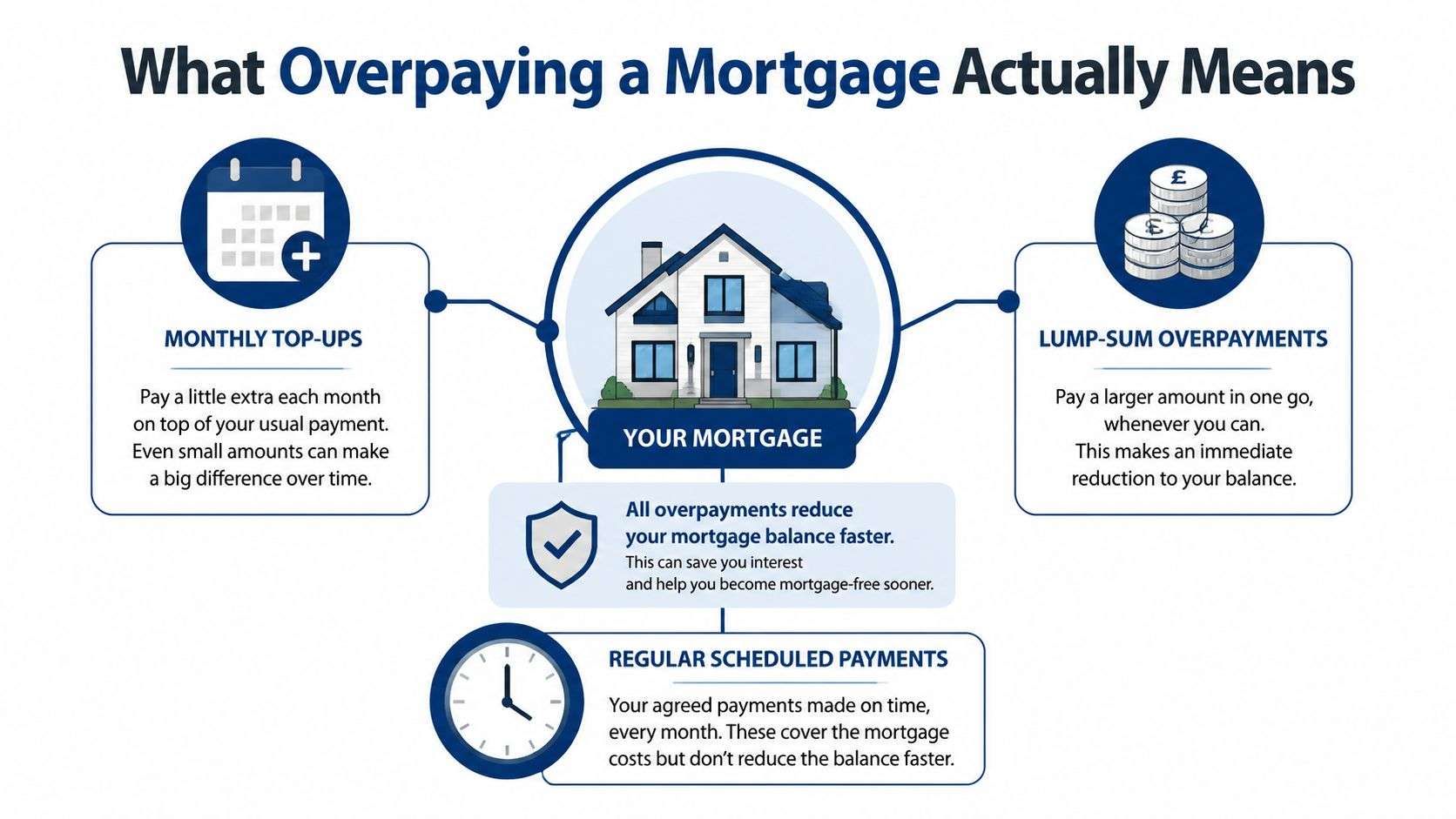
A mortgage overpayment is any payment made to your lender above the required monthly instalment. It can take several forms, and the distinction matters because lenders process each type differently.
Monthly top-ups and lump sums
A monthly top-up adds a chosen amount to every scheduled payment. For example, you might pay an additional amount each month from your regular income. This steadily reduces the capital balance and can help you finish the mortgage earlier.
A lump-sum overpayment is a one-off payment, perhaps from a bonus, inheritance or savings. It reduces the balance immediately, so future interest is calculated on less debt. You’ll still need to confirm that the lender applies the money to the capital rather than treating it as an advance payment of future instalments.
Some products also allow regular scheduled overpayments to be built into the mortgage arrangement. That isn’t the same as an informal payment holiday or payment break. A break may pause scheduled payments under agreed conditions, while an overpayment sends extra money towards reducing the debt.
Why the timing changes the result
Repayment mortgages use amortisation, meaning each payment is divided between interest and capital. At the start, the balance is larger, so the interest calculation has a larger base. An early overpayment attacks that balance while there’s still a long period during which future interest could otherwise accrue.
An overpayment later in the term can still reduce the debt, but the interest savings are usually smaller because you’ve already paid much of the scheduled interest. Overpaying also isn’t the same as changing to a shorter contractual term. The former gives you flexibility, while the latter normally recalculates the required monthly payment.
For a straightforward explanation of how capital and interest interact, read this guide to how a repayment mortgage works. For a broader debt-reduction perspective, this resource explains ways to save thousands on mortgage interest, although your lender’s terms remain the authority.
The practical distinction: An overpayment reduces the balance. A payment break generally gives you temporary breathing space, but it doesn’t provide the same debt-reduction benefit.
The Real Numbers Behind the Benefits of Overpaying a Mortgage
The mathematics can be persuasive, but it should be used as a decision tool, not a sales pitch. The effect depends on the mortgage rate, original balance, remaining term, payment timing and whether the lender recalculates the term or monthly payment after an overpayment.
The following illustration uses a £220,000, 25-year capital and repayment mortgage at 5.5%. The figures are illustrative examples requested for comparison, not a personalised quotation.
| Strategy | Extra paid | Term cut | Interest saved |
|---|---|---|---|
| £200 monthly from day one | £200 a month | Around 4 years 9 months | Around £33,000 |
| £10,000 lump sum in year three | £10,000 once | Around 2 years | About £7,000 |
| £200 monthly from year 20 | £200 a month | Not specified | Under £4,000 |
The pattern is more important than the exact illustration. Earlier payments usually have more time to reduce future interest, while the same cash committed much later has less opportunity to change the overall cost.
Published UK examples also show how even smaller regular payments can matter. Santander’s examples for a £200,000 mortgage over 25 years state that a £100 monthly overpayment could save £9,948 in interest and shorten the term by 3 years. The same examples state that a £10 monthly overpayment could save £1,146 and reduce the term by 4 months. (Santander examples)
The Which? coverage provides further illustrations. It reported that an extra £90 a month on a £200,000 mortgage could cut around three years from the term and save more than £16,800 in interest. It also stated that a £5,000 lump sum on a £100,000 mortgage with 15 years remaining could save £3,866 and shorten the term by 13 months. (Which? mortgage overpayment examples)
Use a reputable overpayment calculator to model your own balance and rate. You can also review strategies with Senki for a wider discussion of early repayment choices. Don’t rely on a headline result without checking your lender’s recalculation method, allowance and charges.
UK Rules That Decide Whether Overpaying Saves or Costs You Money
The biggest mistake borrowers make is paying first and checking the mortgage terms afterwards. That order can turn a useful interest-saving strategy into an expensive charge.
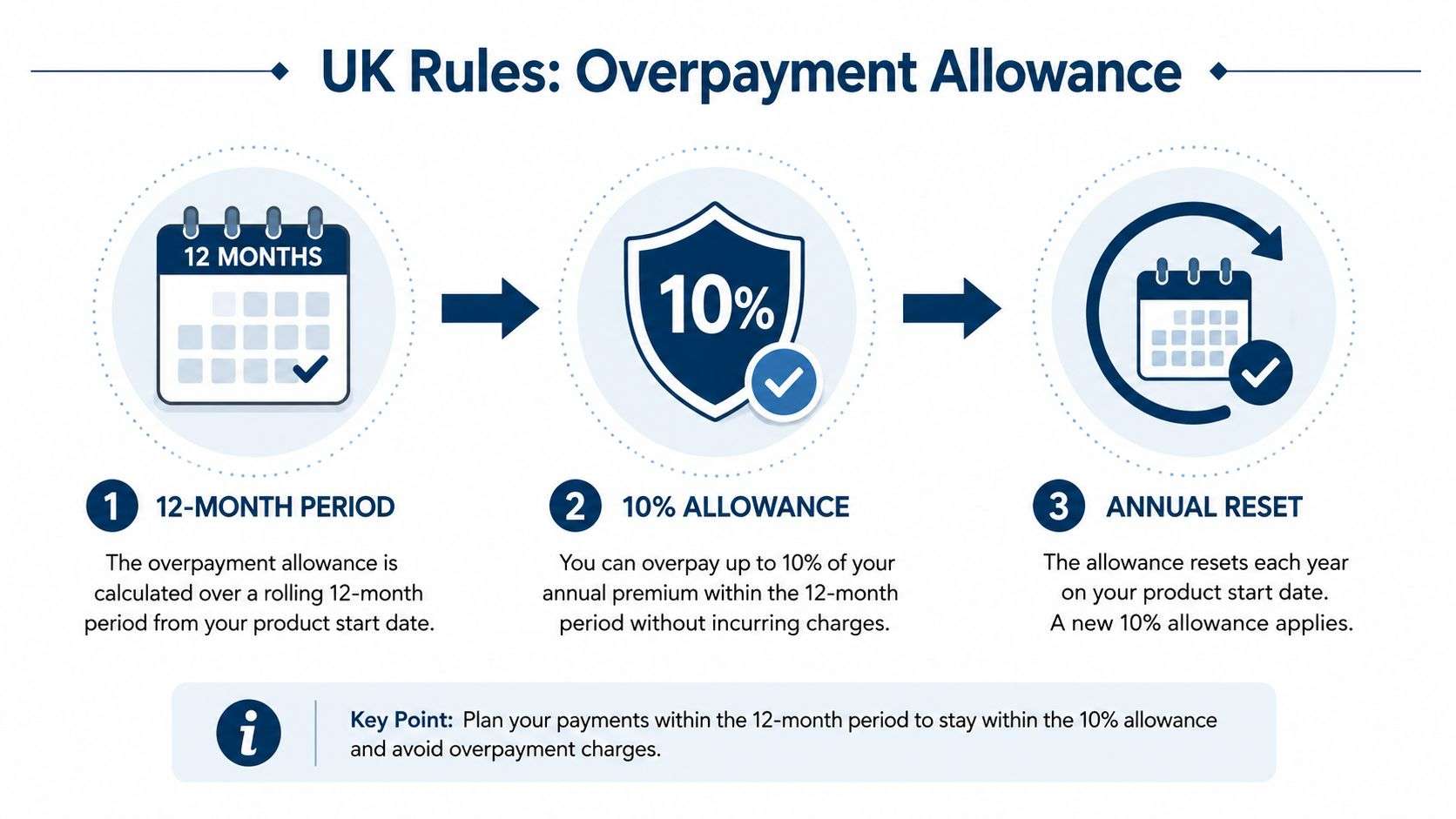
Many UK fixed-rate mortgages allow you to overpay up to 10% of the outstanding balance each year without an early repayment charge, although the exact allowance varies by lender and product. (FCA guidance) The allowance commonly resets every 12 months, but don’t assume that means the calendar year. Your lender may measure it from the product start date or another date stated in the mortgage conditions.
Check the allowance before sending money
Look for:
The permitted annual percentage or cash amount.
Whether it’s based on the original balance or outstanding balance.
The date on which the allowance resets.
Whether unused allowance expires rather than carrying forward.
Whether a lump sum and regular overpayments are counted together.
Santander states that unused annual allowances don’t carry forward. (NatWest overpayment tool and guidance) That makes timing important. An unused allowance may disappear at the reset date, while an overpayment above the limit could attract an ERC.
Early repayment charges are generally triggered when you repay beyond the permitted allowance or redeem the mortgage early. UK consumer guidance commonly describes ERCs as ranging from 1% to 5% of the outstanding balance, depending on the product and circumstances. (Telegraph mortgage guidance) The charge can outweigh the interest saved, particularly when you’re near a product transfer or remortgage.
Practical rule: Ask the lender for a written redemption and overpayment figure before making a large payment. Don’t rely on an assumption based on another bank’s terms.
A product transfer can create another timing trap. Paying shortly before the new deal starts may still be treated under the outgoing product, so an ERC could apply even if the new mortgage would have allowed the payment. If you’re considering whether you can remortgage early, check the current deal’s end date and charge schedule first.
Some mortgages offer redraw facilities, allowing you to access previous overpayments. That feature isn’t the same as keeping cash in your bank account, and withdrawals may count against future allowance or be subject to conditions. An offset mortgage keeps savings alongside the mortgage, with interest charged on the net balance while the funds remain accessible. Retirement interest-only and lifetime mortgage products require particular care because their overpayment provisions can differ sharply, and some may not permit voluntary reductions in the way a standard repayment mortgage does.

Overpaying Against Other Smart Uses of Spare Cash
Mortgage overpayments offer certainty, but certainty isn’t the only measure of a good financial decision. Spare cash has several competing jobs, and the right choice depends on which weakness in your finances needs attention first.
An emergency fund protects your ability to keep paying the mortgage when income falls, or expenses rise. Money held in an accessible account won’t reduce interest as directly as an overpayment, but it can help you handle redundancy, illness, urgent repairs or a future payment shock without taking expensive credit.
Pension contributions deserve separate consideration because tax relief can improve a contribution’s immediate value. A workplace pension may also include employer contributions, so reducing your contribution to overpay the mortgage could mean giving up valuable benefits. The rules depend on your scheme, earnings and tax position, so this is an area for regulated financial advice rather than a mortgage-only calculation.
Investing through a Stocks & Shares ISA or general investment account offers growth potential, but values can fall and access needs to match your time horizon. A mortgage overpayment provides a guaranteed saving linked to the interest you would otherwise have paid, whereas investments carry market risk and may be taxable outside tax-efficient wrappers.
| Option | Effective return/tax treatment | Access to funds | Best suited to |
|---|---|---|---|
| Mortgage overpayment | Guaranteed saving linked to the mortgage rate, subject to charges | Limited once paid | Borrowers prioritising certainty and debt reduction |
| Stocks & Shares ISA | Investment growth potential within ISA rules | Accessible, but value can fall | Investors with capacity for market risk |
| General investment account | Investment growth may involve tax and charges | Accessible, with investment risk | Investors using available tax allowances |
| Pension contribution | Tax relief may apply, with access restricted by pension rules | Restricted compared with cash | Long-term retirement planning |
| Emergency fund | Interest may be taxable depending on the account and allowance | High access | Households needing resilience against shocks |
The order matters. I’d normally prioritise expensive unsecured debt and a workable emergency reserve before voluntary mortgage reduction. Once those foundations are in place, compare the mortgage rate with your pension position, tax band, job stability and attitude to investment risk.
A mortgage overpayment is financially attractive only when it doesn’t leave you exposed elsewhere.
Overpayments Across Buy-to-Let, Remortgage and Later-Life Lending
The benefits of overpaying mortgage debt change with the purpose of the borrowing. A landlord, a residential homeowner approaching a fixed-rate expiry and a later-life borrower may all have spare cash, but they shouldn’t use it in the same way.
Consider a Braintree landlord with a tracker buy-to-let mortgage. Reducing the balance can improve the loan-to-value position before remortgaging and reduce the interest burden against rental income. That may support the property’s longer-term cash flow, but the landlord also needs accessible money for void periods, maintenance and unexpected compliance costs.
Buy-to-let products can contain restrictive overpayment conditions. Before making a lump sum, check the lender’s allowance, ERC schedule and whether the payment could affect a planned refinance. Guidance on buy-to-let mortgages should sit alongside a property-level cash-flow assessment, not replace it.
A Colchester family nearing the end of a two-year fixed deal may take a different approach. Strategic overpayments during the early years can reduce the balance enough to reach a lower loan-to-value bracket at remortgage. Moving into a 75% or 60% LTV bracket can sometimes improve the available rate, with broker illustrations citing possible reductions of 0.3% to 0.6% and potential savings worth thousands over the following deal. Those figures aren’t guaranteed, so the borrower must compare the savings with any ERC and the value of keeping cash available.
Later-life borrowing is more specialised. A retirement interest-only mortgage may permit voluntary capital repayments under its terms, while a lifetime mortgage will often have different restrictions. Some products may not allow the kind of lump-sum reduction available on a standard repayment mortgage, so check the legal offer and lender illustration before acting.
When Overpaying Is the Wrong Move and What to Do Instead
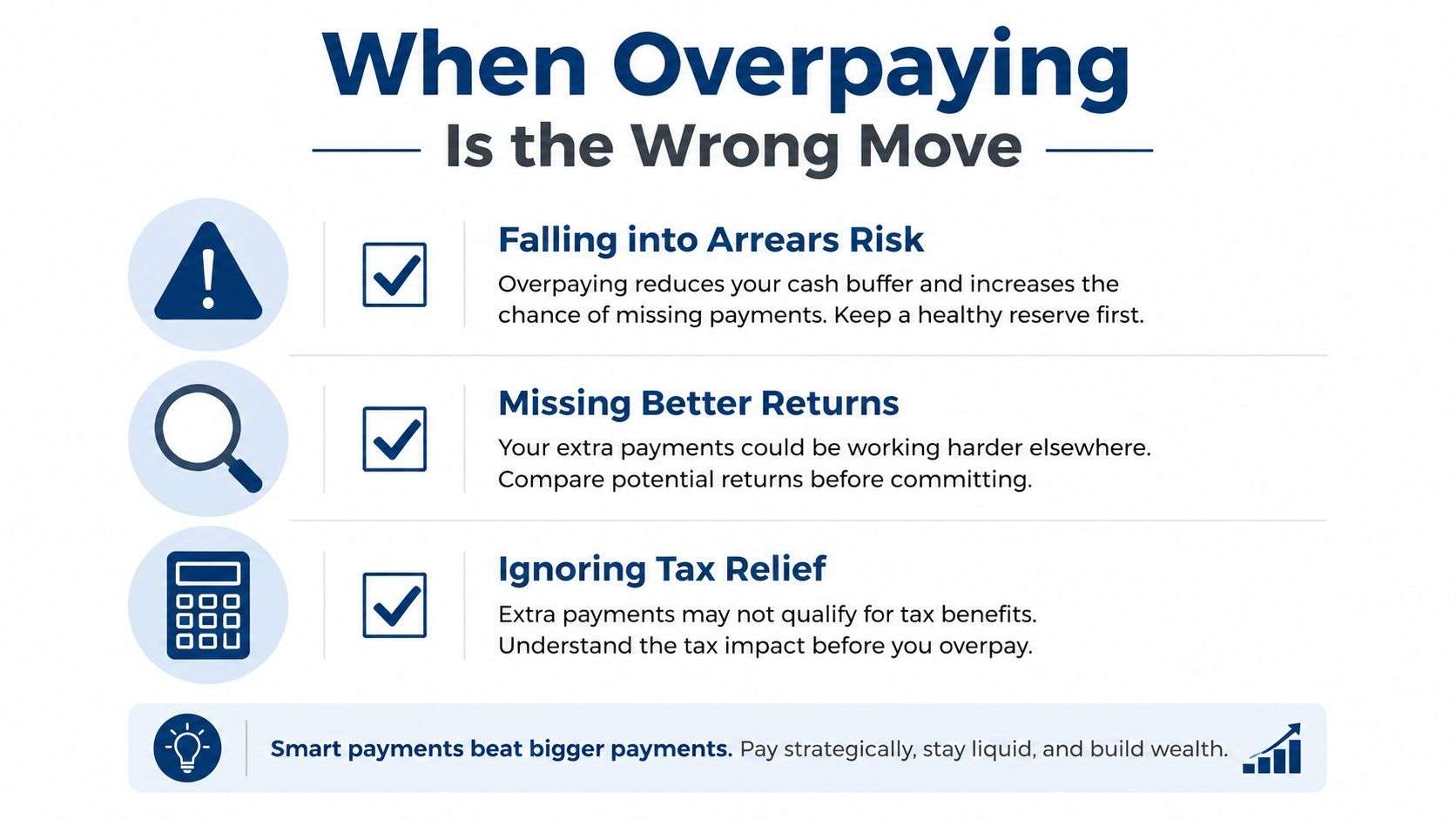
Putting every spare pound into the mortgage can leave your household fragile. You may reduce the balance while leaving yourself unable to manage a broken boiler, a period without work or a higher payment when the fixed deal ends.
UK Finance reported that around 2.5% of the outstanding mortgage balance was in arrears in Q1 2025. (UK Finance Household Finance Review) That figure reminds us that payment resilience matters. A mathematically attractive overpayment is a poor decision if it leaves you closer to arrears after an ordinary financial setback.
Overpay when the foundations are sound
Overpaying is more compelling when:
Your mortgage is competitively priced: The savings from reducing the balance is meaningful relative to alternatives.
Your emergency reserve is established: You can cover a period of essential spending without borrowing.
Your pension contributions receive the available employer match: You’re not sacrificing an immediate workplace benefit.
You’ve cleared high-interest debt: Credit cards and expensive unsecured borrowing usually need attention first.
Your allowance is available: The lender confirms the payment won’t trigger an avoidable charge.
Keep the cash when flexibility matters more
Pause the overpayment if your emergency fund is thin, your fixed deal ends within the next year or an ERC applies. You may also prefer to wait if rates are moving down and you expect a better opportunity to reduce the balance without a charge.
An offset mortgage can provide a middle route by keeping savings accessible while reducing the balance used for interest calculations. Read more about what an offset mortgage is in the UK before assuming a conventional overpayment is your only option.
Use this simple test: Would you still feel financially secure if the payment left your account today? If the answer is no, keep the money accessible and review the mortgage strategy around the next ERC-free window.
Your Next Steps and How EHF Mortgages Can Help
Start with the paperwork, not the transfer screen. Download your latest mortgage statement and identify the product type, outstanding balance, remaining term, fixed-rate end date and overpayment allowance already used during the current allowance period.
Then run the numbers through a mortgage overpayment calculator. Test the same monthly amount as a lump sum, a regular payment and a cash reserve. Compare the mortgage saving with the possible effect of a pension contribution or investment, remembering that investments can fall and pension access is restricted by its rules.
If the numbers favour overpaying, contact the lender before making the payment. Ask how to ensure it reduces the capital balance rather than prepaying future instalments, and request confirmation of any remaining allowance and potential ERC.
Approaching a remortgage, product transfer, buy-to-let refinance, or later-life application makes the decision more involved. EHF Mortgages can assess the overpayment against the timing of a new deal, available mortgage options, and alternative uses of your capital. The firm provides whole-of-market mortgage advice from Chelmsford across residential, buy-to-let, specialist and later-life lending, so the recommendation can account for both pounds saved and household resilience.
Take your statement, current rate, fixed-rate end date and proposed overpayment amount to an adviser. That gives you a practical basis for deciding whether to pay down the mortgage now, wait for the charge-free window, retain an accessible reserve or restructure the borrowing.
EHF Mortgages can help you compare mortgage overpayments with remortgaging, product transfers and alternative uses of spare cash. If you’re based in Chelmsford, Braintree, Colchester or elsewhere in Essex, contact EHF Mortgages for whole-of-market advice customised to your mortgage terms and financial resilience.





