Top Tip: When lenders look at your buy-to-let mortgage application, their main focus is the property’s potential rental income, not just your personal salary.
We’ll break down exactly how this works a little later on.
A buy-to-let (BTL) mortgage isn’t just a regular home loan with a different name. It’s a specific financial product designed to help you buy a property you intend to rent out to tenants. Because the property is treated as a business asset rather than your own home, the rules of the game are completely different.
Your Essential Guide to Buy-To-Let Mortgages in 2026
This guide is your roadmap to financing a rental property. We’ll walk you through everything you need to know, from the basic concepts and eligibility hurdles to the hidden costs and legal duties that come with being a landlord.
Whether you’re dipping your toes in the water as a first-time landlord in Chelmsford or you’re a seasoned investor looking to expand your portfolio in Colchester, this article will give you the clarity to move forward with confidence. Our goal is simple: to help you turn your property ambitions into a successful, profitable venture.
“Understanding the fundamentals of buy-to-let mortgages is the first step towards building a successful property portfolio. It’s not just about securing a loan; it’s about structuring a sustainable business.”
What You Will Learn in This Guide
To help you find what you’re looking for, here’s a quick breakdown of what this article covers. Each section builds on the last, explaining the key parts of securing and managing a buy-to-let mortgage.
- How a Buy-To-Let Mortgage Really Works
- Meeting the Lender’s Eligibility Criteria
- Understanding the True Costs of Being a Landlord
- Your Step-by-Step Buy-To-Let Mortgage Application
- Taking Your Next Steps in Property Investment
- Frequently Asked Questions About Buy-To-Let Mortgages
Becoming a landlord is a major financial commitment, with both risks and rewards. The UK rental market, especially in high-demand areas across Essex, still offers great opportunities for investors who do their homework. But the lending landscape is far more complex and the criteria much stricter than for residential loans.
This is because lenders see BTL properties as a higher risk. Their biggest concern is whether your future rental income will be enough to cover the mortgage payments, even if the property is empty for a few months. Later in the guide, we’ll explain how lenders use stress tests and rental calculations to make their decisions.
From the larger deposit requirements, typically 25% or more, to getting your head around the tax implications, being well-informed is non-negotiable. This guide will give you the solid foundation you need for the journey ahead.
Ready to explore your options and see how a buy-to-let mortgage could work for you? Our expert team is here to help you navigate every stage. Get in touch by visiting our Contact Us page for a no-obligation chat.
How a Buy To Let Mortgage Really Works
Think of a standard residential mortgage like buying your family car; it’s for your own use, and the lender cares most about whether your salary can cover the repayments. A buy-to-let mortgage, on the other hand, is like buying a taxi. It’s a commercial asset designed to generate an income, and that fundamental difference changes everything.
For a buy-to-let property, lenders shift their focus from your personal earnings to the investment’s profitability. It’s less about you and more about the property’s potential to pay for itself. This is where the core mechanics of a BTL mortgage really kick in.
The diagram below illustrates this relationship clearly: the loan is used to acquire the rental property, which in turn generates a steady income stream.
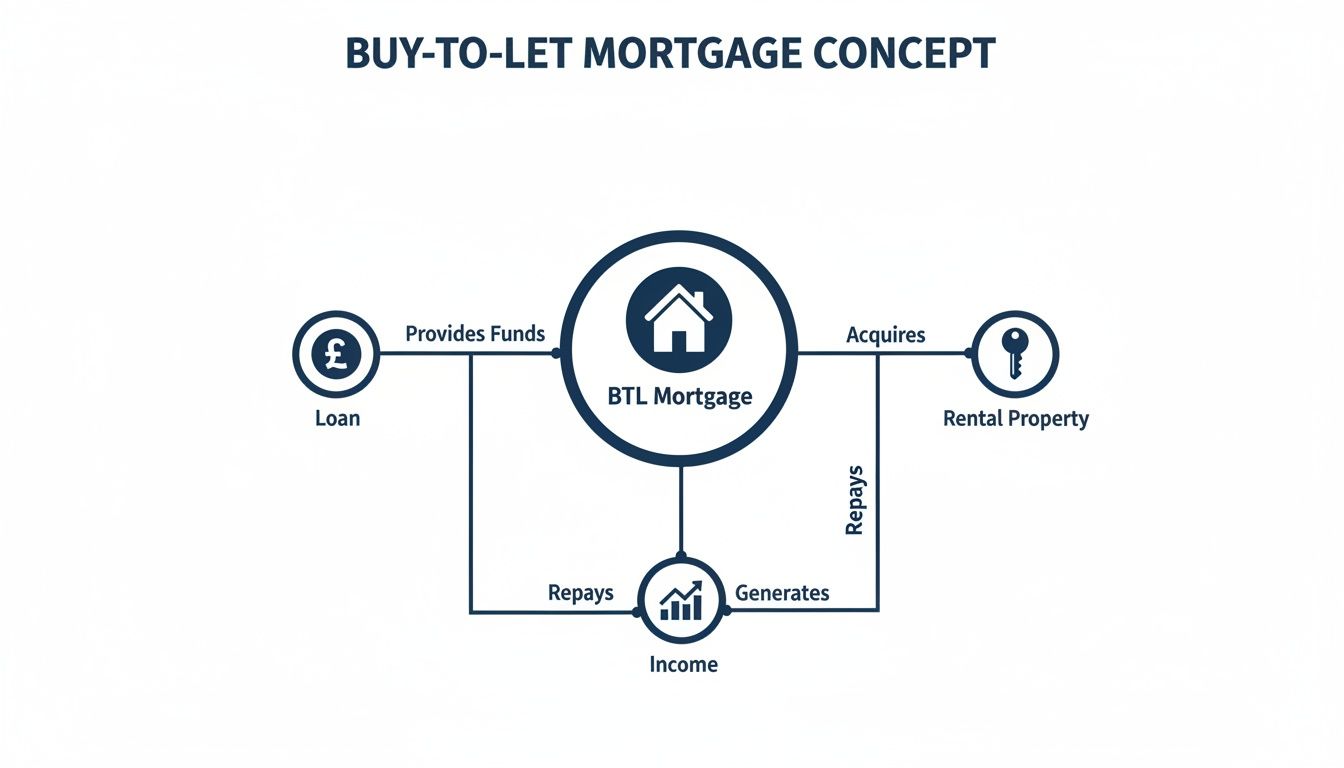
At its heart, a BTL mortgage is a business transaction. The property’s performance is the real key to success.
Rental Calculations and Stress Tests
So, how do lenders measure a property’s potential? They use two main tools: the Interest Cover Ratio (ICR) and a rental stress test. The ICR is a straightforward calculation to ensure the expected rental income covers the mortgage interest payments, with a bit left over for safety.
Typically, lenders want to see the monthly rent cover between 125% and 145% of the mortgage payment.
The stress test takes things a step further. Lenders won’t just calculate affordability at today’s interest rate. They’ll run the numbers at a much higher hypothetical rate, often around 5.5% or higher, to ensure the investment can still stand on its own if rates climb in the future.
“The lender’s logic is straightforward: a successful rental property should be able to pay for itself, with a buffer for safety, regardless of minor market fluctuations.”
This cautious approach is exactly why BTL mortgages often come with higher interest rates and require larger deposits than your standard home loan. Lenders see them as a bigger risk, so they build in more protection for themselves.
The market for these products is huge and constantly changing. For example, while average BTL rates are currently around 5.01%, there are now over 4,500 different products to choose from. This gives landlords in places like Chelmsford an incredible amount of choice. Investors with larger deposits often get access to the most competitive rates, especially as higher interest cover ratios mean rental income covers mortgage payments more comfortably. You can dive deeper into the latest figures on our guide to current buy-to-let mortgage rates and trends.
Interest-Only vs Capital Repayment
Another key difference is how you repay the loan. With BTL mortgages, you generally have two choices, and each one suits a different investment strategy.
Interest-Only: With this option, your monthly payments only cover the interest on the loan. The original capital you borrowed doesn’t go down. You’ll need to repay that lump sum in full at the end of the mortgage term, usually by selling the property.
Capital Repayment: This works just like a standard residential mortgage. Each month, your payment chips away at both the interest and a small portion of the principal, gradually reducing the loan balance until it’s fully paid off.
Most landlords lean towards interest-only mortgages. Why? Because the lower monthly payments maximise their cash flow, which can be reinvested or used to cover maintenance and other property costs.
Here’s a simple breakdown to help you see the difference.
Comparing Interest-Only vs Capital Repayment Mortgages
Your choice between these two repayment types really boils down to your long-term financial goals as a landlord.
| Feature | Interest-Only | Capital Repayment |
|---|---|---|
| Monthly Payment | Lower (covers interest only) | Higher (covers interest and capital) |
| Cash Flow | Maximised for higher monthly profit | Reduced due to higher payments |
| Equity Building | Slower (relies on property value growth) | Faster (guaranteed through payments) |
| End of Term | The full loan amount must be repaid | The loan is fully paid off |
| Main Goal | Maximising rental income | Owning the asset outright |
Ultimately, you need to decide what matters more to you. Are you chasing strong monthly income, or is your focus on building a debt-free asset for the future? Answering that question is one of the most important first steps.
Getting these core mechanics right is essential for any aspiring landlord. With this foundation, you can start to build a clear and profitable investment strategy.
Ready to find out what rental income you might need for a property in Braintree or Colchester? Our team can run the numbers for you. Reach out via our Contact Us page for personalised advice.
Meeting the Lender’s Eligibility Criteria
Getting a buy-to-let mortgage isn’t quite like applying for your own home loan. It’s much more like pitching a business idea for funding. Lenders aren’t just looking at the property’s potential; they need to be completely confident in you as a reliable investor. That means you’ll need to clear a specific set of hurdles they’ve put in place to minimise their risk.
With a standard residential mortgage, your salary is the main event. For a buy-to-let, the property’s rental income takes centre stage. However, your personal financial stability is the crucial backdrop that makes the whole picture work for the lender.
Core Personal Requirements
Before a lender even glances at the property details, they’ll want to know who they’re dealing with. Most have a clear checklist of minimum criteria you must meet to be considered a credible borrower.
Key eligibility factors usually include:
Minimum Age: Most lenders set the minimum age at 25, though some may consider applicants as young as 21.
Minimum Personal Income: You’ll typically need to show a personal income of around £25,000 per year, completely separate from any future rental profits. This proves you have a financial cushion outside of the investment.
Homeowner Status: Many lenders prefer you to already be a homeowner. It shows you’ve handled a mortgage before and understand the responsibilities that come with owning a property.
These rules are there for a reason. They give lenders the confidence that you can manage the financial pressures of being a landlord, even during void periods when the property is empty. If your situation is a bit more complex, perhaps you’re self-employed or have a minor blip on your credit file, a specialist broker becomes essential for finding lenders with more flexible criteria.
The All-Important Deposit and LTV
For most aspiring landlords, the biggest hurdle is saving the deposit. Lenders see buy-to-let as a higher-risk venture, so they demand a much larger down payment than for a residential purchase. This is all measured by the Loan-to-Value (LTV) ratio.
While you might get a residential mortgage with a 10% deposit (90% LTV), for a buy-to-let property, you’ll almost always need at least a 25% deposit, giving you a 75% LTV. Want to unlock the most competitive interest rates? Many lenders will expect you to put down at least 40% (a 60% LTV). You can find out more in our guide on how much deposit is required on a buy-to-let property.
“A larger deposit directly reduces the lender’s risk, which is why it unlocks better rates. It’s a clear signal to them that you are a serious, well-capitalised investor.”
For investors looking at property here in Essex, local house prices have a huge impact. A 25% deposit on a property in a town like Braintree will be a very different number to one in a more expensive area, so it’s vital to do your sums based on where you plan to buy.
Credit History and Financial Health
Finally, be prepared for your credit history to go under the microscope. Lenders need to see a solid track record of responsible borrowing, with no recent defaults or County Court Judgements (CCJs). For most high-street lenders, a strong credit score is non-negotiable.
This requirement is set against a very active lending market. Recent Bank of England statistics show that gross mortgage advances rocketed by 36.9% quarter-on-quarter to £80.4 billion, demonstrating strong investor appetite. While this figure covers all residential lending, buy-to-let is a huge part of this growth, making it a competitive space where a clean credit history helps you stand out.
Ready to see if you meet the criteria for a buy-to-let mortgage? Our experienced advisers can assess your situation and find lenders who are the right fit for your circumstances. Contact us today via our Contact Us page for a free, no-obligation consultation.
Understanding the True Costs of Being a Landlord
A successful property investment is all about mastering the numbers. It’s a common trap to focus solely on the monthly mortgage payment, but to really know if a buy-to-let is going to be profitable, you need an honest picture of all the expenses involved. This means looking at everything, from the initial setup costs to the ongoing bills you’ll face as a landlord.
Before you even think about collecting your first month’s rent, there are several one-off costs tied to securing the mortgage itself. Getting these wrong at the start can throw your financial forecasts way off track.

Upfront Purchase and Mortgage Costs
When you’re buying an investment property, some fees are simply unavoidable. The key to a smooth transaction is being prepared from the outset.
Mortgage Arrangement Fee: This is what the lender charges for setting up your loan. You can often add it to the mortgage balance, but remember that you’ll pay interest on it for the life of the loan.
Valuation Fee: The lender needs reassurance that the property is worth what you’re paying. This fee covers a professional valuation to confirm its market value.
Legal Fees: You’ll need a solicitor or conveyancer to handle all the legal paperwork, from conducting searches to registering the property in your name.
Broker Fees: An expert mortgage broker brings invaluable guidance and whole-of-market access. Their fee covers the work they do to find and secure the best mortgage for your circumstances.
These initial expenses are a huge part of the real cost of buying a rental property. You can get a feel for how different product fees affect the overall cost of borrowing by exploring current buy-to-let mortgage rates.
The Significant Impact of Tax
For any landlord, taxes are one of the highest ongoing costs, and they can seriously eat into your profit margins. The rules are complex and have changed significantly in recent years, making professional advice more crucial than ever.
There are three main taxes you need to have on your radar:
Stamp Duty Land Tax (SDLT): When you buy an additional property in England, you’ll almost certainly have to pay a 5% SDLT surcharge on top of the standard rates. This can add thousands to your purchase cost before you’ve even started.
Income Tax: The rent you receive is taxable income. After the ‘Section 24’ changes, higher-rate taxpayers can no longer deduct their full mortgage interest costs from rental income to calculate their tax bill. Instead, you get a basic-rate tax credit, which often means a higher tax liability.
Capital Gains Tax (CGT): If you eventually sell the property for more than you paid, you’ll have to pay tax on that profit. The tax-free allowances have been shrinking, so more of your gains are now taxable.
“For a landlord, mastering taxes is as important as finding a good tenant. Ignoring it can turn a profitable investment into a financial drain.”
To navigate this financial landscape, landlords need a solid guide. A resource like A Landlord’s Guide to Buy To Let Tax can be incredibly helpful, covering everything from income tax to what you can claim as allowable expenses.
Ongoing Running Costs and Responsibilities
Beyond the mortgage and taxes, there’s a whole list of running costs that every landlord must budget for. These aren’t optional; they ensure your property is safe, legal, and well-maintained, protecting both your investment and your tenants.
| Cost Category | Description | Why It’s Essential | Estimated Cost |
|---|---|---|---|
| Landlord Insurance | Specialist cover for building, liability, and loss of rent. | Protects your asset and income. | £200 – £400+ |
| Safety Certificates | Gas safety, electrical checks (EICR), and EPC. | Legal requirement for tenant safety. | £150 – £300 |
| Maintenance & Repairs | Fund for issues like a broken boiler or a leaking roof. | Keeps property in good condition. | 1% of property value |
| Letting Agent Fees | Fees for finding tenants, managing, and collecting rent. | Reduces your workload and stress. | 8% – 15% of rent |
| Void Periods | Budget for when the property is empty. | Covers mortgage payments. | 1-2 months’ rent |
Factoring in these true costs is the only way to accurately forecast your profitability. An investment that looks fantastic on paper can look very different once you’ve accounted for every single expense.
If you’re planning a property investment in Essex and want to get the numbers right, our expert advisers are here to help. Contact us today for a clear breakdown of the costs and to plan your next steps.
Your Step-by-Step Buy-To-Let Mortgage Application
Getting your head around the mortgage application process can feel like a mammoth task, but it becomes a lot clearer once you know the steps involved. Think of this section as your roadmap, guiding you from that first chat with a broker right through to picking up the keys. Our job is to strip away the jargon and show you exactly how an experienced adviser makes each stage feel simple.
The application isn’t a single event; it’s a series of milestones. Each one is designed to give the lender a complete picture of you as a borrower and the property as an investment, moving you one step closer to becoming a landlord.

Initial Stages: From Consultation to DIP
It all starts with an initial chat with a mortgage broker. This is where we sit down and get to grips with your financial situation, what you want to achieve with your investment, and the kinds of properties you’re looking at in areas like Chelmsford or elsewhere in Essex. With that understanding, we can start hunting down the right lenders and products from the whole market.
Once we’ve got a clear strategy, it’s time to gather your documents. Lenders will want to see proof of your income, address, bank statements, and a summary of any existing debts. Getting organised here is the secret to keeping things moving. With all this in hand, we can apply for a Decision in Principle (DIP), which is basically a lender giving you the green light to borrow a certain amount, subject to final checks.
A DIP is a brilliant tool to have. It proves you’re a serious buyer and gives you the confidence to put in a solid offer on a property.
“The application process is about building a strong case for the lender. Every document and every step is designed to demonstrate that you are a reliable investor and the property is a sound asset.”
From Full Application to Completion
So, you’ve got your DIP, and your offer on a property has been accepted – fantastic! Now we submit the full mortgage application. This is more detailed and includes specifics about the property itself, especially the expected rental income. From here, it goes to the lender’s underwriting team, who will conduct their detailed checks and arrange a valuation survey of the property.
This is the really crucial bit, where the lender verifies every last detail. As long as the underwriting goes smoothly and the valuation stacks up, you’ll receive your formal mortgage offer. This is the legally binding document that confirms the loan. After that, it’s over to the solicitors to handle the conveyancing, exchange contracts, and finally, complete the purchase.
Knowing this process inside and out is vital, especially in a market where timing and preparation can make all the difference. Right now, the UK buy-to-let market is looking strong. In fact, rental yields are at their highest in over a decade, averaging 7.11% nationally in 2025. For anyone investing in Essex, this signals a great opportunity, particularly given forecasts for 2026 that predict steady house price growth. You can get a much deeper look at the numbers in our 2025 Market Recap & 2026 Forecast.
To give you a clearer picture, here’s a breakdown of the key stages you can expect.
Key Stages of the Buy-To-Let Mortgage Application
| Stage | Description | Key Action Required | Typical Timeline |
|---|---|---|---|
| Consultation | Discuss goals and finances with a broker. | Provide financial details. | 1-2 hours |
| Decision in Principle | Get a preliminary lending agreement. | Submit ID and income proof. | 24-48 hours |
| Full Application | Submit the formal mortgage application. | Provide property details. | 1-2 weeks |
| Underwriting & Valuation | The lender assesses the application and property. | Respond to any queries. | 2-4 weeks |
| Mortgage Offer | Receive the formal, binding loan offer. | Sign and return documents. | 1-2 weeks |
Having an expert guide you through these stages ensures nothing gets missed and gives you the best possible chance of a successful outcome.
Ready to start your buy-to-let journey? Our team can guide you every step of the way. Get in touch via our Contact Us page to book your free initial consultation.
Taking Your Next Steps in Property Investment
So, you’ve now got the essentials of buy-to-let mortgages under your belt. You know it’s a commercial loan judged on rental income, needs a bigger deposit than your own home, and comes with some serious financial and legal duties.
But with literally thousands of products out there, each with its own fiddly rules and criteria, trying to find the best deal yourself can quickly feel like you’re drowning in paperwork. This is where getting professional, whole-of-market advice transforms a stressful headache into a smart, strategic move.
Building Your Property Investment Plan
Becoming a property investor is achievable, but the right support really does make all the difference. Whether you’re a first-time landlord eyeing up properties in Essex or a seasoned investor looking to expand your portfolio, your next move should be getting advice that’s built around your specific financial situation.
A clear plan is your most valuable asset. It needs to map out your budget, the type of property you’re after, and your long-term financial goals. To really nail down your strategy, using a good return on investment calculator is a must for projecting potential earnings and making decisions with your eyes wide open. It’s what turns a vague idea into a concrete, actionable strategy.
For instance, some investors prefer to purchase properties through a limited company for the potential tax advantages. To figure out if that’s the right path for you, you can learn more about securing a limited company buy-to-let mortgage in our guide. An experienced broker can help you weigh up the pros and cons of these different pathways.
“The difference between a successful property investment and a stressful one often comes down to the quality of the advice you receive at the very beginning. A solid plan is your foundation for success.”
Why Expert Advice is Non-Negotiable
Navigating the mortgage market is about so much more than just finding the lowest interest rate. A specialist broker lives and breathes this stuff. We understand the nuances of each lender’s criteria, from their specific stress test calculations to how they view different property types in areas like Colchester.
We can help you build a clear plan for success, making sure you’re matched with a lender whose products are a perfect fit for your investment goals. Taking that first step with an expert by your side ensures your property journey starts on the strongest possible footing.
Frequently Asked Questions About Buy-To-Let Mortgages
Even when you feel you’ve got a handle on the basics, there are always those specific questions that pop up based on your own circumstances. It’s completely normal.
Here, we’ll run through some of the most common queries we get from clients looking to invest in property, especially in local hotspots like Colchester.
Can I Get a BTL Mortgage as a First-Time Buyer?
Yes, you absolutely can, but it’s fair to say it’s a tougher path. Most mainstream lenders like to see that you already own your own home. For them, it’s a sign that you have experience managing the financial commitment of a mortgage.
However, the game is changing. A growing number of specialist lenders have created products specifically for the ‘first-time buyer, first-time landlord’ market. They will, without a doubt, put your personal income and financial stability under an even stronger microscope, but the door is no longer closed. A good broker is worth their weight in gold here, as they know exactly which niche lenders to approach.
What If I Can’t Find a Tenant for My Property?
This is the big one, the risk every landlord has to plan for. A spell without a tenant and therefore no rent coming in is known as a ‘void period’, and it’s precisely why lenders are so rigorous with their affordability checks.
Those stress tests we talked about are designed to ensure the investment still works, even with potential gaps in tenancies. As a landlord, your best defence is building a solid contingency fund. Think of it as a financial safety net that can cover at least three to six months of mortgage payments and other running costs. This buffer is what protects you from falling into arrears if finding that perfect new tenant takes a bit longer than you’d hoped.
“A contingency fund isn’t just a good idea; it’s a fundamental part of responsible landlording that lenders expect you to have in place.”
How Many Buy-To-Let Mortgages Can I Have?
Technically, there’s no upper limit on how many BTL mortgages you can hold, but the rules of the game change dramatically once your portfolio starts to grow. Lenders tend to split landlords into two distinct camps:
Standard Landlord: An investor who has fewer than four mortgaged rental properties.
Portfolio Landlord: An investor who owns four or more mortgaged rental properties.
The moment you cross that line into becoming a portfolio landlord, the underwriting process becomes far more detailed and strict. Lenders won’t just look at the property you’re buying or remortgaging; they’ll want to assess the financial health of your entire portfolio. This means a much more complex application, often requiring things like business plans and detailed cash flow forecasts.
At EHF Mortgages, we provide the expert guidance you need to navigate every aspect of property investment with confidence.
Ready to turn your property investment ambitions into reality? Our team is here to provide clear, strategic advice tailored to your goals. Take the first step today by visiting our Contact Us page for a free, no-obligation consultation.