
💡 Top tip: if you’re asking do I need a mortgage advisor, the honest answer is generally yes, especially if you want to save yourself a lot of admin and avoid missing a better deal. I’ll explain why in a moment.
Many residents in Chelmsford, Braintree and Colchester start in the same place. They open a comparison site, look at a few rates, maybe speak to their bank, and assume that’s basically the market covered.
It usually isn’t.
A mortgage isn’t just about finding a headline rate. It’s about finding a lender whose rules fit your income, deposit, credit history, property type and timescale. That’s where people get caught out. The deal looks fine on screen, but the lender’s criteria say no.
Table of Contents
Do You Really Need a Mortgage Advisor
For some people, going direct to a lender can work. If you’ve got a simple employed income, a strong deposit, clean credit, and plenty of time to compare options yourself, you may feel comfortable handling it alone.
But that’s not how it feels for most borrowers.
The market is crowded, lender criteria change, and mortgage products can look similar while behaving very differently once fees, incentives and affordability are taken into account. For homeowners remortgaging or moving home, that can mean spending a lot of time researching and still not knowing if you’ve picked the right lender.
Practical rule: if your case has any complexity at all, advice usually becomes far more valuable than the fee question.
A lot of people also assume mortgage advice is a niche service. It isn’t. The UK market leans heavily on brokers. The Financial Conduct Authority reports there are over 4,000 authorised mortgage brokers in the UK, and they handle 85% of all residential mortgages, as noted in this broker market overview.
The short answer
You probably need a mortgage advisor if you want:
More choice: one bank can only show you its own products
Less risk: an advisor can steer you away from lenders likely to decline your case
Less admin: someone else handles much of the paperwork and lender chasing
Clearer advice: you get help matching the product to your situation, not just to a rate table
When people usually regret going alone
Borrowers tend to struggle when they:
Rely on headline rates: the cheapest-looking deal isn’t always the cheapest overall
Apply too quickly: a failed application can cause delay and added stress
Miss specialist lenders: some lenders are geared towards trickier cases and aren’t obvious to the public
If you’re still weighing it up, the next comparison makes the choice much clearer.
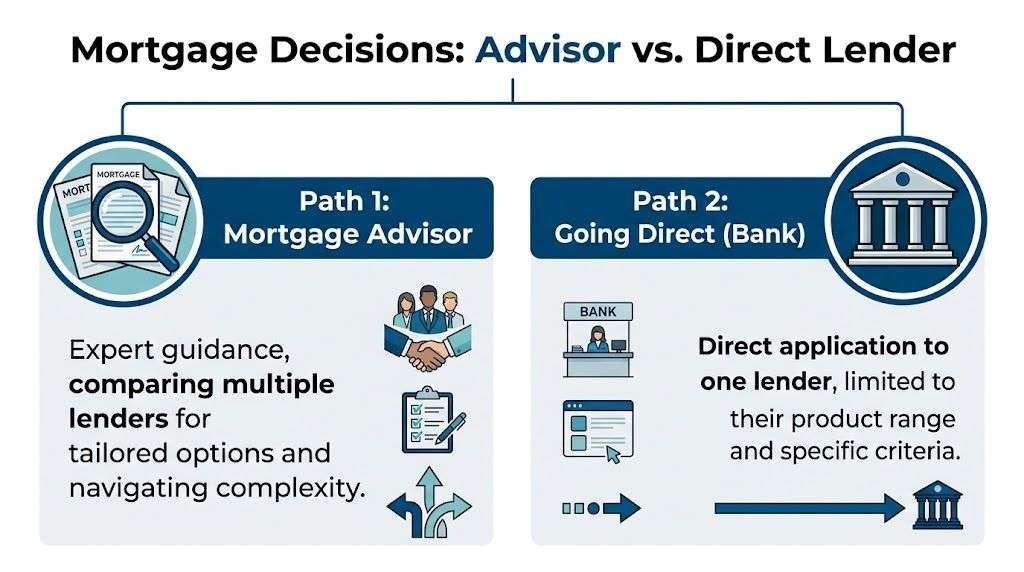
The Two Paths to a Mortgage Advisor vs Going Direct
You’ve really got two routes.
One is to walk into a bank or building society, or apply online direct. The other is to use an advisor who searches across lenders and helps place the case where it fits best.
Neither route is automatically wrong. But they aren’t equal.
Going direct feels simpler
There is a reason people start with their own bank. It feels familiar. You already know the brand, you may hold your current account there, and it seems easier to keep everything in one place.
The catch is simple. That lender can only offer its own range and apply its own rules.
If that bank doesn’t like bonus income, overtime, self-employed earnings, gifted deposits, flat roof properties, older applicants, portfolio landlords or past credit blips, you hit a dead end quickly.
An advisor searches wider
A broker works differently. Instead of asking, “What does this lender offer me?”, the question becomes, “Which lender is most likely to suit this borrower?”
That change matters.
UK homeowners are choosing advice in large numbers for a reason. Market data cited in the verified brief notes there are 15,000+ mortgage products available, which helps explain why comparison by eye is difficult when you’re trying to pick the right mortgage from scratch.
For a fuller side-by-side look at the same question, this guide on mortgage broker vs bank in the UK is useful.
Mortgage Advisor vs Going Direct A Head-to-Head Comparison
| Factor | Using a Mortgage Advisor | Going Direct to a Lender |
|---|---|---|
| Choice | Can compare across a broad panel or whole-of-market access | Limited to one lender’s products |
| Advice | Personal recommendation based on your circumstances | Information on that lender’s own products |
| Admin | Advisor often manages forms, checks documents, and chases progress | You handle the process yourself |
| Complex cases | Better suited to self-employed, buy-to-let, adverse credit, later life lending | More likely to hit strict internal rules |
| Outcome | Broader search can improve fit and reduce wasted applications | Quicker if your case is very straightforward and the lender fits |
Going direct can be fine for a simple case. It becomes risky when your circumstances don’t fit a standard box.
The real trade-off
People often frame this as convenience versus cost. In practice, the bigger trade-off is limited choice versus informed choice.
That’s why the question isn’t only “Can I do it myself?” It’s “Do I want to take on the lender research, criteria checking, paperwork and application risk myself?”
For a lot of borrowers in Essex, the answer is no.
When is a Mortgage Advisor Not Just Helpful But Essential
There are situations where advice moves from useful to very close to necessary.
That usually happens when your paperwork is less tidy than a lender’s standard template, or when one wrong application could waste valuable time.

Self-employed income
If you’re self-employed in Braintree, you already know the problem. Your income may be healthy, but it doesn’t land in the neat monthly salary pattern many lenders prefer.
Some want two years of accounts. Some focus on salary plus dividends. Others treat retained profit differently. If you turn up at the wrong lender first, you can be declined for reasons that have nothing to do with whether you can afford the mortgage.
The verified brief also notes self-employed borrowers make up 15% of UK mortgage applications and that some lenders assess income using documents such as SA302s, which is why lender fit matters so much in these cases.
Buy-to-let and portfolio lending
Landlords in Colchester often hit a different issue. Buy-to-let isn’t just about the property anymore. Lenders may review rental coverage, background portfolio details, and how the overall borrowing stacks up.
For complex scenarios like buy-to-let portfolio lending, specialist advisors are critical because self-directed borrowers face high rejection risk and each declined application can damage credit standing, as discussed on the EHF Mortgages blog.
Adverse credit and unusual properties
A missed payment, default, county court judgment, debt management plan or a previous credit issue doesn’t always stop a mortgage. It does change which lenders are realistic.
The same applies to unusual homes. Non-standard construction, short leases, flats above shops, annexes, or properties with quirks often trigger tighter underwriting.
Comparison sites can become misleading in such situations. They show products. They don’t always show how a lender will view your case once the underwriter gets involved.
First-time buyers and later-life borrowing
First-time buyers in Chelmsford can need extra help with deposit sources, family support, affordability pressure and higher loan-to-value borrowing. Older borrowers looking at later-life options such as RIO mortgages or equity release need careful suitability advice because the product choice affects long-term plans, not just the next two years.
Specialist lenders can matter
Some borrowers won’t fit a mainstream high street lender, but may fit a specialist lender such as Pepper Money, Precise or Kensington. That doesn’t mean the case is poor. It means the lender needs to understand that type of borrower.
A lender decline doesn’t always mean no. It often means wrong lender.
If your case sits anywhere in these categories, advice isn’t just a nice extra. It can be the difference between a smooth approval and a frustrating string of dead ends.
The True Value an Advisor Delivers Beyond a Good Rate
A lower rate matters. Of course it does.
But when people ask do i need a mortgage advisor, they often focus too narrowly on interest rate and miss the bigger value. A good advisor saves time, filters risk, explains trade-offs, and keeps the application moving when everyone else goes quiet.

Time back in your week
A typical mortgage application creates a surprising amount of work. Fact find. Budget review. Document gathering. Comparing deals. Checking criteria. Completing forms. Chasing estate agents. Chasing solicitors. Chasing the lender. Then chasing everyone again.
For many households, that’s exactly the kind of task that drags on into evenings and weekends.
” A typical mortgage application can take 15-20 hours of work for a mortgage broker, and with the range of mortgage options and lenders, the average savings can be £2-3k quite easily “
That figure comes from the content owner’s direct operational context, and it rings true in real life because much of the work is hidden admin rather than obvious “mortgage advice”.
Access that comparison sites don’t give you
The other big benefit is lender access and lender knowledge.
Mortgage advisors develop direct relationships with lenders, which can give them access to exclusive rates and products not available to the public, and that underwriting knowledge can improve approval chances in more complex cases, as described in this advisor and lender relationship overview.
That matters for reasons beyond price:
Criteria fit: advisors know which lenders dislike certain income types or property details
Submission quality: a well-packaged application gives an underwriter fewer reasons to query
Problem solving: if the lender asks awkward follow-up questions, you’ve got someone handling them
Peace of mind has value too
Most borrowers don’t want to become part-time mortgage technicians. They want to know they’re not missing something obvious.
That peace of mind matters most when the transaction itself is stressful, such as:
Buying and selling at once: timings can become fragile very quickly
Remortgaging near a deal expiry: delays can cost money if you slip onto a higher rate
Managing family life: work, school runs and moving plans don’t stop because a lender wants another document
You’re not just paying for product comparison. You’re paying for fewer mistakes, fewer delays, and clearer decisions.
A good advisor also tells you when not to rush, when to fix, when to stay flexible, and when a tempting deal has catches hidden in fees or product terms.
The Mortgage Advisor Process From Start to Finish
If you’ve never used an advisor before, the process can sound more mysterious than it really is.
In practice, it’s a series of simple stages. Each one has a clear purpose, and each one helps reduce surprises later on.

Step 1: The first conversation
In the first conversation, you explain what you’re trying to do.
It might be a purchase, a remortgage, a home move, a buy-to-let refinance or a later-life borrowing enquiry. You’ll usually discuss income, outgoings, deposit, credit history and timings.
At this point, a good advisor also spots the issues that need attention early. That could be proof of income, gifted deposit evidence, credit file queries or property details that need checking.
Step 2: Research and recommendation
Next comes the market search.
The advisor checks lenders, products, criteria and costs, then narrows the field to the options that fit. This stage is often where the value shows itself, because a deal only matters if the lender is likely to accept the case.
For remortgage clients, the financial impact can be significant. The verified brief states that UK homeowners remortgaging through a broker saved an average of £6,500 annually in 2023 by securing rates 0.4% lower than high-street averages, reported in this UK remortgage market analysis.
Step 3: Decision in Principle
A Decision in Principle is the early check that shows whether a lender is likely to lend, subject to full underwriting.
It’s useful when you’re house hunting because estate agents and sellers often want reassurance that your finance is credible.
Step 4: Full application and packaging
This is the paperwork-heavy stage.
Your advisor gathers documents, completes the application accurately, explains any unusual points, and submits the case in a way the lender can follow. That sounds basic, but packaging matters. Missing details create delays.
If you want a broader idea of timings, this guide on how long a mortgage application takes gives a practical overview.
A short explainer can help if you prefer to see the journey visually:
Step 5: Offer to completion
After valuation and underwriting, the lender issues the mortgage offer if all is well.
Then comes the final stretch. Solicitors complete legal work, dates get agreed, funds are released, and the move or remortgage completes.
Keep this in mind: the quiet middle part is often where delays happen. Chasing updates is part of the job, and it’s one of the main reasons borrowers like having an advisor involved.
How to Choose a Reliable Advisor in Essex
Choosing an advisor isn’t about finding the loudest website or the first person who calls you back.
You want someone who is properly authorised, clear about how they work, and able to explain things in plain English.
Start with FCA authorisation
Under UK rules, mortgage advisors must be transparent about their fees and whether they offer independent or restricted advice. Checking the adviser or firm on the FCA Register is a basic first step, and the FCA explains that clearly on its guide to finding and checking a financial adviser.
That one check tells you a lot. It confirms whether the firm is authorised and helps you avoid taking advice from someone who shouldn’t be advising at all.
Understand independent and restricted
This catches people out.
An independent or whole-of-market advisor can search a much wider range of lenders. A restricted advisor works from a limited panel or for a single lender.
Restricted advice isn’t automatically bad. But you should know what you’re getting. If the advisor can only access a narrow slice of the market, that limits your options from day one.
One local option in this category is EHF Mortgages, which provides mortgage advice across mainstream and specialist lending areas.
Green flags worth looking for
A reliable advisor usually shows the basics upfront:
Clear fee explanation: you should know what you may pay, when, and for what
Plain language: good advisors translate jargon instead of hiding behind it
Criteria knowledge: they ask detailed questions before recommending a lender
Local understanding: someone familiar with Chelmsford, Braintree, Colchester and wider Essex often understands common property and borrower patterns better
Steady communication: they reply clearly and keep you updated
If an advisor can’t explain why a lender fits your case, that’s a warning sign.
Red flags to avoid
Watch for behaviour that feels rushed or vague.
Pressure selling: you shouldn’t be pushed into applying before your questions are answered
Foggy fee answers: if the charging structure feels slippery, step back
One-size-fits-all recommendations: different borrowers need different lenders
Poor listening: if they miss basic details now, that won’t improve during underwriting
A reliable advisor should make the process feel calmer, not more confusing.
Your Next Step to Securing the Right Mortgage
If your case is simple, you may be able to go direct and still get a decent outcome.
But for many borrowers, an advisor brings three things that are hard to replace on your own. Wider choice, less wasted time, and a better chance of applying to the right lender first time.
That matters whether you’re remortgaging in Chelmsford, buying in Braintree, expanding a portfolio in Colchester, or trying to make sense of a more complex case in Essex.
If you want clarity before you commit, speaking to an advisor is usually the most sensible next move.
Frequently Asked Questions
Is a mortgage advisor only for complicated cases?
No. Straightforward borrowers use advisors too.
A simple case can still benefit from market comparison, paperwork support and a clearer recommendation. Complexity just makes the value more obvious.
Will an advisor always get me a cheaper deal?
Not always in every single case.
Some direct-only products exist in the market. But an advisor helps you weigh the overall fit, including rate, fees, criteria and approval likelihood, which is often more important than chasing a single headline number.
Do I need a mortgage advisor for a remortgage?
Often, yes.
Remortgaging looks simpler than buying, but it still involves product comparison, affordability checks and lender criteria. If you leave it too late or choose poorly, you can end up on a more expensive rate.
What if I have bad credit?
You should be especially careful about applying blind.
Some lenders are more open than others to previous credit issues. An advisor can narrow the shortlist before you apply, which reduces the chance of a wasted application.
How do I know if an advisor is trustworthy?
Check the FCA Register, ask whether the advice is independent or restricted, and ask for a clear explanation of fees and lender choice.
If the answers are straightforward, that’s a good sign. If they feel slippery, move on.
If you want practical, no-obligation guidance on your mortgage options, speak to EHF Mortgages. They can help you understand what fits your circumstances and what your next step should be.





