
TOP TIP: You can often line up a new mortgage deal up to six months before your current one ends without paying a penalty. We’ll explain how this savvy move can lock in a competitive rate and protect you from future interest rate rises later in this article.
Table of Contents
- Your Essential Guide To Remortgaging Early In 2026
- Understanding The Real Costs Of An Early Switch
- When Breaking Your Deal Makes Financial Sense
- How To Switch Deals Without Paying A Penalty
- Your Step-By-Step Guide To Remortgaging Early
- How Different Borrower Needs Affect Your Strategy
- Your Early Remortgage Questions Answered
Your Essential Guide To Remortgaging Early In 2026

So can you remortgage early? The short answer is yes, absolutely!
But it’s a big financial decision that needs careful planning, to make sure the benefits truly outweigh the costs.
Remortgaging is simply the process of replacing your current home loan with a new one, either with your existing lender or a different one. People usually do this to get a better interest rate, lower their monthly payments, or release some of the equity they’ve built up in their property.
For many homeowners in areas like Chelmsford, Braintree, and Colchester, the question of remortgaging early has become more pressing. With the economy shifting and interest rates changing, locking in a new deal before your current one expires can offer real long-term savings and peace of mind.
Why Consider An Early Switch?
The main reason for an early remortgage is almost always financial. According to the Consumer Financial Protection Bureau, even a small drop in your interest rate can lead to huge savings over the life of your loan. But it’s not just about chasing a lower rate.
You might be thinking about switching early for a few different reasons:
- Securing a Better Interest Rate: If market rates have dropped since you took out your mortgage, you could significantly reduce your monthly outgoings.
- Releasing Equity: You might need a lump sum for home improvements, to consolidate other debts, or for another large expense.
- Switching Mortgage Type: Moving from a variable-rate to a fixed-rate mortgage can give you stability and make budgeting much easier.
- Avoiding the Standard Variable Rate (SVR): When your current deal ends your lender will automatically move you onto their SVR which is usually much higher. Acting early stops this from happening.
The Main Hurdle: Early Repayment Charges
The biggest obstacle you’ll face when leaving a mortgage deal ahead of schedule is the Early Repayment Charge (ERC). This is essentially a penalty fee your lender charges for paying off your mortgage during the initial fixed or discounted period.
An ERC is usually calculated as a percentage of your outstanding mortgage balance so it can be a substantial amount. It’s vital to understand this cost as it can sometimes wipe out any potential savings and make remortgaging early a bad financial move.
Throughout this guide we’ll break down exactly how to work out these costs weigh them against the potential savings and explore some penalty-free options. Our goal is to give you the clarity you need to decide if an early remortgage is the right move for you.
Ready to explore your options with a trusted local expert? Contact Us for a no-obligation chat about your mortgage needs.
Understanding The Real Costs Of An Early Switch
Before you can decide if jumping ship early is the right move you need a crystal-clear picture of the costs involved. The biggest hurdle you’ll almost certainly face is the Early Repayment Charge (ERC). This is a fee your current lender charges to make up for the interest they’ll lose because you’re leaving your deal ahead of schedule.
Think of it like ending your mobile phone contract early. You agreed to stick around for a fixed term and ducking out before that date means there’s a penalty to pay. This charge is the single most important number to get your hands on before you do anything else.
Unpacking The Early Repayment Charge
So where do you find this crucial figure? Your ERC details will be laid out clearly in your original mortgage offer document which might be called a Mortgage Illustration or an ESIS (European Standardised Information Sheet). If you can’t dig out the paperwork just give your current lender a call and ask for the exact charge to pay off your mortgage on a specific date.
The charge is usually a percentage of your outstanding mortgage balance and this percentage often drops each year you’re in the deal. A typical structure might look like this:
- Year 1: 5% of the outstanding balance
- Year 2: 4% of the outstanding balance
- Year 3: 3% of the outstanding balance
Let’s say you had £150,000 left on your mortgage and were in the second year of a five-year fixed rate. With a 4% ERC the penalty would be a hefty £6,000. That’s a serious cost that has to be factored into your sums.
“The ERC is the make-or-break number in any early remortgage calculation. Understanding this fee is the first step towards making a sound financial decision for your future.”
Beyond The ERC: Other Potential Fees
While the ERC is the main event, it’s rarely the only cost you’ll come across. Switching your mortgage involves a few standard administrative and legal steps and each can come with a fee. Knowing what these are helps you build a complete budget for the move.
Some lenders will try to sweeten the deal with incentives, like free valuations or legal work, which can definitely help reduce your upfront costs. This is where an experienced broker can be invaluable helping homeowners in Essex find deals that make the process more affordable. Still it’s always wise to be prepared for every possible expense.
A Breakdown Of Remortgaging Costs
To help you see the full financial picture we’ve put together a table of the typical fees you might run into. Remember these figures can vary wildly between lenders and products so think of this as a guide.
Potential Costs When Remortgaging Early
| Fee Type | Typical Cost Range | What It Covers | Is It Always Charged? |
|---|---|---|---|
| Arrangement Fee | £0 – £2,000 | The lender’s fee for setting up the new mortgage product. | Often yes but many ‘fee-free’ deals are available. |
| Valuation Fee | £150 – £1,500+ | A survey to confirm the property’s value for the new lender. | Sometimes. Many lenders offer a free basic valuation. |
| Legal Fees | £300 – £1,500 | The solicitor’s work to transfer the mortgage deed to the new lender. | Yes though some lenders cover this as an incentive. |
| Booking Fee | £99 – £250 | A non-refundable fee paid upfront to secure a specific rate. | Less common now but still charged by some lenders. |
| Broker Fee | Varies | The fee for the broker’s advice and service in arranging the mortgage. | Depends on the broker. EHF Mortgages is fully transparent on fees. |
Getting these costs right is vital. For a deeper dive into how rates and fees work together you might find our guide to understanding interest rates in the UK helpful.
Armed with this knowledge, you’re now ready to do a proper comparison. The next step is to weigh these combined costs against the potential savings you could make with a new lower-rate deal.
When Breaking Your Deal Makes Financial Sense
Deciding whether to remortgage early really comes down to one simple question: does the long-term gain justify the short-term pain? It’s a cost-benefit analysis where you have to weigh the penalty for leaving against the savings you’ll make down the line. If the new deal is significantly better, the maths can be surprisingly compelling.
For many homeowners, especially if interest rates have dropped since you took out your mortgage, paying an Early Repayment Charge (ERC) can be a genuinely smart financial move. The one-off hit from the penalty could easily be cancelled out by months or years of lower monthly payments, saving you thousands over the remaining term. This is particularly true if you have several years left on your current fixed rate.
Think about the 1.8 million UK households whose fixed-rate mortgages are ending this year. Switching early could potentially save them a significant amount each month—for example dropping payments from £1,190 to £991 on a typical £200,000 deal. As lenders compete for business and rates shift it’s a calculation worth making. You can explore more about current market trends and what they mean for homeowners on the HomeOwners Alliance website.
A Real-World Example From Essex
Let’s make this tangible with a practical example. Meet Sarah a homeowner in Chelmsford with a £200,000 mortgage balance.
- Current Deal: Sarah is two years into a five-year fixed rate at 4.5%. Her monthly payment is £1,111. She has three years left on this deal.
- The ERC: Her penalty for leaving early is 3% of the outstanding balance which works out to a hefty £6,000.
- The New Deal: She’s found a new five-year fixed rate at 3.0%. This would lower her monthly payment to £948.
By switching Sarah would save £163 every single month. Over the three years, she had left on her old deal her total savings would be £5,868 (£163 x 36 months). While this doesn’t quite cover the £6,000 ERC at first glance, she also secures a great rate for an additional two years protecting her from any future rate rises.
Reasons Beyond Interest Rate Savings
While saving money on interest is the most common driver, it’s certainly not the only reason to consider an early remortgage. Sometimes life changes demand more financial flexibility than your current mortgage can offer. In these cases breaking your deal could make sense if you need to achieve other important goals.
Here are some other compelling reasons:
- Releasing Equity for Home Improvements: You might need a significant lump sum for an extension or a new kitchen. Remortgaging early can be a cost-effective way to fund these projects, and add real value to your property.
- Consolidating High-Interest Debt: If you’re juggling expensive debts like credit cards or personal loans, rolling them into your mortgage can drastically lower your overall monthly outgoings, and simplify your finances.
- Needing More Flexibility: Your current mortgage might be restrictive. You may want features like the ability to make overpayments or take a payment holiday which a new deal could offer.
- A Change in Personal Circumstances: Events like a separation or a change in employment might require you to restructure your finances, and a new mortgage could be a key part of that plan.
This decision tree infographic helps visualise the key choices you face when considering paying an ERC versus sticking with your current lender.
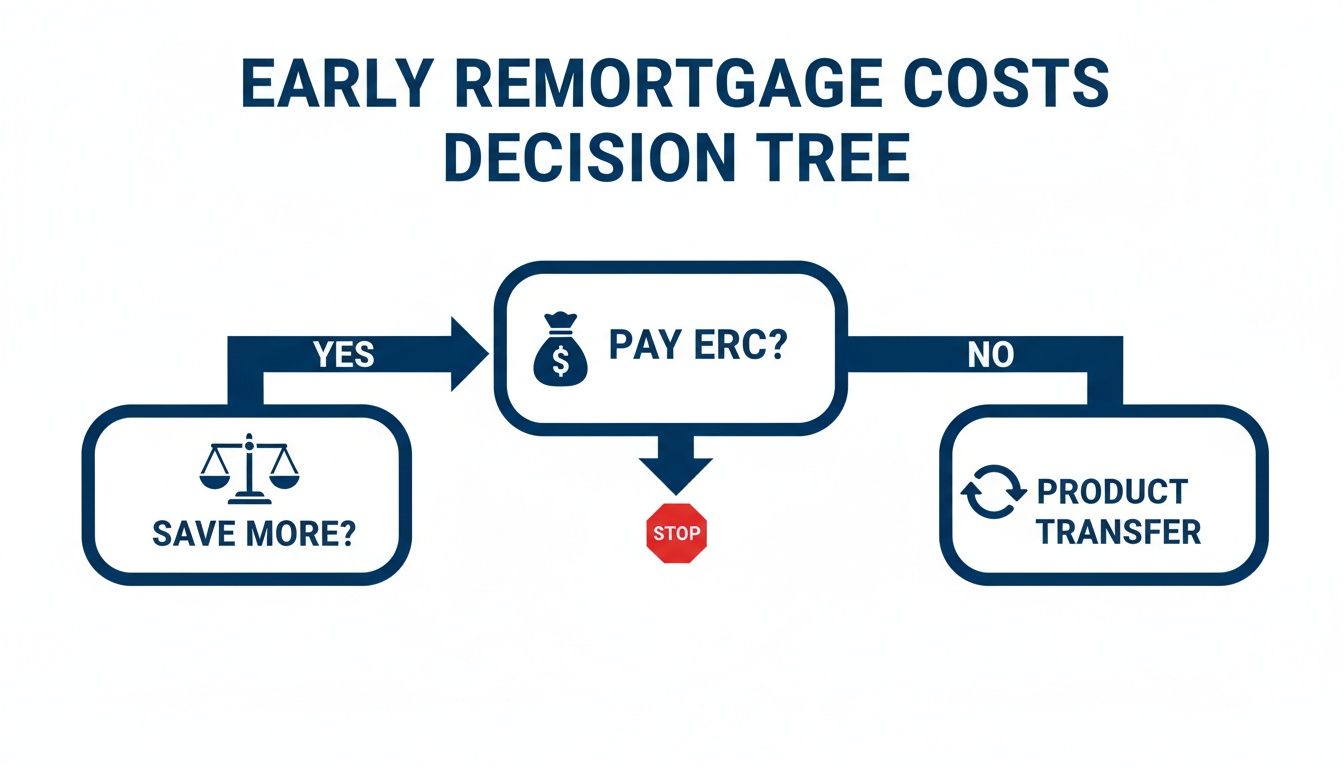
As the flowchart shows if the savings from a new deal outweigh the penalty, it can be a wise move. Otherwise exploring a product transfer is the next logical step.
The Value Of Personalised Advice
Every homeowner’s situation is unique. The right decision for someone in Braintree might be completely different from a homeowner in Colchester, even if their mortgages look similar on paper. Your personal goals income and attitude to risk all play a crucial role.
That’s why crunching the numbers with an expert is so important. A mortgage broker can access deals from across the market and use sophisticated calculators to give you a precise breakdown of the costs versus the benefits. They can tell you exactly what your break-even point is, and help you decide if paying that ERC is a strategic investment in your financial future.
Ultimately breaking your mortgage deal is a calculated risk. But when the numbers stack up, and the timing is right it, can be one of the smartest financial decisions you make as a homeowner.
Thinking about whether an early switch could work for you? Let our experts do the maths. Reach out for a free no-obligation consultation on our Contact Us page.
How To Switch Deals Without Paying A Penalty
Most people think that if they want to remortgage early, they’re automatically on the hook for a hefty Early Repayment Charge (ERC). And while that’s often true if you’re jumping ship to a new lender it isn’t your only move. There are a couple of clever ways to secure a new deal without that painful penalty.
The most common penalty-free route is something called a product transfer which you might also hear called a rate switch. It’s exactly what it sounds like: you simply move from your current deal, onto a new one with your existing lender. Because you’re staying loyal, they may waive any ERCs that would normally apply. It’s a really straightforward way to dodge their expensive Standard Variable Rate (SVR) when your term ends.
The big appeal here is speed and simplicity. The process is usually much quicker than a full remortgage often needing minimal paperwork and sidestepping new legal fees or property valuations. That saves you both time and upfront cash.
The Pros And Cons Of A Product Transfer
While a product transfer sounds like a no-brainer, its biggest weakness is the lack of choice. You’re completely limited to the deals your current lender is prepared to offer you. This means you could be missing out on far more competitive interest rates available from dozens of other lenders on the open market.
Even a slightly lower rate from a new lender could save you thousands over the life of the deal, far outweighing what you’d save on fees by sticking around. This is where getting professional advice is crucial. An independent mortgage broker can quickly run the numbers, comparing your lender’s offer against the entire market. For our clients in Chelmsford, Braintree, and Colchester, this simple comparison provides the clarity they need to make the smartest financial decision.
Let’s break down the key differences between a quick product transfer and a full remortgage.
| Feature | Product Transfer (Rate Switch) | Remortgage (New Lender) |
|---|---|---|
| Lender | You stay with your current lender | You switch to a brand new lender |
| Early Repayment Charge | Not applicable | May apply if within a fixed term |
| Affordability Checks | Usually simplified or not required | Full affordability and credit checks |
| Legal Work | Typically no legal work needed | A solicitor is required |
| Product Choice | Limited to your current lender’s range | Access to the whole market |
Porting Your Mortgage When You Move House
Another penalty-free option this one for people on the move is mortgage porting. It’s the process of taking your existing mortgage deal, interest rate terms and all, with you to your new property. It’s a fantastic feature if you’re locked into a great low rate that you don’t want to let go of.
Porting lets you sidestep the ERC you’d otherwise face for breaking your deal when you sell. If you need to borrow a bit more for your new more expensive home you can often arrange a top-up loan with the same lender. It’s a great way to move house without tearing up your current mortgage agreement.
But porting isn’t always a given. You will still need to reapply, and pass your lender’s affordability and credit checks for the new property. As the Consumer Financial Protection Bureau points out, lenders have to assess your ability to repay. If your financial situation has changed for the worse, or the new property doesn’t meet their lending criteria, they could say no.
This is another situation where a good independent broker is worth their weight in gold. We can handle the porting application for you, while at the same time checking if a brand-new mortgage from another lender might actually work out better financially – even if it means paying the ERC. By exploring every angle, we make sure you make the right move for your new home.
Ready to find out if a product transfer or a full remortgage is the best option for you? Let’s explore your choices together. Get in touch via our Contact Us page for a free no-obligation chat.
Your Step-By-Step Guide To Remortgaging Early

The idea of remortgaging early can feel a bit daunting but it doesn’t have to be. When you break it down into a clear logical sequence the whole process becomes much more straightforward.
This roadmap is designed to walk you through it from those first tentative thoughts right through to completion. Following these steps will help you ask the right questions, and get everything in order for a smooth successful switch.
1. Review Your Current Mortgage Deal
Before you do anything else you need to get intimately familiar with your current mortgage. Dig out your original mortgage offer document or a recent annual statement.
There are two critical pieces of information you’re looking for: the Early Repayment Charge (ERC) percentage and the exact deal end date. These two details form the foundation of your decision, telling you what it will cost to leave and when your penalty-free window opens up.
2. Assess Your Finances And Define Your Goals
With your current deal laid bare, it’s time to look at the bigger picture. What are you actually trying to achieve here?
Are you hoping to lower your monthly payments to improve your cash flow? Or maybe you need to release some equity for that big home renovation you’ve been planning in Chelmsford. Perhaps you want to consolidate other more expensive debts. Defining your goals is crucial, because it shapes the entire search for your next mortgage.
3. Speak With An Independent Mortgage Broker
Honestly this is probably the most important step in the entire process. A good independent broker like us here at EHF Mortgages works for you – not for any single lender.
We have access to the whole market from high-street giants, to niche specialist lenders, uncovering deals you’d never find on your own. More importantly, we do the heavy lifting comparing the cost of your ERC against the long-term savings of a new rate. For homeowners across Braintree and Colchester, this expert guidance is what makes the difference between a good decision, and a great one.
4. Gather Your Essential Documents
Lenders need to see a specific set of documents, to verify who you are and what you can afford. Getting everything together upfront makes the application process infinitely smoother and quicker. It shows lenders you’re organised and ready to go.
Here’s a quick checklist of the documents you’ll almost certainly need:
- Proof of Identity: A valid passport or driving licence.
- Proof of Address: Recent utility bills or a council tax statement from the last three months.
- Proof of Income: Your last three months of payslips and your latest P60. If you’re self-employed plan on needing two to three years of accounts or tax returns.
- Bank Statements: The last three months of personal bank statements showing your salary coming in and your regular outgoings.
- Details of Your Current Mortgage: A recent statement from your current provider.
5. Submit Your Mortgage Application
Once your broker has pinpointed the perfect deal and you’ve got your paperwork ready, they will handle the formal application for you. They’ll make sure every box is ticked correctly to minimise delays, and will field any initial questions from the lender. This is where their expertise really pays off.
6. The Property Valuation And Formal Offer
After the application is in, the new lender will arrange a valuation of your property. This is simply to confirm its current market value,, and ensure they aren’t lending more than it’s worth.
Assuming the valuation lines up, and all the affordability checks are passed, the lender will issue a formal mortgage offer. This is the legally binding document that outlines all the terms of your new loan, and your broker will go through it with you to confirm everything is exactly as you discussed.
7. Finalising Your Switch
With the formal offer in hand the final legal work can begin. Your solicitor will get in touch with both your old and new lenders to coordinate the transfer of funds. On the agreed completion day your old mortgage gets paid off and your new one officially starts.
And that’s it – you’ve successfully remortgaged early! Now you can start enjoying the benefits whether that’s lower monthly payments, or the funds for your next big project.
For a rough idea of what your new payments could be our free mortgage calculators are a great place to start.
How Different Borrower Needs Affect Your Strategy
The question “can I remortgage early?” never has a one-size-fits-all answer. Your personal circumstances and financial goals will always dictate the best path forward. A strategy that’s perfect for a first-time buyer in Chelmsford could be completely wrong for a seasoned property investor in Colchester.
Understanding these differences is the key to finding the right mortgage product. Lenders have very specific criteria for different types of borrowers, and getting to grips with these nuances is essential for a successful application. This is where tailored advice isn’t just helpful, it’s necessary.
Strategies For Buy-To-Let Landlords
For a landlord, a mortgage is a business tool. Remortgaging early isn’t just about trimming a few pounds off the monthly payment; it’s about optimising your entire property portfolio. You might be looking to release equity from one property to fund the deposit for another purchase in Braintree, or perhaps to finance renovations that will boost your rental yield.
Lenders view buy-to-let applications through a different lens than residential ones. They focus heavily on the property’s potential rental income typically requiring it to cover the mortgage payments by a margin of 125% to 145%. When you’re weighing up an early switch especially for investment properties it’s crucial to understand how to finance rental property effectively. It can be a powerful strategic move to restructure finances across your entire portfolio.
Later-Life Borrowers And Retirement Planning
If you’re approaching or already in retirement your priorities are likely quite different. Security stability and keeping outgoings manageable are usually top of the list. For this group remortgaging can be a vital part of a wider retirement plan.
Products like Retirement Interest-Only (RIO) mortgages are designed specifically for older borrowers. With a RIO mortgage, you only pay the interest each month and the capital is repaid when the property is sold, usually after you pass away or move into long-term care. This keeps your monthly payments low and predictable. Looking into these options early can bring significant peace of mind, and financial flexibility in your retirement years. For more details have a look at our complete guide to understanding your borrowing potential.
Navigating More Complex Situations
But what if your circumstances don’t fit neatly into a box? Many people worry that being self-employed or having a less-than-perfect credit history means remortgaging is off the table. That’s rarely true, but it does mean you need a more specialised approach.
Lender criteria can vary dramatically. Some lenders are comfortable with just one year of accounts for the self-employed, while others demand three. Likewise some will consider applicants with past credit issues while others won’t. This is where independent brokers really shine especially for clients with complex cases -like self-employed individuals, with adverse credit, or portfolio landlords in Essex. They offer FCA-authorised advice across high-street and specialist lenders, using their experience to navigate strict lending rules.
Remortgaging early isn’t just possible; for many it’s a strategic move that could save you hundreds each month and build long-term financial flexibility.
Your Early Remortgage Questions Answered
Got questions about remortgaging early? You’re not alone. Here are a few of the most common queries we hear from homeowners across Chelmsford, Braintree, and Colchester, with straightforward answers to help you get started.
How Long Does It Take To Remortgage Early?
From the day you apply to the moment your new mortgage goes live you can expect the process to take between four to eight weeks. Of course this can vary a bit depending on how busy the lender is, if there are any complexities in your application, or how quickly the legal side of things moves along.
My best advice? Start the ball rolling sooner rather than later. As we’ve mentioned you can lock in a new mortgage offer up to six months before your current deal ends. This gives you plenty of breathing room to sort everything out, without any last-minute panic ensuring a smooth switch to your new rate.
Can I Remortgage Early To Release Equity?
Absolutely. In fact releasing equity is one of the top reasons people choose to remortgage before their term is up. It’s a great way to borrow against the value you’ve built up in your home giving you a cash lump sum to put towards other goals.
We see clients use this money for all sorts of things:
- Funding big home improvements like that extension you’ve been dreaming of or a brand-new kitchen.
- Consolidating more expensive debts (like credit cards or loans) into one single lower monthly payment.
- Helping a loved one get a foot on the property ladder with a deposit.
- Paying for major life events such as a wedding or university fees.
A good mortgage broker can run the numbers for you working out exactly how much equity you could release based on your property’s current value and your own financial situation.
Will Remortgaging Early Affect My Credit Score?
When you apply for a remortgage, or any kind of new credit, the lender will run a hard credit check. This leaves a footprint on your credit file, and can cause your score to dip by a few points temporarily.
Honestly, this is a perfectly normal part of the process and isn’t something to lose sleep over. As credit reference agencies like Experian will tell you,, the single most important thing for your credit history is making your payments on time. Once you start managing your new mortgage responsibly you’ll be building a solid credit record for the future.
Figuring out the ins and outs of an early remortgage can feel complicated but it doesn’t have to be. At EHF Mortgages we have the experience to look at your unique circumstances and map out the most cost-effective way forward.
To explore your options with a free no-obligation chat just head over to our Contact Us page.





