
💡 Top tip: While a 25% deposit is standard, some specialist lenders may accept 20% for properties with a strong rental yield. We’ll break down exactly how this works later in the guide.
Your 2026 Guide to Buy-to-Let Mortgage Deposits
Getting a buy-to-let mortgage is the first significant milestone for any aspiring property investor. But often the biggest hurdle is figuring out the deposit required on a buy-to-let property. It’s a different ball game from a standard home loan, and the required deposit is significantly higher.
This guide explains why lenders require more upfront capital for investment properties. We’ll introduce core concepts like Loan-to-Value and clarify its crucial role in calculating your deposit. By the end, you’ll have a crystal-clear picture of the financial commitment involved, whether you’re investing in Chelmsford, Braintree, or Colchester.

What Is a Typical BTL Deposit?
In the UK buy-to-let market, the rule of thumb is to save around 25% of the property’s value as a deposit. This is a far cry from the 5-10% often needed for a residential mortgage on a home you plan to live in.
So why the big difference? It all comes down to risk. Lenders view BTL investments as having more variables, such as potential rental voids or tenant issues, making them a higher-risk venture than a standard home loan. This common 75% loan-to-value (LTV) limit means you need a decent chunk of capital ready.
Certain property types can push that figure even higher. For instance, new builds and flats might require deposits of 25-30% due to depreciation risks, while Houses in Multiple Occupation (HMOs) often face the steepest requirements at 30-35%.
“Understanding the lender’s perspective on risk is the key to preparing your finances for a buy-to-let investment. A larger deposit directly translates to lower risk for them and better terms for you.”
Navigate Our Buy To Let Deposit Guide
This article is your roadmap to understanding BTL deposit rules, from baseline requirements to the specific factors that can affect how much you need to save. Use these links to jump to the sections you need.
And if you’re starting, you might also find our guide on getting a buy-to-let mortgage as a first-time buyer a helpful next read.
Why Are Buy-to-Let Deposits So Much Bigger?
Ever looked at buy-to-let mortgage rates and wondered why the deposit is so much heftier than for your own home? The answer all comes down to how lenders see risk. A residential mortgage is a loan for the roof over your head; a buy-to-let mortgage is essentially funding for a small business.
Lenders are quite rightly more cautious when it comes to business ventures. They aren’t just lending to you; they’re investing in your property’s ability to generate a reliable income. This mental shift from a personal home loan to a business investment is the primary reason you’ll need to find a larger upfront cash deposit.
Understanding The Lender’s Point of View
When a lender looks at a BTL application, they’re weighing up a whole set of risks that don’t apply to a standard residential loan. A larger deposit from you acts as a vital safety net, reducing their financial exposure if things don’t go to plan.
They’re mainly thinking about:
Rental Voids: What happens when the property is empty between tenants? An empty property means zero income, but the mortgage still needs to be paid every month.
Tenant Defaults: There’s always the unfortunate risk that a tenant might stop paying their rent, which puts a direct dent in your ability to cover the mortgage.
Economic Shifts: A local economic downturn, whether in Chelmsford, Braintree, or Colchester, could hit rental demand hard or even cause property values to dip.
“Think of your deposit as the lender’s insurance policy. The more skin you have in the game, the lower their risk and the more confident they feel about the whole venture.”
This cautious approach wasn’t always the norm. The UK’s buy-to-let market exploded after its creation in 1996, with outstanding lending rocketing from £9 billion in 2000 to an incredible £140 billion by 2008. In the run-up to the financial crisis, lending rules were often much looser. In the aftermath, regulators stepped in with tougher regulations, including higher deposit requirements and stricter affordability tests, to create a more stable market. You can read about the history of these changes in a Bank of England report on financial stability.
A Buffer Against Market Dips
A decent-sized deposit also gives the lender a crucial buffer against falling house prices. If the worst happens and they have to repossess and sell the property, a larger deposit means there’s a much bigger cushion before they start losing money on the deal. This is precisely why the 25% deposit has become such a standard benchmark. It ensures that both you and the lender have a meaningful stake in the property’s long-term success.
How Lenders Calculate Your Required Deposit
It’s easy to think lenders pluck a deposit percentage out of thin air, but there’s a proper method to their madness. They use a couple of key calculations to figure out the maximum loan they’re comfortable offering you, which in turn determines the minimum deposit you’ll need to find.
The two most essential tools in their kit are the Loan-to-Value (LTV) ratio and the Interest Coverage Ratio (ICR), which is usually bundled with a ‘stress test’. Getting your head around these is a game-changer for any landlord. It pulls back the curtain on the lender’s thinking and shows you exactly how a property’s rental income in Chelmsford or Colchester directly shapes the deposit required for a buy-to-let mortgage.
Loan-to-Value (LTV): The Starting Point
Loan-to-Value is the most straightforward part of the puzzle. It’s simply the size of the mortgage expressed as a percentage of the property’s total value. For most buy-to-let mortgages, a typical LTV is 75%. This means the lender will finance up to that amount, and you’re responsible for the remaining 25% as a deposit.
Let’s break it down with a quick example:
Property Price: £250,000
Maximum LTV: 75% (meaning a loan of £187,500)
Your Required Deposit: 25% (which comes to £62,500)
But here’s the catch: LTV only sets the initial boundary. The property’s rental income must be sufficient to cover the mortgage payments comfortably. This is where the ICR and stress test come into play. Lenders are always thinking about the “what ifs”, as you can see below.
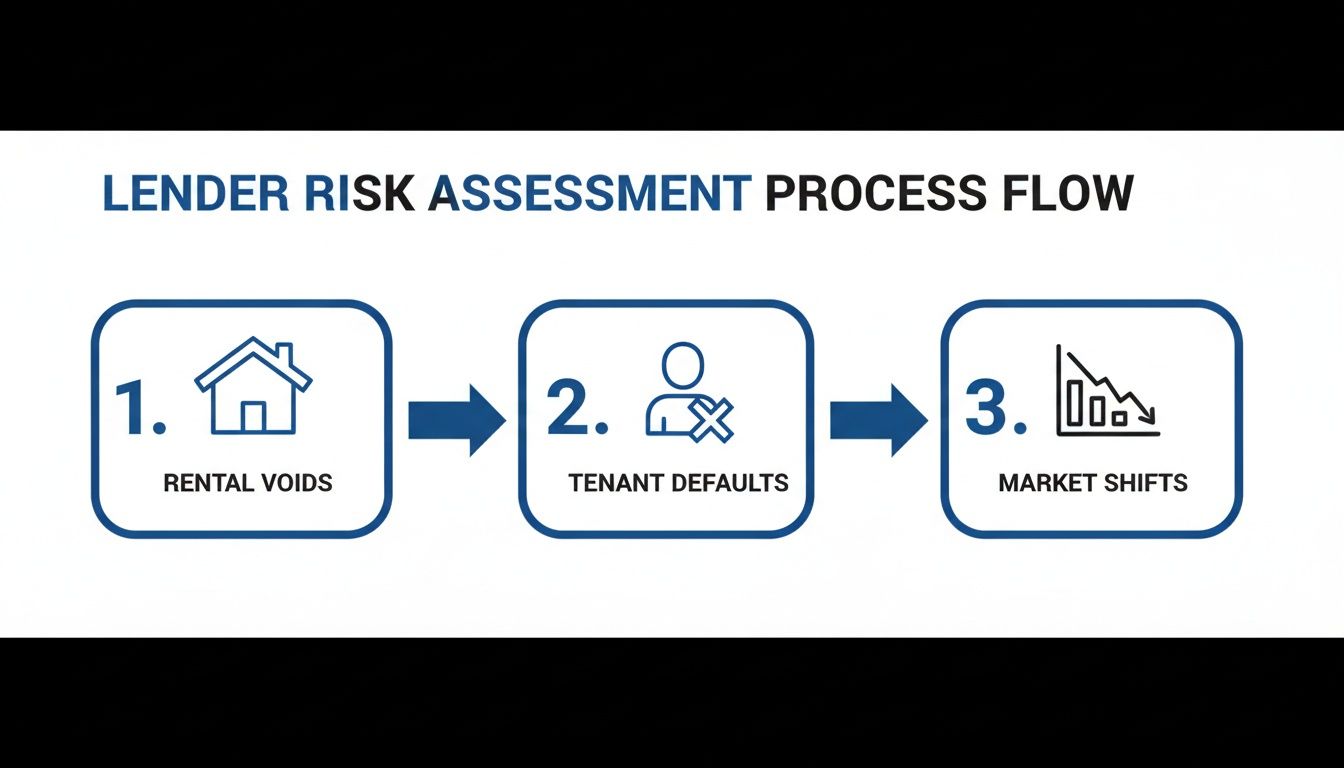
This visual really highlights how lenders are constantly weighing the risks of empty periods or market dips, precisely what their affordability calculations are designed to protect against.
ICR and Stress Testing: The Real Litmus Test
The Interest Coverage Ratio (ICR) is a lender’s way of ensuring that the rent you collect covers not only the mortgage but also provides a healthy buffer. To add another layer of security, they apply a ‘stress test’. They won’t calculate the ICR based on today’s interest rate, but on a much higher hypothetical rate, often around 5.5% or higher.
Most lenders will want to see the rental income cover at least 125% to 145% of the monthly mortgage payment calculated at this higher “stressed” rate. Let’s walk through how this works for a property in Braintree.
Worked Example: Braintree Property
Property Value: £300,000
Monthly Rent: £1,250
Lender’s Stress Rate: 5.5%
Lender’s ICR: 145%
First, we need to work out the minimum rent required to satisfy the lender’s ICR rule:
- £1,250 / 1.45 = £862. This is the absolute maximum monthly mortgage payment allowed by their stress test.
Next, we use this payment figure to calculate the maximum loan they’ll offer:
£862 x 12 months = £10,344 (this is the maximum annual interest payment the rent can support).
£10,344 / 0.055 (the Stress Rate) = £188,072. This is the maximum loan amount.
So here’s the crucial bit. Even though a 75% LTV on a £300,000 property would theoretically allow a £225,000 loan, the rental income in this scenario supports only £188,072.
This means your required deposit jumps to £111,928 (£300,000 – £188,072), which is nearly 37% of the property value. As you can see, the ICR calculation, not the LTV, is often the real decider for how much you need to put down. For a closer look at how lenders assess income-generating properties, understanding DSCR financing for short-term rentals offers some really valuable insights into their mindset.
Key Factors That Influence Your Deposit Amount
When a lender looks at your buy-to-let mortgage application, the headline Loan-to-Value is really just a starting point. Several key factors can shift the goalposts, meaning the final deposit required on a buy-to-let property could be higher or lower than the standard 25%. The truth is not all landlords or properties are viewed through the same lens.
At the end of the day, lenders are managing risk. Your personal circumstances and the specifics of the property you want to buy, whether it’s in Chelmsford, Braintree, or Colchester, will directly influence their calculations. Getting to grips with these variables helps you anticipate what a lender is likely to ask for.
Your Experience as a Landlord
Your track record in the property market really matters. Lenders tend to place applicants into two main camps, and deposit requirements can be quite different for each.
First-Time Landlords: If you’re new to the rental game, you naturally represent a slightly higher risk. Lenders have no history of you managing tenants or properties. Because of this, they will almost always ask for a minimum deposit of 25% to give themselves a comfortable security buffer.
Experienced or Portfolio Landlords: On the other hand, if you already own one or more rental properties and can show a history of successful lettings, you might get access to better terms. Some specialist lenders may even offer an 80% LTV mortgage, meaning you’d only need a 20% deposit.
“A lender’s decision is a blend of data and confidence. While the property’s rental income is primary, a landlord’s experience and financial stability provide the confidence needed for better terms.”
The Type of Property You Are Buying
The property itself is a massive factor. A standard three-bedroom house is a pretty straightforward investment, but more complex or “non-standard” properties often require a larger deposit to offset lenders’ perceived risk.
Lenders may ask for a higher deposit for properties like these:
Houses in Multiple Occupation (HMOs): These properties, which are rented out by the room, often require a deposit of 30-35%. The management is more intensive, and tenant turnover can be higher, which makes lenders a bit more cautious.
New-Build Properties: Some lenders are wary of new builds because of the risk of initial price inflation. They might ask for a 25-30% deposit to protect themselves against any short-term drops in value.
Flats Above Commercial Premises: Properties sitting above shops or restaurants can be harder to sell on the open market. This makes them less desirable as security for a loan, so a higher deposit is often required.
If you’re thinking about buying through a corporate structure, our guide on limited company buy-to-let mortgages provides more detailed information on those specific requirements.
Budgeting For Upfront Costs Beyond The Deposit
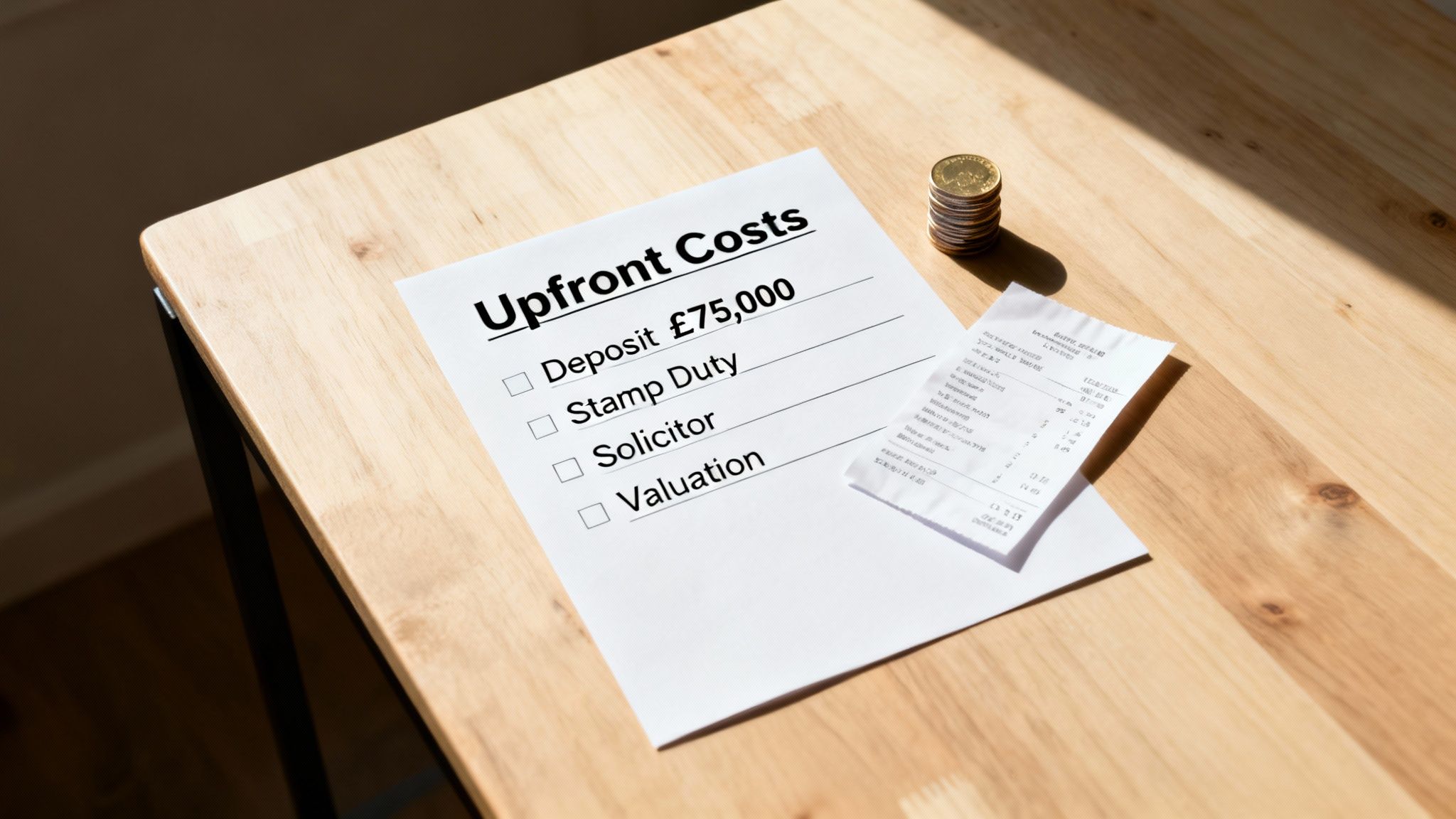
Getting your deposit together is a massive milestone, but it’s only one piece of the financial puzzle. The total deposit required for a buy-to-let property is just the starting point, not the finish line. Both new and seasoned investors often get caught by underestimating the other significant costs you have to cover before the keys are even in your hand.
A solid investment is built on a realistic budget from day one. If you fail to account for these extra expenses, you could put the entire purchase at risk. These costs can easily add thousands of pounds to your initial outlay, so it’s vital to factor them in early.
A Checklist of Common Upfront Fees
Before you finalise your investment budget, you need a crystal-clear picture of all the costs involved. While some fees will vary between solicitors and lenders, most investors buying in areas like Chelmsford, Braintree, or Colchester will come across these:
Stamp Duty Land Tax (SDLT): This is often the highest extra cost by a long shot. In England, you’ll pay a 3% surcharge on top of the standard SDLT rates when buying any additional property. You can work out the exact figure using the government’s official SDLT calculator.
Mortgage Arrangement Fees: These can be a flat fee, typically between £999 and £1,999, or a percentage of the loan itself. Some lenders let you add this to the mortgage, but remember you’ll be paying interest on it for the life of the loan.
Valuation Fees: The lender needs to value the property to make sure it’s good security for their loan. This is a cost you’ll usually have to cover, and it can be several hundred pounds depending on the property’s price.
Solicitor and Legal Fees: You’ll need a solicitor or conveyancer to handle all the legal paperwork. These costs cover things like local searches, contracts, and transferring ownership, and typically range from £850 to £1,500 plus VAT.
“Thinking your deposit is the final figure is a common mistake. Your true ‘day one’ investment is the deposit plus all associated purchase costs combined. Budget for this total figure, not just the deposit.”
Worked Example: An Essex Property Purchase
Let’s put this into practice with a real-world example. Imagine you’re buying an investment property in Essex for £300,000.
Your 25% deposit is £75,000. That’s the big one, but you also need to find the cash for the other fees. Based on typical costs, your total upfront investment would look something like this:
| Cost Item | Estimated Amount |
|---|---|
| Purchase Price | £300,000 |
| 25% Deposit | £75,000 |
| Stamp Duty (inc. 3% surcharge) | £11,500 |
| Mortgage Arrangement Fee | £1,499 |
| Valuation Fee | £400 |
As you can see, the additional costs add almost £14,000 on top of the deposit. Planning for this full amount is crucial for a smooth, successful purchase.
How To Secure The Best Buy To Let Mortgage Deal
Getting the best buy-to-let mortgage deal isn’t just about scraping together the minimum deposit required on a buy-to-let property. To really unlock the best interest rates and more flexible terms, you need to show lenders you’re a reliable, well-prepared investor. Taking a few simple steps can make a massive difference to your application and save you a small fortune over the life of the loan.
Start with the basics: check and polish up your credit score. It’s the quickest way for a lender to gauge your financial responsibility. If you’re already a landlord, get your paperwork in order and be ready to demonstrate a solid track record of rental income. Finally, focus on properties with strong rental yields in sought-after areas like Chelmsford, Braintree, or Colchester. This makes your proposal far more appealing.
The Value Of An Independent Mortgage Broker
While you could approach lenders directly, working with an independent mortgage broker is your key to unlocking the entire market. A whole-of-market broker like EHF Mortgages isn’t tied to any single bank or building society. This means we have access to a vast range of products, including exclusive deals from specialist lenders that you won’t find on the high street.
These specialist lenders are often much more flexible. They might be more open to applicants with complex income streams or even offer lower deposit options for particularly strong applications. To get a better handle on your options, you can explore this guide on how to finance investment property the smart way. A good broker does all the heavy lifting, comparing hundreds of options to find the one that perfectly fits your investment goals.
“Think of a broker as your strategic partner. We understand the nuances of the market and can present your application to the right lender in the best possible light, increasing your chances of success.”
Every property investment journey is different, and your mortgage should be too. Don’t settle for an off-the-shelf product when a properly structured solution could offer much better value. For a snapshot of what’s out there, you can compare our current buy-to-let mortgage rates to see what’s available.
Ready to find a mortgage that genuinely works for you? Our expert team provides professional, tailored advice to help you achieve your goals.
Reach out to us through our Contact Us page to start the conversation.
Common Questions About Buy-to-Let Deposits
When you’re figuring out the finances for an investment property, a lot of the same questions tend to pop up. Let’s tackle some of the most common queries we hear from aspiring and experienced landlords alike.
Can I Use a Gift For a Buy-to-Let Deposit?
Yes, you often can, but lenders are very particular about this. The money must be a genuine, no-strings-attached gift, typically from a close family member, such as a parent.
To prove it, the person giving you the money will need to sign a formal ‘gifted deposit letter’. This confirms they don’t expect repayment and won’t have any legal claim on the property. Not every lender is open to gifted deposits for buy-to-lets, so this is where a good broker really proves their worth by pointing you to the ones that are.
Do I Need a Larger Deposit As a First-Time Landlord?
It’s very likely, yes. From a lender’s perspective, a first-time landlord is an unknown quantity. You don’t have a track record of managing tenants, handling voids, or keeping a property in good shape, which makes you a slightly higher risk.
Because of this, they’ll often limit your Loan-to-Value to a maximum of 75%, meaning you’ll need to find a 25% deposit. A seasoned landlord with a portfolio, on the other hand, might be able to find a specialist lender willing to go to 80% LTV. Having a high personal income can definitely help your case, though.
Does The Property Type Affect The Deposit Required?
Absolutely. The type of property you’re buying has a significant impact on how much a lender will want you to put down. A standard terraced house in a high-demand rental area like Colchester could well be approved with a 20-25% deposit.
However, anything a lender considers ‘non-standard’ or higher risk will require more from you. Think about new-build flats, for example: concerns that they may lose a chunk of their value in the first few years mean lenders might ask for a 25-30% deposit. For more complex investments like a House in Multiple Occupation (HMO), you’ll almost certainly need a larger deposit of around 30-35% to balance out the extra management and risk involved.
Sorting out a buy-to-let mortgage can feel like a minefield, but you don’t have to navigate it on your own. The expert team at EHF Mortgages has real-world experience to guide you through every step, ensuring you find the right deal for your investment goals.
Ready to get started? Visit our Contact Us page to arrange your free no-obligation consultation today.





