
Your fixed rate is ending, the Help to Buy letters are landing, and it can feel like a deadline is closing in. 💡 Top tip: when your interest-free period ends, treat it as a review point rather than a panic point. In many cases, the right move depends less on the headline rate and more on what you want to do with the property over the next few years. I’ll explain that properly as we go.
If you bought with Help to Buy in Chelmsford, Braintree, Colchester or elsewhere in Essex, you’re not dealing with a standard remortgage. You’ve got a second charge in the background, lender rules that can vary sharply, and legal work that needs to line up properly. That’s why remortgaging help-to-buy needs a different approach from an ordinary product switch.
Your Guide to Remortgaging a Help to Buy Property

If you’re approaching the end of your first five years, the pressure usually comes from two directions at once. Your current mortgage deal may be ending, and the Help to Buy equity loan is no longer a passive concern in the background. That changes the conversation from “can I get a lower rate?” to “what’s the smartest overall plan from here?”
The Help to Buy scheme was used at scale, with over 387,000 properties across the UK remaining tied to its equity loans by 2025, according to Help to Buy statistics published by GOV.UK. With the scheme now closed to new applicants, many owners are reaching the point where a remortgage decision becomes far more important than it looked when they first bought.
Why this point matters
A standard remortgage is often about rate, term and monthly cost. A Help to Buy remortgage adds extra moving parts:
The equity loan still has to be dealt with if you’re repaying it, keeping it, or selling.
The property value matters more than many owners expect because the equity loan is linked to the current value, not the original purchase price.
Lender appetite varies because some lenders are comfortable with Help to Buy cases and others are much more restrictive.
Practical rule: The best time to review your options is before the deadline starts to force your hand.
For many homeowners, remortgaging ‘help-to-buy’ works well when it’s planned early. The cases that become stressful are usually the ones left until the current deal is about to expire.
First Steps Before You Remortgage
Before you compare deals, get clear on your position. The first job is understanding the property value, your current mortgage balance, and what you want the next few years to look like. Without that, it’s easy to chase the wrong product.
Start with your numbers
You need a realistic view of the property value, not a hopeful guess. The equity loan is calculated against the home’s current value, so that figure affects what repayment might look like and which lenders will consider the case.
Then work out your combined borrowing position. That means looking at the main mortgage and the Help to Buy equity loan together, because that gives you the true loan-to-value picture.
Check the mortgage balance: use the latest statement rather than an old figure.
Review the Help to Buy share: remember it’s a share of the current property value.
Think about timing: if you plan to move soon, flexibility may matter more than securing the longest fixed rate.
A practical calculator can help you sense-check affordability principles. If you want to see how another mortgage market frames borrowing calculations, calculate your French mortgage as a point of comparison. It won’t replace UK advice, but it can help you understand how different loan assumptions affect repayments.
Your plans matter as much as your rate
A homeowner planning to stay put often needs a different solution from someone expecting to sell. That’s where people go wrong. They look for the cheapest product first and only later ask whether it fits their plans.
If you’re not sure what fees may come into play, it’s worth reviewing what remortgaging can cost in practice. Fees, lender criteria and legal requirements can all change, which option is the best value?
The right lender isn’t always the one with the lowest headline rate. On Help to Buy cases, flexibility can be more valuable.

The Big Decision: How to Handle the Equity Loan
Once the groundwork is done, the choice is how you want to deal with the Help to Buy loan itself. Most homeowners end up in one of three camps. Repay it in full, keep it in place for now, or sell the property.
A recent case involved a client who planned to sell within a few months. The best route wasn’t the cheapest fixed deal. It was a more flexible product with another lender that suited the short-term plan, with affordability assessed including the monthly cost of the Help to Buy loan, and the solicitors obtaining the necessary agreement from the Help to Buy team to complete the remortgage.
Help to Buy remortgage options compared
| Strategy | How It Works | Best For Homeowners Who… | Key Considerations |
|---|---|---|---|
| Repay the equity loan in full | You borrow enough to clear the Help to Buy loan and move to a single mortgage | Want full ownership and can support the new borrowing | Affordability, property value and lender choice all matter |
| Keep the equity loan for now | You remortgage the main mortgage and leave the equity loan in place | Need a new mortgage deal but aren’t ready to clear the loan | Fewer lenders may be available, and flexibility becomes important |
| Sell the property | Sale proceeds repay the mortgage and the Help to Buy share | Are you moving soon, or do you want a clean exit | Product choice should suit a short holding period |
What usually works best
Repaying the loan can simplify everything, but only if the figures stack up. Keeping it can be sensible when equity is tighter, or the timing isn’t right. Selling can be the cleanest answer if a move is already on the horizon.
If you’re unsure how much room you have, start by reviewing how to work out the equity in your home. That usually makes the next decision much clearer.
Navigating the Remortgage Process Step by Step
The process for remortgaging Help-to-Buy is more structured than many people expect. The official route involves a 6-step methodology, including a RICS valuation, a redemption letter, mortgage approval and solicitor-led completion, as outlined in this step-by-step Help to Buy remortgage guide.
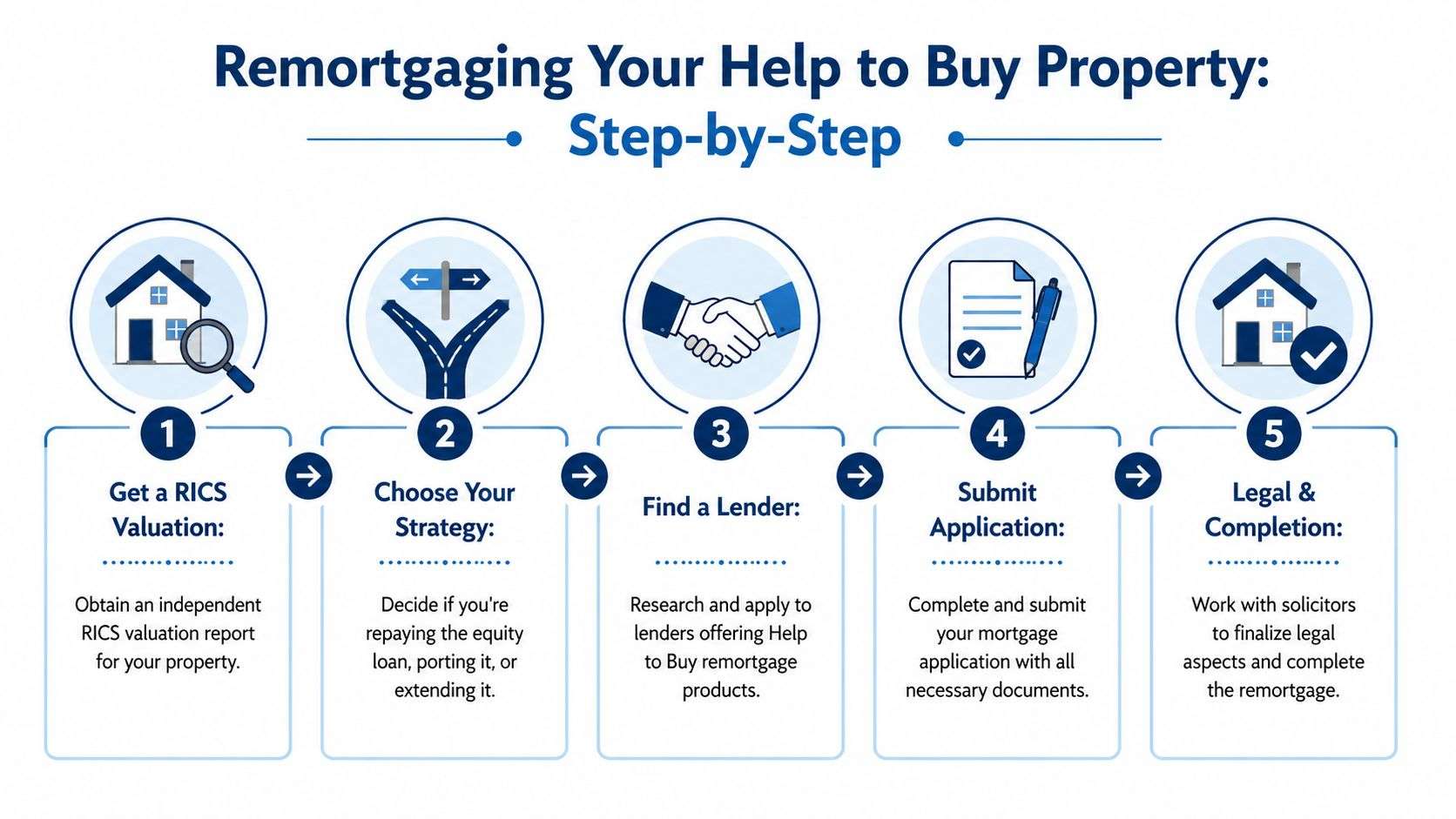
The process in practice
The paperwork has to happen in the right order. If it doesn’t, delays creep in, and offers can end up under pressure.
Get a RICS valuation
This is the figure used for the Help to Buy calculation. It needs to be suitable for the administrator’s requirements, not just a quick estate agent opinion. Speak to EHF Mortgages to grab a quote for a suitable report.Request the redemption figure
Once the valuation and paperwork are submitted, the Help to Buy administrator issues the figure needed to redeem the loan if you’re repaying it.Submit the mortgage application
At this stage, lender selection matters. Some lenders handle these cases smoothly. Others either price them poorly or avoid them altogether.Let the solicitor coordinate completion
Your solicitor has to line up the old lender, the new lender and the Help to Buy administrator. On completion day, funds must be released and applied correctly.Confirm post-completion steps
The final paperwork matters. Missing it creates avoidable problems later.
Where people get stuck
The biggest snags are usually practical rather than dramatic:
Using the wrong valuation route
Applying to a lender without suitable Help to Buy criteria
Leaving the legal work too late
Assuming a normal remortgage timeline applies
If you want a broader overview of the standard mortgage side of the process, this guide on how to remortgage a house is a useful companion.
“On Help to Buy remortgages, the legal coordination is just as important as the rate.”
Overcoming Hurdles and Finding Specialist Lenders

Not every Help to Buy remortgage is neat and straightforward. In Essex, the cases that need the most care often involve slower property growth, self-employed income, credit blips, or lenders that do not like second-charge complexity.
That lender issue catches a lot of people out. Some lenders charge more for Help to Buy cases. Others won’t offer an option at all unless the equity loan is being repaid. That means a product that looks attractive online may never have been realistic for your case in the first place.
When mainstream lenders aren’t the answer
The need for specialist advice is even clearer in more complex income and credit cases. UK Finance reported that 18% of 2025 remortgages involved adverse credit checks, while FCA stats show self-employed applicants in areas like Essex can face 30% higher rejection rates from high-street lenders, as referenced in the government guidance on remortgaging a Help to Buy home.
That doesn’t mean the case can’t be done. It means lender choice becomes far more important.
Self-employed borrowers: income assessment can vary sharply from one lender to another.
Credit issues: a missed payment or older adverse event may be acceptable to one lender and a deal breaker for another.
Lower than expected equity growth: This can limit options if the plan is to clear the loan in full.
A practical example from Essex
A common scenario in Chelmsford or Braintree is a homeowner who assumed they would clear the equity loan at remortgage, only to find the property value hasn’t moved enough to make that easy. In those cases, forcing a full repayment attempt can waste time.
A better approach is often to step back and ask three questions:
Do you need to clear the loan now, or is keeping it temporarily the better move?
Is a specialist lender needed because of income or credit profile?
Would a product with more flexibility suit a planned sale better than the cheapest fixed rate?
Some cases don’t fail because the client is unsuitable. They fail because the first lender chosen was.
Your Remortgage Checklist and Next Steps
If you’re preparing for remortgaging help-to-buy, keep the checklist simple and practical. Good outcomes usually come from getting the basics right early.
Final checklist
Find your original Help to Buy paperwork
Get a realistic current property value
Check your credit file before applying
Work out the combined position of the mortgage plus the equity loan
Decide whether you expect to stay, sell, or need flexibility
Choose a lender based on criteria as well as price
Allow enough time for valuation, lender approval and legal work
The main point is this. Help to Buy remortgages aren’t impossible, but they do have more moving parts than a normal remortgage. The lender has to fit the case, the legal side has to be handled properly, and the mortgage choice needs to match your actual plans rather than a generic comparison table.
If you’re in Chelmsford, Colchester, Braintree or anywhere across Essex, getting individual advice early can save a lot of wasted time and avoidable stress.
If you’re ready to talk through your Help to Buy remortgage options with an experienced broker, contact EHF Mortgages for clear, practical advice suited to your plans. Whether you’re looking to repay the equity loan, keep it in place for now, or find a lender for a more complex case, the next step is to start the conversation.





