💡 Top Tip: Get the ball rolling on your remortgage options at least 6 months before your current deal ends.
We’ll get into exactly why this timing is your secret weapon for a stress-free switch later in this guide.
Remortgaging is simply the process of swapping your existing mortgage for a new one, either with your current lender or a different provider. For many homeowners in the UK, it is the single most effective way to lower monthly outgoings and take control of their finances. This guide will walk you through every stage, ensuring you feel confident and prepared.
Table of Contents
- Knowing the Right Time to Remortgage Your Property
- Preparing Your Remortgage Application for Success
- Navigating Your Remortgage Options and Products
- The Remortgage Timeline from Application to Completion
- Common Questions About Remortgaging a House
Knowing the Right Time to Remortgage Your Property
When it comes to remortgaging, timing is everything. Get it right, and you could save thousands over the lifetime of your loan. Get it wrong, and it can be a seriously costly mistake. For most homeowners, the single most important trigger is the end of their initial fixed-rate deal.
This is the moment you’re at risk of being shunted onto your lender’s Standard Variable Rate (SVR). Think of the SVR as a lender’s default setting – it is almost always much higher than the deals available on the open market, and it can go up or down at any time, throwing your monthly budget into chaos. A key part of knowing how to remortgage a house is planning ahead to dodge this very expensive pitfall.
When Your Fixed Rate Deal Ends
The UK remortgage market was incredibly busy throughout 2025, and all signs point to that continuing. Figures from the FCA’s Q3 2025 mortgage lending statistics revealed that owner-occupier remortgages accounted for 28.6% of all new lending. That is a huge jump of 5.8 percentage points from the year before.
With a staggering 1.8 million fixed-rate deals set to expire in 2026, a lot of homeowners are going to be shopping for a new mortgage product. You can dive deeper into these UK mortgage market trends and statistics on the FCA’s website.
To avoid the SVR trap, you really need to start the ball rolling about six months before your current deal ends. This gives you plenty of breathing room to find the best rate, get the application sorted, and have everything finalised without any last-minute panic. Thinking you might need to act even sooner? You can explore the details of remortgaging early in our dedicated guide.
Unlocking Your Property’s Potential
Remortgaging is not just a defensive move to avoid high rates; it is also a brilliant way to make your property work for you and achieve other financial goals. A popular reason is to release equity – the portion of your home that you own outright.
Take a family I recently helped in Colchester. They wanted to add a loft conversion to create a much-needed extra bedroom. Their home was valued at £400,000, and they had £250,000 left on their mortgage, giving them £150,000 in equity. By remortgaging for a total of £290,000, they paid off their old mortgage and freed up £40,000 in cash for the building work, all while locking in a better interest rate than they were on before.
This is a powerful strategy that can be used for all sorts of things:
- Home improvements: Funding extensions, a new kitchen, or sorting out the garden.
- Debt consolidation: Clearing expensive credit cards or personal loans with a much cheaper mortgage rate.
- Major life events: Helping your kids with a deposit for their first home or paying for a wedding.
- Investing: Using the cash as a deposit to buy a buy-to-let property and start a new venture.
When Your Property Value Has Increased
If you have been lucky enough to see property prices in your area shoot up, your Loan-to-Value (LTV) ratio has likely dropped. Your LTV is simply the size of your mortgage compared to your property’s current value. A lower LTV is great news because it makes you less of a risk to lenders and opens the door to their most competitive rates.
For example, let’s say your property in Braintree was worth £300,000 when you took out a £270,000 mortgage (a 90% LTV). If its value has now climbed to £350,000, your LTV would fall to around 77%. That small shift can make a massive difference to the interest rates you will be offered.
Other Key Moments to Consider Remortgaging
While the end of a deal is the most common trigger, other life events might make it a good time to review your mortgage.
| Scenario | Reason to Remortgage | Key Consideration |
|---|---|---|
| Falling Interest Rates | The Bank of England base rate has dropped, making new deals much cheaper. | Check for any Early Repayment Charges (ERCs) on your current deal. They can be hefty. |
| A Change in Circumstances | You have had a pay rise and want to pay off the mortgage faster. | Look for a flexible mortgage that lets you make overpayments without penalties. |
| Wanting More Security | You are on a variable rate, and the uncertainty is giving you sleepless nights. | A fixed-rate mortgage gives you peace of mind with a set monthly payment for 2, 5, or 10 years. |
| Your Deal Has Expired | You are already on your lender’s SVR and paying a fortune. | This is an urgent situation. You can switch at any time without paying an ERC. |
Understanding these key moments is the first step. Next, it is all about getting your application ready for success.
Preparing Your Remortgage Application for Success

A successful remortgage does not just happen by chance—it is the result of some careful preparation. Putting in the groundwork long before you submit any forms can dramatically boost your chances of landing the best possible deal.
Getting your financial house in order shows lenders you are a reliable borrower, which is the key to unlocking those lower interest rates. We will focus on the three critical areas every lender will scrutinise: your credit file, your property’s value, and your paperwork. Get these right, and the entire process will be far smoother.
Strengthening Your Credit File
A lender’s first impression of you comes from your credit score. It is a snapshot of how well you have managed your finances in the past, and a higher score almost always leads to better mortgage offers. It is absolutely worth spending a bit of time polishing your credit file.
Here are a few practical steps to take in the months leading up to your application:
- Check for Errors: Get copies of your report from all three major UK credit reference agencies—Experian, Equifax, and TransUnion. Look for any mistakes, like incorrect addresses or accounts you do not recognise, and get them corrected straight away. Try a 14-day free trial at CheckMyFile – CheckMyFile for an in-depth report on all of the above agencies
- Get on the Electoral Roll: This is such a simple but powerful way to confirm your name and address. It can give your score an instant boost.
- Manage Your Debts: If you can, try to reduce the balances on credit cards and personal loans. Lenders look at your total outstanding debt and how much of your available credit you are using.
- Pay Everything on Time: Even a single missed payment can leave a mark on your record for years. The easiest way to avoid this is to set up Direct Debits for all your regular bills.
Understanding Your Property’s Value and LTV
Your home’s current market value is just as important as your credit history. It directly impacts your Loan-to-Value (LTV) ratio—the size of your mortgage compared to the value of your property. The lower your LTV, the less risky you look to lenders, which means better interest rates for you.
For example, let’s say your home in Colchester is worth £350,000 and you need a mortgage of £262,500. Your LTV is 75%. But if local property prices have risen and your home is revalued at £375,000, your LTV for the same loan drops to 70%. That small change could easily push you into a lower LTV bracket, potentially saving you thousands over the fixed term of your new deal.
Your Remortgage Document and Preparation Checklist
Getting your paperwork in order is one of the best things you can do for a stress-free application. Lenders need to verify your identity, income, and outgoings, so having your documents ready from the start will prevent unnecessary delays.
Use this checklist to gather the essentials. While exact requirements can vary a little between lenders, this covers what pretty much everyone will ask for.
| Category | Document or Action | Why It’s Important | Expert Tip |
|---|---|---|---|
| Proof of Identity | Passport or Driving Licence | Lenders need to confirm who you are to comply with legal and anti-money laundering regulations. | Make sure your ID is in date! An expired passport can cause unexpected hold-ups. |
| Proof of Address | Recent Utility Bill or Council Tax Statement (within 3 months) | This verifies where you live and must match the address on your other documents and credit file. | Use an original paper copy or a downloaded PDF. Lenders will not accept screenshots. |
| Proof of Income | Last 3 Months’ Payslips & Latest P60 | This shows lenders your regular, stable income and helps them assess affordability for the new mortgage. | If you receive bonuses or commission, gather the last 2 years’ worth to prove consistency. |
| Bank Statements | Last 3-6 Months’ Statements (All Accounts) | Lenders review these to understand your spending habits, regular commitments, and overall financial management. | Be prepared to explain any large or unusual transactions, like a big cash deposit. |
| Existing Mortgage | Latest Mortgage Statement | This confirms your current loan balance, monthly payment, and details of any Early Repayment Charges. | Check for ERCs carefully. Remortgaging too early could cost you thousands. |
For a self-employed professional in Braintree, the income verification process is a bit different. Instead of payslips, you will typically need to provide:
- Your last two or three years of accounts prepared by a qualified accountant.
- SA302 forms or a Tax Year Overview from HMRC for the same period.
This is where having an expert on your side really helps. An experienced broker knows exactly what lenders are looking for and can help package your application perfectly, making sure all the necessary evidence is clear and complete. With your finances in good shape and your documents ready to go, you are in a great position to start looking for the best deal.
Navigating Your Remortgage Options and Products

Once you’ve got your application paperwork sorted, the next part of learning how to remortgage is picking the right product. The mortgage market can feel like a maze of different rates, terms, and features, but getting to grips with the main types is the key to finding a deal that fits you like a glove.
The product you end up with will dictate what you pay each month and for how long. It is a decision that needs to line up with your personal circumstances, whether you crave the stability of fixed payments or you’re happy with a bit of flexibility for potential savings down the line.
Fixed Rate vs Tracker Mortgages
For most homeowners, the choice boils down to a fixed-rate or a tracker mortgage. They each have their pros and cons, and the right one for you really depends on how much certainty you need versus your appetite for a little bit of risk.
A fixed-rate mortgage is by far the most popular choice in the UK. Your interest rate is locked in for a set period—usually for two, three, five, or sometimes even ten years. This gives you the peace of mind that your monthly payments will not change for the entire deal, making it a dream for budgeting.
On the other hand, a tracker mortgage has a variable interest rate that usually follows, or ‘tracks’, the Bank of England’s base rate. Your payments will rise or fall whenever the base rate changes. This can be fantastic if rates are dropping, but it also carries the risk that your payments could shoot up if the base rate increases.
| Feature | Fixed-Rate Mortgage | Tracker Mortgage | Best For | Key Benefit |
|---|---|---|---|---|
| Interest Rate | Stays the same for a set period (e.g., 2, 5 years) | Changes in line with the Bank of England base rate | Borrowers who prioritise budget certainty and stability | Protects you against rising interest rates |
| Monthly Payments | Identical each month for the fixed term | Can rise or fall over the mortgage term | Borrowers comfortable with risk for potential savings | You benefit immediately if interest rates fall |
The good news for anyone remortgaging now is that the market has become much more competitive. We have seen a substantial improvement in mortgage affordability, with average interest rates falling throughout 2025 and into early 2026.
The average two-year fixed mortgage rate dropped from 5.48% at the start of 2025 to 4.83% by the beginning of 2026. This has created an unprecedented selection of 7,158 mortgage deals for borrowers—the highest number we’ve seen since October 2007. You can discover more insights about the booming 2026 mortgage market on Moneyfactscompare.co.uk.
Specialist Remortgage Products
Beyond the standard fixed and tracker deals, there are more specialist products out there designed for specific situations. These are often essential for landlords or older homeowners looking to make their property assets work harder for them.
For landlords with properties in Essex, a Buy-to-Let (BTL) remortgage is the go-to tool for managing an investment portfolio. Lenders look at BTL applications differently. Their main focus will be on the property’s potential rental income, which typically must cover at least 125% of the monthly mortgage payment. They also tend to ask for a lower Loan-to-Value (LTV), usually around 75% or less.
Options for Homeowners Over 55
For homeowners aged 55 and over, remortgaging can be a fantastic way to unlock some of the wealth tied up in your property to help fund your retirement. Equity release is a popular route, allowing you to access a tax-free lump sum or smaller, regular amounts from your home’s value without having to move out.
With a lifetime mortgage (the most common type of equity release), you do not make any monthly repayments. Instead, the loan and any interest that rolls up are repaid when you pass away or move into long-term care. If you are thinking about this, you can check out our guide on how to remortgage to release equity.
This is a complex area of lending that really does need specialist advice to make sure it is the right move for you and your family. With so many options out there, from straightforward fixed rates to more intricate later-life products, getting expert guidance is invaluable in matching you with the perfect solution.
The Remortgage Timeline from Application to Completion
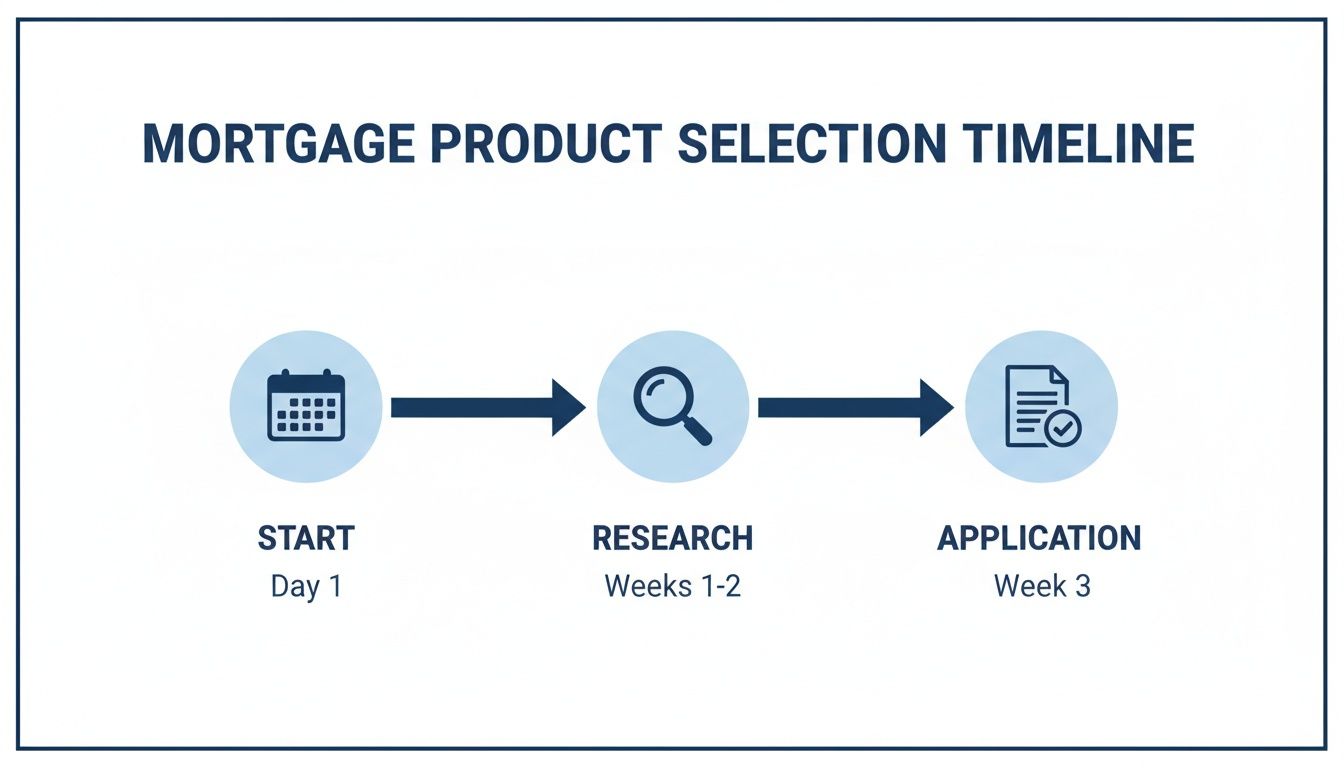
So, you’ve decided to remortgage. What actually happens next?
Understanding the journey from submitting your application to the moment the new deal is active can make the entire experience feel much more manageable. While every case has its own quirks, the process tends to follow a well-trodden path.
Knowing the key milestones helps you stay in the driver’s seat and spot potential delays before they become a real headache. Let’s map out what you can realistically expect, step by step.
Getting From Application To a Decision in Principle
The first real step is the formal mortgage application, which your adviser will handle. They’ll submit your completed form along with all the supporting documents we’ve talked about – payslips, bank statements, ID – to your chosen new lender.
Soon after, you should receive a Decision in Principle (DIP), sometimes called an Agreement in Principle (AIP). Think of this as a crucial early thumbs-up from the lender, confirming they are happy to lend to you based on the initial information. It is not a formal mortgage offer, but it is a very strong sign that you meet their basic criteria.
This initial phase is usually pretty quick, often taking just 24 to 72 hours, especially if all your paperwork is in perfect order.
The Underwriting And Valuation Stage
Once your DIP is in hand, your application moves over to the lender’s underwriting team. This is where a human underwriter takes a fine-tooth comb to your file, double-checking every document to ensure you tick all their lending and affordability boxes. They are essentially verifying that you are a reliable borrower.
At the same time, the lender will instruct a valuer to assess your property. Their job is to confirm the property is worth what you say it is and provides enough security for the loan. This might be a physical inspection by a surveyor, or sometimes just a simple “desktop” valuation using online data, which is common for straightforward remortgages.
This underwriting and valuation phase is where the real due diligence happens and typically takes between one and three weeks. The exact time depends on the lender’s current workload and how quickly they can get a surveyor out to your property, if needed.
The Legal Process And Final Completion
Following a successful underwriting review and valuation, the lender will issue your formal mortgage offer. This is the legally binding document you have been waiting for. A copy is sent to you, your adviser, and your solicitor.
Now, your solicitor takes centre stage. Their key jobs include:
- Carrying out identity checks to comply with anti-money laundering rules.
- Requesting a redemption statement from your current lender. This confirms the exact amount needed to clear your existing mortgage on a specific date.
- Checking the legal title of your property and carrying out any necessary searches.
Once all the legal work is done, your solicitor sets a completion date. On that day, they will draw down the funds from your new lender, use them to pay off your old mortgage, and register the new lender’s legal charge against your property title. From receiving the mortgage offer, this final legal stage and completion usually takes two to four weeks.
All told, you can expect the entire remortgage journey—from application to completion—to take between four and eight weeks. For a deeper dive into what can speed things up or slow them down, you can find more information about how long a mortgage application takes in our detailed guide.
Common Questions About Remortgaging a House
The world of remortgaging can feel a bit like alphabet soup, full of jargon and what-if scenarios. To help clear things up, I’ve pulled together the most common questions we get from homeowners, along with some straightforward, practical answers.
Can I Remortgage With Bad Credit?
Yes, you often can. It is a common misconception that a blip on your credit file means you are stuck with your current lender forever. While the big high street names might get nervous, there are plenty of specialist lenders who take a more rounded view of your finances. They understand that life happens—a missed payment or a default does not tell the whole story.
This is where a specialist broker becomes invaluable. We have relationships with lenders who manually underwrite applications. That means a real person reviews your case, rather than a computer algorithm simply saying “no.” We can build a strong application that explains the context behind any credit issues, presenting you in the best possible light.
What Are The Costs Of Remortgaging?
Switching your mortgage can save you a fortune in the long run, but it is smart to be aware of the potential upfront costs. The good news is that many remortgage deals are designed to be fee-free, but it is crucial to check the small print.
Here are the usual suspects to look out for:
- Arrangement Fees: These can range from a few hundred pounds up to £1,000 or more. Some lenders let you add this fee to the mortgage loan, but remember you will pay interest on it.
- Legal Fees: You will need a solicitor to handle the legal side of switching lenders. A lot of remortgage products come with a “free legals” package included, which is a great perk.
- Valuation Fees: The new lender will want to value your property to confirm what it is worth. Just like legal fees, many deals offer a free standard valuation.
A good broker will not just look at the headline interest rate. We will help you weigh up a lower rate with higher fees against a slightly higher rate with no fees, so you can see which deal is genuinely the most cost-effective for you.
Will I Face An Early Repayment Charge?
An Early Repayment Charge (ERC) is a penalty your current lender hits you with if you try to leave your deal before the initial fixed or tracker period is over. These charges are usually a percentage of your outstanding loan and can easily run into thousands of pounds.
Before you even think about looking at new deals, your very first job is to dig out your current mortgage offer. Find out exactly when your initial deal period ends. Most people start the remortgage process in the last six months of their term, as the ERC typically no longer applies during this window.
Can I Borrow More When I Remortgage?
Absolutely. In fact, it is one of the main reasons people remortgage. This is often called releasing equity or getting a ‘further advance’. By increasing your overall mortgage, you can free up cash for all sorts of things, like building an extension, consolidating more expensive debts, or even helping your kids with a deposit for their first home.
When you apply to borrow more, the lender will run the same affordability checks as they would for any mortgage, looking at your income, outgoings, and credit history. We see homeowners in places like Chelmsford do this all the time to fund home improvements, boosting their property’s value while locking in a great new rate on the whole loan.
Trying to navigate the remortgage market on your own can be a real headache, but you do not have to. The team at EHF Mortgages has the experience to guide you through every stage, answer all your questions, and find a deal that’s right for your circumstances.