
Yes, pensioners can get a mortgage in the UK. There’s no legal upper age limit, but approval depends on whether the lender can verify sustainable retirement income under FCA rules.
You may be sitting in your home in Chelmsford, Braintree or Colchester, wondering whether a lender will dismiss your application because you’ve reached retirement. That isn’t how the decision works. The lender wants to know whether the mortgage remains affordable throughout the term, including after you stop earning income.
💡 Top tip: Don’t start by asking which bank has the highest age limit. Start by proving exactly how your pension, investments and other income will cover the mortgage and your essential spending. I’ll explain how lenders assess that evidence, then match the main mortgage routes to common pensioner situations later in this guide.
UK Finance recorded 353 retirement interest-only mortgages advanced in Q1 2026, an increase of 5.4% year on year, and its later-life lending data tracks borrowing by people aged over 55. That makes pension-age borrowing an established part of the market, not an odd exception. The UK Finance later-life lending data also sits within an increasingly active regulatory environment.
The rules matter because later-life borrowing needs careful planning. If you’re considering releasing equity rather than taking a traditional mortgage, you can also review EHF’s guidance on equity release over 55. For property decisions generally, it’s sensible to understand the difference between comparing surveyor and bank valuation costs, particularly when you’re deciding whether a purchase, remortgage or equity-release route makes sense.
Yes, Pensioners Can Get a Mortgage, and Here Is How
Reaching State Pension age doesn’t automatically end your borrowing options. There is no legal upper age limit for getting a mortgage in the UK, although each lender sets its own criteria and usually assesses your age at the end of the term, not just on the application date. Lender age criteria can vary widely, with some later-life arrangements running into advanced retirement ages where the affordability evidence supports them.
The two tests are straightforward.
The lender must accept the proposed term. A standard lender may restrict the age you can reach when the mortgage finishes. Typical maximum ages commonly sit between 70 and 80 at application, or between 70 and 95 at the end of the term, depending on the lender and product. Publicly reported 2026 criteria changes show that some mainstream lenders have extended borrowing capacity for older applicants, including terms reaching age 80. Later-life mortgage criteria demonstrate why one bank’s refusal doesn’t prove that borrowing is impossible.
The repayments must remain affordable. The lender needs evidence of sustainable income, not optimism about future finances. Pension income, investment income and other verified sources may be considered, but the lender will assess them alongside household expenditure and the full mortgage term.
What this means locally
EHF Mortgages is an independent, whole-of-market broker based in Chelmsford, Essex, serving clients throughout the UK, including Braintree and Colchester. A specialist adviser’s role isn’t just finding an older-borrower product. It’s identifying which lender will understand your income and structuring the application around that evidence.
One lender may consider a 68-year-old applicant with a 20-year term, while another rejects them. The difference could be the lender’s end-of-term age limit, how it treats drawdown income, or its view of essential expenditure. Applying randomly can create unnecessary credit searches and wasted time.
Practical rule: Your age starts the conversation. Your sustainable income and repayment structure decide the outcome.
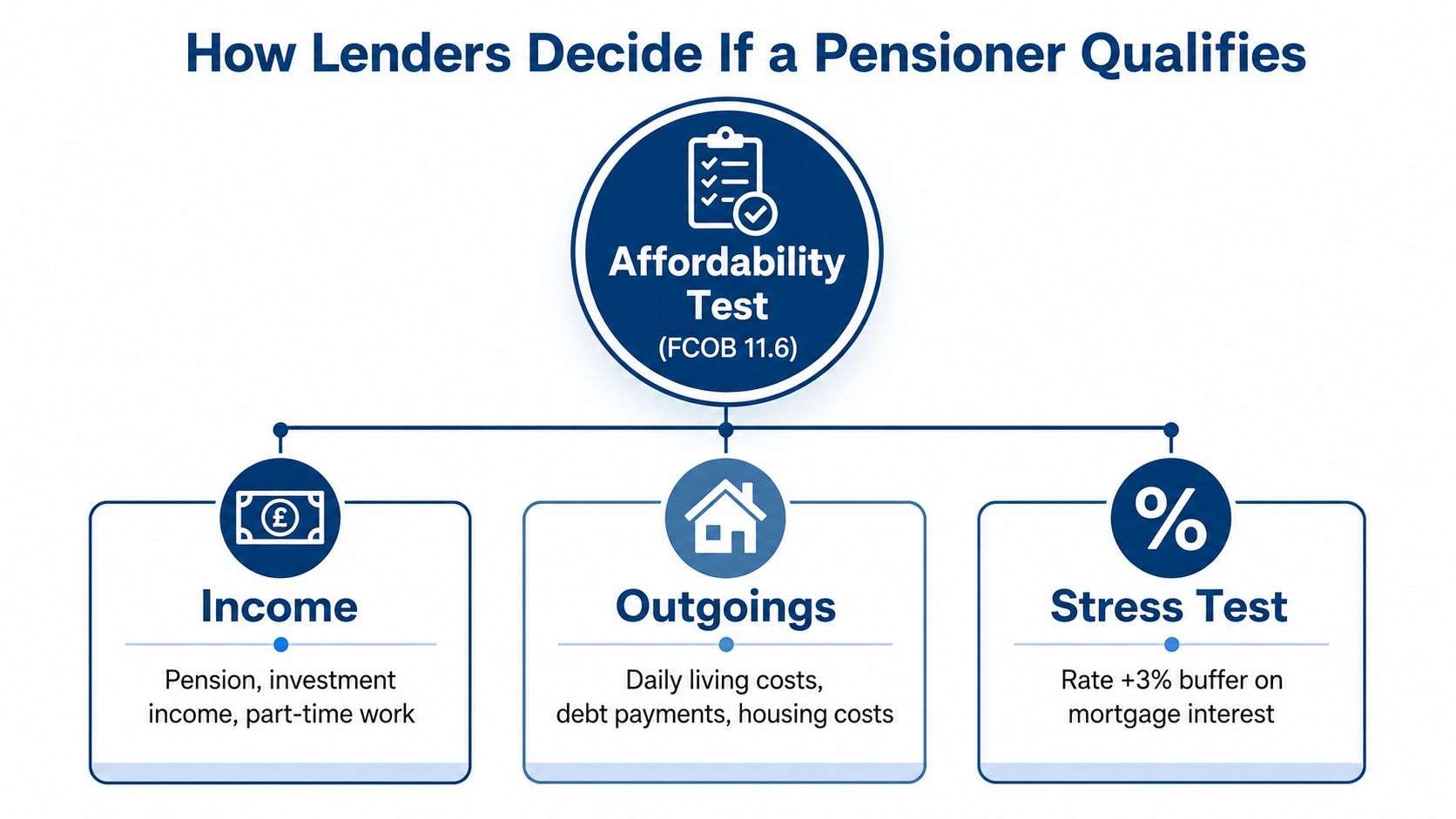
How Lenders Decide If a Pensioner Qualifies
Affordability rules matter more than the label “pensioner”. FCA MCOB 11.6 requires firms to evidence every income element used in affordability checks and expressly permits income from pensions or investments. Where the term extends beyond expected retirement age, the lender must take a prudent and proportionate view of post-retirement income, rather than relying on employment income alone. The FCA mortgage conduct rules set the framework.
In plain English, the lender builds a household budget. It records the income it can verify, deducts essential expenditure and existing commitments, then tests whether the proposed mortgage payment remains manageable. The lender won’t assess the application based on the pension figure alone.
The two boxes to tick
First, the lender must accept the income. That could include a State Pension, private pension, annuity, investment income or continuing employment, depending on the lender’s policy and the supporting documents. Irregular withdrawals or income that may stop soon require closer scrutiny.
Second, the lender must accept the term and repayment plan. A repayment mortgage gradually reduces the balance through monthly capital and interest payments. An interest-only mortgage normally requires a credible capital repayment strategy. A Retirement Interest-Only mortgage, or RIO, generally requires the interest to be paid monthly while the capital is repaid later, often when the property is sold, or the borrower dies.
The age-at-end-of-term point catches many applicants out. A 68-year-old asking for a 20-year mortgage isn’t being assessed only as a 68-year-old. The lender needs to understand the income and expenditure position at the point the term ends, including whether the proposed retirement income can support the payments.
Why one lender may say no
Age policies differ. Some mainstream lenders stop accepting new applications beyond a particular age, while others will consider older borrowers if the term is shorter or the income is particularly strong. Specialist lenders may extend the term further, but they still need a credible affordability case.
Don’t treat a maximum age as the target. A mortgage that technically runs to an advanced age may still be unsuitable if it leaves too little disposable income. The right term balances affordability, capital repayment, and the borrower’s plans for the property.
Comparing Mortgage Routes for Older Borrowers
The right product depends on the borrower’s objective, income and preferred monthly commitment. A standard residential mortgage usually fits someone with sustainable income who can repay both interest and capital within the lender’s age policy. A Retirement Interest-Only mortgage can suit a borrower who can meet the monthly interest but wants to preserve cash flow. A lifetime mortgage is an equity-release option for homeowners who want to raise funds without a standard repayment schedule.
| Option | Who It Suits | Typical Minimum Age | Main Benefit | Main Drawback |
|---|---|---|---|---|
| Standard residential mortgage | Borrowers with sustainable income and a suitable term | Varies by lender | Repays capital and interest in the usual way | Age-at-end-of-term and affordability limits may restrict the borrowing |
| Retirement Interest-Only mortgage | Borrowers aged 55 and over who can afford monthly interest | 55+ | Lower monthly payments because capital is not normally repaid each month | The capital remains outstanding and needs a repayment event |
| Lifetime mortgage | Older homeowners wanting to release equity without a standard repayment schedule | Varies by product | Can provide cash without selling the home | Interest and the balance can grow, reducing remaining equity |
A standard mortgage is normally the first route to test where the loan is modest, income is well documented and the proposed term remains practical. It gives the borrower a clear capital repayment plan, but the lender will assess affordability through to the end of that term.
A Retirement Interest-Only mortgage addresses a different problem. It reduces the required monthly payment by leaving the capital outstanding, so the borrower needs a credible repayment event, such as selling the property or using other available funds. The lower payment does not make it automatically cheaper or safer.
A lifetime mortgage can be more suitable where regular payments would place too much pressure on the budget and the borrower wants to stay in the property. The trade-off is direct: interest can increase the balance, which may reduce the equity available later and affect what beneficiaries receive.
A Colchester example
A 72-year-old homeowner in Colchester may want to remain in the family home while releasing equity. If verified retirement income supports the monthly interest, a RIO mortgage may fit. If those payments would strain the budget, a lifetime mortgage may be more appropriate. A standard remortgage should still be tested where the loan is modest, the term works, and repayment affordability is strong.
The decision should follow the borrower’s income, monthly budget and plans for the property, not the product label. A whole-of-market assessment also matters because lenders apply different age limits, income rules and repayment requirements.

What Income Lenders Accept in Retirement
Retirement income is where many applications succeed or fail. FCA rules allow lenders to use pensions and investments, but the lender must evidence each income source and decide whether it is sustainable for the proposed term.
A State Pension can form part of the affordability calculation, but it may not support a large mortgage on its own. A defined benefit, or final salary, pension is often easier to assess when it provides a regular, documented payment. Defined contribution pensions may produce income through an annuity or drawdown, but the lender will want to understand how the payments are calculated and whether they’re likely to continue.
Investment income can include dividends, interest or rental income, subject to the lender’s policy and evidence requirements. Some lenders may also accept continuing part-time employment or certain benefits. Others restrict what you can use once retirement begins. One lender’s criteria state that from retirement, or age 75 if earlier, only retirement income will count for affordability. That single rule can change which lender is suitable.
Documents to prepare
Gather the paperwork before submitting an application. A complete file gives the adviser and lender a clearer view of sustainable income.
State Pension award letter: Use the official document confirming the payment.
Private pension statements: Include defined benefit and defined contribution statements.
Annuity confirmation: Provide the letter showing payment terms and frequency.
Drawdown evidence: Supply statements showing regular withdrawals and the underlying pension arrangement.
Investment records: Include portfolio valuations and evidence of dividends or interest.
Tax documents: P60s, tax returns and relevant bank statements can support declared income.
Small or irregular income needs a different approach
A small pension doesn’t automatically mean a decline. It does mean the loan amount, term and product need to be realistic. A lender may be more comfortable with a modest loan against a low loan-to-value property than a large advance that depends on unpredictable withdrawals.
If your income is partly drawn from investments, don’t present a single recent withdrawal as if it were a salary. Show the pattern, the source of the money and the assets supporting it. The lender needs to see whether the income can continue after essential spending and mortgage costs.
You can use EHF’s mortgage affordability calculation guide to organise the figures, but the lender’s own criteria remain decisive. Prepare the evidence first, then choose the lender.
Three Real Pensioner Scenarios and What We Would Recommend
The right mortgage depends on the problem to solve. Replacing an existing loan, releasing money from an unmortgaged home and borrowing with irregular pension income each require a different recommendation.

The 67-year-old in Colchester
This borrower is approaching the end of a fixed-rate deal on an existing interest-only mortgage. The first test is whether a standard remortgage onto capital repayment remains affordable, based on income the lender can verify. If the monthly payment fits and the balance can be cleared over a suitable term, that is usually the cleaner route.
If capital repayment produces too much pressure, a RIO mortgage may be more appropriate. It limits the monthly payment to interest, while the capital remains outstanding. The balance then needs a defined solution, such as a future property sale, a separate repayment plan or another agreed event.
Do not wait for the mortgage to reach maturity before investigating. UK Finance data show that the number of interest-only mortgages due to mature by 2027 halved in 2025, leaving approximately 60,000 borrowers exposed to repayment timing risk. Recent UK Finance maturity commentary explains why borrowers should start early.
No adviser can quote a responsible monthly payment or loan-to-value without the property value, outstanding balance, interest rate and verified income. Those figures need an individual assessment.
The 72-year-old in Chelmsford
This homeowner owns the property outright and wants to gift money to family or supplement retirement income without moving. A lifetime mortgage is often the most direct option because it can release equity without a standard income-based mortgage assessment.
The cost is substantial. Interest can accumulate, the balance can increase, and the equity left for the homeowner or beneficiaries can fall. A RIO mortgage is worth considering if the borrower has enough income to pay interest each month. It is the wrong fit for someone who wants to avoid regular repayments.
Start by defining how the money will be used. Then check potential effects on benefits and estate planning, where relevant, and compare lifetime mortgage features before committing.
The 70-year-old with small drawdown income
This borrower has a small State Pension and irregular income from pension drawdown. A standard lender may reject the case if withdrawals lack a consistent pattern. A lender with more flexible retirement-income criteria may consider the drawdown history, pension value and wider assets together.
The borrowing request should be modest and tested against essential expenditure. For a purchase or remortgage, a repayment mortgage may work if the term is short enough. If monthly cash flow is restricted, a RIO or lifetime mortgage may fit better, depending on whether the borrower wants regular payments.
The application should include a clear record of withdrawals, the underlying pension value and evidence of other assets.
Video summary: the scenarios explain how existing interest-only mortgage maturity, equity release and irregular drawdown income can lead to different later-life mortgage recommendations.
Why a Specialist Later-Life Broker Makes the Difference
A single high-street branch can only assess you against that bank’s products and interpretation of retirement income. That’s a poor strategy when lender criteria differ on age, drawdown, investment income, term length and repayment plans.
EHF Mortgages operates from Chelmsford and provides whole-of-market advice across over 100 lenders, with more than 35 years of industry experience. It is FCA authorised under FCA No. 940123, and its later-life work includes membership of the Equity Release Council. Those are factual credentials, not a guarantee of approval.
The practical advantage is lender selection. Most standard lenders commonly cap mortgages within the 70 to 80 age range, while one intermediary lender says it can lend to age 95 at the end of a repayment term or age 89 at application for interest-only borrowing. That doesn’t make the oldest available term suitable. It does show why a broker who knows specialist criteria can identify options a branch adviser won’t have.
Evidence makes or breaks borderline cases
A specialist adviser can organise pension statements, annuity letters, investment evidence and expenditure in a format that matches the lender’s assessment. That matters when income is split across several sources or changes during retirement.
Before choosing an adviser, read guidance on how to choose a mortgage broker. Check the firm’s regulatory status, product access, later-life experience and explanation of fees. Don’t accept vague reassurance. Ask which income sources will be used, which lender rules create the constraint and what happens if the first lender declines.
Practical Steps to Improve Your Chances of Approval
Start preparing before you request a Decision in Principle. Pensioner applications become harder when documents are missing, debts are overlooked or the requested term doesn’t match the borrower’s age and income.
Check your credit file. Look for old errors, incorrect balances and accounts that should have been closed. Correct problems before an application rather than explaining them after a decline. Guidance on the minimum credit score for a mortgage in the UK can help, but there isn’t one universal score that guarantees acceptance.
Gather every income document. Put State Pension evidence, private pension statements, annuity letters, drawdown records, investment valuations, P60s and bank statements in one folder. Don’t rely on estimates from memory.
Reduce avoidable commitments. Paying down small credit card balances or loans can improve the monthly affordability picture, provided you don’t use money needed for the deposit, fees or emergency reserves.
Choose the term realistically. A longer term may reduce the monthly payment, but it can push the mortgage beyond a lender’s maximum age or leave capital outstanding later in life. A shorter term can improve the repayment position but may fail the affordability test because the monthly payment is higher.
Obtain a Decision in Principle. Get advice before viewing properties or submitting multiple applications. The DIP should reflect verified income and realistic outgoings, not an optimistic borrowing estimate.
Bring the documents to the first appointment and be open about future plans. If you expect to downsize, gift money, move into care or change your drawdown pattern, say so early. The mortgage needs to fit your retirement plan, not just pass today’s calculation.
Your Next Step and How to Speak to EHF
You now have the three points that matter. There’s no legal upper age limit, retirement income must be evidenced under FCA affordability rules, and the suitable product depends on whether you’re buying, remortgaging, managing an interest-only maturity or releasing equity.
Don’t choose a lifetime mortgage just because you’re older, and don’t assume a standard mortgage is automatically better because it has monthly capital repayment. The correct route depends on income stability, property value, existing debt, desired cash flow and what you want to leave or retain in the property.
The Chelmsford-based EHF Mortgages team serves clients across the UK, including Essex, Braintree and Colchester. Take your pension documents and current mortgage statement to an adviser, ask for a lender-specific affordability assessment, and request a clear comparison of standard, RIO and lifetime mortgage options.
EHF Mortgages offers whole-of-market mortgage advice, including standard residential lending, remortgages, Retirement Interest-Only mortgages and equity-release options for later-life borrowers. If you’re ready to discuss your retirement income, existing mortgage or plans to release cash, visit EHF Mortgages and start the conversation.





