
Thinking about renting out your house because a move is coming, the sale isn’t quite where you want it, or you’d rather keep hold of the property in Essex?
💡 Top tip: check your mortgage before you do anything else. That one step stops the most expensive mistakes, and I’ll explain exactly why later.
Many homeowners start with the practical bits. Finding tenants, setting rent, tidying the place up. In practice, the actual starting point is whether your lender will allow the property to be let at all.
That matters more now because letting a home is no longer unusual. The private rented sector accounted for 19% of households in England in 2022–23, up from 10% in 2003–04, while owner occupation fell from 71% to 65% according to the English Housing Survey figures referenced here. If you’re asking, “Can I rent out my house?”, you’re asking a mainstream housing question, not an edge case.
Can You Rent Out Your House? The First Question to Ask
The short answer is yes, you can often rent out your house, but only if the legal, lending, insurance, and tax pieces line up properly.
For most owners in Chelmsford, Braintree, Colchester and the wider Essex area, the first question isn’t whether the property would make a decent rental. It’s whether the current mortgage allows it. If you have a standard residential mortgage, the property was usually approved on the basis that you would live in it yourself. Change the use without permission, and you can create problems before the first tenant even picks up the keys.
The first filter to apply
Ask yourself these questions in this order:
Do I have a residential mortgage? If yes, lender consent is usually the starting point.
Am I still tied to a fixed rate? If yes, changing products too early can be costly.
Will this be temporary or long-term? That affects whether consent to let or a buy-to-let route is more sensible.
Am I ready for landlord obligations? Rent collection is only one part of the job.
Practical rule: If your mortgage position isn’t clear, don’t market the property yet.
That sounds basic, but it’s where many accidental landlords go wrong. They assume that because they own the property, they can let it. Ownership and permission aren’t the same thing when a lender still has a charge over the property.
What usually works and what doesn’t
What works is a clear sequence. Check the mortgage. Confirm the lender’s position. Review the costs of staying put versus switching. Then move on to insurance, safety, tenancy setup and tax reporting.
What doesn’t work is doing it backwards. Listing the house first, accepting a tenant quickly, then trying to sort the mortgage later can leave you under pressure and with fewer good options.

Navigating Mortgage Rules and Lender Permissions
This is the part that decides whether your plan is straightforward or expensive.
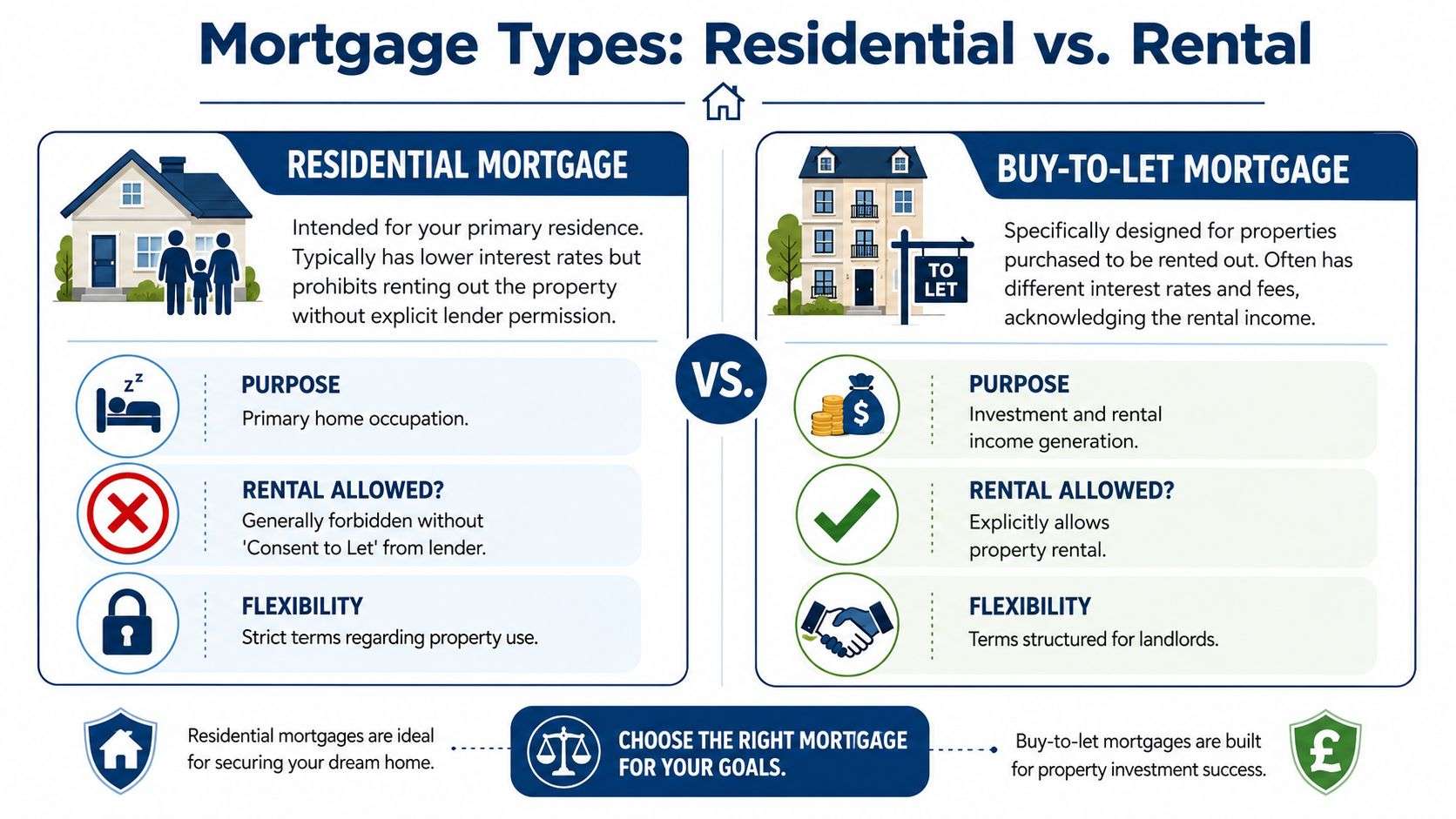
If you have a standard residential mortgage, letting without permission can breach the contract. A formal consent-to-let or switch to a buy-to-let product is required so the mortgage matches the property’s use, and lenders often assess buy-to-let affordability on rental income coverage rather than just personal income, as noted in this mortgage permissions explanation.
Consent to let
Consent to let is often the most practical answer when the move is temporary or when you’re part-way through a fixed deal and don’t want to trigger penalties.
In day-to-day broker work, this is one of the most common routes for homeowners who didn’t originally buy with landlord plans in mind. The lender authorises the property to be rented while keeping the existing residential mortgage in place. You usually need to arrange this directly with the lender, and there is commonly a cost involved. It is also often granted for a limited period rather than indefinitely.
“To rent your property whilst you have a residential mortgage, you do need permission from the lender. Typically, there is a cost, and they will grant permission for a year at a time.”
A real example from practice shows why this matters. We dealt with a client who was 2 years into a 5-year fixed residential mortgage and wanted to let the property for a period. Switching straight to a buy-to-let mortgage would have caused £8,000 of Early Repayment Charges. The better answer was to obtain lender consent, avoid those fees, and review a buy-to-let switch once the current deal expired.
Buy-to-let remortgage
A buy-to-let remortgage is usually the cleaner long-term structure when the property is clearly becoming an investment rather than a temporary let.
That route tends to suit owners who are keeping the property as part of a longer strategy, especially if they may buy another residential home elsewhere. It aligns the mortgage product with the property’s intended use from the outset.
For a fuller breakdown of lender criteria and rental property borrowing, EHF’s guide to buy-to-let mortgages explained is a useful next read.
Which route fits your situation
| Option | Best for | Main benefit | Main drawback | Typical pattern |
|---|---|---|---|---|
| Consent to let | Temporary letting | Avoids changing product too early | Usually time-limited | Existing lender permission |
| Buy-to-let remortgage | Long-term landlord plans | Mortgage matches rental use | May trigger fees if timed badly | New or replacement product |
The mistake I see most often is homeowners assuming buy-to-let is automatically the right move because the property will be rented. Sometimes it is. Sometimes it creates avoidable costs. The right answer depends on timing, tie-ins and how long you expect to let the house.
Your Legal Duties and Insurance as a Landlord
A house can be mortgage-ready to let and still be nowhere near tenancy-ready.
That gap catches out a lot of first-time landlords. They have lender consent in place and a tenant lined up, only to discover the property still needs safety documents, the right alarms, the right insurance, or a licence from the council. Those are not admin details to sort out later. They affect whether you can let the property properly from day one.

The legal starting point is straightforward. The property must be fit for human habitation, safe to occupy, and kept in repair throughout the tenancy. The Homes (Fitness for Human Habitation) Act 2018 strengthened tenants’ rights in England to challenge poor conditions directly, as set out in the UK Government’s guidance on the Homes (Fitness for Human Habitation) Act 2018.
Safety and condition
Before handing over the keys, check the property like a landlord, not like an owner who knows its quirks.
That means dealing with the paperwork and the physical condition together:
Gas safety: Arrange an annual gas safety check if the property has gas appliances or pipework covered by the rules.
Electrical safety: Ensure the installation is safe and obtain the required electrical inspection report where the tenancy requires it.
Smoke and carbon monoxide alarms: Fit the alarms required for the layout and fuel type, then test them at the start of the tenancy.
Repairs and defects: Fix leaks, heating faults, broken windows, unsafe stairs, damp issues, and poor ventilation before the tenant moves in.
Furniture and appliances: Any items you provide need to be safe and suitable for tenant use.
If you want a wider background on the standards landlords are expected to meet, this guide to fair housing and habitability laws is useful reading.
Why standard home insurance usually fails
Owner-occupier insurance is written for a different risk. Once tenants move in, the insurer is assessing a rental property, not your home.
I see this missed regularly in Essex, especially where the owner plans to let for “just a year” and assumes the existing policy will do. It may not. If a claim arises and the insurer was never told the property was tenant-occupied, you can end up arguing over cover at the worst possible time.
Landlord cover is built for that use. It commonly includes buildings insurance, property owners’ liability, and options for risks such as accidental or malicious damage, loss of rent after an insured event, and legal expenses. EHF has a practical guide to landlord insurance for rental properties if you want to compare what is usually included.
A short explainer is useful here:
Local licensing checks
Licensing can change the whole setup. A standard single-let may need nothing beyond the usual compliance work, while an HMO or a property in a selective licensing area can need council approval before the tenancy starts.
Do not assume the rule in one Essex postcode applies to another. Chelmsford, Colchester, Southend and other councils can each take a different approach. Check the local authority’s current licensing position directly, then build that into your timing and costs before the tenant moves in.
Understanding Your Tax Obligations on Rental Income
Many owners only look at the rent. HMRC looks at the taxable profit.
That distinction matters early, especially if you are already working through lender consent, a possible rate change, or the cost of moving onto a buy-to-let mortgage. I often see homeowners focus on whether the rent covers the monthly payment, then realise later that the tax position changes the numbers more than they expected. If you want to know whether letting the property stack up, run the tax calculation before you commit to tenants.
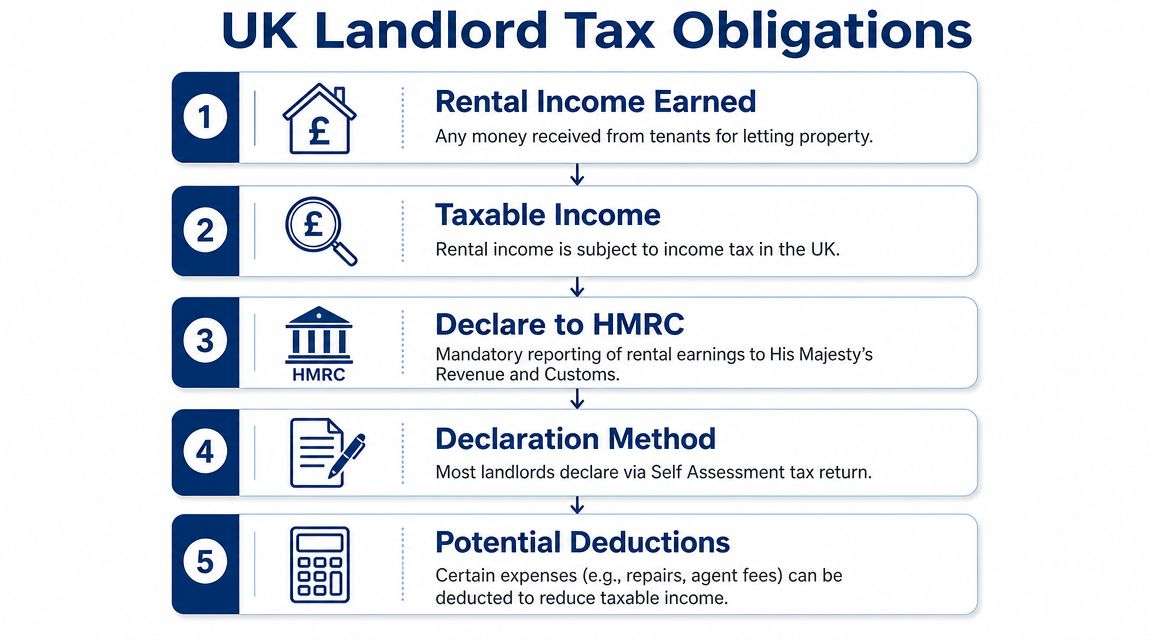
Rental income usually needs to be declared to HMRC. If your receipts go over the property allowance, or you need to report the profit in full, that often means registering for Self Assessment and keeping proper records from day one. HMRC explains the rules for tax on property income.
What landlords often miss
The practical question is not just how much rent comes in each month. It is what costs are allowable, what your taxable profit will be, and how that profit sits alongside your salary or other income.
Costs often reviewed include:
Letting or management fees
Repairs and maintenance that keep the property in rentable condition
Landlord insurance
Accountancy and admin costs linked to running the tenancy
The detail matters. A repair is treated differently from an improvement. Replacing a worn-out item is not the same as upgrading the property beyond its previous standard. That is why I usually tell first-time landlords to speak to an accountant before the tenancy starts, while choices can still be structured properly.
Mortgage interest relief changed
This catches many accidental landlords.
The tax rules changed over several years. Individual landlords no longer receive full relief for mortgage interest as before. Instead, relief is restricted and provided as a basic-rate tax reduction. HMRC sets out the current treatment in its guidance on residential property finance costs.
That means a rental can look fine at first glance and still produce a weaker net position once tax is worked through properly. It is one reason I push owners to get lender consent sorted first and test the whole picture together. Mortgage terms, rate changes, agent fees and tax all feed into the same decision.
There is also the Stamp Duty Land Tax surcharge to factor in if you buy another property while keeping the current one as a let. HMRC applies higher rates to additional residential properties. For some owners, that charge completely changes the plan.
A rental property can still be a good move, but the figures need to work under current tax rules and current mortgage terms.
Do not leave the sale to future you
Tax does not stop with the rent. If the property is sold later at a gain, Capital Gains Tax may come into play depending on how long you lived there, when it was let, and whether any reliefs apply.
In these cases, short-term thinking becomes expensive. A house meant to be rented for a year can end up being let for several years, and the tax history becomes harder to reconstruct if the records were poor from the start.
Choosing Between Short-Term and Long-Term Lets
Once the mortgage, legal setup, and tax position are under control, the next decision is how you want the property to operate day-to-day.
A long-term let usually suits owners who want steadier occupation and a simpler rhythm. A short-term let can be attractive if you want flexibility or the possibility of a higher income during stronger periods, but it usually entails more management, more changeovers, and more wear on the property.
Long-term letting
For many first-time landlords, a long-term tenancy is the easier introduction.
You’re typically dealing with one household over a longer period, fewer check-ins and check-outs, and a clearer maintenance cycle. That doesn’t make it passive. It just makes it more predictable. If you live in Braintree and the property is in Chelmsford, or you’ve moved out of Essex altogether, predictability matters.
Long-term letting often works well when:
You want stability: Fewer gaps and less constant administration.
You’re new to being a landlord: The process is easier to manage.
The house suits family or professional tenants: Standard homes usually fit this route better than highly unusual properties.
Short-term letting
Short-term and holiday-style letting is a different business model. It needs active management, rapid cleaning turnaround, tighter booking control and closer attention to guest use of the property.
It can suit some owners, but it isn’t just “normal letting for shorter periods”. Mortgage terms, insurance wording, and local rules all need to be checked against that specific use.
A practical way to decide
| Factor | Long-term let | Short-term let | Better if you want |
|---|---|---|---|
| Management effort | Lower day to day | Higher day to day | Simplicity |
| Occupancy pattern | More stable | More variable | Flexibility |
| Wear and tear | Usually steadier | Often heavier | Lower turnover |
| Mortgage fit | Common landlord route | Needs careful checking | Fewer surprises |
What usually doesn’t work is choosing short-term letting because it sounds more profitable, without pricing in the extra admin, void risk, furnishing demands and compliance checks. If the property is your former home in Colchester and you’re trying to keep life simple, long-term often proves easier to live with.
Your Practical Checklist for Renting Out Your Home
A house becomes rentable when it is rent-ready, not when it is merely empty.
That means safe systems, a clean and functional property, the right paperwork, and proper evidence of condition. A signed move-in inventory with photos is essential because strong pre-tenancy documentation reduces deposit disputes and helps landlords in evidence-driven tenancy deposit schemes, as explained in this guidance on preparing a property before listing it.
Before you list the property
Start with the building itself.
Finish repairs first: Leaks, broken handles, damaged flooring and tired sealant all look minor until a tenant reports them in week one.
Check the core systems: Heating, plumbing, electrics and ventilation need to work properly.
Deep clean the home: A professionally presented property usually attracts stronger applicants.
Inspect room by room: This comprehensive property inspection guide is a good reference point if you want a sensible structure for that process.
On the ground: Most deposit disputes are harder to defend when the starting condition was never properly recorded.
Before tenants move in
The second stage is paperwork and proof.
Right to Rent checks, referencing, a written tenancy agreement, deposit protection and a detailed inventory all matter. The inventory should be specific, signed, and supported by clear, dated photos. “Good condition throughout” is weak evidence. A room-by-room schedule is much better.
Pre-tenancy checklist summary
| Task | Area | Why it’s important | Typical Cost | DIY or Pro? |
|---|---|---|---|---|
| Mortgage permission confirmed | Finance | Prevents breach of mortgage terms | Varies by lender and product | Usually lender and broker |
| Repairs and safety checks | Property condition | Makes the home fit to occupy | Varies by work needed | Mixed |
| Inventory with photos | Evidence | Helps with deposit disputes | Varies by provider | Either |
| Insurance switched | Risk protection | Matches the property’s new use | Varies by policy | Usually adviser or insurer |
| Deposit and tenancy paperwork | Compliance | Protects the tenancy setup | Varies by scheme and documents | Mixed |
A practical sequence that works well is this:
Get lender approval
Arrange insurance
Complete repairs and safety work
Prepare the tenancy documents
Record condition thoroughly before move-in
What doesn’t work is rushing to fill the property just to get rent coming in quickly. A poor tenant in a poorly documented property incurs more costs than a short delay ever does.
When to Seek Expert Advice from EHF Mortgages
Some rental decisions are straightforward. Many aren’t.
Advice becomes especially useful when you’re part-way through a fixed mortgage, trying to avoid penalties, moving on from your main residence, or weighing up whether the property should become a longer-term investment. Those choices affect borrowing, insurance and tax planning together, not one at a time.
If you’re comparing lender consent against a remortgage, a broker can help you map the cost of each route before you commit. If you want a sense of where specialist support fits in, EHF’s page on whether you need a mortgage advisor is worth a look.
For firms handling complex mortgage journeys, wider technology changes, such as tools that optimise mortgage lending operations, also show how much the market has shifted toward tighter processes and cleaner decision-making. For homeowners, that means getting the setup right early matters more than ever.
In practical terms, expert advice is most valuable when the wrong move could lock in costs you didn’t need to pay. That is often the case for homeowners in Chelmsford, Braintree, Colchester and across Essex who are converting a main home into a rental while still tied into an existing deal.
If you’re asking, can I rent out my house? The answer may be yes. The better question is whether you can do it in a way that protects your mortgage position, keeps the property compliant and avoids avoidable costs.
If you want personalised guidance on lender consent, buy-to-let options or the best next step for your property plans, speak to EHF Mortgages.





