
You’ve got an old flat in Chelmsford, Braintree or Colchester, and you’re deciding whether to let it or sell it before buying your next home.
💡 Top tip: don’t choose between a buy-to-let mortgage and a residential mortgage by comparing rates alone. Compare cash flow, tax, deposit, and your long-term exit plan. I’ll show you exactly how that decision works, including a worked rental example, later in this article.
A buy-to-let mortgage is designed around an investment property and its rental income. A residential mortgage is designed around the home you live in and your personal affordability. That sounds simple, but the difference affects almost every part of the application, from the deposit and stress testing to repayment method, tax and lender documentation.
Why This Choice Matters in 2026
The wrong mortgage can leave you owning the right property with the wrong monthly economics. A former home might feel like an obvious rental, yet the rent may not support the required borrowing once the lender applies its stress test. Equally, selling may release useful capital but remove a potentially valuable long-term asset.
In 2026, lenders still separate these decisions firmly. A residential application asks whether you can afford to live in the property. A buy-to-let application asks whether the rent can support the mortgage, while also considering your experience, wider finances and the property itself.
That distinction matters if you’re moving home and keeping your existing property. You can’t take out a residential mortgage on an investment property just because the rent looks comfortable. If you’ll no longer occupy the home, you’ll need the lender’s permission or a suitable buy-to-let arrangement. Applying on the wrong basis can create serious legal and financial problems.
Start with the decision, not the product
Ask yourself three questions:
Will I live there? If yes, residential lending is usually the relevant route.
Will a tenant occupy it? If yes, assess buy-to-let finance and the property’s rental performance.
What do I need the property to do? It might provide income, preserve future options, release equity or fund the next purchase.
A landlord also needs to allow for void periods, maintenance, insurance, management costs and tax. The mortgage is only one part of the investment calculation.
Practical rule: If the property only works when every month is fully occupied and every repair is ignored, it doesn’t work.
This is why the buy-to-let mortgage vs residential choice deserves advice before you make an offer or commit to a remortgage. The answer depends less on which product sounds attractive and more on whether you’re buying a home or operating a rental business.
The Two Markets at a Glance
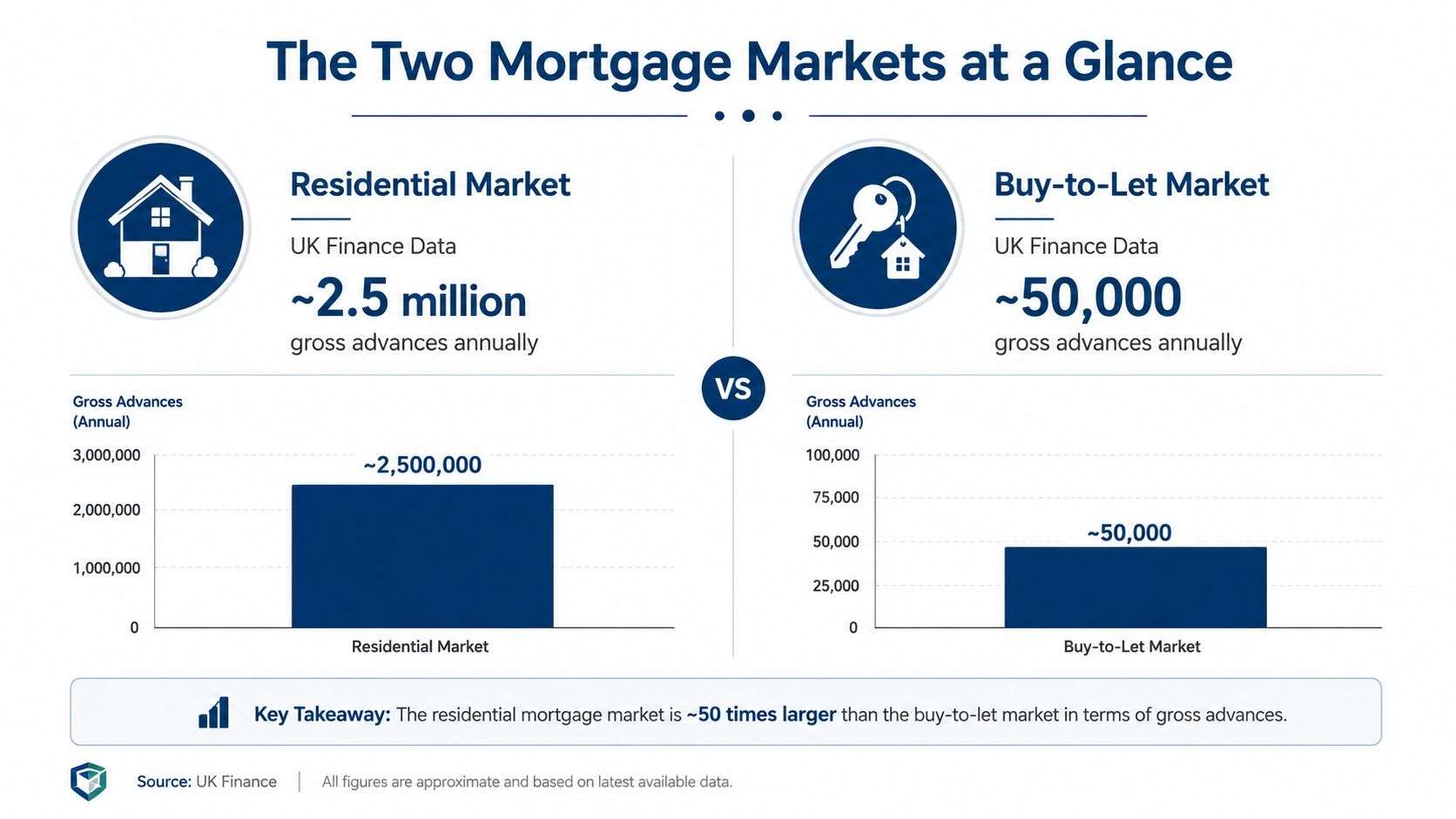
The choice between buy-to-let and residential lending is a cash-flow decision before it is a product decision. In Q1 2026, 58,272 new buy-to-let loans were completed, worth £10.8 billion, while the FCA recorded £1,746.1 billion of outstanding residential mortgage loans in June 2026, according to UK Finance’s buy-to-let lending data.
That scale difference matters. Residential mortgages serve owner-occupiers across the main mortgage market. Buy-to-let is a smaller, specialist market where the property must support an investment case. The FCA reported that BTL represented 8.9% of gross mortgage advances in Q1 2026. UK Finance recorded an average buy-to-let interest rate of 4.71% and an average interest cover ratio of 221% in the same quarter.
Two different lender questions
A residential lender starts with your salary, committed expenditure, credit history and household circumstances. The property secures the loan, but your personal affordability normally determines how much you can borrow.
A BTL lender starts with the expected rent. It tests whether that rent covers interest at a stressed rate. Personal income can still affect eligibility, particularly for certain applicants and products, but rental income remains central. The PRA supervisory statement on buy-to-let underwriting says lenders should use an interest coverage ratio test or, when using personal income, an income affordability test.
That creates a clear break-even question. If you live in the property, your income supports the mortgage, and you benefit from occupying the home. If you let it, rent must cover mortgage interest, voids, repairs, insurance, management and tax. A higher rent does not automatically produce a better result.
Fixed pricing also dominates landlord finance. UK Finance recorded 1.47 million fixed-rate BTL mortgages outstanding compared with 453,000 variable-rate loans, showing how common fixed pricing is in the landlord book.
If you are comparing an early indication with something more formal, read about pre-approval vs commitment letter. The wording and certainty vary, so treat neither document as a guaranteed mortgage offer unless the lender has formally confirmed it.
Eligibility and Deposit Differences
Residential lending generally suits someone buying a home to occupy. The lender focuses on personal income, existing commitments, credit conduct, and household affordability. Buy-to-let lending is more selective about the property’s rent, the applicant’s landlord profile and the proposed loan structure.
The biggest practical difference is the deposit. Buy-to-let borrowing is typically capped at around 75% loan-to-value, so you usually need a 25% deposit or equivalent equity, according to Padlord’s mortgage stress test guidance. Residential mortgages can reach up to 95% loan-to-value, making owner-occupier borrowing far less reliant on a large deposit.
Eligibility and deposit differences at a glance
| Criteria | Buy to let | Residential | Typical range | Watch out for |
|---|---|---|---|---|
| Main purpose | Rental investment | Owner-occupied home | Depends on use | Don’t occupy a BTL property without permission |
| Deposit or equity | Usually substantial | Can be lower | Around 25% BTL, up to 95% LTV residential | Product and applicant criteria vary |
| Main affordability driver | Rent and ICR | Personal income and expenditure | Lender-specific | Rent may not support the loan |
| Applicant profile | Landlord or investor | Homebuyer or homeowner | Standard to specialist | Portfolio and credit history affect choice |
| Property requirements | Must suit letting | Must suit occupation | Property-specific | HMOs and unusual homes need specialist review |
For a property valued at £300,000, a 25% BTL deposit would be £75,000, leaving a £225,000 mortgage. That example uses the stated 75% LTV structure, but your own deposit requirement depends on the lender, property, rent and applicant profile. You can also use equity in another property instead of cash, subject to the lender’s assessment.
A residential buyer might borrow more against the same purchase price, but lenders usually assess the monthly payment against salary and household expenditure. That can help a first-time buyer, but it doesn’t make residential lending suitable for an investment purchase.
Foreign nationals need particular care. Santander Intermediaries said in June 2026 that some eligible residential applicants without permanent right to reside could be considered up to 90% LTV, subject to additional income, bank statement and UK-deposit evidence. The policy explicitly excluded buy-to-let applications for foreign nationals, as reported in NetRent’s discussion of landlord stress tests and affordability.
If you’re trying to work out how much cash or equity a rental purchase may need, use this guide to the deposit required on a buy-to-let. Don’t assume a residential decision will transfer across unchanged.
Interest Rates, Product Types and Repayment Structure
Buy-to-let rates generally sit higher than residential rates because the lender is financing an investment rather than your main home. Rental income can change, tenants can leave, and property costs can arrive unexpectedly. Lenders price for that different risk profile.
UK Finance recorded an average BTL interest rate of 4.71% in Q1 2026, with the figure reported in its buy to let lending data. That’s a market average, not a promise of the rate you’ll receive. Your LTV, property type, credit history, portfolio and tax structure can all affect the deal.
Interest-only changes the cash-flow equation
Most buy-to-let borrowing is arranged on an interest-only basis. Your monthly payments cover the interest, while the capital remains outstanding until the mortgage ends. A residential repayment mortgage normally reduces the capital while also paying interest, as explained in This is Money’s comparison of buy-to-let mortgage structures.
The most important BTL decision isn’t the rate. It’s whether interest-only cash flow is appropriate and how you’ll repay the capital.
Interest-only can leave more rent available for tax, maintenance and reserves, but it creates an end-of-term repayment obligation. You need a credible plan, such as selling, refinancing, using savings or relying on other assets. Repayment reduces the debt gradually, but the larger monthly payment can fail the lender’s test or leave less room for property costs.
Both markets offer fixed, tracker and variable products. Landlords often prefer a longer fixed period because stable payments make rent and cash-flow planning easier. UK Finance’s outstanding loan split supports that preference, with 1.47 million fixed-rate BTL mortgages compared with 453,000 variable-rate loans, according to its published BTL data.
Check early repayment charges before fixing. A low initial rate can become poor value if you need to sell, refinance or restructure during the incentive period. Portfolio lenders may also price more cautiously where the borrower has multiple properties, complex ownership or weaker coverage.
For a broader explanation of choosing between product types, read this guide to fixed rate versus variable rate mortgages.
Affordability, Rental Income and Stress Tests
BTL affordability is not a simple calculation of rent minus the monthly mortgage payment. The lender applies a stressed interest rate and checks whether the rent covers the stressed interest by the required margin.
The commonly used test is the higher of 5.5% or a 2 percentage point increase, with an interest coverage ratio of about 125% for basic-rate taxpayers and 145% for higher and additional-rate taxpayers, according to this UK buy-to-let mortgage affordability guide.

A worked example
Suppose a property in Chelmsford produces £1,500 monthly rent. Assume the proposed interest-only mortgage is £225,000, reflecting a 75% LTV loan on a £300,000 property.
At a stressed rate of 5.5%, the annual stressed interest is:
£225,000 × 5.5% = £12,375
Monthly stressed interest = £1,031.25
At 125% ICR, required annual rent = £15,468.75
Required monthly rent = £1,289.06
On that simplified basic-rate taxpayer test, £1,500 monthly rent clears the coverage requirement. The surplus is not pure profit. You still need to allow for insurance, repairs, management, compliance, voids, tax and the eventual repayment of the capital.
For a higher-rate taxpayer test at 145%, the required monthly rent would be £1,495.31 on the same stressed interest calculation. The same example therefore passes narrowly under that simplified test, leaving little room for a lender’s own criteria or valuation changes.
Residential affordability works differently
A residential lender usually assesses salary, variable income, credit commitments, dependants and household expenditure. The property’s rent isn’t normally the central affordability engine because you’re expected to occupy the home.
The PRA framework for BTL lending supports the distinction between ICR testing and income affordability testing. You can use this guide to calculate mortgage affordability, but a lender’s formal calculation remains decisive.
A property can be profitable in your spreadsheet and still fail the lender’s stress test.
Tax, Regulation and Landlord Duties
Buy-to-let adds costs and responsibilities that a residential homeowner may not face in the same way. The purchase price is only the starting point. You need to budget for tax, safety work, insurance, licensing and the administration of being a landlord.
In England and Northern Ireland, an additional 5% Stamp Duty surcharge applies to buy-to-let and other additional-property purchases on top of standard SDLT rates, according to Uswitch’s buy to let mortgage guidance. That surcharge can materially increase the cash required at completion, particularly when you’re also funding a deposit, legal work and mortgage costs.
Tax needs its own calculation
Mortgage interest tax treatment has changed over time, and individual ownership doesn’t let landlords treat interest the same way as a straightforward business expense. The result can be uncomfortable for higher-rate taxpayers, especially where the property generates modest cash flow but produces taxable income under the applicable rules.
A limited company may suit some portfolio strategies because it changes how profits, interest costs and withdrawals are handled. It also brings company administration and professional costs. Read about landlord mortgage interest relief in 2026 before deciding how to own a property, then confirm the position with a qualified tax adviser.
Compliance is part of the investment
Landlords need to manage safety checks, property condition, tenancy obligations, and any applicable licensing. HMO licensing can be more demanding, while selective or additional licensing schemes vary by council. That matters across Essex, including properties in Chelmsford, Braintree and Colchester.
You also need to consider EPC requirements and the cost of bringing a property up to an acceptable standard. Don’t treat compliance as paperwork after completion. It can affect the property’s suitability, running costs and lender appetite.
If you’re wondering whether your existing home can become a rental, review whether you can rent out your house. You need to check mortgage permission, insurance, and your tenancy position before you advertise the property.

Special Cases Worth Knowing
Some applications don’t fit the standard single-property landlord model. The mortgage route may still be BTL, but the lender’s questions become more detailed, and the property may need specialist underwriting.
Portfolio landlords
The FCA’s Financial Lives 2024 survey found that 3.0% of UK adults, around 1.6 million people, held a buy-to-let mortgage, rising to 9% among self-employed adults, according to the FCA mortgage lending commentary. Portfolio landlords need a joined-up view of borrowing, property values, rents, vacancies and future refinancing rather than treating each mortgage in isolation.
HMOs and multi-unit blocks
An HMO or multi-unit block may require different licensing, valuation and management evidence. Lenders can assess the property’s layout, tenant use and income differently from a standard family house. Specialist advice matters before you spend money on valuation or legal work.
Later-life landlords
If you’re approaching retirement, interest-only borrowing needs a particularly clear capital repayment plan. Retirement income, age limits and equity can shape the available route. A later-life or retirement interest-only solution may be more appropriate than forcing a standard product to fit.
Let to buy
Let to buy can work when you’re moving into a new residential home and retaining the old property as a rental. The old home is assessed as BTL, while the new purchase is assessed as residential. That creates two linked affordability exercises, so the rent, equity and new household income must work together.
A limited company can also be relevant for some investors. Explore limited company buy-to-let before incorporation, because the ownership decision affects lender choice, tax administration and future flexibility.
Which Route Is Right for You and How EHF Helps
The straight answer depends on what you’ll do with the property.
First-time buyer in Chelmsford: Choose residential if you’ll live there. You’ll generally be assessed on personal affordability, and a residential deposit structure may require less upfront capital than BTL.
Accidental landlord in Braintree: Don’t automatically keep the old home. Compare achievable rent, stressed coverage, tax, repairs and the equity you could release by selling. If the cash flow is weak, selling is the cleaner decision.
Portfolio landlord in Colchester: Use BTL finance and review the whole portfolio. A lender needs to understand the combined exposure, not just the next property in isolation.
Downsizer releasing equity: Consider whether a sale, residential remortgage or later-life lending gives you the most reliable outcome. Don’t use BTL because the property could technically be let.
Foreign national buying to let: Treat BTL as a specialist application from the outset. Residential policy improvements for some applicants don’t mean the same criteria apply to landlord borrowing.
The right route is the one that survives a bad month, a tax bill and a refinancing decision, not the one that looks cheapest on day one.
EHF Mortgages is one option for borrowers who need whole-of-market mortgage advice across residential, buy to let, limited company, portfolio, HMO and later-life cases. Its advisers can assess the intended use of the property, compare lender criteria and help structure an application where income, ownership or property type isn’t straightforward.
Before you proceed, prepare the facts that will drive the recommendation:
Expected monthly rent and supporting rental evidence.
Property value, existing mortgage and available equity.
Personal income, commitments and credit history.
Whether you’ll own the property personally or through a company.
Your plan for interest-only capital at the end of the term.
The likely sale, remortgage or portfolio strategy.
That information gives an adviser something useful to work with. It also stops the conversation becoming a superficial buy-to-let mortgage vs residential rate comparison.
EHF Mortgages can compare residential, buy-to-let, portfolio, limited company and later-life lending around your actual cash flow and plans. If you’re deciding whether to let or sell a property in Chelmsford, Braintree, Colchester or elsewhere in the UK, visit EHF Mortgages





