
You’ve found a property in Chelmsford, Colchester or Braintree, but your savings are moving slower than prices.
💡 Top tip: a shared equity mortgage isn’t a cheap mortgage. It’s a co-ownership arrangement that trades part of your future property value for a smaller deposit today. I’ll explain exactly how that works, where buyers get caught by the rules, and which route makes sense later in this guide.
A shared equity product can reduce the amount you need to borrow, but it doesn’t make housing costs disappear. The provider’s share, rent on an unsold share, affordability limits, resale conditions and future repayment all matter. Treating it like a normal mortgage is how buyers end up with the wrong product.
What Shared Equity Really Means for UK Buyers
A first-time buyer in Chelmsford may have a steady job, a reasonable salary and disciplined spending, yet still struggle to build a deposit quickly enough. House prices can move beyond reach while savings grow gradually. Shared equity can address that gap, but only if you understand the ownership and repayment terms before applying.
💡 Top tip: shared equity is a co-ownership arrangement in which a partner contributes towards the purchase while retaining a defined stake. That partner could be a lender, government body, housing provider or developer. You fund your share with a deposit and mortgage, while the other party supports the remaining portion. You repay the interest later as a lump sum or as an agreed percentage of the property’s value.
A standard mortgage creates debt secured against the home. You repay the lender’s capital and interest, and you keep future growth in the property’s value once the mortgage is cleared. Shared equity gives another party an interest in part of that future value.
The difference affects your long-term costs. If the home rises in value, settling the partner’s stake can require more money. If values fall, the settlement may be reduced, but your mortgage and other property costs still continue. You are sharing an asset and arranging borrowing.
The ownership structure to keep clear
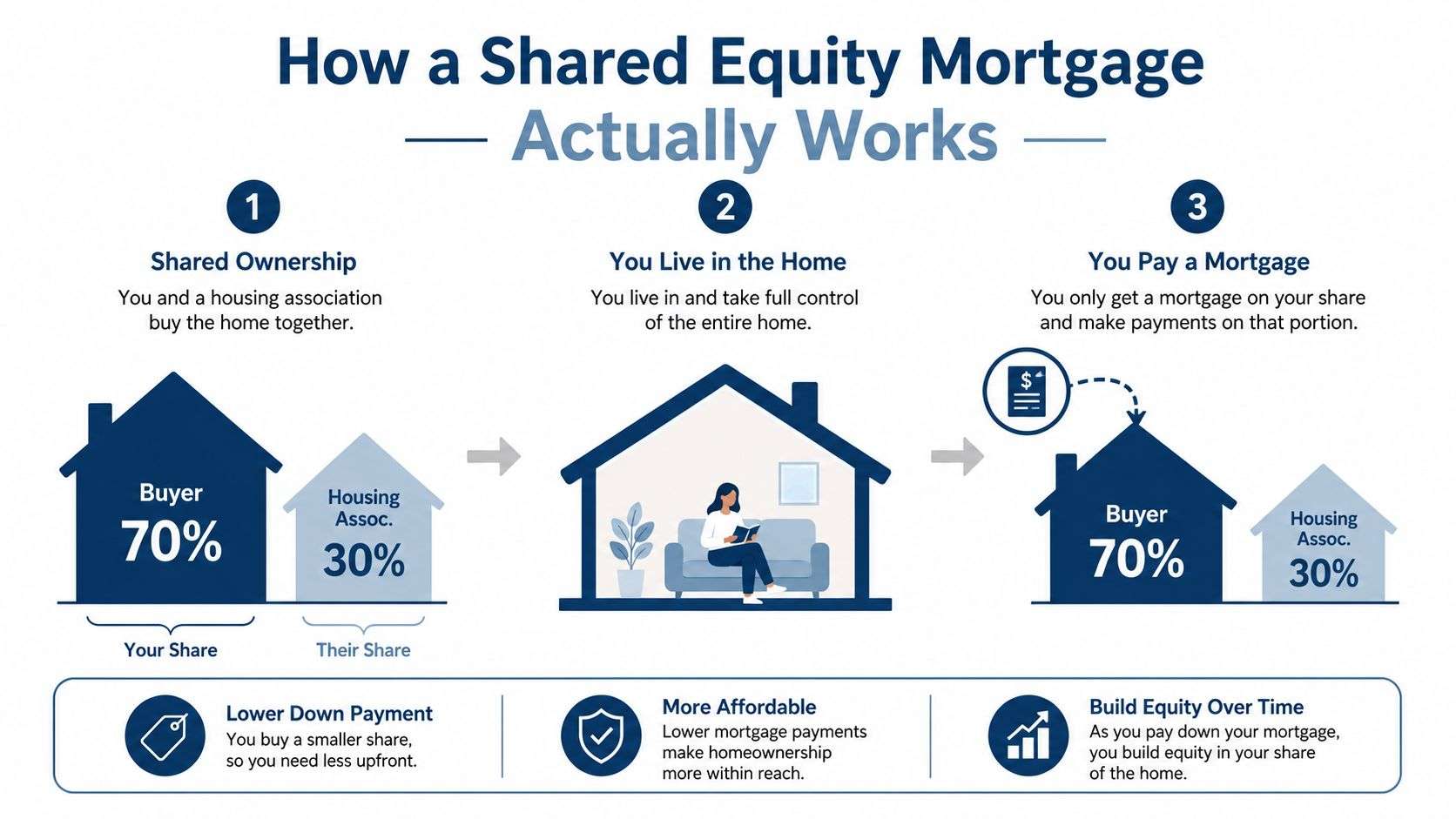
The property is split into ownership shares. You live in the home and usually hold the main mortgage, while the equity partner funds or retains another portion. Your monthly mortgage covers your borrowing. Any rent or fee charged on the unsold share is separate.
The legal structure depends on the scheme. Shared ownership, government equity loans and developer-backed arrangements have different rules for ownership, repayments, staircasing and resale. The label “shared equity” does not identify all of those terms by itself.
Adviser’s rule: never compare the deposit alone. Compare the mortgage, rent, fees, future settlement and restrictions on selling.
Government figures show that shared ownership in England has retained a stable core structure. In 2024–25, the average initial equity stake was 38%, with the average market price of a shared ownership home recorded at £323,700 and the average initial equity stake at £121,100. The government’s longer-run data places average initial stakes broadly between 37% and 43%. See the government’s shared ownership figures for the underlying data.
For an Essex buyer in Chelmsford, Braintree or Colchester, the right route depends on the scheme rules, income, affordability assessment and property. EHF’s guide to how much equity you have provides a useful starting point, but the headline purchase price never gives the full answer.
How a Shared Equity Mortgage Works
A shared equity arrangement sets up two financial interests in one property. You buy the home, live there and use your deposit and mortgage to fund your share. The equity partner contributes or retains the balance, which you settle later if you staircase, refinance or sell.
The process normally follows this order:
The property is valued. The purchase price sets the value used to calculate each interest.
The shares are agreed. Your deposit and mortgage cover one portion, while the provider supports the remaining portion.
The legal interest is protected. The provider’s stake is recorded through the relevant legal and security documents.
You make regular payments. These usually include the mortgage on your funded share and, where applicable, rent or a fee on the unsold share.
The arrangement is settled. A sale, remortgage or further ownership purchase will usually trigger repayment.
The provider’s stake generally follows the property’s value. If the property rises, buying out a percentage stake requires more cash. If the property falls, that percentage is worth less, but your mortgage balance does not automatically fall with the market.
What the buyer is really exchanging
A standard repayment mortgage has a borrowing balance that reduces as you repay capital. An interest-only mortgage leaves the capital outstanding until a later repayment event. A shared equity mortgage adds a second claim because part of the property’s value belongs economically or legally to another party.
The trade-off is clear: you need less cash or borrowing at the start, but you give up some future equity or accept ongoing rent on the unsold share. A smaller mortgage payment does not prove that the overall arrangement costs less.
The PropLab financing guide explains the relationship between property value and mortgage debt. Use it as background, but remember that a shared equity agreement adds repayment and ownership rules beyond a standard loan-to-value calculation.
Shared equity and shared ownership need separate treatment. With an equity loan, you own the whole property but repay a percentage of its value under the agreement. With shared ownership, you buy a share from a housing association and pay rent on the remainder. Under England’s current shared ownership framework, buyers can purchase an initial stake between 10% and 75% of the home’s full market value, with many able to staircase to full ownership. The official Right to Shared Ownership guide sets out which homes and tenants qualify for that route.
A loan-to-value ratio measures the mortgage against the property value. The equity agreement answers a different question: who holds the remaining value, and how and when must that interest be repaid?

Shared Equity Versus Shared Ownership, Equity Loans and Standard Mortgages
Buyers often conflate these terms, but the ownership structure, monthly payments, eligibility rules and exit route differ materially. For buyers in Chelmsford, Braintree and Colchester, that distinction affects whether a scheme solves an affordability gap or replaces a large deposit with ongoing restrictions.
| Criteria | Shared Equity Mortgage | Shared Ownership | Equity Loan, Help to Buy legacy | Standard Mortgage |
|---|---|---|---|---|
| Deposit | Usually based on the buyer’s funded share | Based on the share being purchased | Buyer funds the required deposit and mortgage share | Based on the full purchase borrowing |
| Other party | Provider, developer or scheme partner | Housing association owns the unsold share | Government holds an equity loan | No co-owner once the purchase completes |
| Monthly cost | Mortgage plus any rent or fee, depending on structure | Mortgage, rent and service charge | Mortgage, plus later equity-loan charges under scheme terms | Mortgage and normal property costs |
| Staircasing | Depends on the agreement | Usually permitted under scheme rules | Repayment is linked to the current property value | No staircasing, you already own the home |
| Resale | May involve partner or scheme conditions | Housing association nomination and resale rules can apply | Sale normally settles the equity loan | Broadest resale freedom |
Which route suits an Essex buyer
A buyer in Chelmsford with a strong deposit but a borrowing shortfall may prefer a standard mortgage if the monthly payment remains sustainable. That route usually provides the clearest ownership and resale position. A shared equity arrangement can cover the gap, but the buyer must accept the agreement’s future settlement terms and any restrictions.
Shared ownership suits someone who can manage rent and service charges but cannot buy the whole property. It depends on finding a suitable housing association home and meeting the scheme’s conditions. EHF’s shared ownership mortgage deals explain how borrowing applies to the purchased share rather than the full home.
The income cap remains a real eligibility trap for some households. A key worker may appear able to afford a home against local prices, yet still fail the relevant rules, while a household that passes the income test may fail the affordability assessment. Homes England affordability requirements and scheme conditions need checking before treating shared ownership as a practical option.
Permanent housing affordability models such as community land trusts keep affordability rules central over the long term rather than treating the initial purchase as the only hurdle. That structure differs from both shared ownership and shared equity, where the agreement and the eventual exit can determine the actual cost.
Equity loans are not shared ownership
Under Help to Buy’s equity loan model, the government provided up to 20% of the purchase price, or up to 40% in London from February 2016, in exchange for the same share of the home’s future value, as documented by the Bank of England. The scheme targeted new-build homes and had a maximum property value cap of £600,000, according to parliamentary material.
The buyer owned the whole property with the equity loan. Shared ownership involved buying a defined share from a housing association and paying rent on the remainder. An equity loan therefore changes how part of the property is funded, while shared ownership changes the ownership structure itself. Lenders and estate agents should describe those routes separately, because the repayment, resale and staircasing consequences are not interchangeable.
Worked Example, Costs and Honest Pros and Cons
Consider a £320,000 two-bedroom flat in Chelmsford. The buyer earns £42,000, has a first-time buyer profile and uses a shared equity partner to cover 25%, equal to £80,000 of the property value.
The buyer puts down a 5% deposit of £12,000 and borrows roughly £228,000 on a repayment mortgage at a representative 5.2%. Rent on the unsold share, modelled at around 2.75% per year, comes to approximately £183 a month. These are illustrative figures, not a quotation, and the actual mortgage rate, term, service charge and scheme rules would change the result.
| Cost Line | Shared Equity, 25% Partner | Standard 90% Mortgage |
|---|---|---|
| Property price | £320,000 | £320,000 |
| Buyer deposit | £12,000 | £32,000 |
| Mortgage | About £228,000 | About £288,000 |
| Rent on unsold share | About £183 monthly | None |
| Representative mortgage rate | 5.2% | Not specified |
| Approximate total monthly outgoings | Near £1,580 | Roughly £1,860 |
The shared equity route reduces the initial cash requirement and the mortgage principal. That creates a genuine monthly saving in this illustration, but it doesn’t make the partner’s share free. Rent continues, and the equity partner’s eventual settlement is linked to the property arrangement.
What I’d count as a genuine advantage
Lower upfront barrier: the buyer funds a smaller portion of the purchase rather than trying to raise the full deposit and borrowing requirement.
Smaller mortgage balance: borrowing less can reduce monthly debt service and may improve affordability.
Defined partner stake: the agreement sets out the provider’s interest, rather than leaving the buyer to arrange an unsecured shortfall.
Access to a suitable home: in a high-cost commuter market, the structure may turn an otherwise impossible purchase into a manageable one.
Where buyers get caught
Staircasing costs: each transaction can involve valuation, legal and administration costs. The figures supplied for this example put staircasing fees at £1,500 to £3,000 per transaction, so buying extra shares in small steps can become expensive.
Restricted resale: some schemes give the provider or housing association rights over the sale process or the type of buyer.
Rent that doesn’t reduce: rent on the unsold share remains a separate cost until you buy that share or sell the property.
Negative equity exposure: you remain exposed to the value of the whole property, while your mortgage still has to be serviced if the market falls.
Future repayment uncertainty: the cash amount needed to settle a percentage stake depends on the property value at the time.
The government’s repayment guide for Help to Buy also shows why the small print matters. Borrowers could repay the equity loan in full at any time or make part payments from 10% of the current market value, but couldn’t leave less than 5% outstanding after a partial repayment. That is a scheme-specific rule, not a universal shared equity rule, so always read the actual contract.
Eligibility and Lender Criteria in 2026
Eligibility is where many Essex applicants fall out. The headline income limit for Homes England-backed shared ownership support is £80,000 outside London, and £90,000 in London, and industry commentary says those limits have not changed since October 2016. The same commentary argues that inflation has reduced their real-terms value, leaving some professional households above the cap even as they still struggle to buy locally. Read the broker-market commentary on the affordability gap for that policy context.
Homes England’s affordability model also uses hard sustainability limits. Housing costs are assessed between 25% and 45% of net wage, while gross-income multiples run from 2.5 times to 4.5 times, with the 4.5 times household-income limit acting as an absolute cap on the equity stake a buyer can purchase. The detailed Homes England affordability guidance explains why deposit size alone doesn’t determine the share you can buy.
Lenders still inspect the details
A lender may assess:
Income evidence: basic salary, overtime, bonuses, commission, benefits and allowances may be treated differently.
Credit conduct: missed payments, defaults, County Court Judgments and debt levels can change the available lender panel.
Employment structure: self-employed applicants need properly prepared accounts and tax evidence.
Property suitability: lease length, service charges, new-build restrictions and the provider’s legal terms all matter.
Affordability resilience: the lender checks whether the payment remains manageable under its stress assumptions.
The official guidance doesn’t turn a complex income into a simple pass. A bonus may be discounted, a car allowance may be excluded, or a second income may be restricted by the lender. Use the mortgage eligibility guide before reserving a property, not after.
Practical rule: get the income and scheme checks done before you fall in love with the flat. An agreement in principle based on the wrong product can create false confidence.
Step-by-Step Application Process and How EHF Mortgages Can Help
Shared equity applications fail most often when the mortgage, provider and legal work move on separate tracks. Keep the process joined up from the start.
The eight stages
Discovery chat: establish your target area, deposit, income, existing commitments and whether shared equity or shared ownership is relevant.
Fact-find: gather payslips, bank statements, tax documents and credit information.
Agreement in principle: test borrowing against the correct lender and scheme criteria.
Property shortlisting: check the provider, developer, tenure, service charge and resale conditions before offering.
Full mortgage application: submit the mortgage case with consistent income and property information.
Valuation: the lender or provider arranges the required valuation, which must support the purchase price and structure.
Legal work: solicitors check title, lease terms, security documents and the partner’s requirements.
Exchange and completion: contracts exchange once finance and legal conditions are satisfied, followed by completion and key release.
A broker’s job isn’t just to find a rate. It’s to identify lenders willing to handle the exact ownership structure, test the applicant against the income rules, and make sure the mortgage meets the provider’s legal requirements. The guide on whether you need a mortgage adviser sets out why specialist cases need more than a quick online search.
Where local case management matters
A Chelmsford-based adviser can keep pressure on the parties who control the timetable. That includes the lender, valuation firm, housing association or developer, solicitors and the buyer’s conveyancer. Provider paperwork often moves more slowly than a normal residential purchase, so missed documents can threaten exchange.
EHF Mortgages can source suitable shared ownership and specialist mortgage options, pre-check affordability, flag future staircasing costs and discuss protection such as life cover, critical illness cover and income protection. The recommendation should reflect the mortgage you’ll owe and the continuing costs attached to the partner’s share.
Who Shared Equity Really Helps in Today’s Market
Shared equity isn’t a universal first-time buyer solution. It helps a particular group: buyers with enough income to pass the affordability test, enough savings to cover the required contribution and a property that fits the provider’s rules.
The strongest fit is often a single earner in a high-cost commuter town, with income below the applicable cap and a deposit that can cover part of the purchase but not a conventional route. Key workers in Chelmsford and Colchester can also benefit when local prices exceed what their salary supports, provided the scheme’s income and property conditions work.
The problem is that the rules haven’t kept pace with many households’ circumstances. The reported income limits have remained unchanged since 2016, while prices, salaries and commuting costs have shifted. Essex applicants can therefore be caught in an awkward middle ground. They earn too much for a capped scheme but not enough to buy the home they need through a standard mortgage.
Who may need a different route?
Higher-earning single applicants: a guarantor mortgage or a joint borrower sole proprietor structure may increase borrowing capacity, subject to lender rules and advice.
Households with variable income: a lender that understands commission, contracting or self-employment may produce a better result than a rigid scheme.
Buyers with a smaller deposit: conventional 95% loan-to-value products may be worth comparing where affordability supports them.
Applicants priced out by monthly payments: a longer fixed-rate product can improve payment certainty, but it won’t remove the capital owed.
Buyers seeking government support: check current alternatives rather than assuming the legacy Help to Buy equity loan is still available.
Government data demonstrates that shared ownership has become a durable housing model, with average initial equity percentages remaining broadly stable between 37% and 43% over the longer period covered by official reporting. That durability doesn’t make it suitable for everyone. It makes careful product selection more important.
Common Questions and Your Next Step With EHF Mortgages
Can I take a shared equity arrangement to another property?
Usually, portability isn’t automatic. Moving to a new-build home, a different developer, or a non-participating provider may require you to repay the original arrangement rather than transfer it. Check the agreement before offering on the next property, because the sale and purchase may need to be completed in a tightly coordinated sequence.
What does staircasing really cost?
The cost depends on the scheme and the size of the additional share. You may need a current valuation, legal work and administration, and the worked figures above show how charges of £1,500 to £3,000 can make frequent small purchases unattractive. Don’t assume an annual 1% staircasing expectation applies to everyone. The contract controls.
How is the provider’s share calculated when I sell?
The provider normally receives the agreed percentage of the property’s value under the relevant agreement, not just the cash originally contributed. A rising market can therefore increase the settlement, while a falling market can reduce it. Your solicitor should confirm the valuation process, sale costs and any nomination or marketing requirements.
Can I combine shared equity with protection?
Yes, subject to the mortgage and scheme structure. Life cover can help repay the mortgage after death, while critical illness and income protection can support payments if illness or incapacity affects earnings. The cover needs to reflect the mortgage debt and the ongoing housing costs, not just the buyer’s initial deposit.
If you’re weighing shared equity against shared ownership in Chelmsford, Braintree or Colchester, get the full figures checked before reserving a property. Visit EHF Mortgages for a review of the scheme, mortgage, affordability and protection requirements, then use the Contact Us page to start the conversation.





