
💡 Top tip. If you’ve got three mortgaged buy-to-lets and you’re thinking about a fourth, don’t start with the property; start with the portfolio schedule. Get the rents, balances, deal end dates, and ownership structure lined up first, because that’s usually what gets the deal moving faster, and I’ll explain why later in the article.
If you’re a landlord in Chelmsford, Braintree, Colchester, or anywhere else in Essex, you may already have felt this shift. The lender that was happy with your first or second buy-to-let can suddenly ask for your whole book, not just the new flat you’ve found, and that’s where a portfolio landlord mortgage becomes a different conversation altogether.
A lot of landlords run into this when they’re refinancing, buying at auction, or trying to release equity from one property to fund another. The basic point is simple: once you’re treated as a portfolio landlord, lenders stop looking at the subject property in isolation and start checking whether the whole business stacks up. That matters more in 2026 because buy-to-let remains active, lenders are still underwriting hard, and landlords are using remortgage equity to keep their portfolios moving.
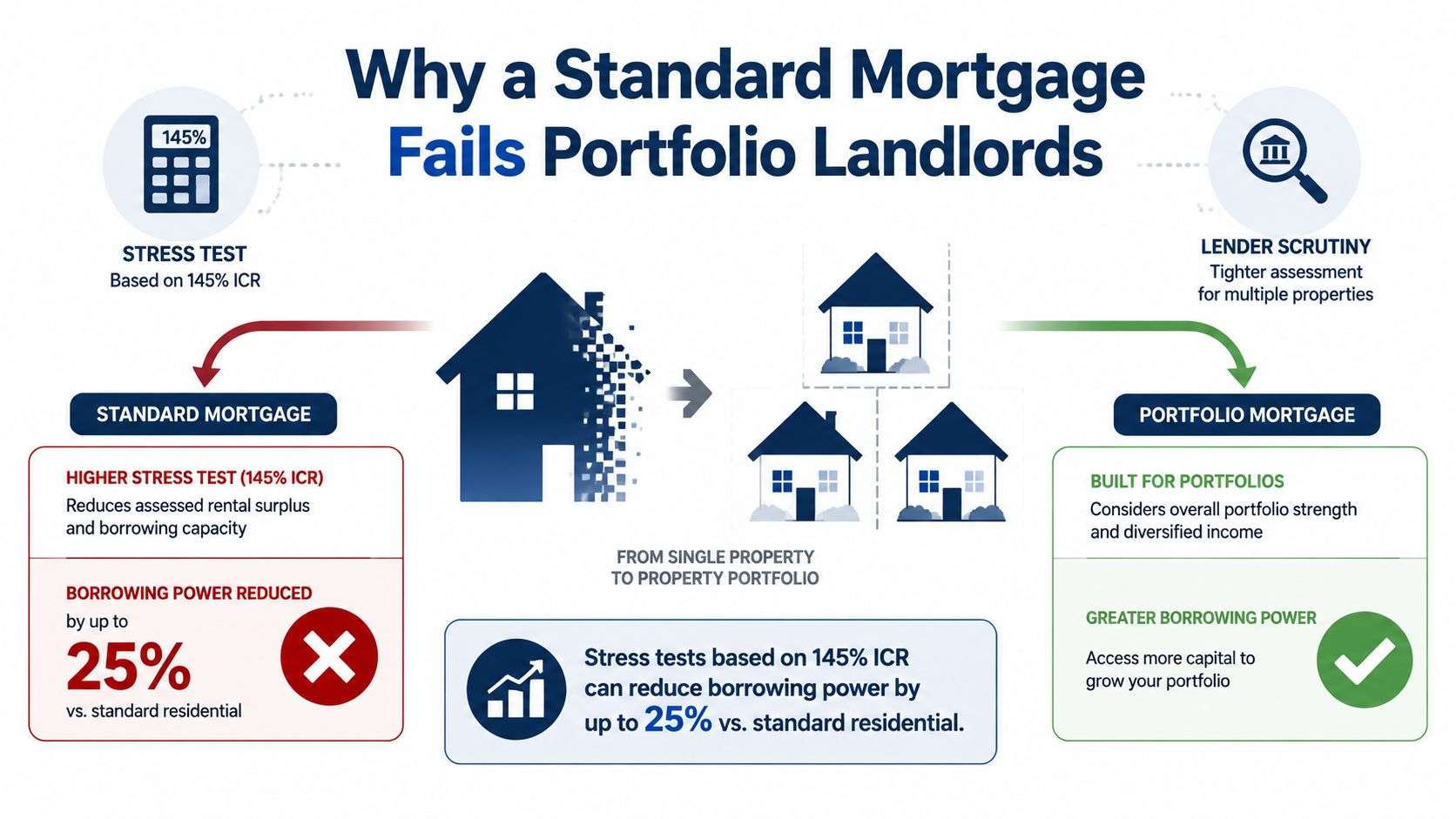
Why Portfolio Landlords Need a Different Mortgage Strategy
Reach four mortgaged rental properties and the lender’s job changes. The deal is no longer just about the flat or house you are buying now, because the bank wants to see how the wider book behaves, how the debts are structured, and whether the rent across the portfolio can continue to cover the borrowing if rates move or one property underperforms.
That is why the paperwork matters so much. A landlord who turns up with a clean schedule, matching figures, and a clear ownership structure usually gets a better hearing than someone trying to assemble the details while the underwriter is already asking questions. If you are still building the next purchase plan, a guide to building your property portfolio helps set out the practical order of play before the application starts.
The difference is not only about the lender asking for more paperwork. Portfolio lending also changes the decisions you need to make before you apply. Some landlords are better off buying in their personal names for a simple refinance, while others should consider SPV or limited company ownership due to tax treatment, future refinancing plans, and how the book will look once a lender reviews it all. Aggregate LTV matters too, because a portfolio can look fine on each individual loan and still become awkward if the overall borrowing across the book is too concentrated.
There is also a timing issue. If you are remortgaging one property to support another purchase, the dates on existing deals can either help you move quickly or leave you stuck waiting for an exit. I see that most clearly with auction buys, where brokers often line up a single facility that can span multiple BTLs, so the landlord can raise money quickly without having to rebuild the entire financing structure for each asset.
💡 Top tip. Do not wait until you have an offer accepted to think about the structure. Lenders are far more comfortable when they can see the portfolio as an operating business, not just a set of separate mortgages with different end dates and ownership types.
The market context still matters because lenders are active, but selective. As noted above, the average buy-to-let underwriting position remains tight, with UK Finance’s market update highlighting the income testing and rental-yield pressure that underpin most portfolio decisions. That is why landlords in Chelmsford, Braintree, Colchester, and elsewhere need a strategy that fits the whole book, not just the next property.
For landlords who also hold short-term lets, the same sort of planning applies, which is why the real estate portfolio for Airbnb owners is useful reading if you are comparing different ways to structure income-producing property.
What Counts as a Portfolio Landlord in the UK
Under Prudential Regulation Authority guidance, a borrower is classed as a portfolio landlord once they hold four or more distinct mortgaged buy-to-let properties. That threshold has applied since 30 September 2017, and lenders such as The Mortgage Works still use it in their portfolio criteria. It counts properties held personally, jointly, and through a limited company, so landlords can cross the line without realising it if they mix ownership types.
Practical rule: if the property has mortgage debt against it and it sits within your rental business, assume a lender will want it on the schedule.
The important change isn’t the label, it’s the underwriting. A normal buy-to-let application primarily focuses on the subject property. A portfolio landlord mortgage requires the whole book because the lender wants to understand the overall financial structure, concentration, void sensitivity, and whether the rentals can carry the debt if one or two units underperform. That’s why a landlord can be comfortable on each individual property and still run into trouble once the portfolio is reviewed as a whole.
A simple example helps. If you own three mortgaged rentals and you’re buying a fourth, you don’t just need the numbers for the new purchase. You need the balances, rents, and deal end dates for all four, because the lender may want to know whether the new loan pushes the wider book past its comfort point.
A strong portfolio case is never just about the new purchase. It’s about whether the landlord business still works if one property has a void, a rate reset, or a repair bill.
This is also why landlords with more complex books often need to think about structure early. Someone with a mixed personal and company portfolio, or a landlord who’s also looking at short-term rental exposure, should be planning around the whole lending picture, not just the next property.
How Lenders Stress Test a Portfolio Landlord Mortgage
A portfolio landlord mortgage is usually sized based on interest coverage ratio (ICR) stress tests. In market guidance, common underwriting baselines sit around 125% to 145% ICR at stressed rates of roughly 5.0% to 5.75%+, with portfolio buy-to-let commonly capped at about 75% LTV according to Fox Davidson’s portfolio mortgage guidance. The lender is checking the whole rental business, not just whether the new property looks fine on its own.
That is where many landlords get caught. A unit can look healthy in isolation, only to fail once the lender adds the rest of the book, especially if existing borrowing is already tight or if one property has been vacant. Some lenders test the background portfolio against the new loan as part of the same decision, so the result can turn on the wider rent pool, not just the asset being bought.
A landlord with six properties in Chelmsford and Colchester can see this play out quickly. If five are paying well but one sits empty for two months, the portfolio may still be financeable, but the borrowing headroom can shrink as the income supporting the book dips. That is why remortgage timing matters, especially if rents are due to reset, a refurbishment is not finished, or a vacancy is already showing on the schedule. The same issue arises when a broker uses a single facility across multiple BTLs to expedite an auction purchase, because the lender still wants the full picture before releasing funds.
Here is the practical way lenders look at it.
| Underwriting point | What the lender checks | Why it matters |
|---|---|---|
| ICR stress test | Rental income against stressed payments | Shows whether rent can carry the debt |
| LTV ceiling | Total borrowing versus property value | Limits borrowing across the book |
| Portfolio review | All mortgaged rentals, not just the new one | Exposes weak links, concentration, and void risk |
The figures also explain why landlords plan remortgages carefully. As shown earlier, the average buy-to-let interest cover ratio was 202%, and the average gross yield was 6.94% in the UK Finance data for Q1 2025, but individual portfolios can look very different once a lender applies its own stress rate and structure rules. For a lender-friendly affordability view, the mortgage affordability guide is a useful place to check the maths after you have gathered your figures.
A lot also depends on ownership structure. A portfolio held in a personal name can be straightforward for some lenders, whereas SPV or limited company borrowing can affect how the book is assessed, especially when the lender wants to understand the company’s purpose, rental surplus, and future borrowing plans. The same question arises for landlords with holiday lets or short-term rentals, who must file a separate Airbnb LLC and set up taxes, because the lender still wants to see how the wider business is held and funded.
What gets deals over the line is usually paperwork, not optimism. Lenders want current tenancy schedules, evidence of rent, mortgage statements, and a clear explanation of any voids, arrears, or recent refinancings. If the portfolio is mixed, the underwriter will usually look for a clean schedule that shows which assets are in personal name, which sit in a company, and how the rental income supports the debt overall.
Personal Name, SPV, or Limited Company
The ownership structure is where many portfolio decisions are won or lost. A landlord buying in personal name often wants simplicity and direct control. A landlord using an SPV or limited company is usually thinking about tax treatment, scaling, or keeping the portfolio more easily separated from personal assets.
| Structure | Typical Use | Key Benefit | Main Trade-off | Portfolio Impact |
|---|---|---|---|---|
| Personal name | Smaller or slower-growing portfolios | Straightforward ownership | Less flexibility for some tax planning | Can work well below the threshold |
| SPV | Buyers wanting a separate property vehicle | Cleaner separation of assets and borrowing | More admin and company maintenance | Often suits repeat acquisitions |
| Limited company | Larger or more actively expanded books | Easier to scale in a business format | Needs proper company setup and lender fit | Common in specialist portfolio lending |
For many landlords, the decision rule is practical rather than ideological. If the next purchase is small and the portfolio is still modest, personal ownership may be the cleaner route. If the landlord is already scaling, refinancing often, or wants the lending linked to a company structure, SPV or limited company borrowing can make more sense, especially where the lender is happy to assess the wider book in that format.
The wrong structure usually shows up later as friction, not as a declined application on day one.
That’s why I always look at how the borrower plans to use the next deal. If the goal is to move quickly, reuse equity, or keep future refinancing smoother, company-style ownership can be easier to work with. If the aim is to keep things simple and the portfolio is still relatively contained, personal name may be perfectly acceptable, provided the lender is comfortable with the aggregate exposure.
For landlords comparing company-style holdings with platform rules and tax administration, this airbnb LLC filing and taxes article is a useful reminder that structure decisions are never just about the loan. On the mortgage side, EHF Mortgages also has a dedicated limited company buy-to-let page that sits squarely in this part of the market.
If this article has already answered the basics and you’re now weighing up your next move, click through and speak to EHF Mortgages today. A quick conversation can save you from choosing the wrong ownership structure or approaching the wrong lender.

Documentation and Underwriting for Portfolio Applications
The cleanest portfolio applications start with a proper schedule. Lenders want to see the property addresses, property types, rent received, mortgage figures, outstanding balances, and end dates for each deal. If the book is spread across Chelmsford, Braintree, or Colchester, I’d still present it as one business file, because that’s how the underwriter will read it.
A landlord should have five things ready before the first call with a broker.
Complete Property Schedule: list every rental with address, value, lender, balance, and deal end date.
Current Rent Schedule: show the tenancy details and recent bank statements supporting the rental income.
Personal Asset and Liability Statement: give the lender the wider financial picture, not just the rentals.
Latest Tax Returns and SA302s: prove income consistency and reduce back-and-forth.
Insurance Evidence: make sure the landlord cover is in place for each property.
Each item matters because the lender is checking consistency. If the rent schedule says one thing and the bank statement says another, the case slows down. If the refinance timetable is unclear, the underwriter begins asking whether the portfolio can support both the old and new borrowing simultaneously.
This is also where experience counts. A landlord who has done this before can usually gather the documents quickly, but someone who has only ever remortgaged one property at a time often misses the portfolio-wide detail. That’s one reason a broker will often build a portfolio overview first, then go to specialist lenders once the numbers make sense.
For compliance-led checks that tend to come up during underwriting, this anti-money-laundering check guide is worth keeping to hand. It helps explain why lenders ask for so much source material before they get to an offer.
Broker’s rule of thumb: if you can’t explain the portfolio in one clean spreadsheet, the lender probably can’t price it properly.
Portfolio Landlord Case Studies and Real Examples
A facility across multiple properties can speed up an auction purchase because the lender already understands the wider book and does not need a fresh application for every move. That matters when a landlord wants to act quickly on the right asset and keep the paperwork light.
One Essex landlord I’ve seen work through this had six BTL properties and wanted to buy an auction lot without having to start from scratch each time. The answer was a facility across multiple properties, which meant less administration and a faster route to funding when the right asset came up. The main benefit was speed, because auction purchases do not sit around waiting for a slow paper chase.
“We managed to provide a facility across 6 BTL properties with one lender, who gave a discount on fees for multiple applications, and also gave my client a facility to use if the right property became available, without having a long application process to follow.”
Another useful case is the Chelmsford landlord with a three-property book and a fixed rate ending soon. The move was to refinance before crossing the four-property threshold, so the portfolio did not get caught mid-move with a weaker documentation pack and a rushed valuation process. The paperwork was manageable, but the timing mattered, because once the landlord moved into portfolio territory, the underwriting conversation became broader and less forgiving.
A third example comes from a Colchester investor holding property both personally and through a company. As the book grew, the borrower restructured the next move so that the lender could see a clearer distinction among the holdings, liabilities, and the intended use of equity. That made the portfolio easier to present and reduced the chance of the book being treated as a jumble of separate transactions.
I’ve also seen lenders such as Aldermore offer portfolio products that landlords find more workable when they want to reduce admin and borrow against several assets at once. The value lies in the lender’s ability to quickly understand the book and move when a suitable property becomes available.
The common thread across all three cases is simple. The landlord who presents the entire portfolio well has more options, and the one who waits until the last minute usually has less room to negotiate. If you are checking acquisition costs on the next move, use this stamp duty on BTL calculator before you commit.
Tax, Regulation, and the Real Cost of Expanding Now
Many landlords assume that if a property looks rentable, expansion must be the right move. That isn’t always true in a higher-rate, higher-scrutiny environment. The underwriting hurdle is one part of the story, but tax treatment and portfolio concentration matter just as much when you’re deciding whether to add, refinance, or pause.
If you’re close to the four-property threshold, the question isn’t just whether you can borrow, it’s whether the wider book will still work after the next acquisition or refinance. Some landlords deliberately reduce property count to stay below portfolio underwriting pressure, while others use remortgage equity to consolidate and move more efficiently. Both can be sensible, depending on cash flow, financing, and the quality of the assets already held.
The hard truth is that lender willingness is often the blocker, not property quality. A good rental property can still fail if the portfolio looks too concentrated or too stretched. That’s why tax, structure, and underwriting need to be discussed together, not in separate silos.
This matters for anyone comparing personal ownership with a company route, or for a landlord wondering whether to use equity from one unit to support another. The wrong answer isn’t always expensive on day one, but it can be painful when the next refinancing window arrives.
If you’re weighing up the tax side of a purchase or remortgage, this stamp duty on BTL calculator is a useful starting point. It won’t make the decision for you, but it will stop you underestimating the upfront cost of moving.

Next Steps and How EHF Mortgages Can Help
If you’re thinking about a portfolio landlord mortgage, the next 48 hours should be simple. Pull together the property schedule, the rent schedule, the latest mortgage statements, and the refinance dates, then decide whether you want to expand, refinance, or pause. That one top tip from the start, build the portfolio pack first, still holds up, because lenders are far more relaxed when they can see the whole picture from the outset.
A whole-of-market broker can help match the book to the right lender, especially when a single facility across multiple BTLs would save time or when the structure choice isn’t obvious. In practice, that means speaking to lenders who are comfortable with portfolio underwriting, not just those with a standard buy-to-let product on the shelf.
EHF Mortgages, based in Chelmsford, works with landlords across Essex and beyond on buy-to-let, limited company, and specialist lending cases. If your portfolio is already moving, or you’re just about to cross the threshold, speak to someone who can review the whole schedule before the lender does.
EHF Mortgages can help you assess your current portfolio, compare ownership structures, and line up the right lender for your next move.





