💡 Top Tip: Your first buy-to-let mortgage is the bedrock of your empire, so get it right. Getting expert advice from day one unlocks faster growth and better returns down the line.
We will show you exactly how this works throughout this guide.
Table of Contents
- Foundations for Success
- Making Your First Move
- Smart Structuring
- Scaling Your Empire
- Protecting Your Future
Foundations for Success: Strategy and Finance

Building a successful property portfolio is far more than just buying a few houses; it is about executing a calculated business strategy. The first step for anyone starting is to understand the core principles of Real Estate Investing. This means shifting your mindset from that of a typical homeowner to a professional investor with a clear vision for long-term wealth.
For many new investors, exploring up-and-coming areas like Chelmsford or Colchester in Essex can provide a strong starting point. But before you even think about viewings, you need to get your financial foundations in order.
A great place to start is our guide on the deposit required on buy to let to get a realistic picture of the initial capital you will need.
Making Your First Move: Securing Your Investment

This is where your strategy meets the real world. Making your first move is all about sourcing the initial investment, which starts with a deep dive into high-demand rental areas. You are looking for the telltale signs of a solid investment: strong transport links, major local employers, and good school catchments. These are the factors that consistently drive the rental markets in towns like Braintree and Colchester.
But your analysis has to go much deeper than a simple viewing. You need to get your hands dirty with proper due diligence. That means accurately calculating the potential rental yield and return on investment (ROI), making sure to factor in every single associated cost. We are talking about everything from Stamp Duty right through to potential void periods between tenancies. This financial scrutiny is not just good practice; it is exactly what lenders will do.
The Financial Hurdle: Getting Your Mortgage
The buy-to-let mortgage application process is a different beast from a standard residential one. Lenders are far more rigorous and will apply stringent stress tests. Their main concern is ensuring that rental income comfortably covers the mortgage payments, even if interest rates rise.
It is crucial to understand these differences before you apply. To help, here is a quick comparison of the two main mortgage types.
Key Differences Between Residential and Buy-to-Let Mortgages
| Feature | Residential Mortgage | Buy-to-Let (BTL) Mortgage |
|---|---|---|
| Purpose | To buy a home you will live in. | To buy a property you intend to rent out. |
| Deposit Size | Typically, 5% – 10% of the property value. | Usually requires a larger deposit, often 25% or more. |
| Affordability | Based on your personal income and outgoings. | Based primarily on the property’s potential rental income. |
| Interest Rates | Generally, lower rates are available. | Rates and fees are often slightly higher. |
| Regulation | Heavily regulated by the Financial Conduct Authority (FCA). | The FCA does not regulate most BTL mortgages. |
Getting to grips with the nuances of BTL lending is vital for success. We offer a more comprehensive breakdown in our guide to buy-to-let mortgages explained, which can give you some valuable clarity.
This is a market where having expert support truly pays dividends. A specialist mortgage broker can navigate the maze of complex lender criteria, uncover exclusive deals you will not find on the high street, and ultimately secure the best possible finance for this pivotal first purchase.
Smart Structuring for Tax Efficiency and Growth
As your property portfolio expands, so does the financial admin. One of the biggest decisions you will face early on is how you actually own the properties. This is not just a bit of paperwork; it is a fundamental choice that will shape your tax bill and how easily you can grow.
The debate usually boils down to two paths: holding properties in your personal name or setting up a limited company, often called a Special Purpose Vehicle (SPV), to own them instead.
So, which is right for you? Honestly, it depends entirely on your personal tax position. If you are a higher-rate taxpayer, the government’s Section 24 rules have made personal ownership much less appealing by restricting mortgage interest relief.
On the other hand, an SPV lets you offset 100% of your mortgage interest against rental income before you even think about paying Corporation Tax. For many investors, that is a game-changer.
It is not just about income tax, either. You have got to think ahead to Capital Gains Tax when you eventually sell, and Inheritance Tax when you plan to pass your assets on. The structure you choose impacts it all.
For a much deeper dive, our guide on limited company buy to let mortgages is packed with valuable insights.
Scaling Your Empire: From One Property to a Portfolio
Making the jump from a single buy-to-let to a full-blown portfolio is a serious step up. It is less about buying one-off properties and more about building a sustainable business, which means your financing strategy needs to evolve.
One of the most powerful tools for expansion is leveraging the equity you have built in your existing properties. This usually means remortgaging to release that capital, giving you the cash to put down deposits on new purchases. It is a proven way to accelerate your growth.
Of course, this strategy relies on a healthy property market. You can dive deeper into the latest UK real estate market trends on aberdeeninvestments.com to get more context.
The “Portfolio Landlord” Threshold
Once you have four or more mortgaged buy-to-let properties, lenders will start treating you differently. You will officially be classed as a ‘portfolio landlord’, and this triggers a much more forensic underwriting process.
Lenders will not just look at the new property you want to buy; they will scrutinise the performance of your entire portfolio. This means your financial house needs to be in impeccable order, with clear records of rental income, costs, and overall profitability.
Structuring Your Portfolio: Personal vs Limited Company
A crucial decision you will face as you grow is how to hold your properties. Should they be in your personal name, or should you set up a limited company? This choice has significant implications for your tax position, financing options, and personal liability.
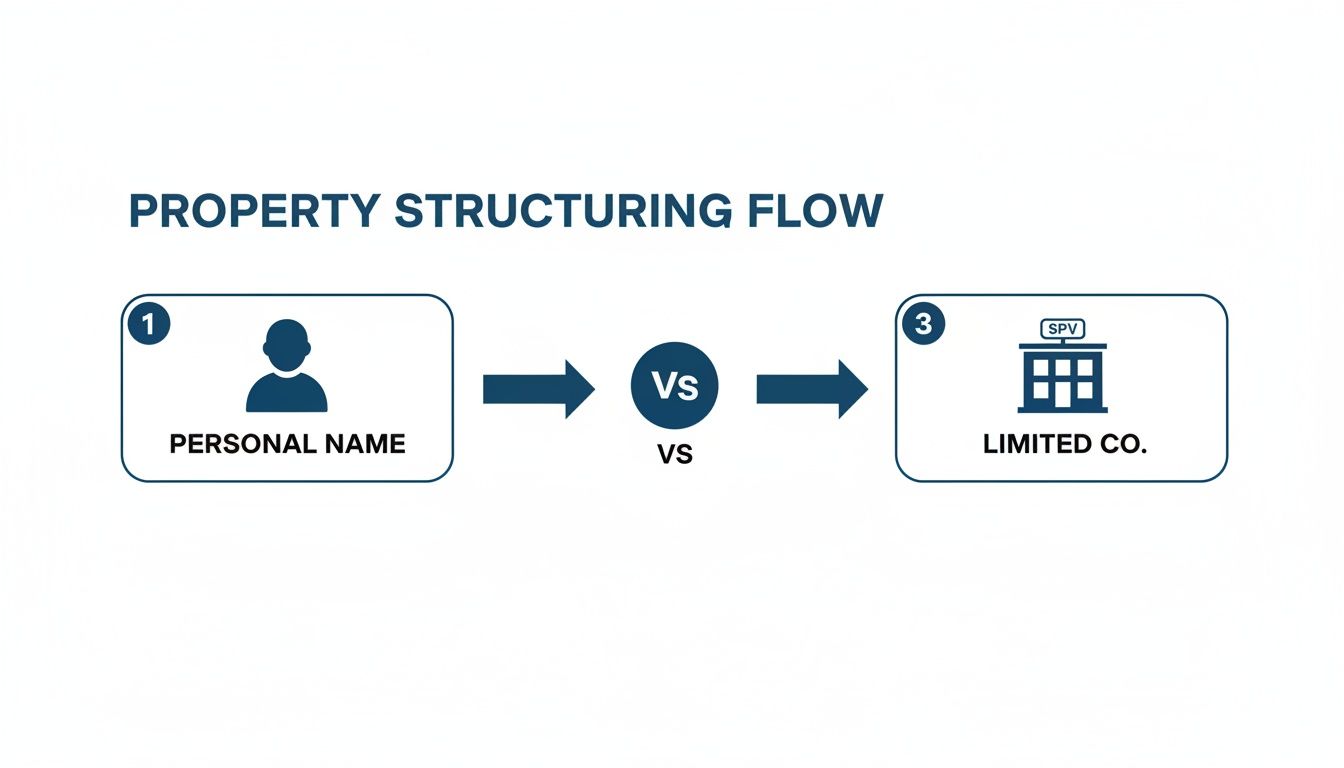
As the diagram shows, using a limited company (often a Special Purpose Vehicle (SPV) set up to hold property) creates a clear separation between your personal finances and your property business. For portfolio landlords facing stricter lender criteria, this structure can offer a cleaner, more professional way to manage and grow your assets.
As your portfolio grows, so do your financing needs and the complexity of managing it all. The options available to you become more specialised, each with its own advantages depending on your strategy.
Financing Options for Portfolio Growth
| Financing Method | Best For | Key Consideration |
|---|---|---|
| Portfolio Mortgage | Landlords with 4+ properties looking to consolidate debt or release equity across their portfolio. | Lenders will assess the entire portfolio’s profitability, not just a single property. |
| Remortgaging | Releasing equity from an individual property that has increased in value to fund a new deposit. | You will need to meet the lender’s criteria for the existing property and your overall finances. |
| Bridging Loan | Quickly securing a property, often at auction, before long-term financing is in place. | These are short-term, high-interest loans, so a clear exit strategy is essential. |
| Second Charge Mortgage | Accessing equity without disturbing your current mortgage is useful if you are on a great fixed rate. | Interest rates are typically higher than those for a standard remortgage. |
Ultimately, the right financing depends on your specific goals, from rapid expansion to steady, long-term growth. Working with a broker who understands the nuances of portfolio lending can make all the difference in securing the right funding to scale your empire effectively.
Protecting Your Future Assets and Exit Strategy
Building a property portfolio is one thing; protecting it is a different ball game entirely. A portfolio is only ever as strong as its defences, and the foundation of that protection is solid, comprehensive insurance.
Thinking like a business owner means safeguarding your income and assets against the unexpected. This is not just a nice-to-have; it is a core part of a professional property investment strategy.
Every landlord should have these key policies in place, no exceptions:
- Landlord Buildings and Contents Insurance: This is your first line of defence, covering the physical structure and any items you provide within the property.
- Rent Guarantee Insurance: What happens if a tenant stops paying? This insurance protects your cash flow, ensuring you do not fall behind on your own mortgage payments.
- Public Liability Cover: This shields you from claims if someone (a tenant, a visitor, or even a contractor) is injured on your property.
Beyond the immediate risks, you need to think about long-term wealth preservation. A well-crafted exit strategy is vital, even if you have no plans to sell for decades.
This plan could involve passing the portfolio to the next generation in a tax-efficient way using wills and trusts. Or, it might be a phased disposal plan, where you strategically sell individual properties to release capital – for example, selling a property in a high-growth area like Chelmsford when the market peaks could fund your next three purchases elsewhere.
Having a clear exit strategy is not about quitting; it is about defining your long-term vision and ensuring the wealth you build lasts.
Your Frequently Asked Questions Answered
Getting into property investment throws up a lot of questions, especially when you are just starting. As you learn how to build a property portfolio, understanding the key details is crucial. Here, we tackle some of the most common queries we hear from aspiring landlords.
How Many Properties Make a Portfolio?
Technically, owning more than one investment property means you have a portfolio. However, for mortgage lenders, the term has a very specific meaning.
You are officially considered a ‘portfolio landlord’ once you have four or more mortgaged buy-to-let properties. Hitting this number is a significant milestone, as it triggers a much more detailed underwriting process from lenders. They will scrutinise the performance of your entire portfolio, not just the single property you want to finance next. This is where specialist mortgage advice becomes essential to navigate the extra complexity.
Should I Buy Properties in a Limited Company?
This is one of the biggest questions we get, and the honest answer is: it depends entirely on your personal circumstances and tax status.
For higher-rate taxpayers, using a limited company (often called a Special Purpose Vehicle (SPV)) is usually more tax-efficient. This is because you can deduct all your mortgage interest from your rental profits before tax is calculated.
On the other hand, mortgage rates for limited companies can be slightly higher, and there is more admin and paperwork involved. If you are a basic-rate taxpayer with just one or two properties, holding them in your personal name might be simpler and more cost-effective. Always get professional tax and mortgage advice to work out what is right for your specific situation.
What Are the Biggest Risks of Building a Portfolio?
Like any investment, property comes with its own set of risks. It is not just about collecting rent; you need to be prepared for the challenges. The main ones you will face are:
- Void Periods: This is when a property sits empty between tenants. No rent comes in, but your mortgage and bills still need to be paid, which can really strain your cash flow.
- Unexpected Maintenance: A boiler suddenly packing in or a major leak can result in a bill that wipes out months of profit. It happens.
- Rising Interest Rates: If you are on a variable rate, an increase in your mortgage payments can quickly shrink or even eliminate your monthly profit.
- Legislation Changes: The government is always updating rules and tax laws for landlords. These changes can seriously impact your profitability and how you operate.
The key to managing these risks is preparation. A healthy cash reserve is non-negotiable. Comprehensive landlord insurance is a must. And diversifying your portfolio across different areas (perhaps mixing properties in places like Colchester and Braintree) can spread local economic risk and make your investment journey much smoother.
Ready to Start Building Your Property Empire?
Building a successful property portfolio is one of the most reliable routes to long-term wealth, but it is a journey that is easy to get wrong. The difference between a thriving portfolio and a stressful liability often comes down to getting the strategy, structure, and financing right from day one.
Whether you are lining up your very first investment property in Essex or looking to scale an established portfolio, getting expert guidance is not just helpful – it is essential.
Are you ready to make your move? Our team of specialist mortgage advisers is here to guide you through every single stage. From securing that first buy-to-let mortgage to arranging complex portfolio finance for your growing empire, we have the hands-on experience to support your goals in Chelmsford, Braintree, and beyond.
Let’s start building together.