
💡 Top Tip: Lenders care more about your recent profitability than your past credit mistakes. We’ll explain how to prove that properly later in this guide.
If you’re self-employed in Chelmsford, Braintree, Colchester or elsewhere in Essex, and you’ve already had one bank say no, it’s easy to assume the door is shut. That reaction is understandable. High-street lenders often struggle with applications that combine irregular income and adverse credit, especially where the borrowing need is tied to property rather than a simple unsecured loan.
That doesn’t mean you can’t get a loan for the self-employed with bad credit. It usually means the case needs proper packaging, the income needs to be presented correctly, and the lender choice needs to match the facts of your situation.
Before you apply anywhere, it helps to gather the documents that explain how you work. For freelancers and consultants, even a clear freelancer contract review can help tidy up the commercial side of your paperwork if contract wording is muddy or inconsistent.
Securing a Loan When You are Self-Employed with Bad Credit
Many people arrive at this point after a blunt rejection. A self-employed electrician in Essex wants to remortgage, raise capital for works on a rental property, or buy a buy-to-let. The business is active, money is coming in, but the bank sees an old missed payment, a default, or uneven income and stops there.
Specialist lending doesn’t work like that.
Why mainstream banks often say no
High-street systems are built for neat cases. Regular salary, standard payslips, clean credit file, simple affordability. Once you add self-employed income and historic credit issues, many automated systems struggle to read the case properly.
That creates a common problem. The borrower thinks the issue is eligibility in general, when often the issue is lender fit.
Practical rule: A decline from one lender tells you that lender said no. It doesn’t tell you the whole market said no.
Property finance adds another layer. If you need funds for a remortgage, buy-to-let, second charge, bridging facility or development project, the lender is looking not only at you, but also at the property strategy and exit route. That is why this niche is so often misunderstood by generic bad credit loan guides.
What usually works better
The cases that move forward tend to share a few traits:
Clear income evidence. Finalised accounts, SA302s, tax year overviews and bank statements that line up.
A sensible explanation of past credit problems. Brief, honest and supported by what has changed since.
A realistic borrowing purpose. Lenders are more comfortable when the use of funds is coherent and documented.
The right product choice. A client who wants to keep a low existing first-charge rate might be better off taking out a second-charge loan than replacing the whole mortgage.
People in Chelmsford and across Essex are often surprised by how many routes may still be open once the case is positioned properly. That is particularly true for landlords, owner-occupiers remortgaging, and older borrowers considering later life options alongside self-employed income.
The first shift in mindset
Stop thinking in terms of “Can I get accepted anywhere?” Start thinking in terms of “Which lender is built for my case?”
That small change matters. It moves you away from random applications and toward a structured approach in which each piece of evidence serves a purpose.
How Lenders See Your Self-Employed Income
Your turnover is not your mortgage income. That’s the first correction most self-employed applicants need to make.
Lenders usually focus on net profit, or on salary and dividends if you trade through a limited company. They want to understand what you keep and what can reasonably support the monthly payment. According to Swoop Funding’s self-employed loans guidance, lenders typically target a debt-to-income ratio below 36%, based on net profit from SA302s rather than gross turnover, and over-relying on gross income is a common reason self-employed applicants get rejected.

What documents usually matter most
If you want a realistic view before applying, start with the basics lenders ask for again and again:
SA302s and tax year overviews. These help verify declared income.
Finalised accounts. Usually, the cleaner and more up-to-date, the better.
Business and personal bank statements. Lenders often want a run of statements that shows money coming in consistently and bills being managed sensibly.
ID and proof of address. Basic, but delays often start here when the paperwork doesn’t match.
For contractors and freelancers, it also helps to understand which tax deductions strengthen your records and which ones can reduce provable affordability. A practical read is Senki’s guide for contractors, as it highlights the trade-off between lowering taxes and showing sufficient income for lending.
A rough way to sense-check your affordability
Don’t use your annual turnover as your guide. Use the income figure shown in your tax documents and accounts. Then look at your committed monthly outgoings and ask a blunt question. If the proposed new payment lands on top of existing commitments, does the picture still look stable?
A simple self-check is:
Start with the income your SA302s support.
Be cautious about business expenses. Lenders often strip back what they see as unavailable for mortgage payments.
Add your regular credit commitments.
Compare that total against the monthly income lenders are likely to recognise.
Banks don’t lend on optimism. They lend on what your paperwork proves.
If your numbers feel tight, it doesn’t always mean the case is dead. It may mean the product needs to be changed, the deposit needs to be increased, or the application should go to a lender that understands your trading model. Anyone preparing for a mortgage should also review practical criteria around self-employed mortgage requirements, because many avoidable declines start with missing or inconsistent documentation.
What catches people out
One issue comes up repeatedly. A borrower says, “The business turns over enough,” but the tax position shows a much lower usable figure. Another is messy bank conduct. Even if income is high overall, erratic presentation can make an underwriter uneasy.
That is why presentation matters just as much as earnings. A good case is not only profitable. It is readable.
Finding the Right Lender for Your Situation
Not every borrowing need should be solved with the same product. That’s especially true if you’re self-employed, have credit issues in the background, and the funds are linked to property.
A high-street lender may still be an option for some borrowers. But if the case includes recent blips, complex income, retained profit questions, unusual property, or the need to move quickly, the better answer is often a specialist lender or specialist finance product.
Different lenders solve different problems
Mainstream banks tend to like clean, standard cases. Specialist lenders operate in the middle ground between perfect credit and outright rejection. They look more closely at context, business performance, property security and the overall story.
That matters for cases such as:
Remortgaging after credit issues
Buy-to-let purchases with self-employed income in the background
Raising capital without disturbing an existing first mortgage
Short-term property transactions where speed matters
The administrative side matters too. Clean packaging, document extraction and accurate data transfer can make a complex case easier to handle, which is why tools like the DigiParser MyLoanOfficer integration are useful examples of how brokers and lending teams streamline document-heavy applications.
Comparing Loan Options for Self-Employed Borrowers
| Loan Type | Best For | Security | Typical Lender | Bad Credit Suitability |
|---|---|---|---|---|
| Residential mortgage | Buying or remortgaging your home | Property secured | High-street or specialist lender | Possible with specialist criteria |
| Buy-to-let mortgage | Purchasing or refinancing an investment property | Property secured | Specialist buy-to-let lender | Often better through specialist routes |
| Second charge loan | Raising capital without replacing your main mortgage | Property secured | Specialist secured loan lender | Can suit borrowers with complex histories |
| Bridging loan | Short-term purchases, refurbishments or chain breaks | Property secured | Bridging lender | Often flexible if the exit is clear |
| Business or personal loan | Smaller unsecured borrowing needs | Usually unsecured | Bank or specialist lender | More restrictive where credit is impaired |
Matching the product to the real objective
Borrowers often lose time by asking for a “loan” when what they really need is one of several distinct solutions.
If your aim is to buy a rental property in Colchester, a buy-to-let route may be the proper fit. If you’ve got a strong rate on your current mortgage and want to release funds for business use or home improvements, a second charge might preserve that existing deal. If you’re trying to secure a property quickly before long-term finance is arranged, bridging may be the right tool.
The cheapest-looking product on paper isn’t always the right one. The right one is the product you can complete, afford and exit safely.
For broader criteria comparisons, a useful starting point is reviewing the best mortgage lenders for self-employed borrowers. The key is not just who lends, but who lends based on your income and credit profile.

Strategies to Improve Your Mortgage Application
A weaker case can often be improved. Not by hiding problems, but by controlling how they are explained and evidenced.
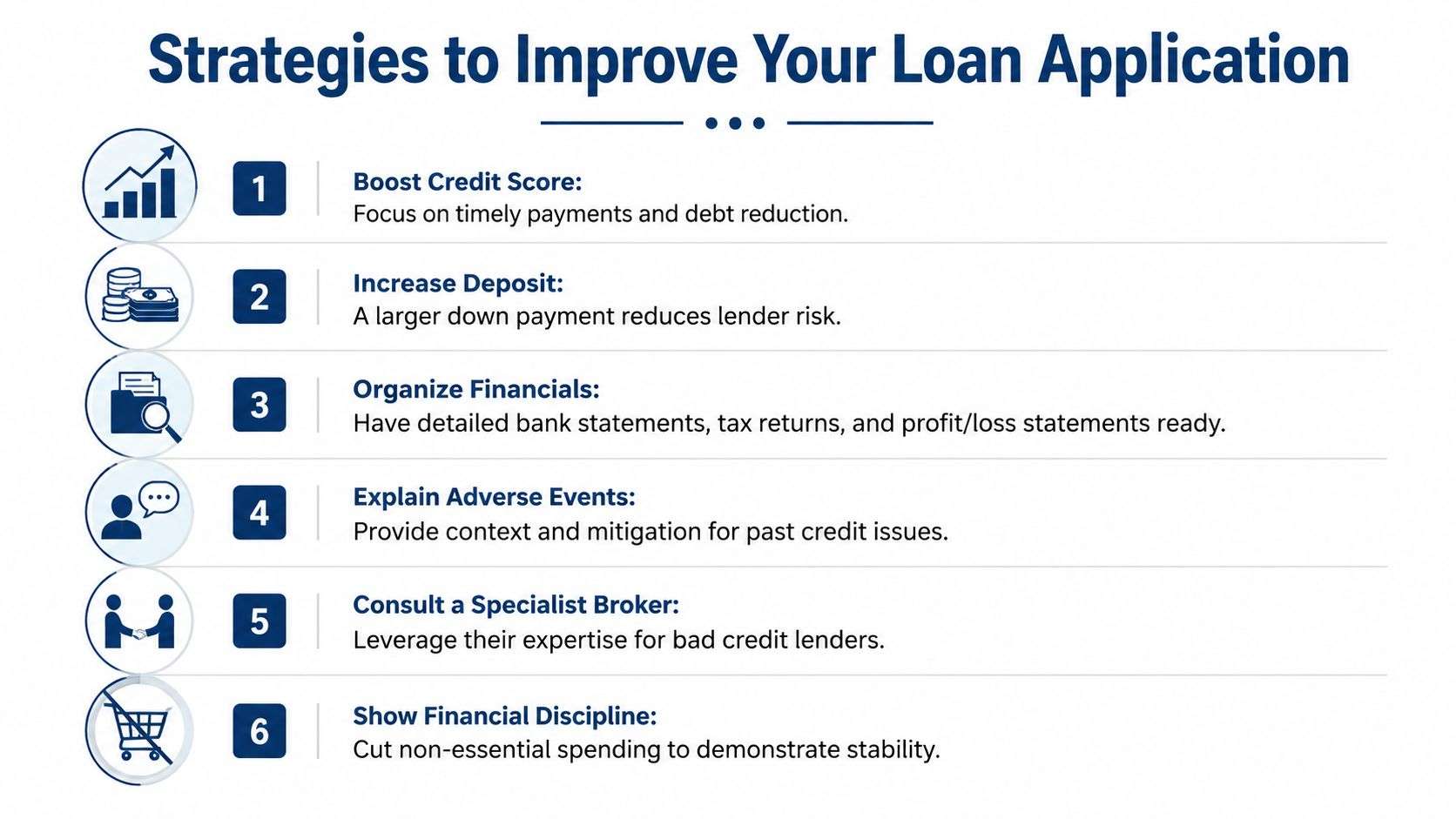
Deal with adverse credit directly
If there are defaults, missed payments, payday loan history, a debt management plan, CCJs or an old bankruptcy, don’t hope the underwriter won’t notice. They will.
The better approach is a concise written explanation covering what happened, when it happened, why it happened, and what is different now. Specialist lenders often assess adverse credit case by case. In practice, CCJs under £500 that have been cleared are often ignored, and bankruptcies discharged more than six years ago can be acceptable. That treatment is noted qualitatively here, based on specialist lending guidance referenced earlier.
“The story behind your numbers is as important as the numbers themselves. A well-prepared application that explains past issues and demonstrates current stability can make all the difference.”
Strengthen the parts you can control
Some improvements are straightforward. Others take planning. The point is to show a lender that today’s risk is not the same as the risk shown by an old credit file entry.
Increase the deposit if you can. More equity reduces lender risk and can increase the number of available products.
Clean up account conduct. Avoid bouncing payments, gambling transactions and unnecessary overdraft pressure where possible.
Prepare future income evidence. A pipeline of signed work, repeat clients or upcoming contracts can help support the overall picture.
Keep explanations short and factual. Underwriters don’t need a life story. They need confidence that the issue is understood and contained.
Many borrowers also benefit from checking whether their credit issues are being reported correctly before they apply. Errors, duplicates and unresolved statuses can create unnecessary friction.
To understand how adverse credit is viewed in mortgage underwriting, this guide to getting a mortgage with bad credit is a sensible companion read.
Here is a useful overview if you’re trying to tighten your application mindset before submitting anything:
Small details that make a big difference
Address consistency matters. Dates matter. Business descriptions matter. If your bank statements, tax records and application form all describe your work slightly differently, someone will have to stop and query it.
Underwriter’s view: The easier your file is to follow, the easier it is to say yes.
That sounds simple, but it’s one of the biggest practical differences between a rushed application and one that stands up well.
Setting Realistic Expectations for Your Loan
This part matters because honesty saves time.
If you’re applying for a loan for a self-employed individual with bad credit, especially where property is involved, the borrowing is likely to cost more than a straightforward high-street case. That’s the trade-off. The lender is taking on a more complex risk, using more manual underwriting, and often moving outside standard criteria.

The costs borrowers should expect
You may come across several layers of cost, depending on the product:
Arrangement fee. Charged by the lender for setting up the loan or mortgage.
Valuation fee. Needed where a property is being assessed as security.
Legal costs. Common in secured borrowing where solicitors need to act.
Broker fee. Sometimes payable for advice, placement and case management.
Not every case includes every fee, and the structure varies by product. A bridging loan, for example, doesn’t behave like a standard remortgage. A second charge loan won’t always involve the same process as replacing a first mortgage.
Timelines are often longer than borrowers expect
Complex cases take longer because more people need to look at them. An underwriter may query income, ask for updated statements, revisit the credit file, or need more details on the property.
That doesn’t mean anything is wrong. It means the file is being assessed properly.
A sensible mindset is to allow time for:
Document gathering
Initial lender review
Underwriter questions
Valuation and legal work
Final offer and completion
In places like Braintree or Chelmsford, where onward purchases and remortgage deadlines can create pressure, this timing piece is often just as important as the rate.
Fast decisions are possible on some products, but complex self-employed cases rarely benefit from being rushed blindly.
The best applications are those in which the borrower understands the likely trade-offs upfront. Better to know the shape of the deal accurately than to chase an unrealistic headline and lose weeks.
Your Roadmap to a Successful Application
Being self-employed with bad credit doesn’t make borrowing impossible. It makes it more specialised.
The borrowers who succeed are usually the ones who stop treating the process like a standard comparison-site application. They gather the right evidence, choose a lender that understands self-employed income, and present the case with the adverse credit issues already addressed rather than left hanging in the background.
What a strong process looks like
A workable roadmap usually comes down to five practical moves:
Know your usable income. Not turnover. Not guesswork.
Be honest about the credit file. Old issues can often be worked around if explained properly.
Pick the correct product. Mortgage, buy-to-let, second charge, bridging and unsecured lending all solve different problems.
Expect some friction. Specialist cases need more checking.
Use proper guidance. Complex property finance is rarely improved by trial and error.
For borrowers across Essex, including Chelmsford and Colchester, local knowledge also helps. Lenders may share broad policy language, but the way a case is positioned still matters. A broker who regularly handles self-employed and adverse-credit cases can often spot a workable route far earlier than a borrower applying blind.
Why expert help matters in this niche
This is one of those areas where whole-of-market access and practical packaging make a real difference. It isn’t just about finding a lender. It’s about finding the lender whose criteria, appetite and process fit your exact situation, then managing the paperwork from start to finish so the case doesn’t fall apart under scrutiny.
That is particularly important if your needs sit at the crossover of self-employment, bad credit and property finance, because that combination is exactly where generic lending advice tends to fall short.
If you’re ready to discuss your options with EHF Mortgages, the next step is a straightforward conversation about your income, credit history, property plans and the lenders most likely to consider your case.





