Here’s the most critical tip for anyone worried about their credit history: get a full copy of your credit report from all three UK credit reference agencies before you do anything else. This one move transforms you from a hopeful applicant into an empowered borrower, and we will explain precisely why later in this guide.
Table of Contents
- Your First Step to Getting a Mortgage With Bad Credit
- How Lenders Really Assess Bad Credit Applications
- Actionable Steps to Boost Your Mortgage Eligibility Now
- Finding Mortgage Options Beyond High Street Banks
- Preparing Your Application and Avoiding Common Pitfalls
- How a Specialist Mortgage Broker Can Be Your Greatest Asset
- Your Top Questions About Bad Credit Mortgages Answered
Your First Step to Getting a Mortgage With Bad Credit
“Understanding your past is the foundation for building a stronger mortgage application. It’s not about being perfect, it’s about being prepared.”
If you’re worried about getting a mortgage because of your credit history, you are far from alone. In fact, over 15 million people in the UK have some form of adverse credit on their record. It just goes to show that financial setbacks are a standard part of life for many would-be homeowners.
The good news? Securing a mortgage is still entirely possible. The path looks a little different from the one taken by those with a flawless credit file.
Your journey starts with that one non-negotiable step: getting your hands on your complete credit reports. Lenders don’t just see a single score; they see your entire financial story. Knowing what that story says is crucial.

Why Your Full Credit Report Matters
From a lender’s perspective, not all ‘bad credit’ is created equal. A missed mobile phone payment from four years ago carries far less weight than a recent County Court Judgement (CCJ).
Here’s a glimpse at what a lender will scrutinise:
- The type of credit issue: Was it a default on a secured loan or a late catalogue payment?
- The date of the issue: An older mistake is almost always viewed more leniently than a recent one.
- The amount involved: A £50 missed payment is much less concerning than a £5000 default.
- The frequency of problems: Was it a one-off blip during a tough time, or does it look like a pattern of behaviour?
A significant hurdle for many is navigating the home-buying process after bankruptcy. Each of these scenarios requires a different strategy and will be assessed very differently by specialist lenders.
Lenders aren’t just looking at a score; they’re building a picture of you as a borrower. The table below provides a clearer view of how different credit issues are typically viewed and what that might mean for your application.
How Lenders View Different Types of Bad Credit
| Credit Issue | Lender Severity Level | Typical Deposit | Impact on Interest Rate |
|---|---|---|---|
| Late Payments (Mobile Utility) | Low | 5-10% | Minimal to Slight Increase |
| Credit Card Defaults (under £500) | Low to Medium | 10-15% | Slight to Moderate Increase |
| County Court Judgement (CCJ) | Medium to High | 15-25% | Moderate to High Increase |
| Debt Management Plan (DMP) | Medium to High | 15-25% | Moderate to High Increase |
| Bankruptcy / Repossession | Very High | 25-35%+ | Very High Increase |
This table is just a guide, of course. The exact impact depends on the lender, how long ago the issue occurred, and the overall strength of your application. But it highlights why knowing the specifics of your file is so important.
Taking Control From Day One
Walking into a discussion with a mortgage broker armed with your complete credit reports completely changes the dynamic. Instead of discovering problems during the live application process, we can proactively address them.
For homeowners in Chelmsford, Braintree, and Colchester, this level of preparation allows us to have a much more productive initial conversation. You can pinpoint the exact issues that need explaining, and we can work together to present your case in the strongest possible light.
This simple act of preparation positions you for success and makes the entire process smoother from day one.
At EHF Mortgages, we specialise in helping clients navigate these challenges. We provide expert guidance and have access to lenders who understand that your past doesn’t have to define your future.
How Lenders Really Assess Bad Credit Applications
When you apply for a mortgage with a less-than-perfect credit history, lenders are looking at far more than just a three-digit score. A skilled underwriter is trained to read between the lines and understand the whole story behind your finances. Getting to grips with their perspective is the first step to building a stronger case.
It all comes down to risk assessment, where context is king. A single missed mobile phone payment from three years ago is a world away from a recent County Court Judgement (CCJ). The first is a minor blip; the second is a significant red flag that needs a solid explanation.
Lenders consider several factors to build a complete picture of you as a borrower, and it goes much deeper than the score itself.
“We often find that the ‘why’ behind a credit issue is as important as the ‘what’. A lender who understands the circumstances is more likely to be flexible.”

The Importance of Time and Context
Time is your greatest ally here. The older a credit issue is, the less weight it carries. An issue from five years ago shows a historical problem that you’ve since managed. An issue from five months ago? That suggests current financial instability.
Specialist lenders, in particular, are adept at considering the broader context. They know that life happens. For example, was your period of bad credit caused by a one-off event?
- Redundancy or Job Loss: A temporary drop in income can easily cause missed payments.
- Illness or Injury: Unexpected health problems often bring significant financial strain.
- Divorce or Separation: The financial turmoil of a relationship breakdown is a common trigger for credit issues.
If you can provide clear evidence and a compelling narrative explaining what happened, it can completely change the lender’s view. A good broker knows precisely how to frame this story for the best possible outcome.
Beyond the Blips: What Underwriters Look For
Mortgage underwriters are the real decision makers who manually review your application. They’re looking for patterns that point towards your current financial health. A key part of this, of course, is your credit score. For a clearer picture of how these profiles are judged, it’s worth understanding what constitutes a good credit score, as the same principles apply.
But they also put your overall affordability under the microscope. This is where your income stability and existing financial commitments are scrutinised. Our guide on how much you might be able to borrow provides deeper insight into how these calculations work.
This holistic review helps lenders make a far more informed decision. They want to see that, despite past issues, you’re now a responsible borrower who can comfortably meet your mortgage payments.
The Current Market for Bad Credit Mortgages
The wider economic climate also plays its part. The UK mortgage market has had its ups and downs, but as of mid 2025, we’re seeing some positive momentum. For instance, net mortgage approvals for house purchases rose to 65,400 in May 2025, and the average interest rate on new mortgages dipped slightly.
For anyone with bad credit, this improving market can open doors. More competition among lenders often leads to more flexible criteria. This insider knowledge is where a specialist broker proves their worth, especially in local markets like Chelmsford, Braintree, and Colchester, as they know which lenders are actively seeking business and which are more likely to consider your specific circumstances.
Actionable Steps to Boost Your Mortgage Eligibility Now
Waiting years for your credit file to clear isn’t just frustrating for most people; it feels completely out of the question. The good news is you don’t have to sit on the sidelines. There are some powerful practical steps you can take right now to improve your mortgage readiness and show lenders you’re a reliable borrower.
Taking control of your finances today can make a massive difference. We’re going to focus on three key areas where you can see the best results quickly: your credit file, your affordability, and your deposit.
Quick Wins for Your Credit File
Think of your credit report less as a permanent record of the past and more as a living document you can actually influence. You’d be surprised by how much impact a few minor adjustments can have on how lenders see you.
Here are two of the quickest and most effective things you can do:
- Get on the Electoral Roll: This is a big one. Lenders use the electoral roll to confirm your identity and address. If you’re not registered, it can be a significant red flag and an easy reason to decline an application. It’s often the most straightforward fix: you can register online in about five minutes.
- Add a Notice of Correction: If your credit issues were triggered by a specific life event, such as redundancy, illness, or divorce, you can add a 200-word explanatory note to your credit file. This note is shown to any lender who pulls your file, giving them crucial context that a simple credit score never could.
A Notice of Correction doesn’t magically erase the issue, but it does tell your side of the story. For instance, you could explain that a string of missed payments happened right after you were furloughed. This demonstrates to a lender that it was a temporary situation, not a long-term pattern of poor financial management.
“We helped a client in Braintree add a Notice of Correction explaining their defaults were linked to a business closure. This single action helped a specialist lender understand the context and ultimately approve their mortgage.”
Prove Your Affordability Today
Affordability is about so much more than just what your payslip says. Lenders will pore over your bank statements to get a real picture of how you manage your money day to day. For anyone applying with bad credit, proving you’re financially responsible is essential.
Your main goal here is to lower your debt-to-income (DTI) ratio. This is simply the percentage of your monthly income that goes towards paying off debts. Most lenders look for a DTI of 43% or less, but for bad credit applicants, getting this number even lower will seriously strengthen your case.
Start by tackling your most expensive unsecured debts first, which usually means credit cards and personal loans with eye-watering interest rates. Every pound you pay off not only reduces your DTI but also frees up more of your income, which looks fantastic to an underwriter. It’s also incredibly wise to show a consistent pattern of saving, even if it’s just a small amount each month.
The Power of a Stronger Deposit
While saving a larger deposit obviously takes time, even a slight increase can be a complete game-changer. A larger deposit reduces the lender’s risk, which is their number one concern when reviewing an application with adverse credit.
Here’s a real-world scenario. A couple in Colchester were really struggling to get approved with a 15% deposit because of some old CCJs. They decided to put their purchase on hold for six months and managed to push their deposit up to 20%.
That extra 5% accomplished two crucial things:
- It immediately lowered their loan-to-value (LTV) ratio, making them a less risky proposition.
- It opened the door to a much wider range of specialist lenders, some of whom offered better rates and more flexible criteria.
The result? They secured a mortgage offer that was totally out of reach just a few months earlier. It just goes to show that your deposit size is one of the most powerful levers you can pull to turn things in your favour. If you are self-employed and facing these challenges, our article on home loans for the self-employed with bad credit offers more specific advice.
By methodically working on these three areas, you can transform your mortgage application from a ‘no’ into a ‘yes’. For personalised guidance on how these steps apply to your situation, particularly in Chelmsford and the surrounding Essex area, our team is ready to help.
Finding Mortgage Options Beyond High Street Banks
Getting a “no” from a high street bank because of your credit history can feel like a massive blow. It’s easy to think your dream of owning a home is over, but honestly, this is often just the first hurdle, not the end of the road.
Mainstream banks rely heavily on automated credit scoring systems. These are rigid by design and can instantly decline applications that don’t tick every single box without ever looking at the person behind the numbers.
This is where the world of specialist lenders comes into play. These lenders exist specifically to help people who don’t fit the standard high street mould. Their approach is entirely different; they use manual underwriting to look beyond the algorithm and understand the story behind your application.
For anyone with a history of defaults, CCJs, or even bankruptcy, getting a mortgage often comes down to finding a lender who is willing to listen. Specialist lenders do precisely that.
“A specialist lender’s underwriter will take the time to review your case individually. They consider the context of your credit issues and your current financial stability, making them a vital resource for complex applications.”
What Makes Specialist Lenders Different?
The most significant difference lies in how they view risk. A high street bank might see a past credit blip as an unacceptable red flag, but a specialist lender sees a chance to assess your current circumstances properly. They are set up to handle complexity and have far more experience evaluating non-standard applications.
This flexibility can be a genuine lifeline. For example, we helped a self-employed client in Chelmsford who had a history of defaults and was repeatedly turned down by major banks. A specialist lender, however, took the time to review his last two years of accounts and understand the reason for the default, which ultimately led to a successful mortgage offer.
Key features of specialist lenders include:
- Manual Underwriting: A real person reviews your file, not just a computer program.
- Flexible Criteria: They are often more lenient about the age and type of credit issues.
- Individual Assessment: They look at the “why” behind your financial history, not just the “what.”
- Broker-Only Access: Many of these lenders don’t deal directly with the public, so you’ll need a broker like EHF Mortgages to access their products.
This flowchart breaks down the key areas you should focus on to boost your mortgage eligibility.
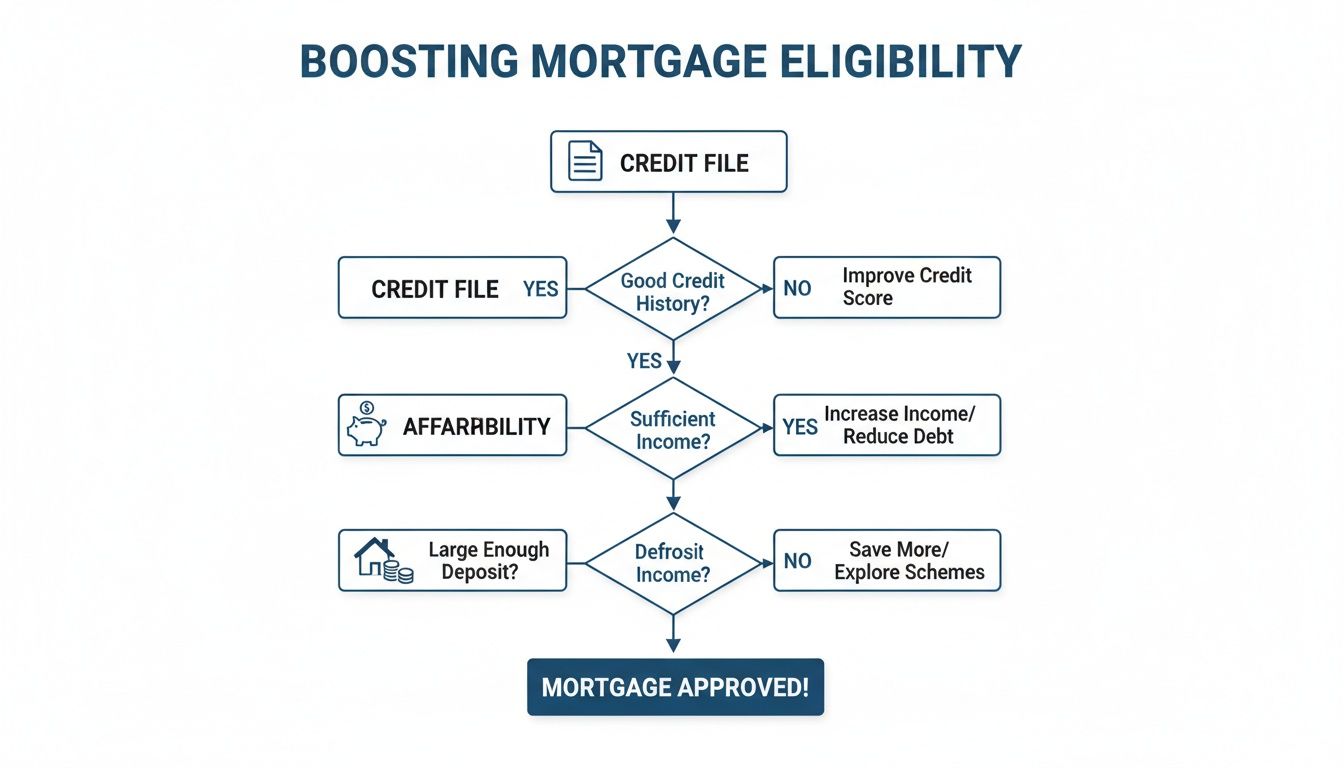
As the visual guide shows, it really boils down to three core pillars: improving your credit file, strengthening your affordability, and saving a larger deposit.
Exploring Alternative Routes to a Mortgage
Beyond specialist lenders, there are a few other avenues that could help you secure a mortgage. These options often involve getting support from family or exploring different product structures designed for situations just like yours. They aren’t right for everyone, but for some, they can be the key that unlocks the door to a new home in places like Braintree or Colchester.
One of the most common alternatives is a Joint Borrower, Sole Proprietor Mortgage (similar to a Guarantor Mortgage). This is where a close family member, usually a parent, agrees to use their own income or property as security for your loan. Their backing gives the lender extra reassurance, making them much more likely to approve your application despite your credit history. You can learn more about how these loans work from trusted sources like MoneyHelper.
When you start looking beyond the high street, you’ll find several different solutions, each with its own pros and cons.
Comparing Bad Credit Mortgage Solutions
The table below breaks down some of the main options available, highlighting who they’re best for and what to keep in mind.
| Mortgage Solution | Best Suited For | Key Advantage | Main Consideration |
|---|---|---|---|
| Specialist Lender | Borrowers with significant or recent credit issues like CCJs or defaults. | Willingness to manually assess complex cases and consider the individual context. | Interest rates are typically higher than those of high street lenders to reflect the increased risk. |
| Guarantor Mortgage | Applicants with a low income or bad credit who have a creditworthy family member to help. | It can make mortgage approval possible when you wouldn’t qualify on your own. | Your guarantor is legally liable for the debt if you fail to make payments. |
| Joint Borrower Sole Proprietor | Individuals buying alone but needing a parent’s income to boost affordability. | Increases borrowing capacity without adding the other person to the property deeds. | The joint borrower is fully liable for the mortgage but has no ownership rights. |
| Right to Buy (Council Tenants) | Council tenants with an established tenancy who want to purchase their current home. | Offers a significant discount on the property’s market value, making it more affordable. | Eligibility criteria apply, and not all properties are included in the scheme. |
Each of these paths has its own unique requirements and implications. A specialist mortgage broker can assess your situation and guide you toward the most suitable and realistic option, helping you avoid a damaging rejection and move forward with confidence.
Preparing Your Application and Avoiding Common Pitfalls
When you’re trying to get a mortgage with bad credit, a solid, organised, and sincere application can make all the difference. Lenders are seeking reassurance, and the paperwork you provide is your first and best chance to build their confidence in you as a borrower.
Think of it like this: you’re presenting a clear, compelling business case for your future homeownership. The aim is to make the underwriter’s job as straightforward as possible. A complete, well-explained file leaves no room for doubt and drastically cuts the risk of delays or an outright ‘no’.
Your Essential Documentation Checklist
Getting your paperwork together early is one of the smartest things you can do. Scrambling for documents at the eleventh hour only adds stress and can lead to sloppy mistakes. Specialist lenders need a forensic view of your finances to make their decision, so let’s get it right from the start.
Here’s a rundown of the core documents you will almost certainly need:
- Proof of Identity: A valid passport or driving licence.
- Proof of Address: Recent utility bills or council tax statements from the last three months.
- Income Verification: Your last three months of payslips and your most recent P60. If you’re self-employed, you’ll need two to three years of accounts or your tax calculations (SA302s).
- Bank Statements: At least three months of statements for every current account you hold, showing all your income and outgoings.
- Proof of Deposit: Statements showing the funds are in your account, along with a clear paper trail of where they came from (e.g. savings, inheritance, or a gift).
- Copy of your Credit Report: If you need one, use our Check My File link to get a comprehensive overview of your credit history.
- Credit Report Explanations: A written summary explaining any adverse credit events. Be honest and concise, detail what happened, why it happened, and the steps you’ve taken to get back on track since.
“We always tell clients that honesty is non-negotiable. A lender who finds an undeclared credit card during their checks will question everything else on the application. Full transparency from the start is the only way forward.”
Common Pitfalls That Can Derail Your Application
Navigating the mortgage process with bad credit is tricky enough without making unforced errors. Unfortunately, we often see simple mistakes cause enormous problems for applicants. If you know the common tripwires, you can sidestep them and keep your application moving forward.
One of the biggest mistakes is applying for new credit in the run-up to your mortgage application. A new car loan, credit card, or even a mobile phone contract triggers a hard search on your file and instantly makes you look riskier to lenders. Just put all other credit applications on hold until your mortgage is finalised.
Another all-too-common issue is undeclared credit commitments. Forgetting to mention a store card or an old catalogue account might seem trivial, but lenders will find it. This kind of discrepancy can lead to an immediate rejection. Finally, make sure your deposit funds are liquid and easily accessible, not tied up in investments that could drop in value.
A Realistic Timeline for Your Journey
Understanding the timeline can help you manage your expectations, especially when buying a property in areas like Chelmsford, Braintree, and Colchester. While every case is different, a bad-credit mortgage application nearly always takes a little longer due to the manual underwriting required.
Here’s a typical timeline:
- Initial Consultation & Fact-Finding (1-2 Days): Wemeetn to discuss your situation andbegint gathering your initial documents.
- Decision in Principle (DIP) (2-5 Days): We approach the right specialist lender to get their preliminary approval.
- Complete Mortgage Application (1 Day): We submit your polished application and all supporting paperwork.
- Underwriting & Valuation (2-4 Weeks): This is the deep dive. The lender’s underwriter reviews everything in detail and orders a property valuation.
- Mortgage Offer (1-2 Weeks Post Valuation): Once they’re satisfied, the lender issues your formal mortgage offer.
- Legal Process & Completion (4-8 Weeks): Solicitors handle the conveyancing, leading to the day you get the keys.
This process underscores the importance of lender affordability checks. While the overall rate of mortgages in arrears was low at 1.00 per cent in Q2 2025, recent data shows growing financial pressure on borrowers. This makes lenders even more diligent in ensuring you can comfortably afford your repayments over the long term. You can read the comprehensive research about these emerging trends from UK Finance.
By preparing thoroughly, you give yourself the best possible chance of a smooth and successful journey to owning your new home.
How a Specialist Mortgage Broker Can Be Your Greatest Asset
Trying to get a mortgage with bad credit can feel like you’re hitting a brick wall at every turn. But you really don’t have to go it alone. Working with a specialist mortgage broker isn’t just a nice-to-have; it’s often the single most significant factor in getting your application over the line.
At EHF Mortgages, we have access to the whole market, which means we can connect you with lenders you’d never find on your own. Most high street banks rely on rigid automated credit scoring that instantly rejects anything outside the norm. We know how to sidestep these computer-says-no algorithms and talk directly to the decision-makers who can assess your application on its own merits.

Expertise That Opens Doors
A broker’s real value is in their deep market knowledge. We know which lenders are more understanding of specific credit issues, from a few old defaults to more significant events like a CCJ or bankruptcy.
This expertise is crucial. Itpreventss you from applying to unsuitable lenders, which onlyfurther damages your credit score through unnecessary hard inquiries.
Instead, we carefully select the right lender and package your application to present you in the best possible light. By explaining the context behind past financial blips, we can show that you’re now a responsible borrower back on solid ground. This is especially important for more complex cases, such as our specialist mortgages for professionals, which often require a more nuanced approach.
“Our job is to translate your story for the lenders who are willing to listen. We bridge the gap between your past and your future.”
Local Knowledge and Proven Success
For our clients across Chelmsford, Braintree, and Colchester, our local insight and strong lender relationships give them a real advantage. We turn complex cases into successful outcomes every single day for people in situations just like yours.
We’ll manage the entire process for you from the first chat right up to the day you get your keys. This saves you considerable time, stress, and potentially thousands of pounds.
Your credit history doesn’t have to stop you from owning your own home. With the proper expert guidance, there’s a clear path forward.
If you’re ready to see what’s possible, contact us today. Let’s have a conversation about your future home.
Your Top Questions About Bad Credit Mortgages Answered
We hear a lot of the same questions from clients who are understandably worried that their credit history will get in the way of owning a home. Let’s clear up some of the most common myths and give you the straightforward answers you need.
Is There a “Magic” Credit Score for a Mortgage?
Honestly, there’s no single magic number. Lenders all have their own goalposts, but as a general rule, a score below 580 makes things very tough. If your score is hovering between 580 and 640, you might find a home with a specialist lender, but you’ll likely need a larger deposit and face higher interest rates.
But here’s the thing: specialist lenders care more about your recent financial behaviour than a score from years ago. They want to understand the story behind the number and see that you’re on solid ground now.
“Focus less on the score itself and more on the story it tells. A well-prepared application that explains past issues is far more powerful than a three-digit number alone.”
Can I Really Get a Mortgage With a CCJ or Default?
Yes, it’s absolutely possible to get a mortgage even with a County Court Judgement (CCJ) or a default on your file. Lenders won’t just see the black mark and say no; they’ll dig a little deeper.
Here’s what they’ll be looking at:
- How old is it? An issue from four years ago is much less of a concern than one from last month. Time really does heal credit wounds.
- Has it paid off? A ‘satisfied’ CCJ shows responsibility and is viewed far more favourably.
- How much was it for? A small missed utility bill is a world away from a default on a large secured loan.
We’ve successfully helped clients in Chelmsford, Braintree, and Colchester secure mortgages despite these exact issues on their records.
How Much Deposit Do I Need With Bad Credit?
Your deposit is your biggest asset in this situation. At the same time, some lenders might, in particular cases, consider a 10% deposit, which is not the norm for most people with adverse credit.
A larger deposit significantly strengthens your application. If you can aim for 15-25% or more, you’ll not only boost your chances of getting approved but also unlock better deals with more reasonable interest rates. It shows the lender you’re serious and reduces their risk.
A bumpy credit history doesn’t have to mean the end of your homeownership dream. With the right advice and a clear strategy, getting that mortgage is well within reach. The team at EHF Mortgages has the specialist expertise to guide you every step of the way.
Ready to see what’s possible? Visit our Contact Us page to book your free, no-obligation chat today.