
💡 Top Tip: Using a gifted deposit from a family member can be a fantastic way to reach your 5% goal, and most lenders are very happy to accept this. We’ll explain more about this later in the article.
Dreaming of your first home but finding the deposit a major hurdle? You’re not alone. For many aspiring homeowners in Essex, saving a huge lump sum feels like an impossible task. The good news is, a 5% deposit mortgage is making homeownership a genuine reality, even as we look towards 2026.
Table of Contents
Your Step-by-Step Guide to Applying for a 95% Mortgage in 2026
Government Schemes and Alternative Ways to Buy Your First Home
Getting on the Property Ladder with a 5% Deposit
This guide is designed to cut through the noise and confusion of the property market. We’ll give you a clear, straightforward roadmap for securing a 95% LTV mortgage, helping you finally escape the rental cycle and get the keys to your own place, whether you’re looking in Chelmsford, Colchester, or anywhere in between.
We’ll walk you through everything you need to know, from how these mortgages work to what lenders are looking for, so you can take that first exciting step with confidence.

So, What Exactly Is a 5% Deposit Mortgage?
In simple terms, a 5% deposit mortgage is a home loan where you put down 5% of the property’s price yourself, and a lender provides the other 95%. This is often referred to as a 95% Loan-to-Value (LTV) mortgage.
This option has become a lifeline for first-time buyers, especially with the cost of living making it tough to save for the traditional 10% or 15% deposit.
“While a smaller deposit gets you through the door faster, it’s crucial to weigh the long-term costs. A whole-of-market broker helps you see the complete picture, not just the initial saving.”
How It Works in Practice
Let’s put that into a real-world scenario. Say you’ve found a fantastic two-bedroom flat in Braintree on the market for £250,000.
With a 5% deposit mortgage, your contribution would be just £12,500. The bank or building society would then lend you the remaining £237,500. Suddenly, that dream of owning a home feels much more achievable, doesn’t it?
Understanding the deposit is the first step. For more detailed information, check out our guide to the minimum deposit for a house.
What Are the Trade-Offs?
While a smaller deposit gets you onto the property ladder much faster, it’s important to understand the trade-offs. Because the lender is taking on more risk, 95% LTV mortgages often come with slightly higher interest rates than deals requiring a larger deposit. This will, in turn, affect your monthly repayments.
Here’s a quick comparison:
| Factor | 5% Deposit Mortgage | 10% Deposit Mortgage |
|---|---|---|
| Deposit on £250k Home | £12,500 | £25,000 |
| Loan Amount | £237,500 | £225,000 |
| Lender Availability | More restricted | Wider choice |
| Interest Rates | Typically higher | More competitive |
| Time to Save | Faster | Slower |
The main advantage is speed; you get to stop paying rent and start building your own equity sooner. But it’s essential to balance this against the higher potential costs over the life of the mortgage. Throughout this guide, we’ll help you navigate these points so you can make the right decision for your financial future.
Ready to find out if a 5% deposit mortgage is the right path for you? Our expert team is on hand to give you personalised advice without any pressure or obligation.
What Is a 5% Deposit Mortgage and How Does It Work

So, what exactly is a 5% deposit mortgage? Think of it like this: the deposit is your initial down payment, and the mortgage is the loan that covers the rest. It’s the key that unlocks the door to your first property.
With this type of mortgage, you put down 5% of the property’s price from your own funds, and the lender loans you the remaining 95%. This is a huge helping hand, specifically designed to get first-time buyers onto the property ladder without needing to save for a decade.
For instance, if you’ve found a flat in Braintree for £280,000, your deposit would be just £14,000. The lender would then provide a mortgage for the other £266,000, making that first big step feel much more achievable.
Understanding the Core Concept
The whole idea behind a mortgage for first-time buyers with a 5% deposit is to make homeownership more accessible. It tackles the single biggest hurdle for most aspiring buyers head-on: saving up a huge lump sum while still paying rent.
By lowering this financial barrier, these mortgages open up the property market to a much wider group of people. Lenders recognise this challenge and have created these products to help bridge that gap.
Breaking Down Loan-to-Value
You’ll hear the term Loan-to-Value (or LTV) crop up a lot in the mortgage world. It’s simply a percentage showing how much of the property’s value you’re borrowing compared to what you’re putting down.
In this scenario, a 5% deposit mortgage is exactly the same as a 95% LTV mortgage. Simple. The lender is covering 95% of the property’s value. You can get a more detailed breakdown in our article explaining what the Loan-to-Value ratio means.
As a general rule, a lower LTV (which means a larger deposit) signals to lenders that you’re lower risk, and that can often unlock better interest rates.
How a 5% Deposit Impacts Your Mortgage Deal
Because the lender is taking on more risk by lending 95% of the property’s value, these mortgages often carry slightly higher interest rates. It’s how lenders balance things out.
This means your monthly payments might be a bit higher than for someone who had a 10% or 15% deposit. You might also find there are fewer lenders offering 95% LTV products, though the market has become much more competitive recently.
“While a smaller deposit gets you through the door faster, it’s crucial to weigh the long-term costs. A whole-of-market broker helps you see the complete picture, not just the initial saving.”
The Growing Popularity of Low Deposit Mortgages
Low-deposit mortgages have surged in popularity, becoming a vital route to homeownership. In January 2026, nearly one in four first-time buyers (24.2%) chose products with an LTV of 90% or higher, the highest share since 2008. This trend is helped by more competitive interest rates, with 93% of first-time buyers securing deals below 5% in that same month. You can read the full research about the 2026 housing market kick-start to see the data for yourself.
This shows a clear shift in the market, making a mortgage for first time buyers with a 5% deposit a very real and popular option.
Ready to explore your options and see if you qualify? Our team of experts is here to provide clear, friendly advice tailored to your situation in Chelmsford, Braintree, and across Essex.
The Pros and Cons of a 95% Mortgage
A mortgage for first-time buyers with a 5% deposit can feel like a golden ticket, getting you onto the property ladder years sooner than you might have thought possible. While this is a huge advantage, it’s smart to weigh it against the potential drawbacks. A 95% mortgage is a powerful tool, but it’s vital to understand both sides of the coin before you commit.
This balanced look will help you decide if it’s the right move for your financial situation. We’ll walk through the clear benefits and the important considerations you need to have on your radar.
The Advantages of a 5% Deposit
The most obvious benefit is speed. For most first-time buyers, especially those renting in areas like Chelmsford and across Essex, saving a hefty deposit is the single biggest hurdle. A 5% deposit dramatically shortens that saving period, letting you buy a home and start building your own equity much sooner.
Instead of paying your landlord’s mortgage, your monthly payments start building your own wealth. Every payment you make increases your stake in the property, a crucial step towards long-term financial security.
Here are the key advantages:
Get on the Property Ladder Faster: You can stop renting and start owning, potentially years ahead of schedule compared to saving for a 10% or 15% deposit.
Start Building Equity Immediately: Your monthly mortgage payments go towards owning your home, rather than disappearing as rent. Equity is the slice of the property you own outright.
Benefit from Rising House Prices: If the property market in your area continues to grow, the value of your home could increase, building your equity even faster without you lifting a finger.
“While a smaller deposit gets you through the door faster, it is crucial to weigh the long-term costs. A whole-of-market broker helps you see the complete picture, not just the initial saving.”
The Disadvantages and Risks to Consider
The main trade-off for a smaller deposit is cost. Because the lender is fronting 95% of the property’s value, they’re taking on more risk. To balance this out, they almost always charge higher interest rates.
This means your monthly mortgage payments will be higher than for someone with a larger deposit. Over the full term of the mortgage, this can add up to a significant amount of money. You might also find that fewer lenders offer 95% LTV deals, which gives you less choice.
The Risk of Negative Equity
One of the most talked-about risks with a small deposit is negative equity. This is where the value of your property drops below the amount you still owe on your mortgage. With only a 5% stake in your home, even a small dip in house prices could put you in this tricky position.
Let’s say you buy a home in Colchester for £300,000 with a 5% deposit of £15,000. Your mortgage is £285,000. If house prices fall by just 6%, your home could now be valued at £282,000, which is less than what you owe the bank. This can make it incredibly difficult to sell or remortgage until prices recover or you’ve paid off more of your loan.
Weighing Your Options: 5% Deposit vs. 10% Deposit Mortgage
So, what does this look like in practice? Taking the time to save for a larger deposit can have a real impact on your monthly outgoings and the total cost of your mortgage.
Here’s a simple comparison based on a typical first home in Essex to help you see the difference.
| Factor | 5% Deposit | 10% Deposit | Key Consideration |
|---|---|---|---|
| Property Price | £300,000 | £300,000 | The starting value of the home. |
| Deposit Amount | £15,000 | £30,000 | The initial cash you need. |
| Loan Amount | £285,000 | £270,000 | The amount borrowed from the lender. |
| Interest Rates | Typically Higher | More Competitive | A larger deposit reduces lender risk, unlocking better rates. |
| Monthly Payments | Higher | Lower | A smaller loan and a better rate mean lower monthly costs. |
Ultimately, deciding on the right path involves balancing your eagerness to buy now against the long-term financial implications. There’s no single right answer, only what’s right for you.
Who Is Eligible for a 5% Deposit Mortgage
Getting a mortgage for first-time buyers with a 5% deposit ultimately comes down to one core principle: proving to a lender that you’re a reliable borrower who can comfortably handle the repayments. Because they’re lending 95% of the property’s value, you can expect their checks to be thorough.
That said, the criteria are often more flexible than people assume. Lenders are trained to look at the complete picture of your financial health, not just a single number on a form. Let’s break down exactly what they look at.
The All-Important Affordability Check
The first major hurdle is the affordability assessment. Put simply, lenders need to be confident that your monthly mortgage payment won’t stretch your finances too thin. They start this process by looking at your annual income.
As a general rule, most high street lenders are prepared to lend between 4 and 4.5 times your gross annual income. If you’re buying as a couple, they’ll use your combined income, which can significantly boost your borrowing potential.
This flowchart shows the simple decision path many buyers face when starting out.
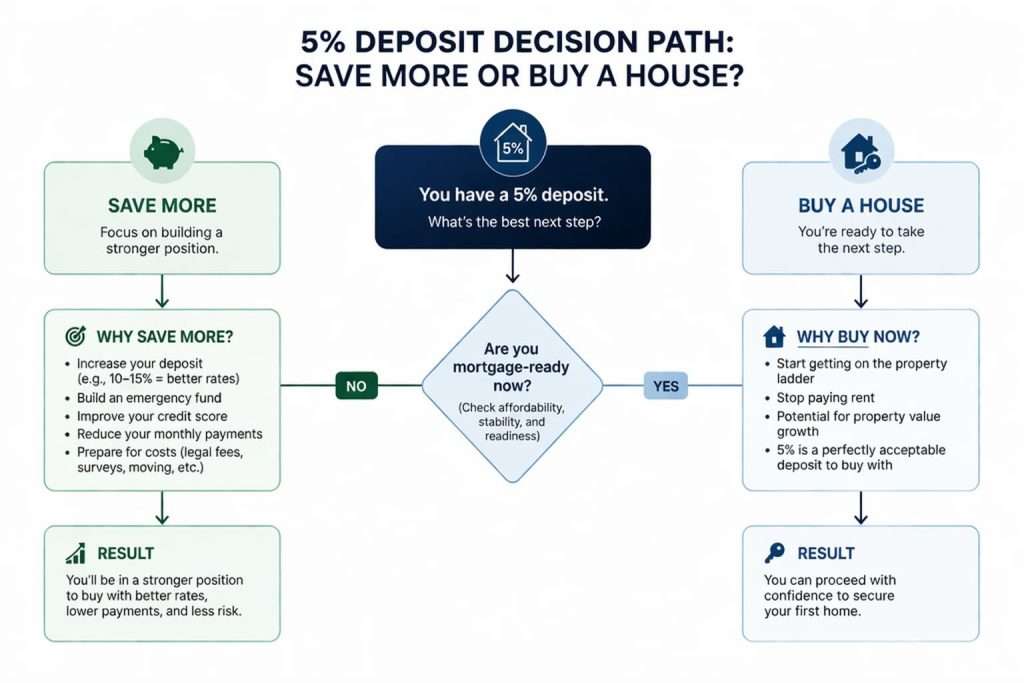
It really comes down to a choice between saving for a bit longer or getting on the property ladder sooner with a 5% deposit, a key decision for so many first-time buyers in Essex and beyond.
Higher Income Multiples: The Game Changer
There’s been a positive shift in the market recently. Some lenders, particularly when approached through a broker, are now willing to offer higher income multiples, such as 5 or even 5.5 times an applicant’s salary. This flexibility can be a real game-changer, especially for those buying in pricier areas like Chelmsford.
This isn’t just a fluke; it’s part of a wider trend making homeownership more attainable for UK first-time buyers in 2026. Data from early 2026 shows that an incredible 93% of first-timers secured rates below 5%. This is partly thanks to FCA changes that allow these higher-income multiples, boosting borrowing power and leading to a surge in property sales. You can learn more about the 2026 first-time buyer findings to see how this impacts affordability.
Lenders also conduct a detailed “stress test” on your finances. They’ll carefully review your bank statements to understand your spending habits and fixed outgoings, including:
Credit card and loan repayments
Childcare costs
Car finance agreements
Travel and commuting expenses
They use this information to work out your disposable income, making sure you could still afford your mortgage if interest rates were to rise in the future.
Your Credit Score: The Foundation of Your Application
For a 95% mortgage, a strong credit score is non-negotiable. It’s the main tool lenders use to assess your borrowing track record. A healthy score shows that you’ve managed credit responsibly in the past and are a good bet to do so again.
“A great credit score isn’t just about avoiding mistakes; it’s about actively demonstrating you’re a reliable borrower. Simple steps, taken a few months before you apply, can make a huge difference.”
Before you even think about applying, it’s vital to check your credit report with agencies like Experian, Equifax, or TransUnion. This gives you a chance to spot any errors and get them corrected.
If your score needs a bit of a boost, focus on these simple actions:
Register on the Electoral Roll: This is a quick and easy way to confirm your address and can give your score an instant lift.
Pay All Bills on Time: Consistency is everything. Even one late payment on a mobile phone bill can leave a mark.
Reduce Existing Debt: Work on lowering your credit card balances and other outstanding debts. Lenders pay close attention to your total debt-to-income ratio.
Avoid New Credit Applications: In the months leading up to your mortgage application, try not to apply for new credit cards or loans.
What If My Situation Is Complex?
So many first-time buyers we speak to worry that their personal circumstances will automatically disqualify them. At EHF Mortgages, we specialise in finding solutions for these exact scenarios.
Self-Employed Applicants: Lenders typically want to see two to three years of accounts or SA302 tax calculations. However, some specialist lenders we work with will consider applications with just one year’s trading history.
Minor Credit Issues: A late payment from a while ago or a satisfied Default from a few years back doesn’t have to be a deal-breaker. We have access to lenders who take a more forgiving view of past financial blips.
Non-Standard Income: If a large part of your income comes from bonuses, commission, or overtime, we know how to present your case to lenders who are happy to factor this in.
The key is working with a broker who knows which lenders are most receptive to your specific profile and can champion your application.
Ready to find out if you’re eligible and what you could borrow? Our team provides no-obligation advice tailored to your unique circumstances.
Your Step-by-Step Guide to Applying for a 95% Mortgage in 2026
Navigating the route to securing a mortgage for first-time buyers with a 5% deposit is so much simpler when you have a clear plan. Follow these seven steps, and you’ll be prepared, confident, and in the best possible position for a ‘yes’.
Step 1: Financial Health Check
First things first. Before you do anything else, you need an honest, crystal-clear picture of your finances. Start by going through your budget to see exactly where your money goes each month. This isn’t just about making sure you can afford the mortgage; it’s about proving it to the lender.
Next up, get your credit report. This is non-negotiable, as a solid credit history is absolutely vital for a 95% LTV mortgage. Pull your reports from all three main UK agencies – Experian, Equifax, and TransUnion – to check for any mistakes and start improving your score if it needs a little love.
💡 Top Tip: Grab a copy with a 7-day Free Trial at CheckMyFile – You get details of all 3 UK Agencies in one report – Click Here
Step 2: Document Preparation
Lenders need a fair bit of paperwork to confirm your identity, income, and outgoings. Being prepared is one of the single best things you can do to avoid frustrating delays down the line. Get all your key documents together now, and you’ll thank yourself later.
To help you get organised, we’ve put together a checklist of the core documents you’ll need. Getting these ready before you start the full application will make the whole thing run much more smoothly.
Essential Documentation Checklist for Your Mortgage Application
| Document Category | Examples | Why It’s Needed | Pro Tip |
|---|---|---|---|
| Proof of Identity | Passport, Driving Licence | To verify who you are and prevent fraud. | Check the expiry dates on these well in advance! |
| Proof of Address | Utility Bills, Council Tax Bill, Bank Statement | To confirm where you currently live. | Make sure they’re dated within the last 3 months. |
| Proof of Income | Latest 3 months’ payslips, P60, SA302s for self-employed | To prove you have a stable income to afford the repayments. | Have the last 3-6 months’ worth organised and ready to go. |
| Bank Statements | 3-6 months of statements for all current accounts | To show your spending habits and financial management. | Scan them for any large or unusual transactions you might need to explain. |
| Proof of Deposit | Savings account statements showing the build-up of funds | To show the source of your 5% deposit. | If your deposit is a gift, you’ll need a signed letter from the gift giver. |
Having this file ready to go shows lenders you’re a serious, organised applicant.
Step 3: Seek Professional Advice
This is where a good mortgage broker becomes your most valuable player. As a whole-of-market broker, we at EHF Mortgages aren’t tied to any single bank or building society. We have access to thousands of deals, including some exclusive products you won’t find on the high street, especially from lenders who are more flexible with a mortgage for first-time buyers with a 5% deposit.
We’ll handle the mountain of paperwork, chase the lender on your behalf, and frame your application in the strongest possible light. It saves you an enormous amount of time, hassle, and stress.
Step 4: Get a Decision in Principle
A Decision in Principle (DIP), sometimes called an Agreement in Principle (AIP), is an official estimate from a lender stating how much they’re prepared to lend you. It’s based on your initial income details and a ‘soft’ credit check, which won’t affect your score.
Getting a DIP is a game-changer. It proves to estate agents you’re a serious, credible buyer and gives you the confidence to start making offers on properties in Chelmsford, Colchester, or anywhere else in Essex.
Step 5: Find Your Property and Make an Offer
Now for the really exciting part! With your DIP secured, you can go house-hunting with a firm budget in mind.
Once you find a place you love, it’s time to make an offer. If it gets accepted, you’re ready to move on to the main event.
Step 6: The Full Mortgage Application
This is it, the formal submission to the lender. Your broker will complete the detailed application form and submit all the documents you’ve already prepared. The lender then conducts a full underwriting assessment and a ‘hard’ credit check, which will appear on your file. As you work through this stage, a detailed checklist for first home buyers can be a lifesaver, helping you keep track of everything from finances to legal steps.
“The full application is where all that early preparation really pays off. A clean, well-documented file, expertly presented by a broker, dramatically improves your chances of a quick and positive decision.”
Step 7: Valuation, Offer, and Legal Process
The lender will arrange a valuation survey of the property to ensure it’s worth the price you’re offering to pay. Assuming the valuation comes back fine, and the underwriter is happy, you’ll receive your formal mortgage offer.
From there, your solicitor takes over to handle all the legal conveyancing work. Once that’s all done, you can exchange contracts and agree on a completion date. This is the final hurdle before you get the keys to your very first home.
Government Schemes and Alternative Ways to Buy Your First Home
What happens if a 5% deposit feels just out of reach, or your income isn’t quite stretching far enough for the mortgage you need? Don’t worry, this is a common hurdle. Fortunately, there are several government schemes and alternative mortgage solutions designed specifically to help first-time buyers in Essex and beyond get a foot on the property ladder.
Let’s break down some of the most effective routes available.
Government-Backed Support for First-Time Buyers
The government has rolled out several initiatives to make a mortgage for first-time buyers with a 5% deposit a more realistic goal. These schemes essentially reduce the lender’s risk, which in turn encourages them to offer more of these high-LTV products.
Here are a couple of the key schemes you might come across:
Shared Ownership: This lets you buy a share of a home (typically between 10% and 75%) while paying rent on the rest of the home. The big advantage is that your deposit is based only on the share you’re buying, not the property’s full market value, which can make it significantly more affordable.
First Homes Scheme: This scheme offers brand-new homes to local first-time buyers and key workers at a discount of at least 30% off market price. The eligibility criteria can be quite specific, often prioritising people with a strong connection to the local area.
“Alternative schemes can be the key that unlocks homeownership, but they often come with specific rules and lender criteria. A specialist broker is essential to match you with the right scheme and the right lender.”
Powerful Alternatives Using Family Support
Beyond the official government routes, some of the most powerful strategies involve getting a bit of help from your family. These aren’t just informal handouts; they’re properly structured mortgage products designed to use a family member’s financial standing to strengthen your application.
One of the most popular methods is a gifted deposit. This is exactly what it sounds like: a close relative, usually a parent, gives you the money for your deposit. Lenders are generally very happy with this, but they will need a signed letter confirming the money is a true gift, with no strings attached and no expectation of repayment. You can learn more by reading our dedicated article on a gifted deposit mortgage.
Another fantastic option is a Joint Borrower Sole Proprietor (JBSP) mortgage. With a JBSP mortgage, a family member (like a parent) can add their income to yours on the mortgage application, boosting how much you can borrow. They become jointly responsible for the payments, but their name isn’t on the property deeds. This means you are the sole owner and can avoid potential extra Stamp Duty costs.
Navigating Your Options With Expert Guidance
The first-time buyer market has shown incredible resilience. In 2025, mortgage completions for first-time buyers jumped nearly 18%, driven by falling interest rates and new, more flexible rules from the Financial Conduct Authority (FCA) that allow lenders to offer higher income multiples. This innovation looks set to continue, making homeownership more accessible. If you want to dive deeper into this trend, you can discover more insights about the first-time buyer boom on Morningstar.com.
Finding your way through these different government schemes and alternative mortgages requires specialist knowledge. As whole-of-market brokers, we live and breathe this stuff, and we’re experts at finding the perfect solution for your unique circumstances.
Ready to explore these alternative paths to owning your first home in Braintree or the wider Essex area? Get in touch with our team for a friendly, no-obligation chat.
So, Where Do You Go from Here?
Getting on the property ladder with a 5% deposit mortgage is a very real possibility in 2026, and it’s an exciting prospect. As we’ve covered, it does mean navigating higher interest rates and stricter lender criteria, but these aren’t roadblocks; they’re just hurdles that are much easier to clear with a solid plan and the right people in your corner.
Every first-time buyer’s situation is different, but you certainly don’t have to figure it all out on your own.
Why Expert Guidance Makes All the Difference
Getting a mortgage approved, especially a 95% LTV one, is about more than just filling in an application. It’s about knowing which lenders are open to smaller deposits at any given time, understanding what their underwriters are looking for, and presenting your finances in the best possible way. This is where an experienced mortgage broker proves their worth, turning what feels like a complicated maze into a clear, step-by-step path.
“The journey to homeownership is unique for everyone, but you do not have to navigate it alone. We are committed to finding the right mortgage for you.”
It’s also a good idea to think about how you’ll protect your new home and your family’s financial security down the line. A mortgage life insurance policy is a key part of this, and another area where getting professional advice is invaluable.
Your Local Essex Mortgage Specialists
As brokers proudly serving Chelmsford, Braintree, Colchester, and the rest of Essex, we know the local property market inside and out. Our job is to find the right mortgage for first-time buyers with a 5% deposit that truly fits your life and your budget. We’re here to work for you, not for the lenders.
From your very first questions to the day you’re handed the keys to your new home, we’re here to give you clear, honest advice and support you every step of the way.
If you’re ready to see what’s possible or want to take the next step, our friendly team at EHF Mortgages is here to help.





