
💡 Top Tip: You might be surprised to learn you can buy a home with no deposit, even if you have been told you need 5%-10% or more. We’ll explain exactly how this is possible later in the article.
Your Guide To The Minimum Deposit For A House in 2026
Saving for a house deposit is usually the most prominent financial mountain to climb for anyone hoping to buy a home. It’s the down payment you make upfront, with the rest covered by a mortgage. Lenders ask for this because it lowers their risk and, just as significantly, gives you an immediate ownership stake in your property, known as equity.
The path to getting on the property ladder can feel bewildering, especially when you hear conflicting stories about how much you really need to save. This guide is here to cut through the noise and give you some absolute clarity. We’re going to break down everything you need to know about the minimum deposit for a house.
What This Guide Covers
We aim to give you a clear roadmap, whether you’re a first-time buyer in Chelmsford, an experienced investor eyeing up property in Colchester, or looking to move up the ladder in Braintree. Use the links below to jump straight to the parts that matter most to you.
- How Much Deposit Do You Actually Need
- Understanding What Lenders Are Looking For
- Putting Your Deposit Into a Real World Context
- How To Secure A Mortgage With A Smaller Deposit
- Let EHF Mortgages Guide Your Next Step
- Frequently Asked Questions About House Deposits
There’s no denying the challenge. In 2025, the average first-time buyer deposit in England soared to £68,154, which is about 23% of the typical property price. Here in East Anglia, the average deposit is £66,381, showing just how high the savings hurdle is in Essex. You can dig deeper into these UK deposit trends from Unbiased.co.uk.
But remember, these are just averages. Your personal situation dictates what’s possible.
Ready to get started? Let’s explore what these deposit figures really mean for you.
How Much Deposit Do You Actually Need?
You’ve probably seen the headlines shouting about 5% minimum deposits, and while that’s a great starting point, the reality on the ground is a little more complex. The amount you’ll need depends directly on your personal circumstances and the type of mortgage you’re getting.
Think of the 5% deposit as the minimum entry ticket to get into the homeownership game. But aiming for a bigger deposit is like upgrading that ticket; it often gets you a better seat with a much better view in the form of lower interest rates.
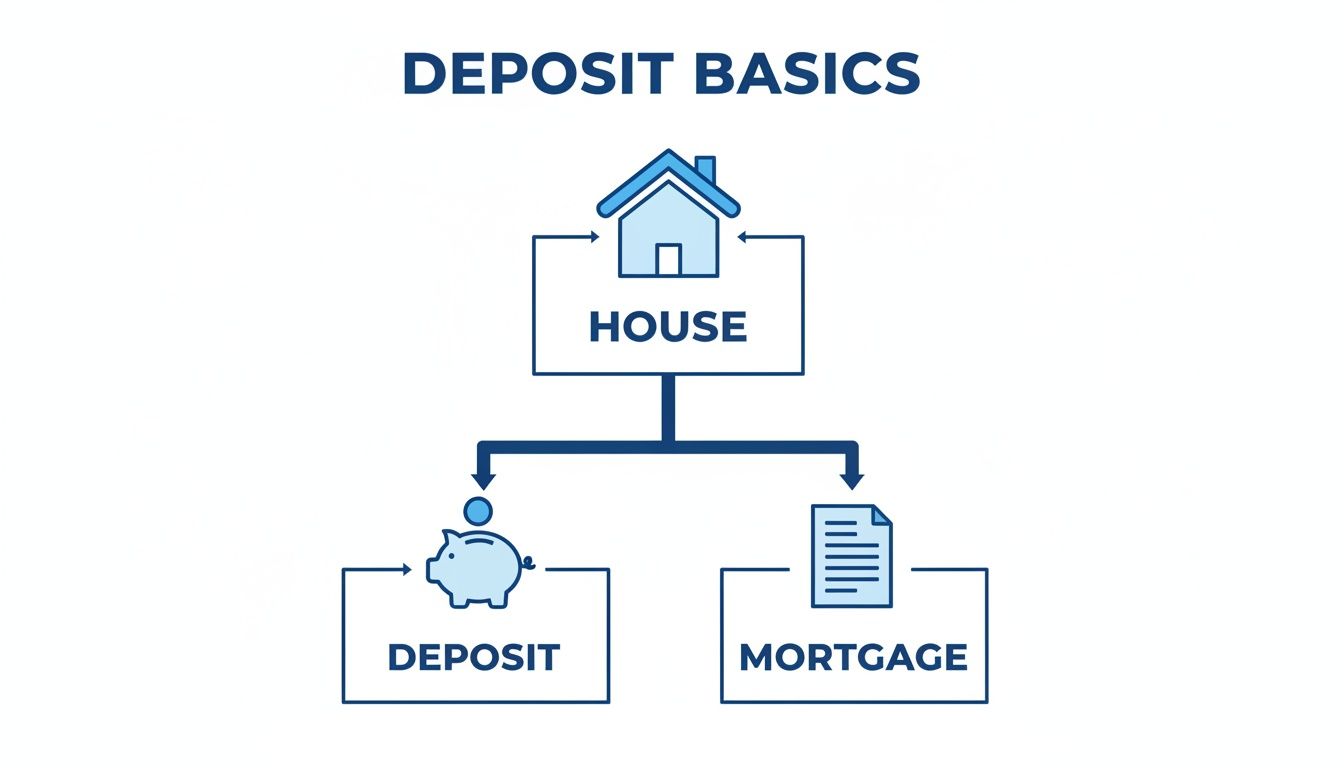
At its heart, your deposit is your personal stake in the property. It’s the portion you pay upfront, which reduces the amount you need to borrow from a lender and proves you’ve got some skin in the game.
The Power of Loan-to-Value (LTV)
To get your head around deposit requirements, you first need to understand a key bit of mortgage jargon: Loan-to-Value (LTV). It’s simply a percentage that shows how much of the property’s price you’re borrowing versus how much you’re putting down yourself.
Let’s break it down. Say you’re buying a home for £300,000 and you’ve saved a £30,000 deposit. Your deposit is 10% of the property’s value. That means you need to borrow the remaining £270,000, bringing your LTV to 90%. Simple as that.
A lower LTV is always the goal. Why? Because it signals to lenders that you’re a lower-risk borrower, and they’ll often reward you with their most competitive interest rates. This is the single biggest reason why saving for a larger deposit can save you a serious amount of money over the life of your mortgage.
Feel free to play around with different deposit amounts and see how they could impact your monthly payments by using our free mortgage calculators.
Minimum Deposit Requirements By Buyer Type
The deposit you’ll need can vary quite a bit depending on your situation. A first-time buyer in Chelmsford is playing a different game from a seasoned landlord adding a new property in Colchester to their portfolio.
To give you a clearer picture, we’ve broken down the typical deposit requirements for different buyers. This table should help you quickly see where you might fit in and what lenders will expect.
| Buyer Or Mortgage Type | Typical Minimum Deposit | Recommended Deposit | Key Considerations |
|---|---|---|---|
| First-Time Buyer | 0%-5% | 10% or more | Government schemes can help, but a larger deposit unlocks better deals. |
| Home Mover | 10% (often from equity) | 25% or more | Your existing equity is your biggest asset for your next deposit. |
| Remortgaging | N/A (based on equity) | Aim for lower than 90% LTV | The more equity you have, the better the remortgage rates you’ll find. |
| Buy-to-Let Investor | 25% | 25%-40% | Lenders see this as a higher risk, so the entry barrier is higher. |
| New Build Property | 5%-10% | 15% or more | Some lenders are cautious, but developer incentives can help. |
| Adverse Credit | 15%-20% | 25% or more | A larger deposit helps offset the perceived risk from credit issues. |
| Self-Employed | 10% | 15%-20% | A strong deposit gives lenders confidence when income is less predictable. |
| Later Life Lending | Based on equity/income | Varies significantly | Options like RIO or Equity Release have very different criteria. |
As you can see, your personal circumstances really do dictate the deposit you’ll need. Let’s dig into a few of these scenarios.
Common Buyer Scenarios Explained
First-Time Buyers
For those just starting, the most common minimum deposit is indeed 5%. This is often achievable thanks to specific mortgage products and government schemes designed to give a helping hand onto the property ladder. Options with little or no deposit (100% mortgages) are also in scope and may appeal if you have a track record of paying rent or have other family help. That said, if you can save 10% or 15%, you’ll open up a much wider choice of lenders and significantly better rates.
Home Movers
If you’re already a homeowner, your deposit for the next place will usually come from the equity you’ve built up. Equity is simply the slice of your home that you own outright. For instance, if your home in Braintree is worth £400,000 and you have £250,000 left on your mortgage, you have £150,000 in equity available as a deposit for your next purchase.
“A larger deposit doesn’t just reduce your loan size; it actively lowers your monthly payments and the total interest you’ll pay over time. It’s the single most effective way to make your mortgage more affordable.”
Buy-to-Let Investors
The rules change quite a bit for anyone looking to buy a property to rent out. Buy-to-let mortgages are considered higher risk by lenders, so they require a much larger commitment from you. The absolute minimum is usually 25%, and some lenders may require up to 40%, depending on the property, rental income, and the landlord’s expertise.
What About More Complex Situations?
At EHF Mortgages, we spend a lot of our time finding solutions for clients whose circumstances aren’t straightforward. These cases often have unique deposit requirements.
- New Build Properties: Some lenders may be wary of new builds and may require a larger deposit of 10-15% if 5% deposit options are not in scope. On the flip side, many developers offer brilliant incentives and schemes, such as Shared Ownership, which can make these properties far more accessible.
- Adverse Credit: If you’ve had a few bumps in the road with your credit history, like missed payments or a low score, lenders will view you as a higher risk. To balance that risk, they’ll almost certainly ask for a larger deposit, often 15% or more, depending on how severe the credit issues are.
- Self-Employed Applicants: When you work for yourself, proving a stable income can be trickier than handing over a few payslips. A larger deposit really strengthens your application and gives lenders the confidence they need. While a 5-10% deposit isn’t impossible, a bigger sum massively improves your chances.
Understanding where you fit is the crucial first step. Once you know what lenders are likely to expect, you can set a realistic savings goal and start planning your journey to getting those keys.
Understanding What Lenders Are Looking For
When you send off a mortgage application, it can feel like your financial life disappears into a black box, only for a simple ‘yes’ or ‘no’ to pop out weeks later. But it’s not magic. Lenders follow a surprisingly logical process designed to answer one crucial question: how much risk are they taking on?
Your deposit is a massive part of this, but it’s just one piece of the puzzle. Knowing what else they’re looking at gives you an enormous advantage. It helps you understand how a smaller deposit can be offset by strong performance in other areas. Let’s take a look behind the curtain.
Your Loan to Value (LTV) Ratio
We mentioned Loan-to-Value (LTV) earlier, but it’s so vital that it’s worth circling back to. For any lender, this percentage is the number one indicator of risk. A 95% LTV mortgage, where you’re putting down a 5% deposit, is seen as a much bigger gamble for them than an 80% LTV mortgage with a 20% deposit.
Why? Imagine property prices dipped slightly. The lender’s loan could suddenly be worth more than the house itself, a scary situation known as negative equity. A bigger deposit acts as a safety cushion for both you and the bank.
This risk calculation directly affects the interest rates you’ll be offered. Lower LTVs almost always unlock better, cheaper mortgage deals, which can save you a small fortune over the life of the loan.
Affordability Checks: The Stress Test
A lender needs to know you can afford the monthly payments. Not just today, when rates might be manageable, but also if they were to shoot up in the future. This is where their affordability checks come in, and they are incredibly thorough.
They don’t just glance at your salary. They’ll dig into the details of your finances, looking at things like:
- Regular household bills: council tax, utilities, and commuting costs.
- Existing debt: Credit card balances, car finance, and any personal loans.
- Lifestyle spending: Think gym memberships, Netflix, and childcare costs.
- Future changes: They’ll even consider upcoming changes, such as planned maternity leave.
- Family Size: How many mouths to feed in your household? Couples without children or dependents will be able to borrow more than those with a family.
To top it off, they will “stress test” your budget against a much higher interest rate. It’s a legal requirement from the Financial Conduct Authority to stop people from overstretching themselves. If your finances look solid even under pressure, a lender might feel more comfortable accepting a smaller deposit.
Your Credit History: A Financial CV
Think of your credit history as your financial CV. It’s a detailed record that tells lenders how you’ve handled borrowing in the past. They’ll use credit reference agencies like Experian and Equifax to check for any red flags. A history of missed payments, defaults, or County Court Judgements (CCJs) will make it tough to get a mortgage, especially with a low deposit.
On the other hand, a clean credit report showing you pay your bills on time proves you’re a reliable borrower. An excellent credit score can seriously strengthen your application, giving a lender in Chelmsford or Colchester the confidence they need, even if you’re only starting with a 5% or 10% deposit. For some great tips on polishing up your score, the MoneySavingExpert guide is an excellent place to start.
The Type Of Property You Are Buying
Finally, the property itself matters. Lenders have their own rulebooks, and some types of property are seen as higher risk than others. A standard brick-and-tile house in Braintree is usually a straightforward case.
However, specific properties can make lenders nervous, often meaning you’ll need a bigger deposit or might struggle to find a mortgage at all:
- Non-standard construction: Things like concrete or timber-framed houses.
- High-rise flats: Especially in large blocks or buildings with known cladding issues.
- Properties with short leases: Anything under 85 years can start to cause problems.
- Homes above commercial premises: A flat over a takeaway or a pub, for example.
If you’ve fallen for a more unusual property, working with a broker like EHF Mortgages is absolutely vital. We have the experience to know which specialist lenders are comfortable with these types of homes and can place your application with the best chance of success.
Putting Your Deposit Into a Real World Context
Understanding percentages and Loan-to-Value ratios is one thing, but it’s seeing how they translate into actual pounds and pence that makes the idea of a house deposit really click. Let’s ground these numbers in reality by looking at our local Essex property market.
We’re going to show you exactly what a 5% 10% and 15% deposit looks like in practice for homes in places like Chelmsford, Braintree, and Colchester. More importantly, we’ll illustrate how pushing for a larger deposit can dramatically slash your monthly payments and the total interest you’ll pay over the years.
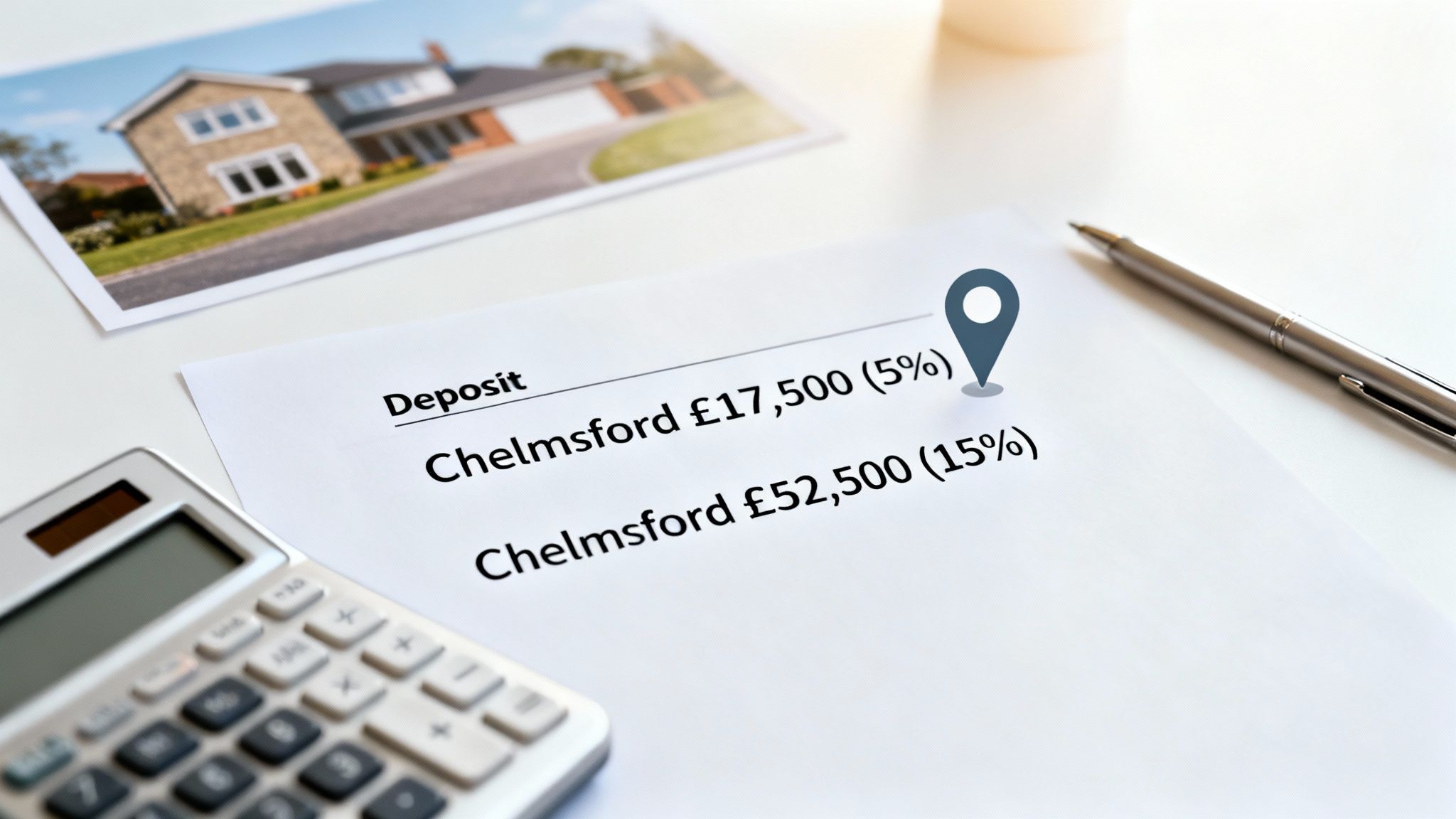
A Chelmsford Property Case Study
Let’s say you’ve found the perfect three-bedroom semi-detached house in Chelmsford and it’s on the market for £400,000. That’s a pretty realistic figure for our area. So how do different deposit sizes stack up?
Here’s a simple breakdown of the numbers:
- 5% deposit (95% LTV): You’d need to have £20,000 saved up. This means your total mortgage loan would be £380,000.
- 10% deposit (90% LTV): Doubling that, you’d need £40,000. This reduces your mortgage loan to £360,000.
- 15% deposit (85% LTV): For this, you would need £60,000, bringing your loan down to £340,000.
Of course, finding an extra £40,000 to jump from a 5% to a 15% deposit is a serious undertaking. But as you’re about to see, the long-term financial benefits are enormous.
How Your Deposit Impacts Your Mortgage Payments
The size of your deposit has a powerful ripple effect on your entire mortgage. It’s not just about borrowing less money; a larger deposit also unlocks better interest rates from lenders because they see you as a lower-risk borrower.
Let’s stick with our £400,000 Chelmsford property and see how it fits into your monthly budget. For this illustration, we’ll use an average interest rate for each LTV bracket calculated over a 30-year term.
| Deposit Percentage | Mortgage Loan | Example Rate | Monthly Payment | Total Interest Paid |
|---|---|---|---|---|
| 5% (£20,000) | £380,000 | 5.5% | £2,158 | £396,880 |
| 10% (£40,000) | £360,000 | 5.0% | £1,933 | £335,880 |
| 15% (£60,000) | £340,000 | 4.5% | £1,723 | £280,280 |
Please note these figures are for illustrative purposes only. Rates change frequently and depend on individual circumstances.
Look at those numbers. Stretching to a 15% deposit instead of a 5% one could save you £435 every single month. That’s a huge difference. Over the full 30-year term, that bigger deposit would save you an incredible £116,600 in interest payments alone. This is precisely why even a slight increase in what you can put down makes a massive difference in the long run.
To get a clearer idea of what you might be able to borrow, it’s worth checking out our guide to understanding your borrowing potential.
The Essex and UK Property Landscape
The amount needed for a deposit varies hugely depending on where you are in the UK. The regional differences paint a stark picture, with Greater London demanding an eye-watering average deposit of £151,731. In stark contrast, Northern Ireland’s average is just £39,035.
Here in Essex, our market sits somewhere in the middle. The average deposit in East Anglia is £66,381, which is very close to the South West at £65,171. This data really highlights why local knowledge is vital, especially when you’re looking at properties in Braintree or new builds in Colchester. If you want to dive deeper, you can discover more about how house deposits vary across the UK on better.co.uk.
Seeing these real-world numbers in your local area is key to turning the “minimum deposit” from an abstract concept into a concrete, achievable savings goal.
How To Secure A Mortgage With A Smaller Deposit
If you’re worried that your deposit isn’t big enough to get you on the property ladder, you’re definitely not alone. The good news is that a smaller deposit doesn’t automatically close the door on homeownership. There are several powerful strategies and schemes out there designed specifically to help bridge that gap.
From government support to family contributions, exploring these different routes can be the key to turning your dream of owning a home into a reality. Let’s walk through some of your most practical options.

Government-Backed Mortgage Schemes
One of the biggest helps for buyers in recent years has been the introduction of government schemes. The Mortgage Guarantee Scheme is a perfect example, giving lenders across the UK the confidence they need to offer 95% LTV mortgages.
What does this mean for you? It means you can buy a home with just a 5% deposit on properties worth up to £600,000. This scheme has been a genuine game-changer,, especially for first-time buyers in areas like Chelmsford and Colchester,, where saving a large deposit can feel like an impossible task.
Of course, there are trade-offs. While these schemes make getting on the ladder more accessible, the interest rates are often slightly higher than those for mortgages with larger deposits. It’s simply how lenders balance out the increased risk.
The Power of a Gifted Deposit
Another extremely common and effective route is receiving a gifted deposit from a close family member, usually a parent or grandparent. This is precisely what it sounds like: they provide some or all of your deposit funds as an outright gift.
Lenders are generally pleased to accept gifted deposits as long as the proper legal steps are followed. The person gifting the money will need to sign a letter confirming a few key points:
- The money is a true gift, with no expectation of repayment.
- They won’t have any legal stake or interest in the property.
- They understand the funds won’t be returned to them under any circumstances.
This simple bit of paperwork gives the lender all the assurance they need. A gifted deposit can be a massive boost to your buying power, quickly turning a 5% deposit into a 10% one and unlocking much better mortgage rates.
Other Creative Solutions
Beyond government schemes and family gifts, there are other valuable options out there. It’s always worth exploring the various financing options available to understand the whole landscape of how you can fund your home purchase.
One fantastic tool is the Lifetime ISA (LISA). If you’re aged 18 to 39, you can open a LISA and save up to £4,000 a year towards your first home. The government then adds a 25% bonus on top of whatever you save up to £1,000 annually. Over just a few years, that bonus can give your deposit a substantial, completely tax-free boost.
Another route is a Joint Borrower, Sole Proprietor mortgage. This is where a family member (usually a parent) agrees to use their surplus income to boost the amount you can borrow, whilst being some form of guarantor at the same time. The mortgage is in joint names, but ownership is only with the primary borrower. The parent can also help with savings or property as collateral for your loan. They’re essentially promising to cover your mortgage payments if you can’t, which makes you a much less risky prospect for lenders. This can sometimes even help you secure a 100% mortgage with no deposit at all, though these products are quite rare.
Finally, never underestimate the value of specialist lenders. High street banks often have rigid one-size-fits-all criteria that can exclude anyone with a low deposit or a slightly complex situation. At EHF Mortgages, we work with an extensive network of specialist lenders who are more flexible and often offer products tailored to these circumstances. You can learn about even more options in our guide to Shared Ownership and Joint Borrower Sole Owner schemes.
Ready to Take the Next Step? Let Us Help
We’ve covered a lot of ground in this guide, showing that while getting on the ladder with a 5% minimum deposit for a house is achievable, aiming higher can open up better deals and save you a small fortune in the long run. From government schemes to gifted deposits, there are plenty of routes to explore, but figuring out which one is right for you can feel like a maze.
That’s where we come in. As an independent whole-of-market broker, EHF Mortgages isn’t tied to any single lender. With over 35 years of experience navigating even the most complex cases, our team has a deep-rooted understanding of the property markets in Chelmsford, Braintree, and Colchester. We know who to talk to and how to get you the best possible deal.
Your Mortgage Journey, Your Way
Your path to owning a home is as unique as you are, so your mortgage advice should be too. Forget trying to squeeze your life story into a generic online calculator. We take the time to sit down, listen, and properly understand your financial situation and what you want to achieve.
Our goal isn’t just to get you a mortgage; it’s to build a lasting relationship. We’ll be with you from that first phone call right through to the day you get your keys, and we’ll still be here for you when it’s time to remortgage down the line. Personalised advice is simply the best way to secure your financial future.
Here’s a quick look at how easy it is to get started on our contact page.
This simple form puts you directly in touch with our expert advisors, who are ready to offer personalised support.
Book Your Free Consultation Today
The next step couldn’t be simpler. Book a free no-obligation chat with our friendly team. We’ll go over your circumstances, answer all your questions (no matter how small!), and give you clear, actionable advice on how to secure the minimum deposit for a house that gets you moving.
It’s time to turn your property dream into a reality. Get in touch with EHF Mortgages today and let our experts guide you home.
Frequently Asked Questions About House Deposits
We hear a lot of questions about the minimum deposit needed for a house. It’s a topic surrounded by myths and misinformation, so to round off this guide, we’ve answered some of the most common queries we get from clients across Chelmsford, Braintree, and Colchester.
Our goal is to give you quick, straightforward answers, cut through the noise, and add a bit of extra clarity to some of the key points we’ve covered.
Can I Get a 100% Mortgage With No Deposit?
The short answer? There are a handful of 100% mortgage schemes in today’s market. While 100% mortgages, sometimes called ‘no deposit’ mortgages, do pop up now and again, they always come with stringent eligibility rules. For most buyers, getting on the ladder without a deposit isn’t easy, but depending on your circumstances, it’s worth considering whether saving a deposit is.
Lenders view these products as high-risk, so they’re usually reserved for borrowers with a perfect credit history and a high, stable income. A much more common alternative for those struggling to save is a guarantor mortgage, where a family member uses their own home or savings as security for your loan.
How Long Does It Take to Save for a Deposit?
This is the classic “how long is a piece of string?” question. The honest answer is that it depends entirely on your income, your spending habits, and the property prices in your area. But we can give you a realistic picture based on what we see every day here in the Essex market.
Let’s say you’re a first-time buyer in Essex aiming for a 5% deposit on an average starter home of around £300,000. Your target is £15,000. Looking at UK savings data from the Office for National Statistics website, it can take several years for a single person or a couple to save this amount. Using tools like a Lifetime ISA can really speed things up by adding a 25% government bonus to your savings.
Does a Bigger Deposit Guarantee a Mortgage?
No, a bigger deposit doesn’t guarantee you a mortgage. It’s a huge advantage and definitely makes you a more attractive applicant, but it’s only one piece of the puzzle lenders consider.
Lenders take a holistic view of your application. They will still conduct thorough affordability checks and review your credit history with a fine-tooth comb. You could have a 25% deposit ready, but if you have a history of missed payments or your income isn’t high enough to cover the mortgage, your application could still be declined.
Think of it like this:
- Your Deposit: Shows you’re financially disciplined and reduces the lender’s risk.
- Your Affordability: Proves you can actually handle the monthly repayments.
- Your Credit History demonstrates that you’re a reliable borrower.
You need all three of these to be in good shape to secure a mortgage offer. A large deposit helps significantly, but it can’t make up for significant problems in other areas. This is precisely why getting professional advice is so important. We can help ensure your entire application is as strong as possible.
Navigating the world of house deposits can feel tricky, but you don’t have to figure it all out on your own. The expert team at EHF Mortgages is here to give you clear, personalised advice to help you reach your property goals.
Book your free no-obligation consultation today. Let’s make your dream home a reality.
Contact Us





