
💡 Top Tip: Start exploring your mortgage refinancing options at least 6 months before your current deal ends. This gives you ample time to secure the best rate without feeling rushed, and we will explain why this timing is so crucial later.

Table of Contents
A remortgage interest rate is the new rate you lock in when swapping your current mortgage for a new one. Think of it as trading in your old deal for a more competitive one. For many homeowners, this is a savvy financial move that can save a significant amount of money.
Your Guide to Lower Mortgage Refinancing Interest Rates
Getting to grips with a mortgage refinance can feel like a big task, but the concept itself is quite simple. You’re taking out a new loan to pay off your existing mortgage, all with the aim of getting a better deal. For countless homeowners in places like Chelmsford and Braintree, it’s a powerful tool for managing their finances.
The main objective is usually to find a lower remortgage interest rate. A better rate means smaller monthly payments, which not only frees up cash in your budget but also cuts down the total interest you will pay over the years.
The Benefits of Reviewing Your Mortgage
Beyond just getting a lower rate, refinancing can help you adapt to life’s changes. Knowing these benefits is the first step in deciding if it is the right move for you.
Lower Your Monthly Payments: This is the most common reason to remortgage. Securing a better interest rate directly reduces your monthly outgoings.
Release Equity: You can borrow against the value you’ve built up in your home to fund renovations, consolidate debts, or cover other big expenses.
Gain Payment Stability: If you’re on a variable-rate mortgage, you might want the peace of mind that comes with a fixed-rate deal, giving you predictable monthly payments.
Pay Off Your Loan Faster: You could switch from a 25-year term to a 15-year term, helping you become mortgage-free much sooner.
“Choosing between a fixed and variable rate isn’t just about the numbers; it’s about aligning your mortgage with your financial goals and your tolerance for risk.”
For homeowners right across Essex, from Colchester to the surrounding towns, the mortgage market is always in motion. A fantastic deal from a few years back might not look so competitive today. By regularly reviewing your mortgage, you ensure your single largest financial commitment is still performing at its best for you. This guide will walk you through everything you need to know.
What Determines Your Refinancing Interest Rate

Landing a great remortgage interest rate isn’t just a matter of luck. Lenders weigh up several key factors to work out what rate they can offer you, and understanding these elements puts you in a much stronger position to negotiate the best possible deal.
Think of it like a job interview for your finances. Your financial history is your CV, and the lender is the hiring manager looking for a reliable, low-risk candidate. The main things they look at are your Loan-to-Value ratio, credit history, income, the type of mortgage you want, and what’s happening in the wider market.
The Importance of Loan-to-Value (LTV)
Your Loan-to-Value, or LTV, is one of the biggest pieces of the puzzle. It’s simply the size of your mortgage shown as a percentage of your property’s current value. For a lender, a lower LTV means less risk, and that almost always translates into a better interest rate for you.
For example, if your home in Chelmsford is worth £400,000 and you have a £300,000 mortgage remaining, your LTV is 75%. As your property’s value goes up or you pay down more of your mortgage, your LTV drops. This makes you a more attractive borrower in a lender’s eyes.
Generally, lenders offer their most competitive rates to homeowners with an LTV of 60% or lower. We’ve put together a full guide where you can learn more about your LTV ratio and how it shapes your options.
Lenders use LTV bands to categorise their rates:
90% LTV: Rates are often higher here because there’s less equity in the property.
85% LTV: This is where rates usually start getting more competitive.
75% LTV: A key milestone where a much wider range of good deals opens up.
60% LTV or less: The sweet spot. This is where you’ll typically find the lowest rates on the market.
Your Credit Score and Financial Health
Next up is your credit score. It’s a number that sums up how you’ve managed debt in the past, and lenders use it to gauge how likely you are to make your mortgage payments on time. A strong score shows you’re financially responsible and can unlock lower interest rates.
Simple things make a big difference here: paying your bills on time, keeping credit card balances low, and checking your credit report for any mistakes. If you’re a homeowner in Braintree thinking about refinancing, taking a few months to polish your score before you apply can have a huge impact on the offers you receive.
Income and Affordability Calculations
It goes without saying that lenders need to be sure you can comfortably afford the monthly payments. They’ll take a close look at your income, whether from your job, a business, or other sources, and balance it against your regular outgoings. This covers everything from credit card debt and car loans to childcare costs and household bills.
Stricter affordability rules mean lenders will also “stress test” your finances. They’ll run the numbers to see if you could still afford your mortgage if interest rates were to rise sharply. Proving you have a stable income and manageable debts is key to passing these checks and securing a competitive rate.
The Product You Choose: Fixed vs Variable
The type of mortgage product you go for has a direct impact on the rate you’ll be offered. Your main choice is between a fixed rate and a variable rate, and each has its own pros and cons.
Fixed-Rate Mortgages
How it works: Your interest rate is locked in for a set term, usually 2, 3, 5, or 10 years.
Impact on rate: This gives you complete certainty over your monthly payments. The rate might be a little higher than a variable deal at first, but it protects you if market rates rise.
Variable-Rate Mortgages
How it works: Your interest rate can go up or down. A “tracker” mortgage follows the Bank of England Base Rate, while a “discounted” rate follows the lender’s own Standard Variable Rate.
Impact on rate: These often come with a lower initial “headline” rate, but your payments could rise if rates change.
How Broader Market Conditions Shape Rates
Finally, some factors are completely out of your hands. The overall health of the UK economy, inflation, and most importantly, the Bank of England Base Rate all play a massive role in the mortgage refinancing interest rate lenders can offer.
A look at historical UK mortgage rates shows this perfectly. Rates have swung between highs and lows over the decades, dropping dramatically after 2008 and hitting a low of around 2.10% in late 2021 before rising again. This just goes to show how much wider market shifts can impact your wallet.
Choosing Between Fixed and Variable Rates
When you start looking at refinancing your mortgage, one of the biggest questions you will face is whether to go for a fixed-rate or a variable-rate deal. This isn’t just about grabbing the lowest number you see; it’s about matching your mortgage to your financial reality, your plans for the future, and frankly, how much risk you’re comfortable taking on.
There’s no single right answer. The best choice depends entirely on your personal circumstances and your appetite for certainty versus potential savings.
The Stability of Fixed-Rate Mortgages
A fixed-rate mortgage is, for good reason, the most popular choice here in the UK. It offers one thing above all else: complete peace of mind. Your interest rate is locked in for a specific period, usually for two, three, five, or even ten years.
This means your monthly payment stays exactly the same for the entire fixed term, no matter what the Bank of England or the wider economy throws at it. This predictability makes budgeting a whole lot easier and shields you from any nasty surprises if interest rates suddenly climb.
This option is often a great fit for:
Families on a set budget: Knowing your biggest monthly outgoing is locked in makes planning for everything else, from school fees to holidays, much more straightforward.
First-time refinancers: If this is your first time navigating the remortgage process, the security of a fixed rate can be incredibly reassuring.
Anyone who dislikes risk: If the mere thought of your mortgage payment going up keeps you awake at night, a fixed rate is the sensible, stress-free choice.
For example, a family in Colchester with young children might find that fixing their rate for five years gives them the financial breathing room to plan ahead without worrying about ups and downs in the mortgage market.
Understanding Variable, Tracker, and Discounted Rates
Variable-rate mortgages are a different beast entirely. Your interest rate can go up or down, which brings an element of risk. The trade-off is that they often start with a lower headline rate than fixed deals, which can be very appealing.
There are a few main types to get your head around:
Tracker Mortgages: These are directly tied to the Bank of England Base Rate. A typical deal might be advertised as “Base Rate + 0.75%”. If the Base Rate increases by 0.25%, your mortgage payment will rise by the same amount, and vice versa.
Discounted Rate Mortgages: This type offers a set discount off the lender’s Standard Variable Rate (SVR). For example, if your lender’s SVR is 8% and your deal has a 2.5% discount, your rate would be 5.5%. The catch is that if their SVR is set independently of the Bank of England Base Rate, then any base rate cuts may not be passed on, or the lender may change rates at will.
The main attraction here is the potential for lower monthly payments, especially if interest rates are holding steady or falling. However, you absolutely must be in a position where you can comfortably afford higher payments if rates do start to rise. This kind of product might suit someone with a healthy financial cushion or a fluctuating income who can absorb the changes.
Fixed vs Variable Rate Mortgages at a Glance
Making the right choice really comes down to balancing the security of a fixed rate against the potential initial savings of a variable one. This table breaks down the core differences to help you decide which path might be better for you.
| Feature | Fixed-Rate Mortgage | Variable-Rate Mortgage | Best Suited For | Example Scenario |
|---|---|---|---|---|
| Payment Stability | Payments are locked in and predictable for the term. | Payments can change, creating budget uncertainty. | Those who value certainty and need stable budgeting. | A family in Essex wanting predictable outgoings. |
| Initial Rate | Often starts slightly higher to pay for the security. | Usually starts lower, offering attractive initial savings. | Those with a financial buffer to afford rate rises. | An investor comfortable with market fluctuations. |
| Risk Level | Low – you are protected from interest rate rises. | High – you are exposed if market rates increase. | Homeowners who dislike financial uncertainty. | Borrowers who believe rates will fall or stay low. |
This table compares the key features, benefits, and risks of fixed-rate and variable-rate mortgage products to help you decide which is more suitable for your refinancing needs. Ultimately, weighing these factors against your own financial situation is key to making a confident decision.
At the end of the day, there is no single “best” mortgage type, only the one that is best for you. By understanding how each product works and taking an honest look at your finances, you can make a smart decision that supports your long-term plans.
This can feel like a lot to take in, but you don’t have to figure it all out on your own. Speaking to an expert, like a Mortgage Broker, who can bring clarity and ensure you choose a path that truly aligns with what you need.
Calculating Your Refinance Savings and Break-Even Point
Getting to grips with the real financial impact of refinancing is the most powerful step you can take. It’s about moving beyond abstract interest rates and seeing how the pounds and pence actually affect your monthly budget. Let’s walk through exactly how to calculate your potential savings and that all-important break-even point.
The numbers don’t lie. A lower mortgage refinancing interest rate means lower monthly payments, plain and simple. This extra cash can be used to overpay your mortgage, build your savings, or just give you more breathing room each month.
Calculating Your Monthly Savings
Let’s look at a real-world example. Imagine a homeowner here in Chelmsford has a £250,000 mortgage balance. Their fixed-term deal has just ended, so they’ve been moved onto their lender’s high Standard Variable Rate (SVR) of 7.5%. They’re now looking to refinance onto a new 2-year fixed rate of 4.5%.
Here’s how their monthly payments would compare:
Current Payment (7.5% SVR): Approximately £1,829 per month
New Payment (4.5% Fixed Rate): Approximately £1,390 per month
That’s a monthly saving of £439. Over a full year, this adds up to an incredible £5,268 back in their pocket. It’s tangible savings like this that show just how crucial it is to review your mortgage regularly.
Don’t Forget the Break-Even Point
While the monthly savings are exciting, you have to weigh them against the upfront costs of setting up the new mortgage. This is where calculating your break-even point comes in. It’s the moment your accumulated savings have officially paid off all the initial fees.
Common refinancing costs can include:
Arrangement Fees: Charged by the new lender for the mortgage product.
Legal Fees: For the solicitor handling the legal side of the switch.
Valuation Fees: To confirm your property’s current market value.
Let’s stick with our Essex homeowner. Say the total fees to lock in their new 4.5% rate come to £1,500. We already know they’re saving £439 a month.
To find the break-even point, you simply divide the total costs by the monthly savings: £1,500 ÷ £439 = 3.4 months.
This means it would take just over three months for the new deal to pay for itself. Since they’re securing a 2-year deal, they will enjoy nearly 21 months of pure savings after hitting that break-even point. We have a detailed article that explores these costs more deeply, which you can read here: Learn more about how much remortgaging costs in our guide.
The chart below shows how the stability of a fixed rate compares to the ups and downs of a variable rate, a key factor when you’re thinking about long-term savings.
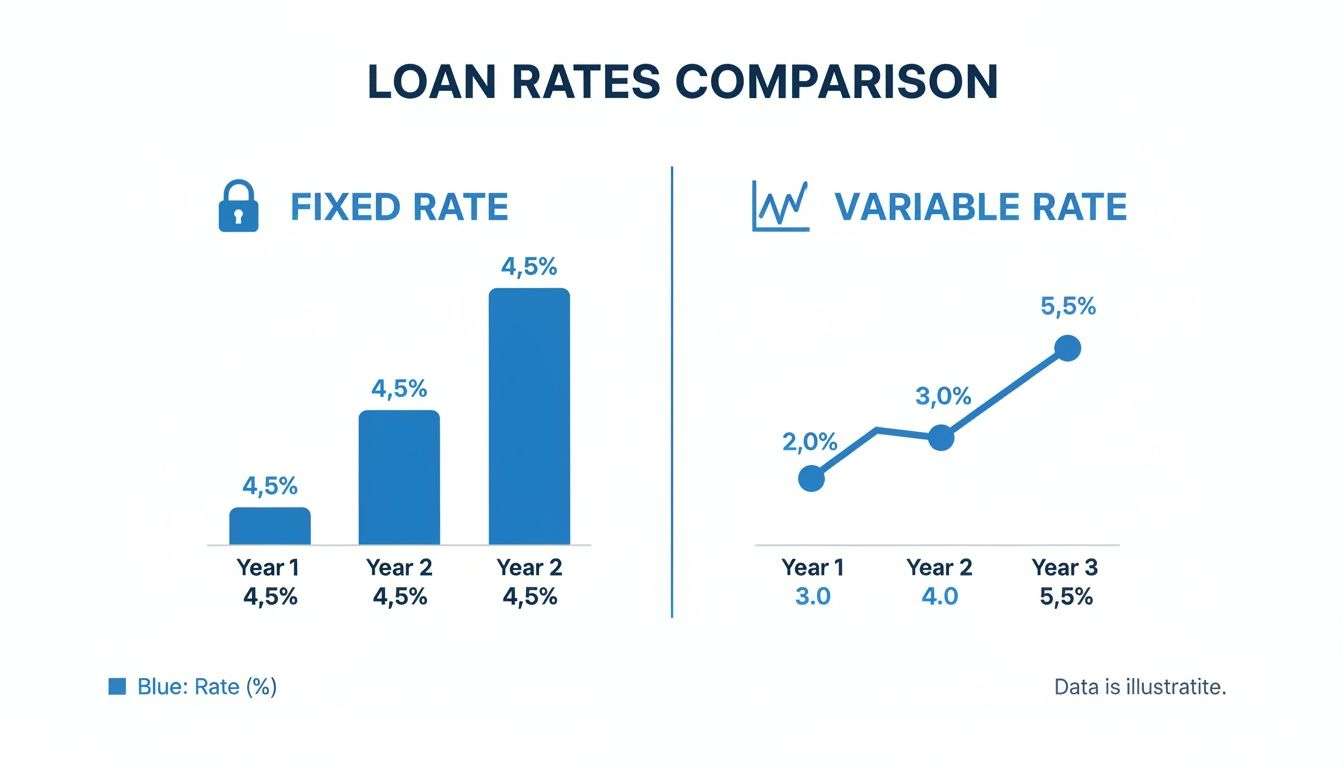
This visual makes it clear: a fixed rate gives you predictability, whereas a variable rate might be cheaper if market rates fall but carries the risk of payments going up.
These rate dynamics heavily influence homeowner decisions. For instance, UK remortgage approvals made up 35% of all mortgage approvals in December 2023. As we head towards 2026, many homeowners in Essex whose cheap fixed deals are ending will face significant payment shocks, making the chance to secure a competitive new rate more important than ever.
By taking the time to run these numbers, you can make a fully informed decision, confident that you understand the entire financial picture, not just the headline rate.
Your Step-by-Step Refinancing Process
Thinking about remortgaging can feel like a huge task, but it doesn’t have to be. When you break it down, the process is actually a series of manageable steps designed to get you from your old deal to a new, better one.
Let’s walk through the remortgage journey together, from the initial planning stages right through to completion.
Step 1: Preparation and Broker Consultation
The best time to start thinking about your remortgage is around six months before your current deal ends. This might sound early, but this “6-month rule” is your best friend. It gives you plenty of breathing room to sort out your finances, pull together your paperwork, and explore the market without feeling rushed.
During this stage, you’ll need to gather a few key documents:
Proof of Income: Your last three months’ payslips and your most recent P60.
Bank Statements: Lenders will want to review your last three to six months of statements to get a clear picture of your income and outgoings.
Proof of ID and Address: Standard stuff like your passport or driving licence, plus a recent utility bill.
This is also the perfect time to decide whether to approach your current bank or work with a mortgage broker. While your own bank is an option, a whole-of-market broker has access to thousands of deals from dozens of lenders, many of which you cannot access directly. For homeowners in Chelmsford and across Essex, that wider access is often what unlocks the very best rates.
Step 2: The Application and Valuation
Once you and your broker have pinpointed the perfect product for you, it’s time to submit the formal application. Your broker will package your application and supporting documents, presenting your case to the lender in the strongest possible light.
From there, the lender begins its underwriting process. A key part of this is the property valuation, in which the lender engages an independent expert to assess your home’s current market value. This is crucial for confirming your Loan-to-Value (LTV) ratio.
A quick heads-up: sometimes a valuation comes in lower than expected, which is known as a ‘down-valuation’. This can impact your LTV and the deal you’re offered. An experienced broker can often challenge this on your behalf or pivot quickly to find an alternative lender if needed.
Step 3: The Mortgage Offer
If the valuation goes smoothly and the underwriters are satisfied with your financial position, the lender will issue a formal mortgage offer. This is the official document outlining the exact terms of your new loan, including the interest rate, your new monthly payment, and the loan term.
The UK remortgage market is always buzzing, especially when interest rates shift. A staggering 316,000 fixed-rate mortgages were up for renewal in Q1 2024 alone, meaning a huge number of homeowners were looking for a new deal. In fact, remortgages accounted for nearly a third (31%) of all UK mortgage approvals between August 2021 and August 2023.
In such a busy market, a good broker can be a massive advantage for homeowners in Chelmsford, helping you cut through the noise to secure a lower rate and avoid a nasty payment shock.
Step 4: Legal Work and Completion
With your mortgage offer secured, the final piece of the puzzle is the legal work, or conveyancing. A solicitor handles the legal side of things, officially transferring your mortgage from the old lender to the new one. They’ll perform final checks, request the funds from your new lender, and use them to pay off your old mortgage balance.
Once that’s done, you’ve completed! Your new mortgage is now active, and you’ll start making payments to your new lender at your new, hopefully much lower, interest rate.
Having a clear roadmap like this makes the whole journey feel a lot less intimidating. You might also find our other guide helpful: Check out our guide on how to remortgage a house.
With a bit of preparation and the right expert guidance, you can move forward with confidence towards a better mortgage deal.
Why You Should Speak to an Essex Mortgage Broker
Going it alone on your remortgage journey can feel a bit like wading through treacle. While this guide gives you a great starting point, the truth is that the lowest mortgage refinancing interest rate you see advertised online isn’t always the one you’ll be offered, or even the right one for your circumstances.
That’s where talking to an experienced mortgage broker really pays off. We live and breathe this stuff, especially when it comes to cases that do not quite fit the standard tick-boxes of high street lenders.
When Specialist Advice Is Essential
While anyone can benefit from a helping hand, there are certain situations where getting professional advice isn’t just a nice-to-have; it’s essential. We have years of experience finding great deals for clients with more complex financial backgrounds.
This is where we really shine:
Self-Employed Applicants: Lenders can be tricky when it comes to self-employed income. They often want to see two or more years of accounts, and understanding how to present your salary, dividends, or net profit correctly is key. We know exactly how to frame your application for the best chance of success.
Challenging Credit History: A few missed payments in the past or a less-than-perfect credit score doesn’t have to shut the door on a great remortgage deal. We have built strong relationships with specialist lenders who look beyond the numbers.
Buy-to-Let Landlords: Whether you own a single rental in Braintree or a growing portfolio across Essex, the buy-to-let market is always changing. We can find competitive products and help you navigate the latest tax and regulatory rules.
Unusual Properties: Trying to get a mortgage on a home with non-standard construction, a high-rise flat, or a property above a shop? Mainstream lenders often get nervous. We know which ones are happy to lend on these types of homes.
Navigating Later Life and Volatile Markets
For homeowners over 55 in Colchester and the surrounding areas, refinancing can open up new possibilities. Specialist products such as Retirement Interest-Only (RIO) mortgages or equity release can offer a significant degree of financial freedom in retirement. These are complex options that require careful thought and expert advice to ensure they’re right for you.
“In a fluctuating market, a broker’s value comes from their whole-of-market access and up-to-the-minute knowledge, turning uncertainty into opportunity for their clients.”
Even beyond these complex situations, a good broker simply saves you time, stress, and potentially thousands of pounds. We handle the paperwork, chase the lenders, and iron out any problems before they even reach you. It leaves you free to get on with your life.
Your home is your biggest asset. Getting the right advice is the smartest investment you can make. A quick, no-obligation chat with us can give you the clarity and a clear plan you need.
Your Remortgaging Questions Answered
When it comes to remortgaging, it’s natural to have questions. We get it. To help clear things up, we’ve put together straightforward answers to some of the most common queries we hear from homeowners across Chelmsford, Braintree, and Colchester.
How Long Does The Remortgaging Process Take?
On average, you can expect the entire process to take between four and eight weeks, from the moment you apply to the day it’s all finalised. We always recommend getting the ball rolling at least six months before your current mortgage deal expires. This gives you plenty of breathing room to gather paperwork, handle any unexpected hiccups, and lock in the best mortgage refinancing interest rate without any last-minute stress.
Can I Remortgage If I Have Bad Credit?
Yes, it’s definitely possible, but it can be trickier. While high street banks often have strict criteria, there are specialist lenders out there who are more willing to look at the bigger picture and consider applicants with a less-than-perfect credit history. This is where a good mortgage broker becomes your biggest asset. We have access to these lenders and know exactly how to position your application to give it the strongest chance of success.
What Is An Early Repayment Charge And Will I Have To Pay One?
An Early Repayment Charge (ERC) is a penalty fee your current lender may apply if you switch out of your mortgage before its initial term ends. The simplest way to avoid this is to wait until your fixed or discounted period ends. We can help you dig into your mortgage documents to see if an ERC applies and, more importantly, do the maths to figure out if switching early would still save you money despite the charge.
“Even if refinancing comes with a fee, it can still save you thousands over the term if the rate drop is significant. It’s about weighing up the short-term cost against the long-term gain.”
Is It Possible To Borrow More Money When I Remortgage?
Absolutely. Many homeowners take the opportunity to borrow more when they remortgage, a process often called releasing equity. It’s a popular way to fund home improvements, consolidate other debts, or pay for a large one-off expense. How much you can borrow will depend on your property’s current value, your outstanding mortgage balance, and your overall financial situation, which the new lender will assess carefully.
Feeling clearer about your options? The next step is to get personalised advice. The team at EHF Mortgages is ready to answer your specific questions and find the right solution for you.





