
How to Choose a Mortgage Broker: The Ultimate UK Guide 2026
Choosing the right mortgage broker is one of the most important decisions you’ll make on your property journey. Get it right, and you could save thousands of pounds and a huge amount of stress. But where do you even start?
💡 Top Tip: If you take one thing from this guide, make it this: always prioritise a broker with ‘whole-of-market’ or ideally ‘Independent’ access. It’s the single most important factor for unlocking the best deals, and we’ll explain exactly why a little later on.
This guide will walk you through exactly how to find a trusted expert, whether you’re a first-time buyer in Chelmsford or a seasoned landlord in Colchester. We’ll cover everything from checking credentials and understanding fees to asking the right questions that reveal their true value.
Think of this as your personal checklist for securing the best partner for your property goals.
Table of Contents
- Verifying Credentials and Market Access
- Understanding Broker Fees and Payment Structures
- Key Questions to Ask Your Potential Broker
- Why Whole-of-Market Access Is a Game Changer
- Red Flags and Common Mistakes to Avoid
Verifying Credentials and Market Access
Before you even think about consultations, two fundamental checks are completely non-negotiable. Getting these right from the start protects you and ensures you’re dealing with a legitimate professional who can genuinely find the best deals out there.
First things first, you absolutely must confirm their Financial Conduct Authority (FCA) authorisation. Any individual or firm offering mortgage advice in the UK has to be listed on the FCA Register.
This is not just a bit of red tape. It’s your guarantee that they meet strict professional and ethical standards. Crucially, it also gives you access to the Financial Ombudsman Service if anything were to go wrong.
The Importance of Market Access
The second critical check is to understand what kind of “market access” the broker has. This directly impacts the number of mortgage products they can show you, and it’s where you’ll find the biggest differences between advisers.
Not all brokers are created equal. Their access to lenders falls into a few distinct camps, and each one offers a very different level of choice.
Knowing the difference is vital. It could mean the difference between getting an okay mortgage and securing the best possible one for your specific situation.
| Broker Type | Description | Access Level | Potential Downside |
|---|---|---|---|
| Independent | Not tied to any lender. They can access thousands of deals from the entire market. | Whole-of-Market | Might charge a fee, but often saves you far more in the long run. |
| Multi-Tied | Works with a limited panel of pre-selected lenders, which could be just a handful. | Restricted | You simply will not see any deals from lenders outside their small circle. |
| Tied | Works exclusively for a single lender, such as a high-street bank or building society. | Highly Restricted | Can only offer you products from one company, severely limiting your options. |
“Choosing a ‘whole-of-market’ or ‘independent’ broker dramatically increases your chances of finding the most competitive rate, especially for complex situations.”
Making an Informed Choice
Ultimately, opting for an FCA-authorised, independent broker gives you both regulatory protection and completely impartial advice. This has never been more important, especially as brokers handle a large share of UK mortgage lending, with 67% voicing concerns about the economic climate in 2025. You can see more on what brokers are facing in this Landmark research.
Firms like us at EHF Mortgages are directly authorised and based right here in Chelmsford. We serve clients across Essex with that all-important whole-of-market reach, which is essential for first-time buyers and anyone with slightly more unusual circumstances.
Full market access is especially powerful if your situation is not straightforward. For instance, getting finance can be trickier for some applicants. Our guide on mortgages for the self-employed in the UK shows just how much specialist advice can help.
Understanding Broker Fees and Payment Structures

One of the most important conversations you’ll have with a mortgage broker is about how they get paid. It is not a one-size-fits-all situation. The industry does not have a single, standard fee structure, so getting total clarity on the costs before you start is crucial to avoid any nasty surprises down the line.
Generally, brokers earn their money in two ways. First, there’s a fee you pay them directly for their advice and for managing your application. Second, they receive a commission from the lender – often called a procuration fee – but only once your mortgage is fully in place.
Common Fee Models Explained
Because there are no hard and fast rules, you’ll find brokers use a few different charging models. A good broker will always sit down with you for a free, no-obligation initial chat to run through your needs and explain exactly how their fees work before you commit to anything.
So, let’s break down the common fee structures you’re likely to see.
Comparing Mortgage Broker Fee Structures
Every broker has their preferred way of charging, and each model has its own pros and cons depending on your situation. This table breaks down what you can expect so you can figure out what works for you.
| Fee Model | How It Works | Potential Pros | Potential Cons | Best Suited For |
|---|---|---|---|---|
| Fixed Fee | A flat fee is charged for the service,and the amount based on your mortgage amount. | Simple, transparent, and easy to budget for. You know the exact cost upfront. | Might feel expensive for smaller mortgage amounts. | Buyers who value certainty and are borrowing a significant amount. |
| Percentage Fee | The fee is calculated as a percentage (e.g., 0.5%) of the total loan amount. | Can be more cost-effective if you’re only borrowing a small amount. | The cost rises with the loanamounte, making itmore expensivey for larger mortgages. | Those with smaller mortgage requirements where a fixed fee would be disproportionate. |
| No Client Fee | The broker is paid entirely by the lender’s commission. They do not charge you a direct fee. | There’s no out-of-pocket expense for you, which is a big plus. | Can sometimes limit the broker to lenders who pay a higher commission. | Borrowers who want to minimise their upfront costs. |
Ultimately, there is no single “best” model; it’s about what feels fair and transparent for the service you’re receiving. Do not be afraid to ask for a full breakdown.
“Always ask for a clear, written breakdown of all potential costs. Transparency is the hallmark of a trustworthy and professional mortgage advisor.”
When Is The Fee Payable?
Just as important as what you pay is when you pay it.
This is a critical question to ask. Some brokers might request paymentup front, when you submit your applicatio, or once you’ve received your formal mortgage offer.
However, many reputable brokers, especially those serving clients across Chelmsford and Braintree, will only charge their fee on successful completion. We think this is the fairest approach because it aligns our success with yours. We only get paid when you get your keys.
Be cautious of any advisor who is vague about their fee structure or demands a large sum before any real work has been done on your case.
Key Questions to Ask Your Potential Broker
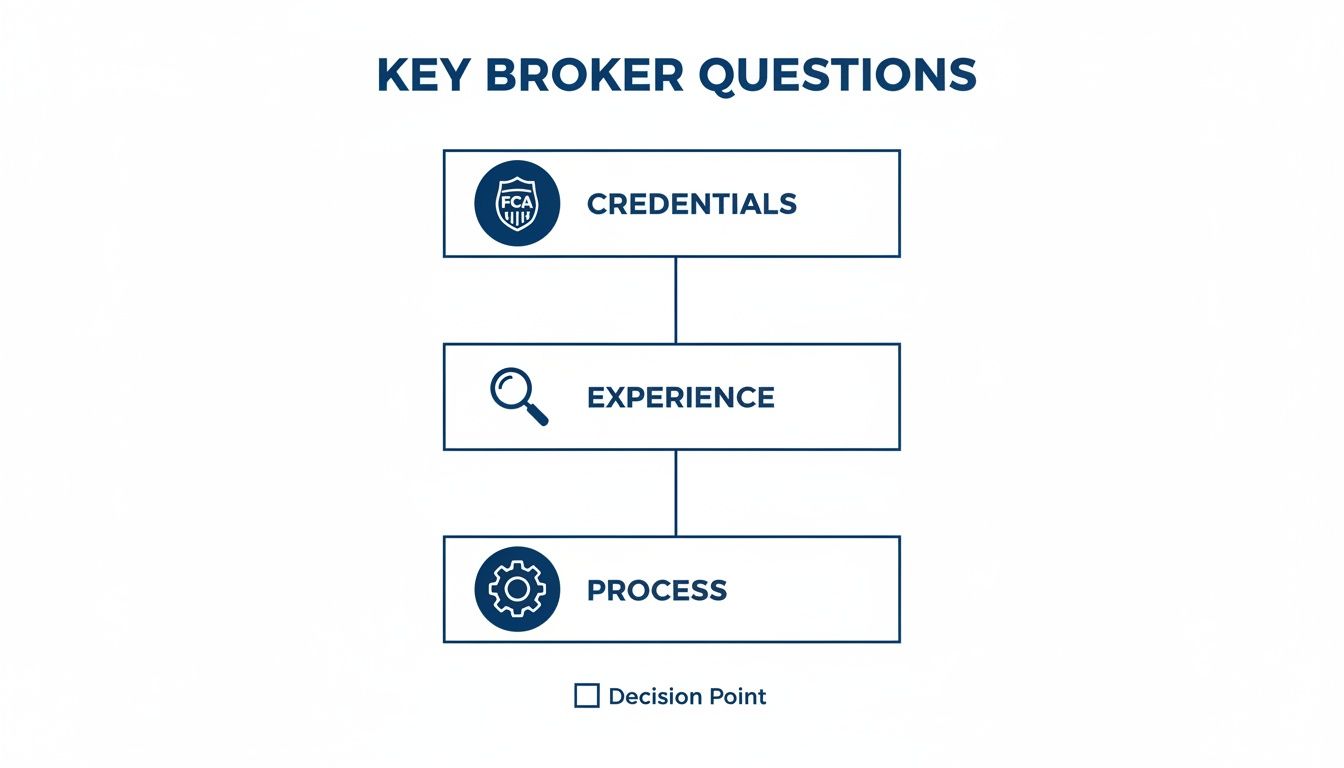
Think of your first chat with a mortgage broker as a two-way interview. It is not just about them quizzing you; it’s your golden opportunity to figure out if they’re the right person to guide you through one of life’s biggest financial decisions.
You need to feel confident in their expertise, comfortable with their communication style, and sure they’re the right fit for you. Once you’ve ticked the essential boxes, like their FCA authorisation and whether they have whole-of-market access, it’s time to dig a little deeper.
Questions About Their Experience and Specialisms
A broker’s track record is often the best indicator of how well they can help you. You want someone who has been there, done that, and successfully navigated situations just like yours. A good broker will be more than happy to share their experiences.
Here are a few questions to get the ball rolling:
- “What’s your experience securing mortgages for people in my situation?” Make this specific to you. Are you a first-time buyer with a gifted deposit? Self-employed with just one year’s accounts? A landlord expanding your portfolio?
- “Can you give me an example of a tricky case you’ve handled recently?” This is not about catching them out; it’s about understanding their problem-solving skills when things do not go perfectly to plan.
- “How familiar are you with the property market here in Chelmsford?” If you’re buying locally in Essex, this is a must-ask. A broker with local knowledge will understand property values and which lenders are most active in the area, which can be invaluable.
A confident, unhurried, and knowledgeable response is exactly what you’re listening for. It’s a huge green flag.
“The quality of a broker’s answers reveals everything about their technical knowledge and, just as importantly, their commitment to client service.”
Questions About Their Process and Communication
Just as important as their technical skill is how they work. A smooth, stress-free mortgage journey depends on clear, consistent communication and a process you can actually understand. You need to know what to expect from day one.
Try asking these practical questions:
- “How will you keep me in the loop with my application?” Are they a phone call person, an email updater, or do they use an online portal? Find out what works for you.
- “Who will be my main point of contact?” There’s nothing worse than being passed from pillar to post. Knowing you have one dedicated person to speak to offers massive peace of mind.
- “How do you handle it when lenders hit us with delays or unexpected requests?” Let’s be honest, it can happen. Their answer will tell you a lot about how proactive and supportive they’ll be when you need them most.
When a broker can clearly map out their process, it shows professionalism and gives you the confidence that your application is in very safe hands.
Why Whole-of-Market Access Is a Game Changer
We called this our top tip at the beginning for a very good reason. The UK mortgage market is far bigger and more diverse than just the big-name banks you see on the high street. An entire ecosystem of specialist lenders exists, and many of them are perfectly suited to clients with more complex needs.
This includes freelancers with fluctuating incomes, buyers with a history of bad credit, or those purchasing non-standard properties. The catch? These lenders often do not work directly with the public. Their products are onl available throughh intermediarie such ase mortgage brokers.
The Difference Between ‘A’ Mortgage and the ‘Right’ Mortgage
A broker with whole-of-market or Independent access can scan this entire landscape for you. They compare thousands of products to find the one that truly fits your life, not just one that’s easy to find online. It’s the crucial difference between getting a mortgage and getting the right mortgage for your specific circumstances.
In a competitive market like Essex, having this complete view can save you a staggering amount of money over the full term of your loan. Choosing a broker with unrestricted access ensures you are not missing out on a better interest rate or more flexible terms from a lender you would never have discovered on your own. You can find out more in our comparison of a mortgage broker vs going direct to a bank.
Having this level of access significantly boosts your chances of securing the best deal. It means a broker in Chelmsford can weigh up deals from high-street giants and specialist lenders across Essex areas like Braintree and Colchester, giving you the full picture.
“Whole-of-market or Independent access is your ticket to seeing the entire picture, giving you the power to choose from the best options available, not just the most visible ones.”
Unlocking More Options
This level of access is especially vital for anyone whose situation is not perfectly straightforward. For example:
- Self-Employed Applicants: Brokers can find lenders who understand complex income structures and do not just look at a standard P60.
- Adverse Credit History: They know which specialist lenders are more willing to consider past financial difficulties and look at the person, not just the credit score.
- Unusual Properties: Access to niche lenders is crucial for unique homes, like converted barns or flats above shops, that high-street banks may not finance.
For those interested in the tech behind how brokers manage all these options, exploring the challenges in brokerage tech stack adoption offers some interesting insight.
Ultimately, a whole-of-market broker works for you, not for a bank. Their goal is to find the best possible fit from every corner of the market.
Red Flags and Common Mistakes to Avoid
Most mortgage brokers are dedicated professionals who work hard for their clients, but it always pays to be vigilant. Knowing what to look out for can help you steer clear of bad advice and a whole lot of unnecessary stress.
One of the biggest red flags is feeling pressured. If a broker is rushing you into a decision or pushing a particular mortgage without clearly explaining why it’s the best fit for you, take a step back. Their job is to advise you, not just sell you the first product that comes to mind.
Another major warning sign? A lack of transparency around fees. A reputable broker will have no problem providing you with a clear, written breakdown of their charges. If they get vague or evasive when you ask about costs, it’s probably best to walk away.
Poor Communication and Its Consequences
Poor communication is more than just an annoyance, it’s a serious red flag. If an adviser is slow to respond or difficult to get hold of when you’re just making an enquiry, imagine the stress that could cause during a time-sensitive mortgage application.
This is especially true in a fast-moving property marke,tase we often see in Colchester and across Essex, where any delay can put your purchase at risk. You need someone who is proactive and keeps you in the loop.
“One of the biggest mistakes buyers make is choosing a broker based solely on the lowest fee. While cost is a factor, expertise and market access are far more valuable.”
Think about it: an experienced broker might charge a reasonable fee, but their ability to secure a better interest rate could save you thousands over the term of the mortgage. That saving will almost certainly outweigh their initial cost.
Common Missteps to Sidestep
Beyond just spotting the obvious red flags, there are a few common mistakes buyers make that can really slow things down. Avoiding these will make your journey significantly smoother.
Here are two frequent errors to be mindful of:
- Not Preparing for Your First Meeting: A broker can only give you accurate advice if they have the right information. If you turn up without your basic financial documents or a clear idea of your goals, the meeting just will not be as productive as it could be.
- Not Disclosing Everything: Holding back information about old credit issues or a slightly unusual income stream will only cause problems down the line. It’s much better to be completely honest from the start so your broker can find lenders who will look at your application in the best possible light.
Being prepared and transparent from day one allows your broker to get on with doing their best work for you.
Your Questions Answered: Choosing the Right Broker
When you’re thinking about how to choose a mortgage broker, a few questions always seem to pop up. It’s completely normal. Getting clear answers is the best way to feel confident you’re making a smart decision, so let’s tackle some of the most common queries we hear.
How Long Does a Mortgage Application Take With a Broker?
Honestly, timelines can vary, but working with a good broker nearly always speeds things up. From our first chat to getting that formal mortgage offer in your hands, you’re typically looking at somewhere between two and six weeks.
The real advantage is that we handle all the tedious paperwork and chase the lender on your behalf. This helps you sidestep the frustrating admin delays that often plague direct applications, keeping everything moving smoothly towards completion day.
What’s the Real Advantage of a Local Essex Broker?
This is a great question. Using a local broker right here in Chelmsford gives you an insider’s perspective on the Essex property market. We know the local property values, the common types of homes in the area, and we have built solid relationships with the local solicitors and estate agents you’ll be dealing with.
That local insight becomes incredibly valuable when you’re looking at unique properties or have a slightly more complex application, maybe for a home in Braintree or Colchester. A local expert often knows which lenders are keen to lend in certain postcodes, a subtle but powerful advantage for your application.
Can a Broker Help If I Have a Bumpy Credit History?
Yes, absolutely. In fact, this is one of the most important ways a broker can really make a difference. Any broker with whole-of-market or independent access will have strong connections with specialist lenders who you just will not find on the high street.
“These lenders are often far more flexible and are set up to consider applicants with past credit blips. Your broker knows exactly which ones are most likely to say yes, saving you the time and heartache of declined applications.”
Do I Actually Need to Meet My Broker in Person?
While we’re always happy to sit down for a face-to-face chat, modern broking is all about flexibility. Many of our clients prefer to handle theentiree process over the phone,viah video calls, orthroughg secure online portals. It’s convenient, efficient, and fits around your life.
A good broker will always adapt to what works for you. The most important thing is that you feel comfortable and completely in the loop, no matter how you choose to communicate. We make the experience work for you, not the other way around.
Choosing the right mortgage broker is the first big step towards achieving your property goals. At EHF Mortgages, our experienced, Chelmsford-based team is ready to answer all your questions and guide you with transparent, whole-of-market advice. Your ideal mortgage solution is just a conversation away.





