💡 Top Tip: Some lenders will assess your limited company’s net profit before tax. This detail can massively increase your borrowing power, and we’ll explain how later in this article.
Navigating the world of self-employed mortgages can often feel like you’ve been handed a complex puzzle without the picture on the box. If you run your business in Chelmsford, Braintree, or Colchester, you’re certainly not alone in feeling that lenders don’t ‘get’ your income.
This guide is here to change that. We’re going to demystify the entire process, separating the myths from the realities and showing you what lenders truly want to see. Think of it as your clear roadmap from application to approval.
Table of Contents
- Why Securing A Mortgage Can Seem Harder
- How To Prove Your Income The Right Way
- How Lenders Calculate Your Borrowing Potential
- Your Action Plan For A Successful Application
- Common Questions About Self-Employed Mortgages
Let’s get one thing straight: securing a mortgage when you’re self-employed is entirely achievable with proper preparation. The days when being self-employed automatically put you at a disadvantage are long gone.
These days, both high-street banks and specialist lenders offer competitive mortgages to self-employed applicants. The real trick is learning how to present your financial story in a language they understand.
“The biggest hurdle isn’t your employment status; it’s translating your hard-earned income into a format that satisfies lender criteria. That’s where expert guidance makes all the difference.”
We’ll cover everything from the essential documents you’ll need to how lenders calculate affordability, making sure you feel confident and fully prepared for success.
A significant part of getting mortgage-ready is understanding how your business’s legal structure affects everything. As guides on choosing the proper business structure explain, whether you’re a sole trader, a contractor, or a limited company director dictates the exact evidence you need and how your income is assessed. This guide will help you put your best foot forward, no matter how your business is organised.

Ready to get started? Let’s begin by exploring why the application process can feel so different for entrepreneurs.
Why Securing A Mortgage Can Seem Harder
It’s a common frustration. You’ve put in the hard work to build a successful business and manage your finances carefully, yet proving your stability to a mortgage lender feels ten times harder than it does for someone with a monthly payslip. To get the best mortgages for self-employed applicants, it helps to step into the lender’s shoes for a moment.
For any lender, it all comes down to risk. They need to feel confident that you can comfortably repay the loan over its entire term, which could be 25 years or more. From their perspective, a salaried employee’s income looks straightforward and predictable; it’s easily verified with a few documents, which makes their financial future seem like a safe bet, whereas a self-employed person’s income can fluctuate. A fantastic year might be followed by a quieter one. This natural fluctuation makes your long-term affordability harder for lenders to forecast, and it’s this perceived uncertainty that’s at the heart of all the extra scrutiny.
The Lender’s Primary Concerns
When an underwriter reviews your application, they aren’t passing judgment on your business skills. They’re simply trying to get a clear, quantifiable picture of the risk involved by focusing on a few key areas. Understanding what’s on their mind is the first step to putting those concerns to rest.
Here’s what’s usually on a lender’s worry list:
- Income Volatility: Sharp peaks and troughs in your earnings can make lenders nervous. What they really want is consistent improvement over the last two or three years.
- Business Longevity: A brand-new business, no matter how promising, is seen as a higher risk than one with a long, successful trading history. Most lenders will ask for at least two years of accounts and a reliable track record.
- Proof of Earnings: Unlike a simple P60 and a few payslips, your income is detailed in your business accounts. Lenders need clear, undeniable evidence of your earnings, which naturally requires more detailed paperwork.
These hurdles are pretty standard for business owners in Chelmsford, Braintree, and Colchester, but they are far from insurmountable with the right strategy.
“A lender’s job is to see the future based on the past. Our job as your broker is to present your past performance so clearly that your future affordability becomes undeniable.”
Understanding The Lending Gap
This perception of higher risk has created a noticeable gap in the mortgage market. The self-employed play a vast and vital role in the UK economy. As of 2024, there were around 4.24 million self-employed workers, representing a large share of the workforce. Yet you often face steeper challenges when applying for a home loan. You can explore more UK mortgage statistics to see the whole picture.
Your business structure also plays a massive role in how you’re assessed. A lender will view a sole trader very differently from a limited company director, typically focusing on net profit for the former and salary plus dividends for the latter. This distinction alone can dramatically change how much you can borrow.
The key is to work with a specialist who understands these nuances and knows exactly how to package your unique financial story. It’s all about building the confidence a lender needs to say “yes”.
How To Prove Your Income The Right Way
This is, without doubt, the most critical part of your mortgage application. Your success hinges entirely on providing clear, credible evidence of what you earn. Don’t just think of it as paperwork; see it as a business plan for your personal finances. Your goal is to convince the lender that your business is stable and your income is reliable. For self-employed individuals in Chelmsford, Braintree and Colchester, the secret weapon is immaculate organisation. Knowing how to organise receipts for tax purposes properly isn’t just good business practice; it’s the groundwork that makes demonstrating your income to a lender much smoother.
The Essential Document Checklist
Lenders need to see official, hard evidence of your earnings over the past two to three years. While the specific list can vary slightly from one lender to another, getting these core documents ready is non-negotiable for anyone applying for a mortgage as a self-employed person in the UK.
The exact documents you’ll need depend entirely on how your business is set up. Let’s break it down.
- For Sole Traders & Partnerships: The lender’s focus will be squarely on your self-assessment tax history.
- For Limited Company Directors: Lenders will want to see both your personal tax documents and your official company accounts.
Decoding Your HMRC Paperwork
Your tax documents from HMRC are the bedrock of your application. Lenders use these to confirm the income you’ve declared and, crucially, that you’ve paid the tax on it.
Two documents are absolutely vital here:
- SA302 Form (Tax Calculation): This is HMRC’s summary of your income for a specific tax year. It breaks down your earnings from all sources and shows the final tax bill.
- Tax Year Overview: Think of this as the companion document to the SA302. It proves that the tax calculated on your SA302 has actually been paid. Lenders need to see the whole story.
You can download both of these directly from your HMRC online account.
“Think of your SA302 as the invoice you’ve sent to HMRC, and the Tax Year Overview as the paid receipt. Lenders need to see both to confirm the transaction is complete and your income is legitimate.”
Company Accounts For Limited Company Directors
If you run your business as a limited company, its financial health will also be put under the microscope. In addition to your personal SA302s, which show your director’s salary and any dividends you’ve taken, you’ll need to provide your certified company accounts.
Lenders will typically ask to see the last two to three years of finalised accounts, and they may need to be prepared and signed off by a qualified accountant. Underwriters will scrutinise these documents to understand your company’s turnover, gross profit, and most importantly, its net profit.
This is where a vast difference between lenders comes into play. Many high-street banks will only consider your personal salary and dividends. However, specialist lenders who are more familiar with mortgages for self-employed applicants might also be willing to consider your share of the retained net profit, money left inside the business. This can significantly boost your borrowing power.
The table provides a quick summary of the essential evidence you’ll rely on, depending on your business structure.
Essential Income Evidence for Self-Employed Applicants
A summary of the primary documents required by UK mortgage lenders based on your self-employment structure.
| Business Structure | Primary Document | Supporting Evidence | Typical History Needed | Key Lender Focus |
|---|---|---|---|---|
| Sole Trader | SA302 & Tax Overview | Bank Statements | 2-3 Years | Consistent Net Profit |
| Partnership | SA302 & Tax Overview | Partnership Agreement | 2-3 Years | Your Share of Net Profit |
| Limited Company | Certified Accounts | SA302 & Tax Overview | 2-3 Years | Salary, Dividends & Profit |
| Contractor/CIS | SA302 or Contracts | Bank Statements | 1-2 Years | Day Rate & History |
Having all this paperwork organised and ready to go shows the lender you’re professional and financially responsible. It presents you as a serious, low-risk applicant, making it much easier for them to say “yes” to your mortgage.
How Lenders Calculate Your Borrowing Potential
Getting your head around how lenders calculate your affordability is the most crucial step. It’s not about your turnover or the headline figures you see in your business bank account; it’s about the profit left after everything is paid. This is how a bank decides what they’re genuinely willing to lend you when you’re self-employed.
For sole traders, the maths is usually relatively straightforward. Lenders will typically look at your declared net profit from the last two or three years, work out an average, and use that as the starting point for their assessment. Simple enough.
For limited company directors, however, things can get much more complicated, and approaches vary widely among lenders. This is precisely where many business owners in areas like Chelmsford, Braintree and Colchester can hit a wall with high-street banks.
The High Street vs Specialist Lender Approach
Most mainstream lenders have a very rigid one-size-fits-all approach. They will only look at the director’s salary you’ve paid yourself and any dividends drawn from the company. Frustratingly, this method completely ignores any retained profit left in the business – money you’ve kept back for growth reinvestment or just for tax efficiency.
This is the fundamental difference in how lenders view your income, depending on your business structure.
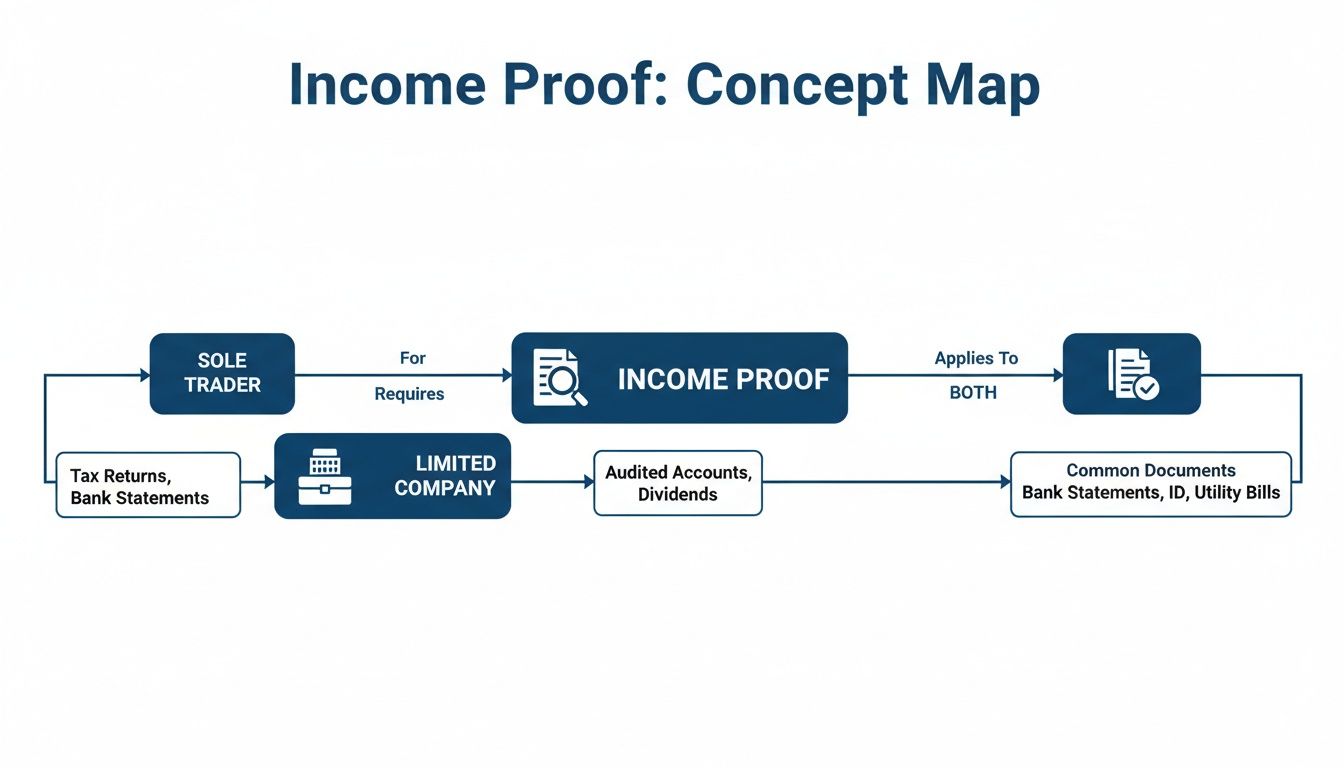
As you can see, the picture for a limited company is much broader. It’s about the overall health of the business, not just your personal drawings, which is precisely where specialist lenders come into their own.
Specialist lenders really shine here. They get the nuances of running a limited company and are often willing to use a much more favourable calculation: ‘salary plus share of net profit’.
This alternative method can dramatically boost your borrowing power. For example, say you paid yourself a modest salary and dividends, but left £50,000 of profit in the company. A high-street bank would likely ignore that substantial sum, whereas a specialist lender could add it to your assessable income. To learn more, you can explore our complete guide to understanding your borrowing potential.
“The difference between using ‘salary and dividends’ versus ‘salary plus net profit’ can be the difference between buying a small flat and securing your dream family home. It’s the single most important calculation for company directors to understand.”
Beyond Your Business Income
A lender’s calculation doesn’t stop with your business earnings. Once they’ve established your average income, they will meticulously review your fixed outgoings and financial commitments. This part of the process is the same for every applicant, whether employed or self-employed.
Lenders will look closely at several key factors:
- Credit Commitments: This covers any outstanding balances and monthly payments for credit cards, personal loans, and car finance. High levels of existing debt can significantly reduce how much you can borrow.
- Dependents: The number of children or other financial dependents you support is always factored in. Lenders use official data to estimate the cost of helping them, which is then deducted from your available income.
- Fixed Outgoings: Regular essential spending, such as council tax, utilities, and insurance payments, is included.
- Lifestyle Spending: Lenders are increasingly scrutinising bank statements for regular non-essential spending patterns, such as subscriptions, holidays, or entertainment.
The Final Affordability Calculation
After analysing your income and outgoings, the lender applies an income multiple. This is typically around 4 to 5 times your annual assessable income, though some lenders might stretch higher depending on your circumstances, profession, and the size of your deposit.
For instance, if a lender assesses your average annual income at £60,000 and applies a 4.5x multiple, your potential borrowing would be £270,000. But remember this is before they subtract the impact of your financial commitments and dependents, which will lower the final figure.
Understanding this two-part process, first establishing your usable income and then stress-testing it against your outgoings, gives you a clear path to maximising what you can borrow. It shows just how important it is to not only have well-documented earnings but also to maintain a healthy credit profile and manage your debts effectively in the run-up to applying.
Your Action Plan For A Successful Application
Preparation is key to turning what can feel like a complex application into a straightforward approval process. Before you even think about approaching a lender, it’s vital to present yourself as the most credible low-risk borrower possible. This strategic action plan will significantly strengthen your position.

Think of the months leading up to your application as the groundwork phase. By taking a few proactive steps now, you can tackle potential red flags before an underwriter ever sees your file. It shows financial discipline and makes the lender’s decision to say “yes” that much easier.
Strengthen Your Credit Profile
Your credit score is a direct reflection of your reliability as a borrower. There’s no getting around it – lenders will scrutinise your credit history to see how you’ve managed debt in the past. A strong score is non-negotiable, so let’s get it in shape.
First, check your credit reports with all three UK credit reference agencies: Equifax, Experian, and TransUnion. Hunt for any errors or inaccuracies that could be dragging your score down, and get them corrected immediately. A simple mistake, like an old address, can cause real issues. We would recommend CheckMyFile, which provides a report for all 3 agencies. You can try a 14-day trial and monitor your ongoing credit via this link, CheckMyFile.
Next, make sure you’re registered on the electoral roll at your current address. Lenders use this for basic identity and address verification. Not being registered is a common oversight that can knock points off your score and become a significant hurdle.
Build Your Deposit And Reduce Debts
A larger deposit is one of the most powerful tools in your arsenal. It directly reduces the lender’s risk, which often unlocks more competitive interest rates and a much wider choice of products. Aiming for a deposit of at least 15% will make your application substantially more appealing.
At the same time, work on reducing your debt-to-income ratio. This is simply a measure of your monthly debt payments against your overall income. Focus on paying down outstanding balances on credit cards, store cards, and personal loans where you can. Lenders want to see that you have plenty of breathing room in your budget after covering existing commitments.
“Every pound you pay off existing debt is a pound that a lender can see is available for your future mortgage payment. It directly increases your affordability.”
Partner With Your Accountant
Your accountant is a crucial ally in this process, far more than just your tax preparer. They prepare the very financial statements that will determine your borrowing potential, so they must be qualified and reputable.
Have a chat with your accountant well before you plan to apply. Discuss your mortgage goals, so they understand the importance of presenting your income and profits clearly and accurately. Their professionally prepared accounts are the bedrock of a successful mortgage application for any business owner in Chelmsford, Braintree or Colchester.
By following this action plan, you methodically build a compelling case for yourself. You demonstrate financial stability, good habits, and a professional approach, making you an ideal candidate for the best mortgages UK lenders offer to self-employed borrowers. Why not use our free online mortgage calculators to see how your deposit and borrowing potential can impact your monthly payments?
Common Questions About Self-Employed Mortgages
We get asked many questions by our self-employed clients across Essex and the UK. Let’s run through some of the most common ones, as understanding these scenarios can help clarify where you stand.
Can I Get A Mortgage With Only One Year Of Accounts?
Yes, it’s definitely possible, but your options will be a bit more limited. Most high-street lenders like to see a solid two or three years of trading history.
However, many specialist lenders recognise that new businesses can be highly profitable right out of the gate. They’ll want to see a robust track record within that first year, often backed up with evidence of your previous experience in the industry and any future contracts you’ve secured. To make it work, a larger deposit of at least 20% and a clean credit history are essentially required. This is where a whole-of-market broker is invaluable, as we have access to these niche lenders who don’t deal directly with the public.
Does Being A Contractor Change The Process?
It certainly can. Lenders often have specific criteria just for contractors working on day rates. Some will calculate your annual income by simply multiplying your day rate by the number of weeks you typically work, which can result in a much healthier assessable income compared to using your company accounts alone.
You’ll need to provide evidence of your contract history to demonstrate a consistent flow of work. Having a decent amount of time left on your current contract is also a big plus in their eyes. For freelancers with fluctuating income, relying on two to three years of tax returns is the more standard route.
“Going directly to your bank limits you to their products. An independent broker works for you, not the lender, matching you with the best deal from the entire market.”
How Do Business Expenses Affect My Mortgage Application?
This one is crucial – your business expenses have a direct impact. Lenders are interested in your net profit, not your turnover. Legitimate business expenses reduce your taxable income, and that’s the figure lenders use for their affordability sums.
While minimising your tax bill is just innovative business, it can, unfortunately, reduce the amount you can borrow. It’s a classic balancing act. Before you even think about applying for a mortgage, it’s an excellent idea to chat with your accountant and your mortgage broker. Together, you can plan an accounting strategy that doesn’t unintentionally sabotage your borrowing potential. If you’re concerned about your financial history, you can learn more about securing a home loan as a self-employed person with bad credit.
Ready to navigate the world of self-employed mortgages with an expert by your side? The team at EHF Mortgages has helped countless business owners in Chelmsford, Braintree and Colchester secure the funding they need.
Book your free no-obligation consultation on our Contact Us page.