💡 Top Tip: Choosing a mortgage broker over your bank can give you access to thousands more deals, potentially saving you a huge amount of time and money.
We’ll explain exactly how this works later in the article.
Deciding how to get your mortgage is one of the biggest financial calls you’ll ever make. So, where do you turn? Your high-street bank or a mortgage broker? This single choice can significantly affect the rates, fees, and overall quality of the loan you end up with.
This guide provides a balanced comparison between using a broker and going directly to a bank. We’ll cover everything from the sheer choice of products and the costs involved to how the application process feels and which route is better for different people—whether you’re in Essex towns like Chelmsford and Braintree or anywhere else in the UK. By the time you’ve finished reading, you’ll have a much clearer idea of which path makes sense for you.
Table of Contents
- Comparing Market Access and Lender Choice
- A Detailed Analysis of Costs and Fees
- Navigating the Mortgage Application Process
- Finding the Right Fit for Your Circumstances
- Real-World Scenarios and a Final Checklist
- Frequently Asked Questions
When you’re buying something as significant as a house, getting the financing right is the crucial first step. It’s particularly important when you’re still in the process of deciding between a mortgage broker and a bank. This decision really does set the tone for your entire property journey.

Broker vs Bank: At a Glance
The whole ‘mortgage broker vs bank’ debate in the UK often boils down to a simple trade-off: choice versus familiarity. A broker is your go-between, your expert guide who scours a vast marketplace of lenders to pinpoint the right deal for you. Going to a bank, on the other hand, is a direct route but is limited to its own in-house products.
This table gives a quick rundown of the main differences.
| Feature | Mortgage Broker | High Street Bank |
|---|---|---|
| Product Access | Whole-of-market or a large panel of lenders | Only their own mortgage products |
| Advice Provided | Independent and tailored to your circumstances | Restricted to their own product range |
| Best For | Complex cases and finding competitive deals | Simple cases and existing customers |
| Typical Cost | May charge a fee or receive commission | Usually, no advice fee, but other charges apply |
Even from this quick look, it is clear that the best path depends entirely on your situation, how confident you feel navigating the market, and how much expert support you want. We’ll dive much deeper into all of these points throughout the guide.
Comparing Market Access and Lender Choice
When it comes to the mortgage broker vs. bank debate in the UK, the single biggest difference comes down to choice. It is a bit like your weekly shop: going to your bank is like visiting a single brand’s store—they only sell their own products. A mortgage broker, on the other hand, is the massive supermarket, offering deals from dozens of different brands all under one roof.
This fundamental difference in market access has a direct knock-on effect on the rates, the terms, and ultimately, the mortgage you can get. An independent mortgage broker like us here at EHF Mortgages provides ‘whole-of-market’ access. This means we can search and compare deals from a wide range of lenders, from the big high-street names to smaller building societies and specialist lenders you may not have heard of.

Why Wider Choice Matters
If you go directly to your bank, you are stuck with their limited, in-house selection of mortgages. Should their lending criteria be too rigid for your situation, or their rates are not competitive, you are back to square one. You would have to start the entire application process all over again with another lender, which is a frustrating waste of time.
This access to wider choice is exactly why brokers now dominate the UK mortgage market. In fact, brokers account for 84% of all new mortgage sales. It is a trend driven by one simple fact: brokers can offer borrowers far more choice than a single bank ever could. You can dig into more of the data in the UK Mortgages Market Report.
This becomes especially important for anyone with slightly more complex needs. For instance, if you’re a self-employed professional in Colchester or have a minor blip on your credit history, your own bank might give you a flat “no”. A good broker, however, knows which specialist lenders are more flexible and have an appetite for such cases, dramatically increasing your chances of getting approved.
Broker vs Bank Access: A Side-by-Side Comparison
Let’s lay out the practical differences in market access. A broker’s ability to scan the entire market gives you a strategic advantage over a bank’s blinkered view. This table breaks down what that means for you as a borrower.
| Feature | Mortgage Broker | High Street Bank | Lender Flexibility | Ideal For |
|---|---|---|---|---|
| Product Range | Access to potentially hundreds of lenders | Only their own in-house products | High | Low |
| Lender Access | Whole-of-market or a large, diverse panel | Restricted to one lender’s criteria | Very High | Very Low |
| Specialist Cases | Can find lenders for complex situations | Often declines non-standard applicants | High | Low |
| Rate Comparison | Compares deals across the entire market | Can only offer their own current rates | High | None |
At the end of the day, a broker’s extensive access is not just about having more options; it is about finding a more suitable and personalised mortgage that genuinely fits your financial situation.

A Detailed Analysis of Costs and Fees
Getting to grips with the true cost of a mortgage means looking far beyond the headline interest rate. When you compare a mortgage broker to a bank, you will find they have very different ways of charging for their services. Understanding these differences is essential if you want to calculate your loan’s total cost.
If you walk into your high-street bank, the fees are typically included in the mortgage product itself. You will see fees such as arrangement, booking, and valuation fees. A mortgage broker, on the other hand, might charge a separate fee for their advice and service, and this is a key point of difference.
Breaking Down Broker Fees
A question I get asked all the time is: “Is using a broker more expensive?” It’s a fair question. Brokers often charge a fee for their advice and for arranging the mortgage, but how this is structured can vary.
- Flat Fee: Many brokers charge a fixed fee, which you might pay upfront or upon completion of the mortgage. This is pretty common for straightforward applications.
- Percentage Fee: For more complex situations, such as a self-employed application or a tricky property, a broker might charge a percentage of the loan amount, typically between 0.3% and 1%.
What’s crucial here is that brokers are legally required to be completely transparent about their fees right from the start. While there’s an upfront cost, it’s often cancelled out (and then some) because a good broker with whole-of-market access can find you a deal with a lower interest rate or cheaper lender fees. Over the life of the mortgage, this can save you far more than the initial broker fee.
Understanding Bank Charges
Banks do not usually charge a separate “advice fee,” but their products come with their own list of charges. It is easy to get drawn in by a ‘fee-free’ deal, but these mortgages often carry higher interest rates to offset the fee, making them more expensive in the long run.
Common charges you’ll see from a bank include:
- Arrangement Fees: This is often the biggest one, costing anywhere from £999 to over £2,000.
- Booking Fees: A smaller, non-refundable charge to secure a particular rate.
- Valuation Fees: The cost for the lender to value the property you want to buy.
Sometimes you can add these costs to the mortgage loan, but that means you will be paying interest on them for the entire term. For a deeper dive into how rates and fees really work together, you can learn more about UK interest rates in our detailed guide.
Comparing the Total Cost of Borrowing
To make a smart decision, you have to compare the total cost over the initial deal period. For instance, I might find a mortgage for a client in Chelmsford with a £500 broker fee, saving them £2,000 in lender fees and locking in a lower rate than their bank is offering. The maths speaks for itself.
Here is a simple table showing how typical costs stack up.
| Fee Type | Broker Average Cost | Bank Typical Charge | When It Is Paid | Key Considerations |
|---|---|---|---|---|
| Advice/Arrangement | £0 – £750 (or % of loan) | £999 – £2,500 | On application or completion | Broker fees can be offset by better rates and lower lender fees found across the market. |
| Booking Fee | Included in the lender fee | £99 – £250 | Upfront (non-refundable) | This secures the rate, but you’ll lose it if you decide not to proceed. |
| Valuation Fee | £250 – £1,500+ | £250 – £1,500+ | Upfront | The cost is tied to the property’s value; some lenders offer it for free. |
| Exit Fees | N/A | Varies by lender | On mortgage redemption | Always check for Early Repayment Charges (ERCs) if you plan to pay off early. |
Ultimately, whether you go with a mortgage broker or straight to a bank, it is vital to look past the headline offers. You need to analyse every associated cost to find the deal that makes the most financial sense for you.
Navigating the Mortgage Application Process
When you are weighing a mortgage broker against a bank, the application process is a major factor. How quickly and smoothly can you get from that first chat to having the keys in your hand? The path you take can make a huge difference.
Think of a good mortgage broker as your dedicated project manager. From the moment you start, they take control of the entire process, giving you a single, reliable point of contact who knows your case inside and out. This alone often makes things move a lot faster.
The Broker-Led Journey
Working with a broker introduces efficiency from day one. They will get all your documents organised, complete the lender’s application forms correctly, and check everything before submission. This significantly reduces the risk of small mistakes causing big delays.
A broker will typically:
- Manage all the chatter: They do the chasing, liaising directly with the lender, solicitors, and even the estate agent, saving you hours on the phone.
- Handle the paperwork headaches: Mortgage applications are heavy on documents. A broker makes sure every ‘i ‘ is dotted and every ‘t’ is crossed before submission.
- Solve problems before you know they exist: If the lender has a question, your broker is the one who fields it, often sorting it out without you even needing to get involved.
This hands-on management is a huge weight off your shoulders. Instead of you juggling confusing requests from different people, your broker does the heavy lifting and keeps the momentum going.
The Bank Application Path
Going straight to your bank can sometimes feel quicker, but that is usually only true for existing customers with squeaky-clean, straightforward applications. If you have banked with them for years, have a perfect credit score, and a simple PAYE job, their in-house process might be swift.
But the moment a complication pops up, the process can grind to a halt. If an underwriter wants to query the source of your deposit or a tiny detail on your credit file, you are the one who has to deal with it. That often means long waits in call centre queues or trying to book a branch appointment.
The biggest risk? If the bank says no, you’re back to square one. You have lost valuable time and have to start the entire process again with a different lender. A broker, on the other hand, would have placed you with a lender who was likely to say yes from the start, avoiding that wasted time and stress. To get a better sense of the timing, you can read our guide on how long a mortgage application takes.
| Stage | With a Mortgage Broker | Direct with a Bank |
|---|---|---|
| Initial Fact-Find | A deep dive to match you with the right lender the first time. | Assessment is based only on that one bank’s strict criteria. |
| Document Submission | Your broker packages and submits all the paperwork for you. | You are responsible for gathering and sending everything correctly. |
| Lender Communication | Your broker handles all questions from the lender on your behalf. | You must respond directly to all lender queries and requests. |
| Problem Solving | Proactively fixes issues to prevent delays or rejection. | Any hiccup can cause a significant delay or a flat-out rejection. |
So, while a simple application directly with your bank might look quicker on the surface, the broker-led process provides a crucial safety net. It ensures that even if things get complicated, your application has the best possible chance of moving forward smoothly.
Finding the Right Fit for Your Circumstances
There is no single “right” way to get a mortgage; it all comes down to your personal and financial situation. For someone with a straightforward financial profile, walking into their high street bank might seem like the easiest path. But for anyone whose circumstances are a little more complex, a mortgage broker often becomes indispensable.
This simple decision tree helps visualise how the path splits based on what you really need from the process.
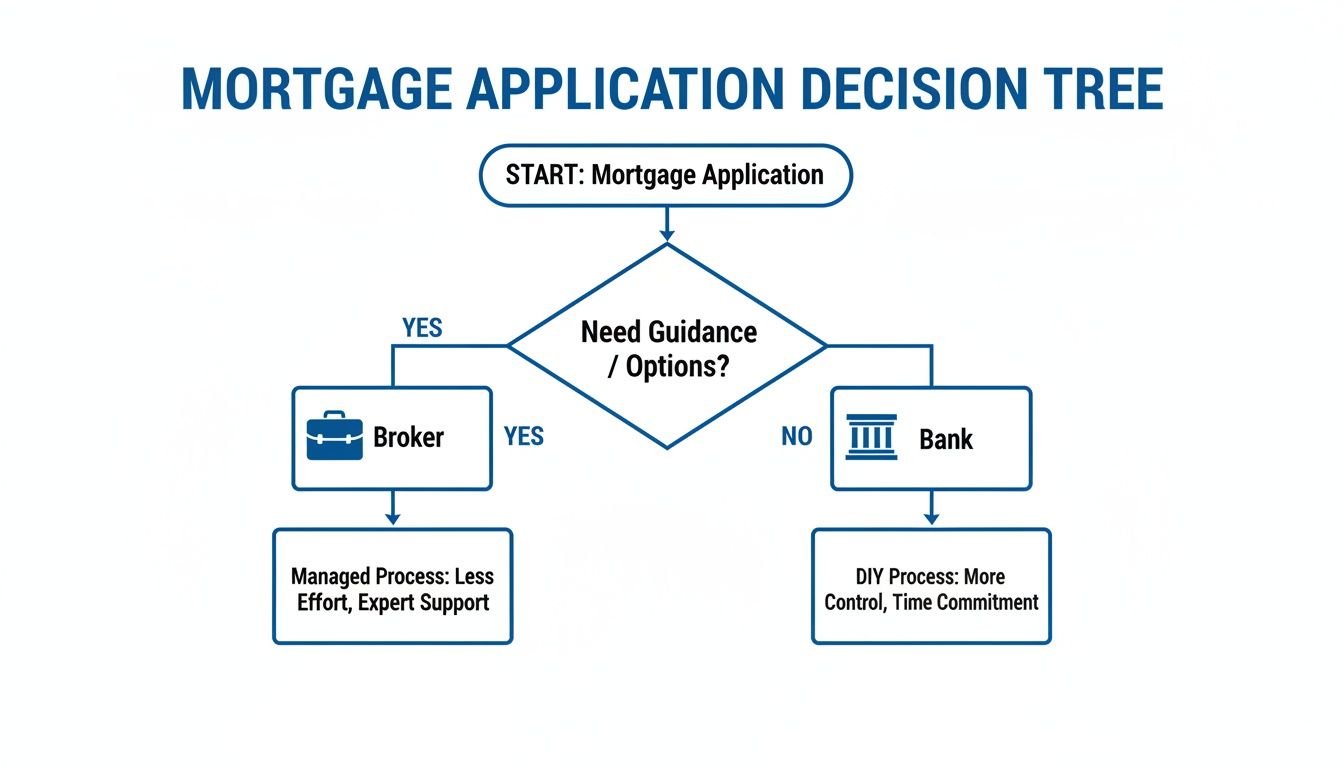
As you can see, the choice really hinges on how much guidance and market access you need. If expert support and a managed process sound appealing, a broker is likely your best bet.
First-Time Buyers Entering the Market
For first-time buyers, the whole mortgage process can feel like a minefield. The jargon is confusing, the paperwork looks endless, and the fear of getting a “no” is very real. This is exactly where a mortgage broker proves their worth.
Think of a broker as your guide. They translate the complex terminology, manage the entire application from start to finish, and assess your affordability across the whole market. This gives you a true picture of your borrowing potential, not just what one bank is prepared to offer. For buyers in areas like Essex, a local broker also brings invaluable knowledge of regional property values and which lenders are most active there.
Homeowners Looking to Remortgage
When your current mortgage deal is coming to an end, the path of least resistance seems to be sticking with your existing lender. In reality, this loyalty rarely pays off. A mortgage broker can scan the entire market to see if switching lenders could lock in a significantly better rate, potentially saving you thousands of pounds over the new term.
This is especially true if your life has changed since your last mortgage. Perhaps you have had a pay rise, or your property’s value has shot up. A broker can leverage these changes to find more competitive deals that your current bank will not offer you.
Specialist Cases Where Brokers Excel
While brokers are a huge help for standard applications, they become essential for anyone with non-standard requirements. High street banks often rely on rigid, computer-driven criteria that can automatically decline anything slightly out of the ordinary. Brokers, on the other hand, have relationships with specialist lenders who are geared up to handle complexity.
Self-Employed Borrowers: Proving your income as a freelancer, contractor, or company director can be a headache with most banks. A broker knows which lenders understand complex accounts and are willing to consider factors such as retained profits or fluctuating income. You can find out more in our detailed article on mortgages for the self-employed in the UK.
Adverse Credit History: A single missed payment or a past default can be enough to trigger an automatic rejection by a high-street lender. Specialist brokers have access to lenders who are prepared to look at the story behind the credit issue and find a solution.
Unusual Properties: Thinking of buying a home with a unique construction, a high-rise flat, or a property in a historic area like Colchester with specific planning rules? A broker can pinpoint lenders who are comfortable with non-standard properties, helping you avoid last-minute valuation problems.
Buy-to-Let Investors: For landlords, getting the right finance is all about maximising investment returns. Brokers have access to a wide range of buy-to-let products -including those for portfolio landlords and limited companies -that are often difficult to obtain directly from banks. They can structure deals based on rental income calculations to help you borrow as much as possible.
In every one of these cases, the crucial difference in the “mortgage broker vs high street bank” debate is a broker’s ability to find a bespoke solution. Instead of trying to force a square peg into a round hole, they find a lender whose criteria are already the perfect fit for you.
Real-World Scenarios and a Final Checklist
Theory is all well and good, but seeing how the mortgage broker vs bank choice plays out in real life makes the decision much clearer. These examples show how expert guidance and market access can deliver results that going directly to a bank cannot match.
Case Study: The Self-Employed Professional
Meet Sarah, a successful freelance graphic designer from Chelmsford. Despite a healthy income and a solid deposit, her high street bank turned her down flat. Their rigid, automated system could not make sense of her fluctuating, non-PAYE earnings and flagged her as too high a risk.
Frustrated but not defeated, Sarah approached a mortgage broker. The broker immediately knew which specialist lenders to contact – three known for their flexible, human approach to self-employed applicants. By packaging her accounts and business projections in a way the lenders understood, the broker secured Sarah a competitive five-year fixed rate. She’s now in her dream home, a move that would have been impossible without a broker in her corner.

Case Study: The Remortgaging Family
The Thompson family in Colchester were nearing the end of their mortgage term. Their existing bank offered a new rate that seemed okay, and for an easy life, they were tempted to accept it. On a whim, they decided to get a second opinion from a broker first.
The broker ran a full market comparison and found a deal with another lender that was 0.5% lower. It does not sound like much, but that small difference will save the Thompsons over £1,800 a year. The best part? The broker handled all the paperwork for the switch, making the process as simple as staying put while leaving thousands of pounds in their pocket.
Your Final Mortgage Application Checklist
Feeling prepared can make a huge difference, helping your application go smoothly. Use this checklist to get organised before you start your mortgage journey.
- Gather Your Documents: You’ll need proof of ID (such as a passport or driving licence), proof of address (utility bills are perfect), and at least three months’ worth of bank statements and payslips. If you’re self-employed, prepare two to three years of accounts.
- Check Your Credit Report: It’s worth signing up for a free service like Experian or Equifax. Look for any errors and make sure your address history is up to date and correct. You can also get a 7-Day Free Trial at CheckMyFile, which shows all the data held by Experian, Equifax, and TransUnion.
- Calculate Your Budget: Be honest with yourself about what you can afford each month. Do not forget to factor in council tax, bills, and potential home maintenance costs.
- Prepare Key Questions: Whether you choose a bank or a broker, have a list of questions ready. Ask about all the fees involved, the typr an applic timelineation, and how they’ll keep you updated.
Ticking these off ensures you begin the process on the front foot, ready to secure the best possible deal for your new home or remortgage.
Frequently Asked Questions
Still weighing up your options? Here are a few common questions we get asked when people are deciding between a mortgage broker and their bank.
What Is the Main Advantage of Using a Mortgage Broker Over My Own Bank?
It really comes down to choice and expertise. A good broker gives you access to thousands of mortgage products from a huge range of lenders, not just the handful your bank can offer. This dramatically improves your chances of finding a better deal, while their expert guidance helps you navigate what can be a very complex process.
Is It More Expensive to Use a Mortgage Broker?
Not necessarily, and in many cases, it is cheaper in the long run. While some brokers charge a fee, they often secure exclusive rates or deals you would not find on your own. These savings can easily outweigh the initial fee over the lifetime of your mortgage, making it a sound financial move.
Can I Get a Mortgage from a Bank if I Have Bad Credit?
Honestly, it is incredibly tough. High street banks usually have rigid lending criteria and are quick to decline applications with any hint of past credit issues. A specialist broker, however, knows which lenders are more flexible. They have access to specialists who assess each case on its own merit, rather than just saying “no.”
As a First-Time Buyer in Essex Which Option Is Better for Me?
For first-time buyers, especially in competitive spots like Chelmsford or Braintree, a broker can be invaluable. The whole process can feel daunting, but a local broker will guide you through everything, from figuring out your true borrowing power to sorting out all the fiddly paperwork. Their market knowledge is considerably valuable and will only help you with your home and mortgage journey.