
💡 Top Tip: Never assume the life insurance offered alongside your mortgage is your only option. In many cases, the right policy is the one that matches your mortgage properly, not the one put in front of you first. I’ll explain how to judge that later in this guide.
Buying a home is exciting, but it also raises a very large question. If you died during the mortgage term, what would happen to the debt, the monthly payments, and the people staying in that home?
Life insurance matters when buying a house. Not because a lender wants a box ticked, but because a mortgage is usually the biggest financial commitment you’ll ever take on.
For buyers in Chelmsford, Braintree, Colchester and across Essex, this topic is often muddied by rushed appointments, lender paperwork, and protection conversations that feel more complicated than they need to be. It doesn’t have to be that way. The practical answer is usually simple. Match the insurance to the mortgage, make sure the amount is right, and don’t overlook the useful extras built into modern policies.
Table of Contents
Introduction: Your Guide to Mortgage Life Insurance
If you’re buying your first place, moving up the ladder, or refinancing an existing home loan, protection shouldn’t be an afterthought.
A mortgage commits your income for years. Life insurance protects the people who would otherwise inherit that commitment with none of the earnings that supported it.
Why this matters in real life
For most buyers, the issue isn’t whether they understand the idea of life insurance. It’s whether they understand which type of mortgage fits the one they are taking.
A repayment mortgage and an interest-only mortgage don’t behave the same way. The cover shouldn’t either.
Practical rule: The insurance should follow the debt. If the mortgage balance reduces over time, the cover often should too. If the balance stays flat, the cover usually needs to stay flat as well.
That’s why generic advice often fails. It ignores the shape of the borrowing.
What good advice should do?
Clear advice should help you answer five things:
Do I need it?
Legally, usually no. Financially, often yes.Which policy type fits my mortgage?
This is the key decision.How much cover should I take?
Enough to protect the home and, where needed, wider family costs.How long should it last?
Usually, in line with the mortgage term or the period of risk.What extra features are worth having?
Some benefits are valuable. Others are just noise.
Buyers across Essex often tell me the same thing. They don’t want a hard sell. They want someone to translate the jargon, point out the traps, and help them make a calm decision.
That’s exactly how mortgage protection should be approached.
Is Life Insurance a Mortgage Requirement
No, life insurance is not a legal requirement for getting a mortgage in the UK.
That point needs to be stated plainly because many buyers are still told the opposite.

A 2023 ActiveQuote survey found that 60% of UK homeowners were incorrectly told by mortgage providers that life insurance is required to secure a mortgage, and 33% of those who took out a policy believed it was legally mandatory (ActiveQuote survey on the mortgage myth).
That confusion causes two problems. First, people buy cover without understanding what they are buying. Second, some buyers accept the first policy offered because they think they have no choice.
Myth and Reality
A lender may recommend protection. That’s not the same as making it a legal condition of the mortgage.
The central question isn’t “Do I have to have life insurance?” It’s “What happens to this mortgage if I die before it’s repaid?”
For a single borrower, the answer can be stark. The debt remains. For couples, the issue becomes whether one income could keep the home going on its own.
“Protecting your mortgage is not about satisfying a lender; it is about safeguarding your family’s future in the home you have worked so hard to build.”
Why do many buyers still choose cover
Even though it isn’t compulsory, there are sound reasons people take it out:
Home security: The main aim is to stop the mortgage from becoming a crisis for your partner or family.
Budget protection: A policy payout can remove a major debt at the worst possible time.
Decision control: Without cover, your family may be forced into choices they would never have made voluntarily, such as selling quickly.
Specialist lending context: In more complex cases, showing a sensible protection plan can support the wider picture of financial prudence, even if it doesn’t replace affordability checks.
Protect the people in the house, not the lender on the paperwork.
What doesn’t work
What usually doesn’t work is buying a policy because someone in the chain said, “You need this.” That approach produces poor outcomes.
I see buyers with the wrong term, the wrong amount, or a policy type that doesn’t match the mortgage. The cover exists, but the design is weak.
A better approach is simple. Work out the mortgage structure first. Then choose protection that mirrors it.
That’s the difference between buying a product and setting up a plan.
Choosing Your Cover: A Breakdown of Policy Types
Most of the confusion around life insurance when buying a house disappears once you focus on one point. How is the mortgage being repaid?
That answer drives the policy choice more than anything else.
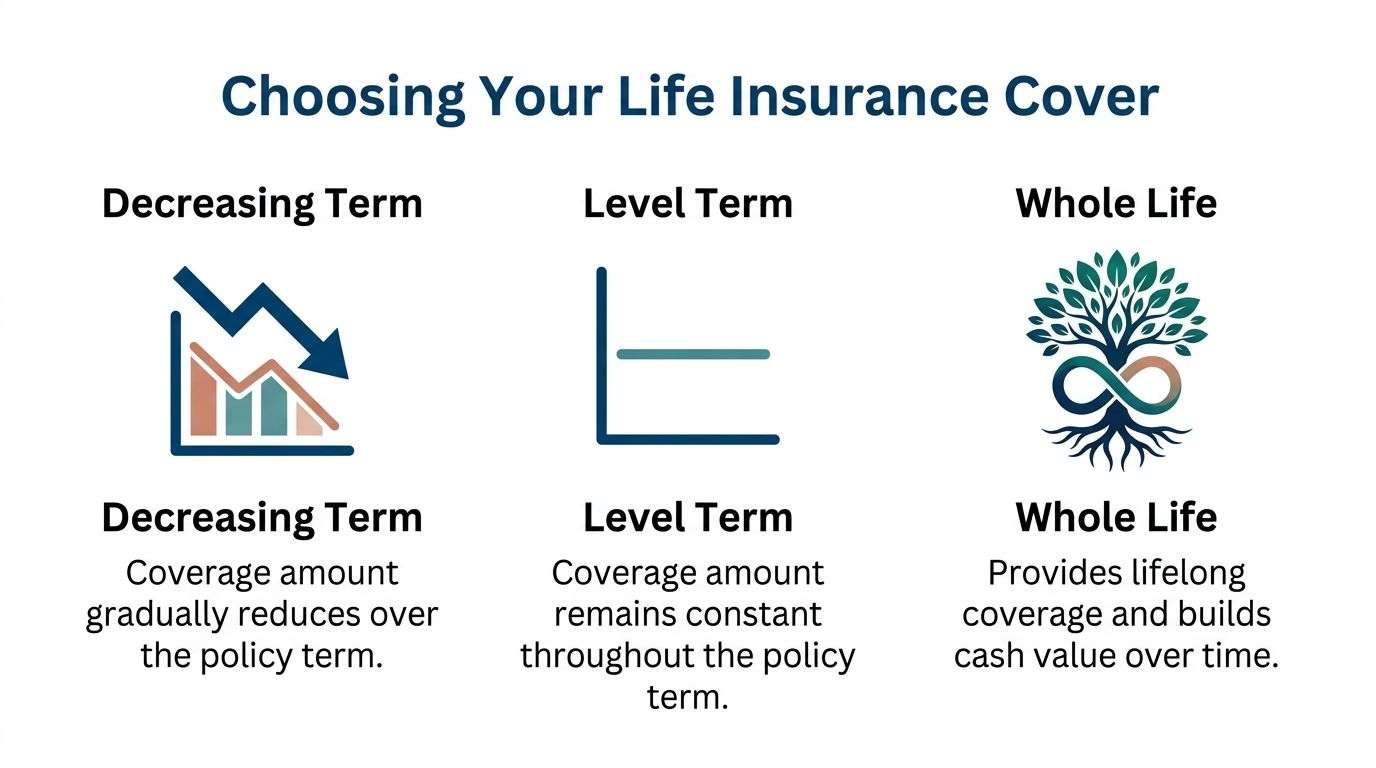
Decreasing term for repayment mortgages
A decreasing term policy is usually the natural fit for a standard repayment mortgage.
The logic is straightforward. Your mortgage balance should reduce over time as you make repayments. The policy payout reduces over time as well, following the same broad direction.
For many first-time buyers in Colchester or Chelmsford, this is the cleanest and most cost-conscious option. You are protecting a debt that shrinks, so you don’t usually need a payout that stays fixed for the full term.
This is also why decreasing term often feels more sensible than level term for ordinary residential borrowing. You are not paying to insure a static sum if the mortgage itself is falling.
Level term for interest-only borrowing
A level term policy keeps the payout the same throughout the policy term.
That makes it more suitable where the mortgage balance does not reduce in the normal way. Interest-only borrowing is the obvious example.
If you owe the same capital amount throughout the mortgage, a decreasing policy can leave a gap. The insurance may fall while the mortgage debt stays where it is.
A level term can also make sense if you want the cover to do more than clear the mortgage. Some families want extra room for household bills, childcare, or a period of financial breathing space. In those cases, a fixed payout can be more appropriate than a reducing one.
Joint life or two single policies
Couples usually face another choice. Should they take one joint policy or two separate single policies?
A joint policy is often arranged on a first death basis. That means it pays out once when the first insured person dies, and then the policy ends.
That can work well when the main aim is to clear the mortgage balance. It is tidy and easy to understand.
Two separate single policies can offer more flexibility. If one policy pays out, the other remains in place. That can matter if the mortgage is only part of what the household needs to protect.
Neither route is automatically right. It depends on the goal.
Advisor’s view: If the only job is clearing a repayment mortgage, joint life can be perfectly practical. If you want more flexibility for family planning, two single policies are often worth serious thought.
A quick comparison
| Policy Type | Sum Assured (Payout) | Typical Monthly Cost | Best For | EHF Mortgages Insight |
|---|---|---|---|---|
| Decreasing Term | Reduces over time | Usually lower than a level term | Repayment mortgages | Best matched where the debt falls over time |
| Level Term | Stays the same | Often higher than the decreasing term | Interest-only borrowing or extra family protection | Useful where the capital balance stays level |
| Joint Life | One payout on the first death | Depends on age, health and cover type | Couples protecting one shared mortgage | Simpler structure, but covers ends after the first claim |
| Two Single Policies | Separate payouts under separate plans | Depends on each applicant | Couples wanting flexibility | Often stronger for wider planning |
| Whole of Life | Designed for lifelong cover | Typically higher than term cover | Niche later-life or estate planning needs | Usually not the first answer for standard house purchase protection |
If you want a broader explanation of how mortgage-related protection works, this guide on mortgage protection insurance explained is a useful next read.
What works and what doesn’t
What works is matching the policy to the mortgage.
What doesn’t work is choosing solely on price or taking whichever policy has the most familiar name. Cheap cover with the wrong structure can be poor value. A slightly dearer cover with the right structure can be the smarter buy.
That’s why the first question should never be “What’s the premium?” It should be “What are we protecting?”
Calculating Your Cover Amount and Policy Length
Choosing the policy type is only half the job. The next question is how much cover you need, and how long it should run.
Here, buyers either get it right or drift into underinsurance.

Start with the mortgage, then widen the lens
The mortgage balance is the starting point.
For a typical repayment mortgage, a decreasing term policy is designed so that the death benefit directly settles the outstanding balance with the lender. This protects beneficiaries from having to cover average UK monthly mortgage payments, which stood at around £1,200 in 2024 according to the Bank of England (Bank of England statistics).
That gives you a practical baseline. If your goal is purely to clear the housing debt, match the initial cover to the mortgage amount.
A common example is a £250,000 repayment mortgage over 25 years. In that case, a decreasing term plan would typically begin at that level and reduce in line with the mortgage balance over time.
But the mortgage alone may not be enough.
Consider whether you also need room for:
Short-term household bills: Council tax, utilities, food and transport still continue.
Unsecured debts: Loans, credit cards and car finance don’t disappear because the mortgage is cleared.
Children’s costs: Childcare and education can strain the remaining household budget.
A breathing space fund: Some families want time to adjust without immediate financial pressure.
How to set the right term
For most buyers, the cleanest answer is to align the policy term with the mortgage term.
If your mortgage runs for 25 years, your cover should usually run for 25 years too. If you remortgage and shorten or extend the term of the loan, review the policy.
There are exceptions. Some people deliberately choose a shorter term because they expect the risk to reduce earlier. Others may choose a longer level policy because they want protection beyond the mortgage itself.
A simple decision framework
Ask yourself these questions:
If I died next year, would I want the mortgage fully cleared?
Would one income be enough to keep the household stable without extra help?
Are there dependents whose costs go beyond the mortgage?
Does the policy term run until the debt remains a risk?
If any of those answers point to a gap, the cover probably needs adjusting.
The minimum amount of cover clears the loan. The right amount of cover protects the household.
Two common mistakes
The first is ensuring only a rough estimate rather than the actual borrowing.
The second is forgetting to review the plan after a move, remortgage, or major life change. A policy that fit five years ago may no longer fit today.
That is why proper setup matters at the start. It saves you from finding out later that the policy existed, but the protection was incomplete.
Exploring Policy Benefits and Alternatives
Many buyers think life insurance is only about one future event. Death, claim, payout.
Modern policies can offer more day-to-day value than that, and this is one of the areas people overlook most often.

Benefits people often miss
Some insurers include extra services that can be useful while you are alive and well, not just if a claim happens.
Depending on provider and product, that may include:
24/7 doctor access: Handy for quick medical guidance without waiting for a routine appointment.
Second medical opinion services: Useful when you want another expert’s view on a diagnosis or treatment plan.
Mental health support: Some policies include counselling or support lines.
Wellness rewards: Certain providers offer discounts or lifestyle perks linked to healthy habits.
These features shouldn’t be the only reason you buy a policy. The core cover must still be right. But they can tip the balance between two similar options.
Some clients dismiss these benefits at first, then end up using them more than they expected. That’s especially true for busy households that value convenience.
Where life cover fits with other protection
Life insurance solves one problem. It doesn’t solve all of them.
Much of the actual strain on households comes not from death, but from serious illness or loss of earnings. That’s why protection is often strongest when life cover sits alongside other policies, not in isolation.
For example:
Critical illness cover: Pays if you are diagnosed with a covered serious condition.
Income protection: Helps replace income if illness or injury stops you working.
If you want a clearer overview of that second layer, this guide explains what is critical illness insurance cover.
Good protection planning asks more than “What if I die?” It also asks “What if I live, but can’t work or face major treatment?”
What to avoid
Don’t get distracted by shiny extras if the structure is wrong.
A policy with useful add-ons is still a poor choice if:
The term is too short
The cover amount is too low
The policy type doesn’t match the mortgage
The ownership setup doesn’t suit your family arrangements
The best way to think about extras is this. They are a bonus on top of a policy that already does the main job well.
That’s how hidden value should be judged. Not as a substitute for proper cover, but as added usefulness once the fundamentals are right.
Special Considerations for Your Property Journey
The right answer varies by borrower type and stage.
Someone buying their first home in Chelmsford won’t need exactly the same setup as a landlord in Braintree or a homeowner over 55 using later-life lending.
When you are remortgaging
Remortgaging is the right moment to review existing cover.
Sometimes the current plan still fits. Sometimes it doesn’t.
You may have:
increased the mortgage balance
changed the mortgage term
switched from one repayment structure to another
added dependants since the original application
If the borrowing has changed, the protection should be checked against the new shape of the debt. Keeping an old policy can be fine if it still does the job. Blindly keeping it without review is where problems start.
A house move creates similar issues. The mortgage may be larger, the repayment horizon longer, and the household budget more stretched in the early years.
If you are juggling the logistics side as well, a practical moving checklist can help. This ultimate guide to moving house is useful for planning the non-mortgage part of the move.
For buy-to-let and portfolio planning
Landlords often treat life insurance differently from residential buyers, but they shouldn’t ignore it.
With buy-to-let, the issue is less about a family home being lost and more about debt sitting against an asset portfolio. If an investor dies, beneficiaries may inherit mortgages, properties, tenants, and management decisions all at once.
Protection can help preserve options. It may allow a property to be retained rather than sold quickly. It can also help keep the wider portfolio stable while the estate is being sorted.
For interest-only buy-to-let borrowing, the same rule applies as before. If the capital balance is staying level, reducing cover can be a poor fit.
Later life lending and RIO mortgages
Later-life borrowing needs much more care.
For homeowners over 55 with Retirement Interest-Only mortgages, level term life insurance is often more suitable than decreasing term. ABI statistics from 2023 show an £18bn protection gap among over-50s, and a level term ensures the full mortgage capital is repaid upon death, preserving home equity for beneficiaries (ABI protection gap data).
That matters because a RIO mortgage does not reduce in the same way as a standard repayment mortgage does. The capital typically remains outstanding until death or the sale of the property.
A decreasing term policy can therefore misfire. The cover falls, but the debt does not.
For later-life borrowing, the policy has to reflect the fact that the capital may still be sitting there many years from now.
This is one of the clearest examples of why generic life insurance advice can be risky. A policy that works nicely for a first-time buyer can be the wrong tool entirely for a later-life borrower.
One recommendation, one test
A simple test helps here.
Ask, “If death occurred during the mortgage term, would this policy leave enough to clear the actual balance that remains?”
If the answer is no, the structure needs another look.
That applies whether you are remortgaging, building a portfolio, or arranging later-life borrowing in Essex. Different journey, same principle. The cover has to match the debt.
The Application Process and Your Next Steps
The application itself is usually less dramatic than people expect. The key is getting the timing and the details right.
What insurers usually ask for
Most applications will ask about:
Age
Smoking status
Medical history
Occupation
Lifestyle details
The amount and term of cover
Honesty matters. If important health or lifestyle information is missed or withheld, that can create serious problems later when a claim is assessed.
Some cases are simple and go through quickly. Others need more underwriting detail. That might involve GP information or further medical questions.
Why timing matters
Apply while the mortgage is being arranged, not after completion.
That gives enough time to handle underwriting, review the terms properly, and ensure the policy is ready to start when it needs to. Leaving it until the last minute often leads to rushed choices.
A broker can also help identify which insurers are more comfortable with particular occupations, health histories or complex circumstances. That matters if you are self-employed, have had past medical issues, or do not fit a clean standard profile.
If you’re preparing for your advice meeting, these questions to ask a mortgage advisor will help you cover both borrowing and protection properly.
One practical option for arranging this kind of cover is EHF Mortgages, which advises on mortgages and protection as part of the wider home finance process.
Frequently Asked Questions About Mortgage Life Insurance
Can I get cover with a pre-existing condition?
Usually, yes. A medical condition doesn’t automatically stop you from getting life insurance.
Some insurers may offer standard terms, some may charge more, and some may place exclusions or ask more questions first. Expert advice can help here, as insurer approaches differ.
What happens if I move house or remortgage again
Your policy doesn’t usually vanish just because you move.
The core issue is suitability. If the new mortgage is larger, longer, or structured differently, your existing plan may no longer be the right match. The safest approach is to review the policy whenever the mortgage changes materially.
Is a life insurance payout taxable
The answer depends on how the policy is arranged and your wider estate planning.
Many people hear about putting a policy in trust. In simple terms, that can help direct the payout to the intended beneficiaries rather than having it pass into the estate first. Trust planning is worth discussing when the policy is set up, especially if speed of payment and estate handling are priorities.
Why not just take the cover from the bank or estate agent
Because convenience and suitability are not the same thing.
The first policy offered may be acceptable, but it may also be limited, overpriced, or poorly matched to your mortgage. Buyers often assume the attached option must be the standard answer. It rarely is.
A proper recommendation should compare the mortgage structure, family situation, budget, and policy features. If that work hasn’t been done, you are not making a choice with full information.
Fast isn’t always efficient. A policy can be easy to buy and still be the wrong fit.
Secure Your Home and Family’s Future Today
Life insurance, when buying a house, isn’t about adding another piece of paperwork to the process. It’s about making sure the home you’ve worked hard to secure doesn’t become a financial burden for the people you care about most.
The strongest protection plans are usually the simplest. Match the policy to the mortgage. Set the amount carefully. Make sure the term lasts as long as the risk. Review it when life changes.
If you’re buying, moving, remortgaging, investing, or looking at later-life lending in Chelmsford, Braintree, Colchester or elsewhere in Essex, getting personalised advice can save a lot of uncertainty later.
If you’d like personalised guidance on mortgage protection and life cover, speak with EHF Mortgages. They can help you assess the right policy structure for your mortgage and household, so you can move forward with clarity and confidence.





