
💡Top Tip: Getting a mortgage when you’re self-employed is less about how much you earn and more about proving your income is stable. Think of it this way: organised accounts are your golden ticket. We’ll dig into exactly what that means throughout this guide.
Table of Contents
- How Lenders Calculate Your Self-Employed Income
- Assembling Your Mortgage Application Paperwork
- Actionable Ways to Boost Your Mortgage Affordability
- Navigating High Street vs Specialist Lenders
- Why a Specialist Mortgage Broker Is Your Greatest Asset
- Frequently Asked Questions About Self-Employed Mortgages
Your Essential Guide to Self-Employed Mortgages in 2026
Trying to get a mortgage when you’re self-employed can feel like you’re playing a different game from everyone else. For many entrepreneurs, contractors, and sole traders across Chelmsford, Braintree, and Colchester, the biggest worry is simple: will lenders even understand how I get paid?
The good news is that things are looking up. Securing a mortgage is more achievable now than in recent years.
The old myth that being your own boss automatically puts you at a disadvantage is finally starting to fade. Lenders are getting much better at understanding the modern workforce, realising that a monthly payslip isn’t the only sign of financial stability. The real key to success is solid preparation and presenting your finances in a way that’s easy for them to understand.
The Current Landscape for Self-Employed Borrowers
The mortgage market in 2026 is surprisingly strong, creating a much better environment for all kinds of applicants. Back in January, the number of available mortgage products shot up to 7,158 deals – the highest we’ve seen since October 2007.
This boom in competition is fantastic news for self-employed people. It means more lenders are actively seeking your business and offering more flexible terms to secure it. This is especially true as around 1.8 million fixed-rate mortgages are set to mature in 2026, driving a projected 10% rise in remortgaging. You can discover more insights about these market trends and what they mean for borrowers on moneyfactscompare.co.uk.
Ultimately, this shift means that with the right guidance, you can find a lender who gets the nuances of your income, whether you’re a limited company director, sole trader, or contractor.
How Lenders Calculate Your Self-Employed Income
Understanding how lenders assess your income is the most critical part of getting mortgage advice for self-employed individuals. It’s not just about what you earn; it’s about what you can prove in a format they recognise. A lender’s calculation can vary significantly depending on your business structure and the lender’s own internal rules.
- For a sole trader or partner, lenders typically look at your share of the net profit before tax, usually averaged over the last two to three years.
- For a limited company director, the calculation gets more complex. Some lenders will only consider your director’s salary plus any dividends you’ve drawn. Others, often specialist lenders, may be willing to look at your salary plus your share of the company’s net profit (before corporation tax).
This distinction is huge. If you retain a lot of profit in your business for growth, using the ‘salary plus net profit’ method could dramatically increase your borrowing power compared to a lender who only looks at salary and dividends.
The Importance of Income Trends
Lenders are looking for sustainability. A steady or rising income year-on-year gives them confidence. On the other hand, a significant, unexplained drop in profits can be a red flag, prompting questions about your business’s long-term health.
This is where having an expert on your side becomes essential. Let’s take a real-world scenario.
Example: The Braintree Graphic Designer
Imagine a graphic designer in Braintree who started her limited company two years ago.
- Year 1: Salary £12,000, Net Profit £20,000
- Year 2: Salary £15,000, Net Profit £45,000
Some high-street lenders might average her income, which wouldn’t reflect her recent success. A specialist broker, however, would know which lenders are happy to use the most recent year’s higher figures, potentially boosting her borrowing capacity.
The flowchart below provides a simplified overview of the initial journey when you’re seeking a self-employed mortgage.
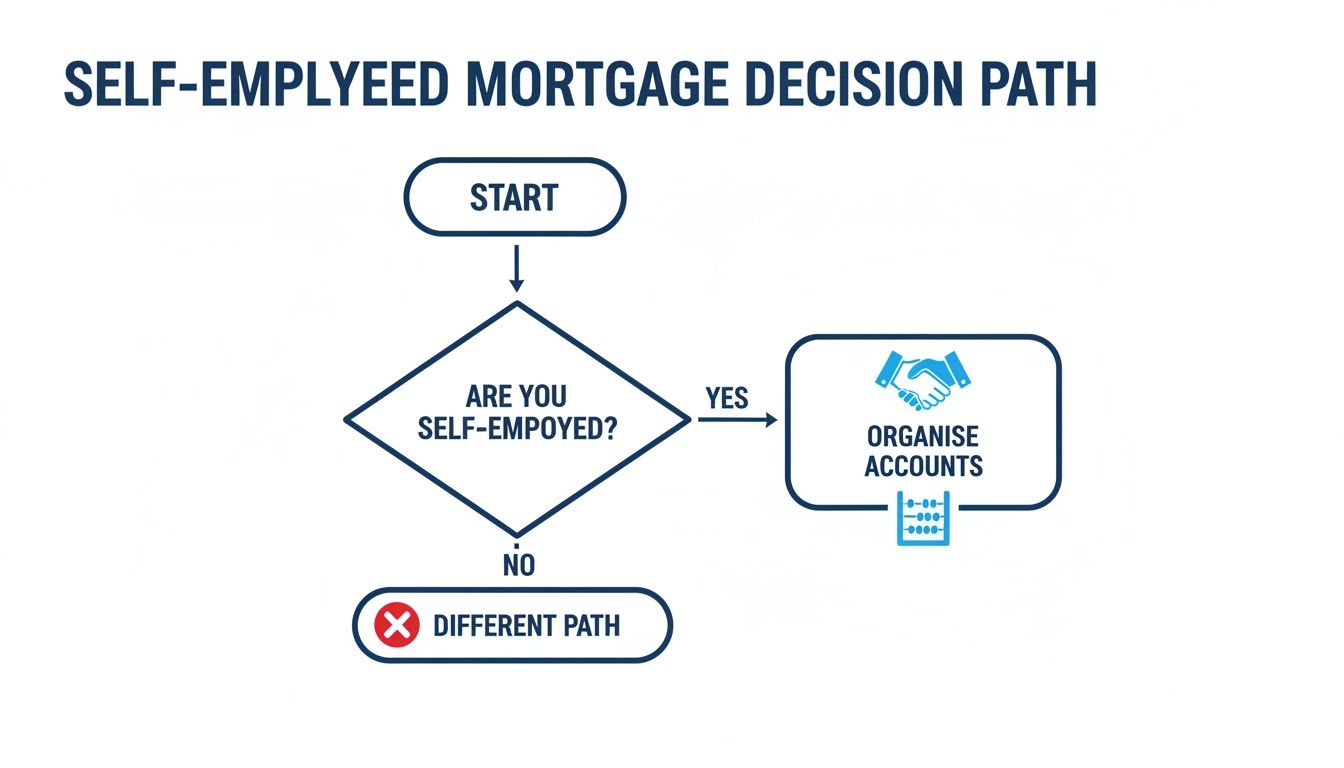
As the graphic shows, getting your financial paperwork organised from the very beginning is the fundamental first step for any self-employed applicant.
Averaging Income vs Latest Year Figures
As we saw with our Braintree designer, the method of calculation is everything. While many lenders prefer to average your income over two years to gauge sustainability, this isn’t a hard-and-fast rule. If your profits have clearly risen year-on-year, some lenders will use only the latest year’s figures, which can significantly increase what you can borrow.
This flexibility can be a game-changer. For example, on a £200,000 mortgage over 30 years, securing a competitive 4.40% fixed rate means a monthly payment of around £984. Reverting to an average Standard Variable Rate (SVR) of 7.25% could push that to £1,351, a difference of over £367 every month. This highlights why finding the right lender and product is so vital. You can learn more about how lenders treat self-employed income and when they make exceptions on foxdavidson.co.uk.
Knowing which lenders take which approach is a core part of what a specialist mortgage broker does. They can match your specific income situation to the lender most likely to view it favourably, saving you time and avoiding disappointing declines.
Assembling Your Mortgage Application Paperwork
If there’s one piece of advice I give every single self-employed client, it’s this: get organised. Lenders need to see a clear, evidence-backed story of your income, and your paperwork is how you tell that story. A messy, incomplete submission is one of the quickest routes to delays, frustration, and even outright rejection.
Think of it as building a case for your mortgage. An underwriter won’t just take your word for it; they need official proof of your financial health. Getting everything in order before you even apply not only speeds things up but also shows the lender you’re a professional and reliable borrower. It’s a simple step, but it makes a huge difference.
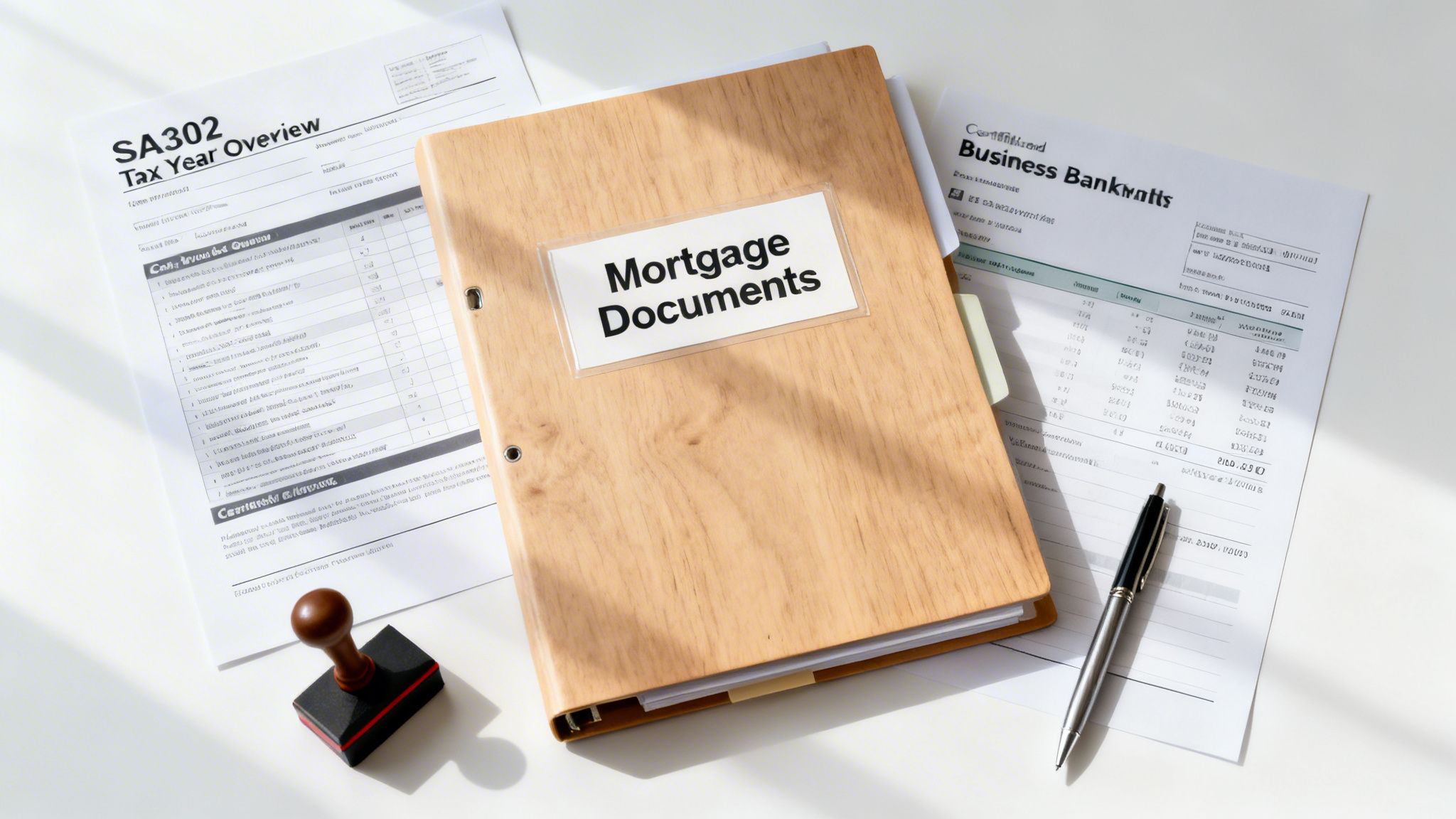
Your Core Document Checklist
While the exact list can vary slightly from one lender to another, there’s a core set of documents you’ll almost certainly need. Having these ready to go puts you in a fantastic starting position.
Here’s what you should start gathering:
- Proof of Income (2-3 Years): This is the absolute bedrock of your application. For sole traders, this means your full, finalised accounts. For limited company directors, it’s your company accounts and often your personal tax returns as well.
- SA302 Forms & Tax Year Overviews: Think of the SA302 as an official summary of the income you’ve declared to HMRC. The Tax Year Overview is the other half of the puzzle—it proves you’ve actually paid the tax you owe on that income. Lenders need both.
- Business Bank Statements (3-6 Months): Lenders will scour these to understand your business’s cash flow. They’re looking for a healthy turnover, consistent income, and any red flags, such as bounced payments.
- Personal Bank Statements (3-6 Months): These give a picture of your personal spending habits, regular outgoings, and how you manage your money day-to-day.
- Proof of Deposit: You’ll need a crystal-clear paper trail showing exactly where your deposit funds came from. This could be savings, the sale of another property, or a gift from family.
- Proof of ID and Address: The standard stuff. A valid passport or driving licence and a recent utility bill or council tax statement will usually do the trick.
It can feel like a lot to pull together, but it’s a non-negotiable step in the process. For a more detailed breakdown, our guide on self-employed mortgage requirements is a great resource. And if you want to make sure your bank statements are in a lender-friendly format, tools like bank statement converter software can be incredibly useful.
The Power of a Good Accountant
You can prepare your own accounts, but I can tell you from experience that having them prepared and certified by a qualified, chartered accountant carries far more weight with lenders. It adds a layer of credibility that immediately puts an underwriter at ease.
A lender is simply more likely to trust figures that have been professionally audited. In many cases, especially for more complex applications, lenders will insist on an accountant’s reference anyway. Building a good relationship with a reputable accountant is always a smart move for any business owner.
To help you get started, we’ve put together a quick checklist of the essential documents, what they prove, and where you can find them.
Essential Documents for Self-Employed Mortgage Applicants
| Document | What It Is | Why Lenders Need It | Where to Get It | Pro Tip |
|---|---|---|---|---|
| SA302 / Tax Calculation | HMRC summary of your submitted income. | Officially proves your taxable income. | Your HMRC online account or accountant. | Download directly for the quickest access. |
| Tax Year Overview | Shows the tax due and that it’s been paid. | Confirms you are up-to-date with tax. | Your HMRC online account or accountant. | Match this to the corresponding SA302. |
| Certified Accounts | Detailed business trading figures. | Provides a full view of business health. | Your chartered accountant. | Finalised, signed accounts are essential. |
| Business Bank Statements | A record of your business’s cash flow. | Verifies turnover and operational stability. | Your business bank. | Ensure all pages are included, even blank ones. |
Ultimately, preparation is what separates a smooth journey from a stressful one. If you’re a business owner looking for a mortgage, getting this paperwork sorted is your first, and most important, step towards success.
Actionable Ways to Boost Your Mortgage Affordability
One of the most powerful realisations for any self-employed borrower is just how much control you have over your own borrowing potential. It’s not simply a case of what you’ve earned in the past. It’s about the smart, proactive steps you take in the months leading up to your application.
Think of it like preparing for a major client pitch. You wouldn’t just show up and hope for the best. You’d get your facts straight, polish your presentation, and prepare for any questions. Boosting your mortgage affordability requires the same level of care and attention.
Declutter Your Debts and Expenses
The very first place a lender will look is at your outgoings. Your declared income is only one side of the coin; what’s left after all your monthly commitments is what truly shows them what you can afford.
Start by tackling any unsecured debts where you can. High-interest credit cards, personal loans, and car finance agreements can seriously dent the amount a lender is prepared to offer. Every pound you pay off is a pound that strengthens your position.
Next, take a look at your last six months of bank statements through a lender’s eyes. Are there large, regular payments for things you could temporarily live without? Cutting back on non-essential spending in the run-up to an application demonstrates financial discipline and instantly boosts the disposable income figure on your affordability assessment.
Master Your Credit Score
Your credit score is your financial CV, and you can be sure lenders will review it with a fine-tooth comb. A healthy score paints a picture of a reliable borrower, whereas a poor one can raise immediate red flags. It’s absolutely vital to know where you stand long before you apply.
Make sure you check your credit file with all three main UK credit reference agencies, as lenders can use any one of them:
- Experian
- Equifax
- TransUnion
💡– You can obtain a comprehensive copy of your Credit File at CheckMyFile – click to request your 7-day free trial and see what data mortgage lenders can see about you.
Scan for any errors or out-of-date information that might be dragging your score down and get them corrected. Simple things, like making sure you’re on the electoral roll at your current address, can give you a quick and easy boost. If you do have some past credit blips, don’t despair; our guide on securing a home loan when self-employed with bad credit offers more specific guidance.
The Power of a Larger Deposit
While it isn’t always easy, saving for a larger deposit is one of the single most effective ways to improve your mortgage prospects. A bigger deposit achieves two crucial things:
- Reduces the lender’s risk: The lower your loan-to-value (LTV) ratio, the more security the lender has. This instantly makes you a more attractive applicant.
- Unlocks better interest rates: The best mortgage deals are almost always reserved for borrowers with larger deposits, typically 15% or more.
Saving that little bit extra, or perhaps receiving a gift from family (which must be properly declared), can open up a wider range of lenders and significantly lower your monthly payments. This is especially important in a competitive market. As of early 2026, UK house prices are topping £300,000 nationally. While average two-year fixed rates are at a more affordable 4.26%, failing to secure such a deal could see you revert to a Standard Variable Rate (SVR) averaging 7.15%. This could add a whopping £349 to your monthly payments on a typical £200,000 loan, making these proactive affordability steps essential. You can explore more on the current UK mortgage market and its implications on oportfolio.co.uk.
Timing and Income Consistency
Finally, timing is everything. Lenders love to see consistency. A business showing two years of steady, declared profits of £40,000 is often viewed far more favourably than one with a £100,000 profit one year and a £10,000 loss the next. It’s best to avoid applying right after a particularly volatile trading period.
This is where expert mortgage advice for self-employed applicants in areas such as Chelmsford and across Essex proves invaluable. A good broker can help you time your application to perfection, ensuring your income is presented in its best possible light.
Navigating High Street vs Specialist Lenders
When you’re self-employed, the mortgage landscape pretty much splits into two camps: the familiar high street banks and the more adaptable specialist lenders. Picking the right one is a huge piece of the puzzle. Honestly, it can be the difference between a smooth approval and hitting a frustrating dead end.
It’s not that one is better than the other; it’s about which one is better for you and your business.
The high street lenders are the household names you see on every corner. They often pull people in with competitive interest rates and brands you recognise. The catch? Their whole system is usually built for straightforward, salaried employees.
This means their lending criteria can be incredibly rigid. If your income structure doesn’t fit neatly into their automated, computer-based process, the system might say ‘no’, no matter how healthy your business actually is.

When High Street Lenders Work
Going straight to your own bank can feel like the path of least resistance, and for some self-employed people, it works out fine. These are what we call ‘vanilla’ cases in the industry.
You might be a good fit for a high street lender if you:
- Have at least two to three years of finalised, consistent accounts.
- Can show a steady or rising net profit year after year.
- Draw a simple salary and dividends with few complexities.
- Have a strong credit history and a decent deposit ready to go.
If your financial story ticks all these boxes, you could very well land a great deal from a high street bank. The problem is, many successful entrepreneurs don’t have such a simple financial picture to show.
The Advantage of Specialist Lenders
This is where specialist lenders shine. These lenders exist specifically to help borrowers with more complex finances, which covers a massive number of self-employed people. The key difference is that they employ experienced human underwriters who look beyond the numbers on a screen.
They get it. They understand that a limited company director might strategically retain profit in the business for tax efficiency or to fund future growth. While a high street bank might only look at the salary and dividends you’ve drawn, a specialist lender is often willing to consider your share of the net profit before corporation tax. This simple shift in perspective can dramatically increase how much you can borrow.
Their flexibility extends to all sorts of scenarios:
- Complex income streams: Perfect for day-rate contractors, freelancers with multiple clients, or partners in a firm.
- Shorter trading history: Some will consider applicants with just one year of accounts, especially if there’s a strong track record in the same industry.
- Fluctuating profits: They’re more likely to listen to the story behind a temporary dip in profits, rather than issuing an automatic rejection.
For self-employed investors looking at rental properties, it’s also worth noting that specialist lenders are often the go-to for products like bridging finance, or for more unusual constructions, which are designed for investment scenarios.
Case Study: An Essex Contractor’s Success
The value of this specialist approach is easiest to see with a real-world example.
We recently worked with an IT contractor from Essex. He ran a very successful limited company and had retained significant profits within the business to fund a new project. A smart move, but one that complicated his mortgage application.
He first went to his own high street bank, where he’d been a loyal customer for over a decade. Despite his healthy business, their automated system only assessed him on his modest director’s salary and small dividends. His application was declined flat-out.
Frustrated, he came to EHF Mortgages. Using our whole-of-market access, we identified a specialist lender known for its positive approach to IT contractors. We packaged his application to highlight not just his salary, but also the substantial retained profit. The specialist lender’s underwriter understood his business strategy and approved a mortgage that allowed him to buy his dream home in Colchester.
This case goes to show that an initial ‘no’ is rarely the final answer.
Why a Specialist Mortgage Broker Is Your Greatest Asset
Trying to find a mortgage when you’re self-employed can feel like a full-time job in itself. The sheer volume of lenders, products, and confusing fine print is enough to make anyone’s head spin. This is where a specialist mortgage broker becomes your most valuable player, turning a stressful and complicated ordeal into a clear, manageable process.
A broker’s first job is to save you time and, crucially, protect your credit score. Applying directly to multiple lenders without knowing their niche criteria is a huge risk. Every application leaves a mark on your credit file, and a string of rejections can seriously hurt your chances of getting a mortgage down the line. We take that gamble off the table. With our 35+ years of experience, we know precisely which lenders welcome self-employed applicants in Chelmsford and the wider Essex area.
Expert Application Packaging and Whole-of-Market Access
Getting an application over the line is about much more than just filling in forms – it’s about telling your story in a way a lender understands. A specialist broker knows exactly how to package your application to present your income and business in the best possible light. We make sure your accounts, projections, and personal finances are framed in a way underwriters can get behind.
Our whole-of-market access is another massive advantage. We aren’t tied to a single bank’s products. This freedom allows us to compare deals from high-street names and specialist lenders you’d probably never find on your own. It gives you a view of the entire market so you can secure the most suitable rate. Understanding these differences is a vital part of the journey, and you can learn more by reading our guide on choosing a mortgage broker.
Your Partner from Start to Finish
At EHF Mortgages, we’re with you for the whole journey. It all starts with a free, no-obligation chat where we get to know you and your business properly. From that point on, we handle everything for you.
This includes:
- Pinpointing the best lenders for your specific situation.
- Completing and submitting all the application paperwork.
- Liaising directly with the lender, solicitors, and estate agents.
- Keeping you in the loop at every single stage until you have the keys in your hand.
We’re deeply rooted in our local communities in areas like Braintree and Colchester, and we focus on building genuine, long-term relationships with our clients. For expert, personalised mortgage advice tailored for the self-employed, start the conversation with us today.
Frequently Asked Questions About Self-Employed Mortgages
When you’re self-employed, navigating the mortgage process can feel like a world of its own, often sparking very specific questions. We get it. Here, we tackle some of the most common queries we hear from our clients in Chelmsford and across Essex, offering clear, real-world answers.
Can I Get a Mortgage with Only One Year of Accounts?
This is one of the first questions we’re usually asked, and the short answer is yes, it’s definitely possible. While it’s true that most high-street lenders prefer to see at least two years’ trading history, a growing number of specialist lenders are much more flexible.
To get them on board, you’ll need to build a strong case. This typically means:
- Having a healthy deposit, often 15% or more.
- Showing a strong, accountant-supported income projection for the current year.
- Demonstrating previous experience in the same field, which shows them you know what you’re doing.
The key is knowing where to look. A good broker has these niche lenders on speed dial and knows how to present your case in the best possible light.
Do Lenders Consider Retained Profits in My Company?
For limited company directors, this is a massive point of contention. It can be incredibly frustrating when a high-street lender only looks at your director’s salary and dividends, especially if you’ve strategically left profits in the business for tax efficiency or future growth.
This is where specialist lenders really come into their own. Many will assess your affordability based on your salary plus your share of the company’s net profit (either before or after corporation tax). This common-sense approach gives a far more accurate picture of your earnings and can dramatically increase your borrowing potential.
How Will a Dip in Profits Affect My Application?
A drop in profits might seem like an immediate red flag for lenders, but it doesn’t have to sink your application. It’s all about context. If you can show the dip was temporary – perhaps due to investing in new equipment, taking parental leave, or even a one-off bad debt – it can often be explained.
This is exactly where expert mortgage advice for self-employed people becomes invaluable; instead of letting an algorithm make a snap judgment, a skilled broker can build a narrative for the underwriter. With the right explanation, a lender might agree to average your income over three years to smooth out the anomaly, especially if your recent figures show a solid recovery.
At EHF Mortgages, we specialise in helping self-employed professionals in Essex navigate these exact complexities to secure the mortgage they deserve. Your homeownership goals are within reach, and we have the expertise to help you get there.





