
You’ve found a buyer, your sale is moving, and the next house in Chelmsford, Braintree or Colchester looks right. Don’t let the mortgage decision become an afterthought, because that’s where people waste time, miss out on a property, and end up paying more than they needed to.
💡 Top tip, get your documents together, sort your Decision in Principle, and show your deposit source before you offer on anything, I’ll explain why that matters later in the article.
Moving house is not one mortgage event, it’s two property transactions happening at once. You’re selling one home, buying another, and the mortgage has to fit the chain, the equity, the dates, and your lender’s current rules. That’s why moving house mortgage advice should be treated as part of the move itself, not just a finance box to tick at the end.
In the UK, this is a mainstream issue, not a niche one. The FCA’s Financial Lives 2024 survey found 1.1 million adults, about 7% of residential mortgage holders, had moved home in the previous three years and taken out a new residential mortgage, and 57% of the 7.7 million residential mortgage holders who changed their mortgage in the three years to May 2024 said they sought advice from a mortgage broker, up from 50% in the comparable 2022 survey. The same data shows movers were heavily active shoppers, with 84% comparing options before arranging a new mortgage and 90% using at least one source of information, which tells you exactly how much decision-making sits behind a house move (FCA Financial Lives 2024 mortgages data).
Why Moving House Mortgage Advice Matters Right Now
A couple in Chelmsford can have the right buyer, a decent onward property, and still see the whole thing wobble because they treated the mortgage as a quick admin step. The problem is rarely the idea of moving, it’s the pressure of the chain, the timing of the sale, and the fact that lenders don’t care how keen you are on the house, they care whether the numbers stack up.
The market has also become less forgiving on the cash side. Lloyds Bank reported about 126,884 home moves in the first half of 2024, up 10% year on year from 115,530 in the same period of 2023, with the South East recording 28,828 movers and Greater London seeing the biggest growth at 16% (Lloyds Bank home mover report). Movers paid an average of £392,107 and the average deposit required rose 22% to £129,951, which is a clear reminder that equity is doing a lot of work in these transactions.
Practical rule: treat the move like a project, not a mortgage switch. If you don’t know your equity, your lender’s view of your affordability, and your exit costs, you’re not ready to bid.
There’s also a bigger affordability backdrop. The English Housing Survey shows the average mortgage payment in 2024-25 was £242 per week, with a median of £208, compared with £182 mean and £147 median in 2019-20, and London’s mean was £375 per week (English Housing Survey mortgage payments). That’s why the right moving house mortgage advice has to join up payment level, equity, timing, and product choice.
Start with the right three things
Documents first. Have payslips, bank statements, ID, and address history ready before you start offering.
Decision in Principle next. Get a proper borrowing figure so you know your real ceiling.
Deposit source last, but clearly evidenced. Savings, ISA money, gift, inheritance, or sale proceeds all need to be traceable.
If you start there, the rest gets much easier. You’ll also know whether your move is a clean upsizing case, a chained trade-up, or a more awkward situation where the lender needs a deeper look.
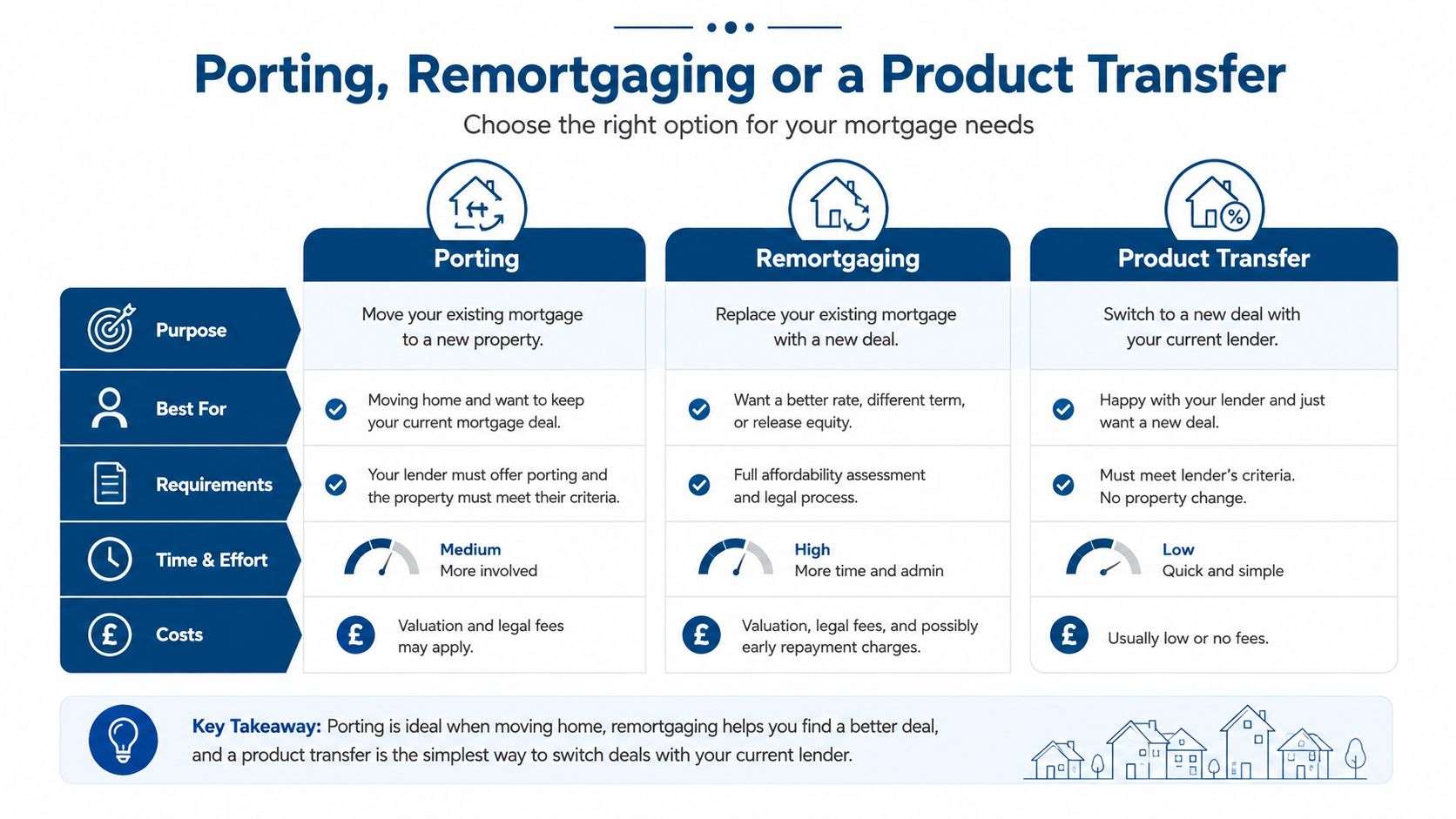
Porting, Remortgaging or a Product Transfer
Porting sounds simple, but it isn’t automatic approval. Your current mortgage product can sometimes move with you to the next property, yet the lender still rechecks affordability on the new loan and the new home. If your income, outgoings, or the property itself no longer fits the lender’s criteria, the port may not land cleanly, even if you’ve never missed a payment.
A remortgage to a new lender is a fresh application. That can be a better outcome when the new lender offers a sharper overall deal, or when your current lender’s portability is awkward, expensive, or tied up with restrictions. A product transfer, on the other hand, is usually just a rate switch on the existing loan, and it doesn’t solve the problem of buying a different property because the old mortgage still has to be settled on the sale.
The decision rule I’d use
Port when the existing rate is strong, the early repayment charge is manageable, and the lender will still lend on the new home.
Remortgage when equity and income support a better total cost over the deal term.
Avoid relying on a product transfer for a house move, because it doesn’t release the loan from the property you’re selling.
That last point catches people out all the time in Essex. They see a low headline rate and assume it wins. It doesn’t, unless the fee stack, ERCs, and lending restrictions line up in its favour.
A good comparison has to include the full cost, not the surface rate. That means looking at valuation, legal, arrangement, and exit costs, then matching them against the length of time you expect to keep the new mortgage. The cheapest quote on paper can become the most expensive route in real life once the sale and purchase are both moving at pace.
If you want a practical explainer of portability, the broker note on what is porting a mortgage is worth reading before you commit to an offer. Use it as a prompt for the right questions, not as a reason to assume your current lender will play ball.
Ask these questions before you choose
Will the lender port the current deal to the new property?
What’s the redemption figure today, and what ERC applies?
Does the new property fit the lender’s criteria without forcing a compromise?
Is the overall cost better if I switch lender instead?
When you put those answers side by side, the right route usually becomes obvious. The wrong route is usually the one chosen in a hurry.
Working Out Your Equity and Deposit Before You Offer
Start with the equity, then strip out the friction. The simple formula is current property value minus outstanding mortgage balance, but that is not the money you can safely spend on the next home. You still need to account for estate-agent fees, conveyancing, and any early repayment charges, because those costs come straight out of the sale proceeds.
A useful way to think about it is equity minus selling costs equals your usable deposit base. MoneySavingExpert’s moving-home guidance says estate-agent fees commonly run at 1% to 3% plus VAT and conveyancing around £800 to £1,500 plus VAT, which is exactly why a property that looks equity-rich can feel tighter once the figures are on paper (MoneySavingExpert moving-home guidance). If you want a simple starting point for the maths, the broker calculator on how much equity do I have is the right place to begin.
Don’t use the balance on your online banking app as your redemption figure. Ask the lender for the actual redemption statement, because that’s the number that clears the loan.
That distinction matters. A redemption figure includes what’s needed to close the mortgage properly, and it can differ from a day-to-day balance because lenders may charge closing fees or calculate interest differently. If you are serious about buying before you’ve sold, you need that exact number before you make assumptions about your buying power.
There’s also a practical ordering issue. Get the redemption figure first, then build the budget, then go for the Agreement in Principle. If you do it the other way round, you risk falling in love with a property that your equity cannot support once the deductions are included. I’d rather disappoint a buyer early than watch them scramble later because the deposit looked bigger on paper than it was in reality.
If you want a useful checklist to take to viewings while you work this out, the checklist for your next house viewing is a handy prompt for the kind of questions that stop costly surprises later. It’s more useful when you’re comparing homes in Braintree or Colchester and need to stay focused on the numbers as well as the kitchen.
Timing the Mortgage Around the Move
The biggest mistake movers make is treating the mortgage as a single event. It isn’t. The sale, the purchase, the lender check, the valuation, and the legal work all move on slightly different clocks, and one slow step can hold the whole chain hostage.
Build the timeline backwards
Start at least 60 days before you market the property. Ask for your redemption statement, confirm whether the current deal is portable, and get the lender’s view on whether a fresh affordability check is likely to pass. That gives you a realistic picture before your home even goes on the market, which is exactly how you avoid scrambling once the right buyer appears (moving-home timeline guidance).
Then lock in the onward budget with an Agreement in Principle. That should sit alongside the sale prep, not after it. If you’re trying to sell in Chelmsford and buy in Colchester, or moving within Braintree, you want your broker coordinating both sides of the chain, not reacting after deadlines have already tightened.
Keep the tasks running in parallel
Before marketing: redemption statement, porting check, and budget review.
After an offer is likely: Agreement in Principle, updated documents, and deposit evidence.
During legal work: valuations and surveys on both properties, with the broker kept in the loop on every chain update.
Before exchange: final lender checks, solicitor sign-off, and clear completion dates.
That sequencing cuts down avoidable delays. It also means you’re not waiting for a lender decision while someone else in the chain is ready to exchange. In practice, the homeowners who stay calm are usually the ones who have already done the boring work early.
The timeline guidance on how long does a mortgage application take is worth reading if you want a clearer sense of where the bottlenecks usually sit. Use it to plan around the chain, not to assume every case will behave the same way.
Keep your broker updated on every chain change. A new completion date, a revised offer, or a change in lender criteria can alter the right mortgage route fast.
That’s where a good adviser earns their keep. They stop you making a decision based on the wrong date, the wrong fee, or a stale affordability picture.
Costs Beyond the Mortgage Most Movers Underestimate
The mortgage payment gets all the attention, but the move itself is what drains the bank account. You’re paying for the legal transfer, the sale, the removals, the energy paperwork, and in some cases the tax bill on the new property. If you don’t budget for all of it, the completion day gets ugly very quickly.
Typical cost bands for a UK move
| Cost Item | Typical Low | Typical High | Who Sets It | Negotiable? |
|---|---|---|---|---|
| EPC | About £100 | About £100 | Assessor | Sometimes |
| Conveyancing | £600 | £900 | Solicitor | Sometimes |
| Estate agent fees | 1.42% | 1.42% | Agent | Yes |
| Removals | £350 | £2,250 | Removal firm | Yes |
Those figures sit alongside the lender-side costs too. A general moving-house guide from Atom Bank also notes that moving involves more than the mortgage itself, which is the right way to think about it. The practical point is simple, a cash buffer matters because several of these charges land before you’ve fully settled into the new place (Atom Bank moving house guide).
Stamp duty needs its own thought. If the new purchase triggers it, that is a separate lump sum you must plan for, and it can be especially awkward if your sale completes late. The broader point is that the buyer often faces two mortgage payments if dates slip, one on the old home and one on the new one, so a neat chain on paper can still strain the cashflow in real life.
If you want to work through the likely outlay before you commit, the cost of moving home calculator is a practical way to sanity-check the numbers. It’s far better to size the move properly now than to discover you’ve undercooked the cash need after the offer has already been accepted.
What to treat as fixed and what to challenge
Fixed or near-fixed: lender charges, legal disbursements, and tax due.
Negotiable: estate-agent fees, removal quotes, and some conveyancing elements.
Timing-flexible: certain moving costs can be staged, but only if your chain allows it.
The key is to build a completion-day buffer, not just a deposit. That buffer is what stops a good move turning into a financial mess.
Specialist Situations Movers Often Face
A self-employed buyer in Braintree often has a different problem from a salaried couple in Colchester. The income may be strong, but the evidence is messier, especially if trading figures, dividends, or a recent job change don’t tell the same story across every document. Lenders want the paperwork to support the conversation, and if it doesn’t, the application slows down or falls apart.
Adverse credit changes the whole tone of the move. A homeowner with a default or a CCJ is not always locked out, but the lender choice narrows and the application needs more care. A high-street bank may be the wrong place to start, because a specialist lender panel is often a better fit when the credit file needs interpretation rather than a blunt yes or no.
Later-life movers have their own set of decisions. Someone aged 55 plus may be looking at equity release or a retirement interest-only option, particularly if the next property is smaller, more accessible, or tied to family needs. If you want a useful comparison of age-related lending thresholds, the proprietary loan age minimums compared article gives a helpful outside reference point for how age rules can shape borrowing, even though UK products are not the same as US reverse mortgages.
Trapped equity is a planning problem, not just a lending problem. If the sale won’t clear the loan, the early repayment charge, or both, the move might need to be delayed, restructured, or paired with extra borrowing.
That’s the point many generic guides miss. Negative equity or trapped equity can make a routine move difficult, because the sale proceeds don’t fully reset the borrowing picture. In those cases, the practical options are usually to stay put for now, add borrowing if the lender will allow it, or revisit the move once equity improves.
Buy-to-let adds a different layer again. Landlords moving between properties need the mortgage choice to fit the rental strategy, not just the next address. The right lender wants the numbers to make sense on their terms, and that is where a whole-of-market adviser earns real value.
For homeowners who want to understand the breadth of later-life options, the page on do I need a mortgage advisor is a useful reminder that not every case belongs with a one-size-fits-all bank process. In specialist cases, the adviser’s job is to shape the application so the right lender can say yes.
Protection, Paperwork and When to Bring in a Broker
Moving day pressure makes people forget the boring stuff. That’s a mistake. Your address changes, your risks change, and your insurance and protection should move with you instead of being left behind in the old property file.
Buildings insurance should be in place from exchange, and life, critical illness, or income protection often need reviewing when the new mortgage, new address, or new income profile changes the household position. If you want a straightforward way to compare cover before you decide, compare mortgage life cover quotes is a useful starting point. It’s not about over-insuring, it’s about making sure the mortgage is protected in the world you’re moving into.

The paperwork mistakes I see most often are plain avoidable. People overstate income, forget that the bank statements tell a different story, or leave a credit issue undisclosed until the broker has already spent time on the case. Others say the outgoings are fine in the first chat, then the paperwork shows a busier picture, and the lender’s affordability check becomes tighter than expected.
Three habits that save time
Be document-ready: pay, bank statements, ID, address history, all of it.
Be honest about income and outgoings: if the documents don’t match the conversation, fix that early.
Check your credit file before the application starts: surprises are expensive once a broker has begun work.
Being upfront is faster than trying to tidy the file later. It also gives the broker room to find the right lender or product structure before you’ve committed to a property that doesn’t fit.
That’s where whole-of-market advice matters most, and it’s where EHF Mortgages can be one option for movers who need residential, buy-to-let, specialist, or later-life lending support. The firm’s role is to line up the mortgage with the move, the paperwork, and the protection, rather than treating them as separate jobs.
If you’re in Chelmsford, Braintree, Colchester, or elsewhere in Essex and you’re preparing to move, start with your documents, your deposit evidence, and a realistic budget. Then speak to a broker before you offer, not after, and you’ll keep far more control over the chain.
If you want moving house mortgage advice from a whole-of-market broker who can look at porting, new deals, protection and the timing of your move together, speak to the team at EHF Mortgages before you make your next offer. They can help you work out what’s affordable, what’s portable, and what needs fixing before the chain gets any longer.
If this guide has helped you understand your options and you’re ready to take the next step, speak to EHF Mortgages for clear moving house mortgage advice and a proper plan for your sale and purchase.





