
💡 Top Tip: Be completely transparent about where your deposit has come from. It’s the single best way to speed up your mortgage application, and I’ll explain why later.
If you’re applying for a mortgage, remortgaging, or buying a buy-to-let in Chelmsford, Braintree, Colchester or elsewhere in Essex, you’ve probably already realised the paperwork can feel relentless. One of the checks that causes the most confusion is the AML check.
Many borrowers assume it’s just a passport check. It isn’t. In mortgage work, an anti-money laundering check is about proving who you are, where your money comes from, and whether the transaction makes sense in practical terms.
That matters because delays usually don’t happen when a case is straightforward. They occur when the deposit trail is unclear, when funds move among several accounts, or when a gift is described as savings at the start and later corrected. If you understand the process early, you give yourself a much better chance of keeping things moving.
Your Guide to Anti-Money Laundering Checks
A simple answer is usually desired for the question of what an anti-money laundering check is. In practice, the answer needs a bit more detail, especially for mortgage applicants.
For a borrower, an AML check is a mandatory review that helps a regulated firm confirm your identity and understand the source of the money involved in the transaction. That includes your deposit, any gifted funds, and sometimes the wider background to your finances, where the case is less straightforward.
Practical rule: The cleaner the paper trail, the smoother the application tends to be.
This is why two applicants with the same income can have very different experiences. One has a salary paid into a single current account and deposit savings built up steadily. The other has money arriving from several accounts, a family gift, and a recent transfer from a business account. Both may be perfectly legitimate, but one will take more checking.
Borrowers often feel uneasy when they’re asked for extra statements or further proof. In most cases, that isn’t because anyone thinks you’ve done anything wrong. It’s because mortgage brokers and lenders have legal duties, and those duties don’t disappear just because a client seems genuine.
Here’s what tends to matter most in real applications:
Identity must be current: Expired documents or unclear scans can hold things up.
Address evidence must match: If your address format differs across documents, expect follow-up questions.
Deposit evidence must tell one story: savings, gifts, inheritances, sale proceeds, or business funds all need a clear trail.
Changes must be explained early: A late correction often creates more work than the issue itself.
For first-time buyers, landlords and home movers alike, the point isn’t to make the process feel intrusive. It’s to make sure the transaction is transparent before a lender commits.
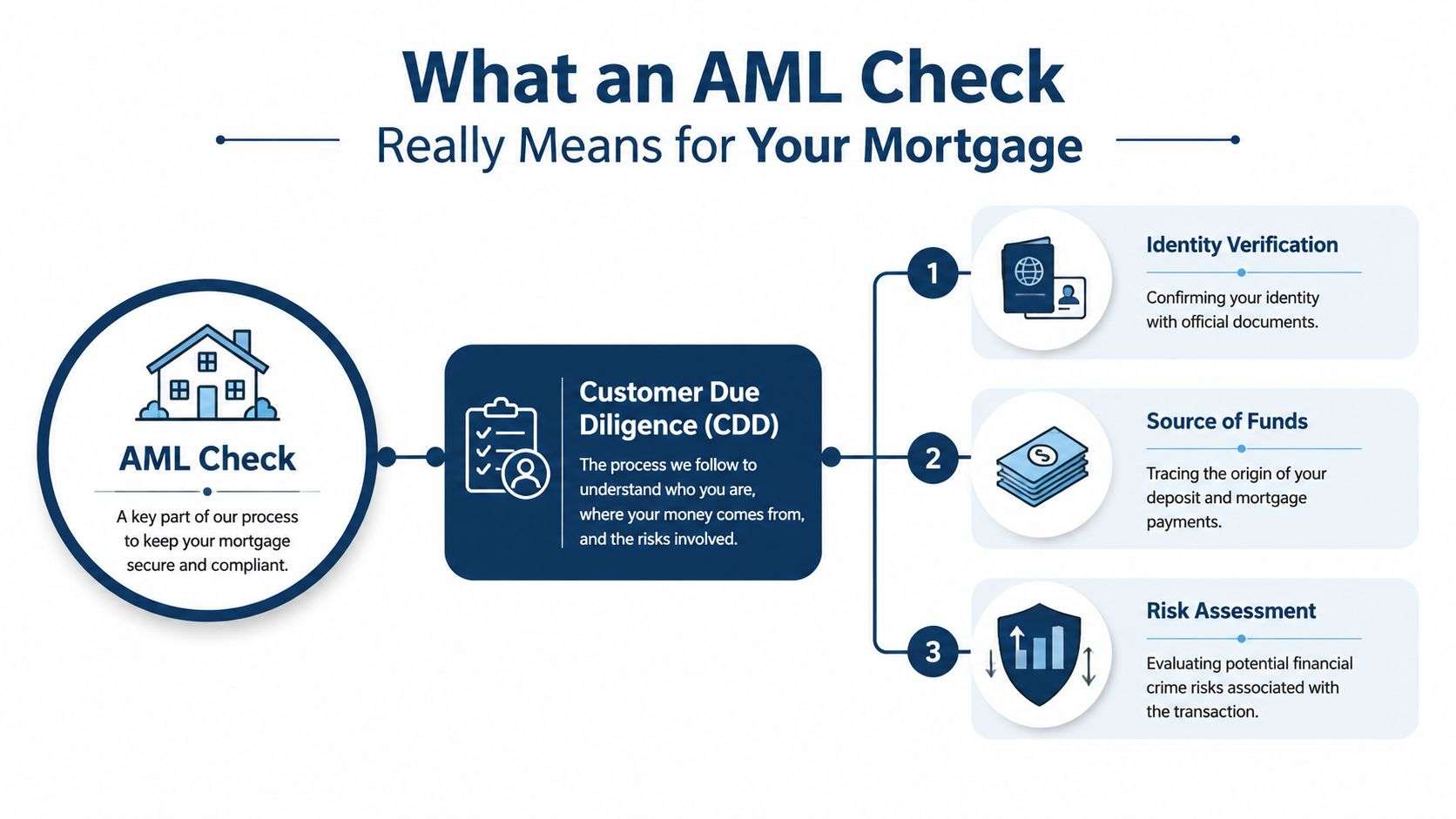
What an AML Check Really Means for Your Mortgage
An AML check for a mortgage is not just identity verification. In the UK, a risk-based customer due diligence process is triggered when a firm begins a business relationship, suspects money laundering or terrorist financing, lacks confidence in earlier identification, or handles certain significant transactions. Guidance also notes a threshold of USD/EUR 15,000, and incomplete or inaccurate customer data can stretch the process from roughly 24 hours to a week or longer before a regulated firm can safely proceed, as outlined in Napier’s explanation of AML checks.
It’s closer to a financial background check
The simplest way to think about it is this. An AML check builds a picture of whether the money in a property transaction is legitimate and whether anything about the client, the funds or the structure raises concern.
For a mortgage applicant, that usually breaks into three practical areas:
Identity verification
The firm confirms you are who you say you are, using independent evidence.Source of funds
The firm checks where your deposit and relevant monies have come from.Risk assessment
The firm assesses whether anything in the case warrants closer scrutiny.
That third part is the one borrowers often don’t expect. If your application is simple, you may barely notice it. If the case is more layered, the lender or broker may need more than standard documents.
Why does it feel more detailed than a normal admin check
A mortgage is a large financial transaction tied to property, and property is an area where firms have to be careful. That’s why AML work often overlaps with KYC checks, sanctions screening, politically exposed person screening, source-of-funds review, and ongoing monitoring rather than being a one-off box to tick.
AML doesn’t ask only, “Is this your money?” It also asks, “Can you show where it came from, and does the story stay consistent from start to finish?”
That distinction is where most of the confusion lies. A client might say, with genuine belief, “It’s my deposit.” But if part of it came from a parent, another part from an account in a different name, and another from sale proceeds, the paper trail needs to show that clearly.
Risk-based means not everyone gets treated the same
This isn’t unfair. It’s how the rules work. A salaried applicant with a single deposit account will usually move through the process faster than someone with overseas funds, complex ownership arrangements or an unusual transaction pattern.
That doesn’t mean the second borrower has a problem. It just means the file needs more evidence before anyone can sign it off comfortably.
Why We Are Legally Required to Conduct AML Checks
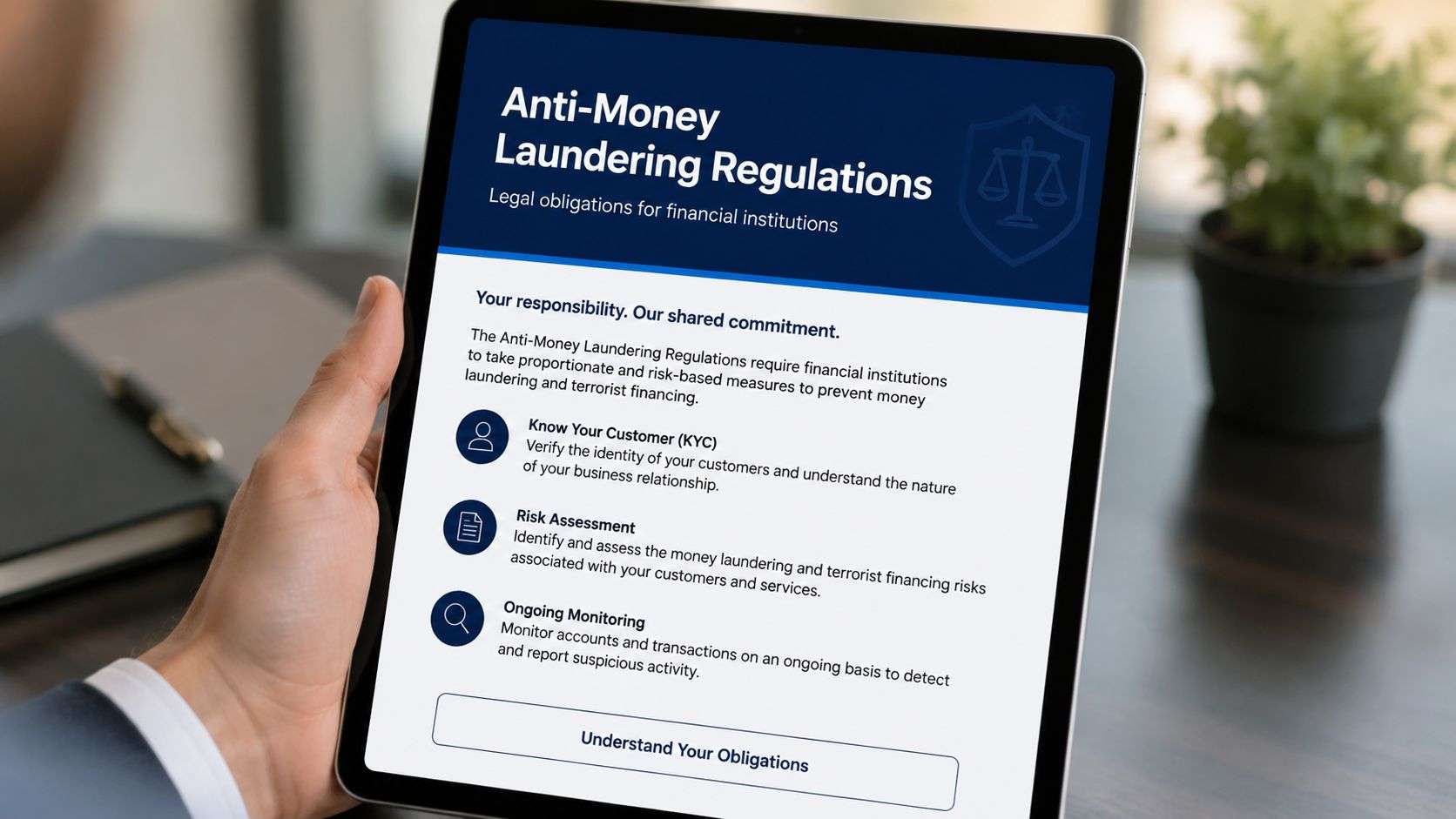
Mortgage brokers don’t carry out AML checks because they feel like it. They do it because UK regulation requires customer due diligence at the start of a relationship, when circumstances change, or where suspicion arises. Firms also have to keep records of identity documents, risk assessments, and transaction records for 5 years after the relationship ends or the transaction is completed, as set out in the UK government guidance on money laundering regulations.
Why that matters to borrowers
Clients sometimes ask why documents are requested again during a remortgage or later in the process. The answer is simple. If circumstances change, the file may need to be refreshed. If a new gift appears, if the deposit moves, or if identification no longer matches what’s on record, the firm may have to revisit the checks.
This is one reason AML can feel repetitive from the client side. From the adviser’s side, though, it’s about ensuring the case remains compliant throughout the life of the transaction, not just on day one.
The wider protection point
These checks protect the integrity of the financial system, but they also protect ordinary borrowers. A lender needs confidence that the transaction is lawful and properly evidenced. A broker needs confidence that advice is being given on a clean and accurate basis. If either party proceeds with incomplete information, it creates a risk for everyone involved.
In property finance, that’s especially important where ownership, funding, and personal circumstances can become complicated quite quickly. The same basic logic applies in other regulated and technical environments too. If you’ve ever looked at how businesses assess third-party exposure in specialist digital sectors, a guide like this DEX development company UK resource shows how seriously firms take transparency, controls and operational scrutiny when financial risk is involved.
Key point: If a broker asks for more evidence, the right question usually isn’t “Why are they making this difficult?” It’s “What gap are they trying to close before the lender reviews my case?”

For clients in Chelmsford, Braintree, Colchester, and across Essex, the practical takeaway is that these checks are routine but not casual. If your adviser is thorough, that’s usually a good sign.
The AML Verification Process and Documents You Need
Most delays happen because people prepare for the mortgage but not for the evidence behind it. AML works best when documents are gathered before the application starts, not after someone urgently asks for them.
The three document groups that matter most
First comes proof of identity. In day-to-day mortgage work, that usually means a passport or a driving licence.
Second is proof of address. A bank statement is commonly used, and a utility bill can also work, depending on the circumstances and what the firm accepts.
Third, and most important in many cases, is proof of deposit and source of funds, as lenders and brokers need to see the trail of money being used. If the deposit comes from savings, the statements should show how those savings were built up. If it’s a gift, it needs to be identified as such from the start. If it came from a sale of an asset, the paperwork needs to connect that sale to the funds now sitting in your account.
Here’s a simple reference point.
| Document Category | Examples | Why It’s Needed | Pro Tip |
|---|---|---|---|
| Identity | Passport, driving licence | Confirms you are the applicant named on the case | Check expiry dates before sending |
| Address | Bank statement, utility bill | Confirms where you live and supports client verification | Use a document that matches your current address exactly |
| Deposit source | Savings statements, gifted deposit evidence, sale documents | Shows where the money for the transaction came from | Keep statements in date order |
| Business-related funds | Business account statements and supporting explanation where relevant | Helps explain transfers that don’t come from personal banking | Flag this early rather than waiting to be asked |
| Asset sale evidence | Completion statements or sale records linked to bank credits | Connects a past sale to the funds used now | Keep the sale paperwork with the receiving account statement |
What works and what doesn’t
What works is a clear story backed by matching documents. One account, obvious salary credits, regular savings and a well-documented gift are usually manageable.
What doesn’t work is sending partial screenshots, missing pages, unexplained large credits or a different explanation every time the question is asked.
Borrowers don’t need a perfect financial history. They need a clear and consistent one.
This is particularly relevant if you’re self-employed. Personal and business money can become intertwined in perfectly normal ways, but that doesn’t mean a lender will assume it all makes sense without evidence. If that’s your situation, it’s worth reviewing these self-employed mortgage requirements early so your income and source-of-funds documents line up properly.
The source of funds is where most real-life cases wobble
The phrase sounds technical, but the issue is straightforward. A firm needs to know where the money came from, and the documents have to support that answer.
A few common examples:
Savings: Show the build-up over time, not just the final balance.
Gift from family: Be upfront that it’s a gift, then provide the donor trail as required.
Inheritance: Keep the paperwork that shows how the funds were received.
Sale of an asset: Match the sale document to the credit into your bank account.
Money moved between accounts: Provide statements for each step, not just the final destination.
If you’re interested in how due diligence works more broadly, this guide to practical vendor risk assessment is a useful comparison. The setting is different, but the principle is familiar. A transaction moves faster when the evidence trail is complete.
How AML Checks Affect Complex Mortgage Cases
Straightforward cases usually pass through AML with little fuss. Complex cases don’t fail by default, but they do attract more questions. That’s because higher-risk customers require enhanced due diligence, with closer scrutiny of ownership complexity, geography, and source of funds or wealth, as explained in Neotas’ overview of AML checks.
Self-employed applicants
If you’re self-employed, lenders and brokers often need to distinguish between personal money and business money. That can become messy if the deposit has been built partly from retained profits, director withdrawals, or transfers from a trading account.
None of that is automatically a problem. The issue is whether the route from the business to your personal contribution is clearly documented in the file.
Landlords and portfolio cases
Buy-to-let clients often have more moving parts. Rental income, refinancing, deposit recycling, limited company structures and portfolio ownership can all make the AML side more detailed.
That’s especially true where funds are being moved across several accounts or where ownership is less obvious at first glance. In those cases, the firm may need to understand not just the current transaction but also the structure around it.
If your borrowing falls outside standard high-street criteria, a specialist mortgage lender may be part of the conversation. That can help with lending policy, but it won’t remove the AML requirement. If anything, complex cases need clearer evidence.
Gifted deposits and non-standard funding
Gifted deposits are one of the most common flashpoints. They’re normal in the market, but they still need a proper trail.
That may include:
Donor identification: The person giving the money may need to verify their identity.
Source of donor funds: The donor may need to show the source of their funds.
Transfer evidence: The route from the donor account to the borrower account should be easy to follow.
More questions on a gifted deposit don’t mean the gift is suspicious. They mean the file needs enough evidence to stand up to scrutiny.
Overseas links and unusual ownership
Cases involving overseas funds, funds routed across borders, or unusual ownership arrangements often draw more attention. Geography matters in AML. So does beneficial ownership if a company, trust or more complicated structure is involved.
Here, borrowers can become frustrated, especially if they feel they’ve already sent plenty. But enhanced due diligence is designed for exactly these situations. The file needs to answer the awkward questions before the lender asks them, not after.
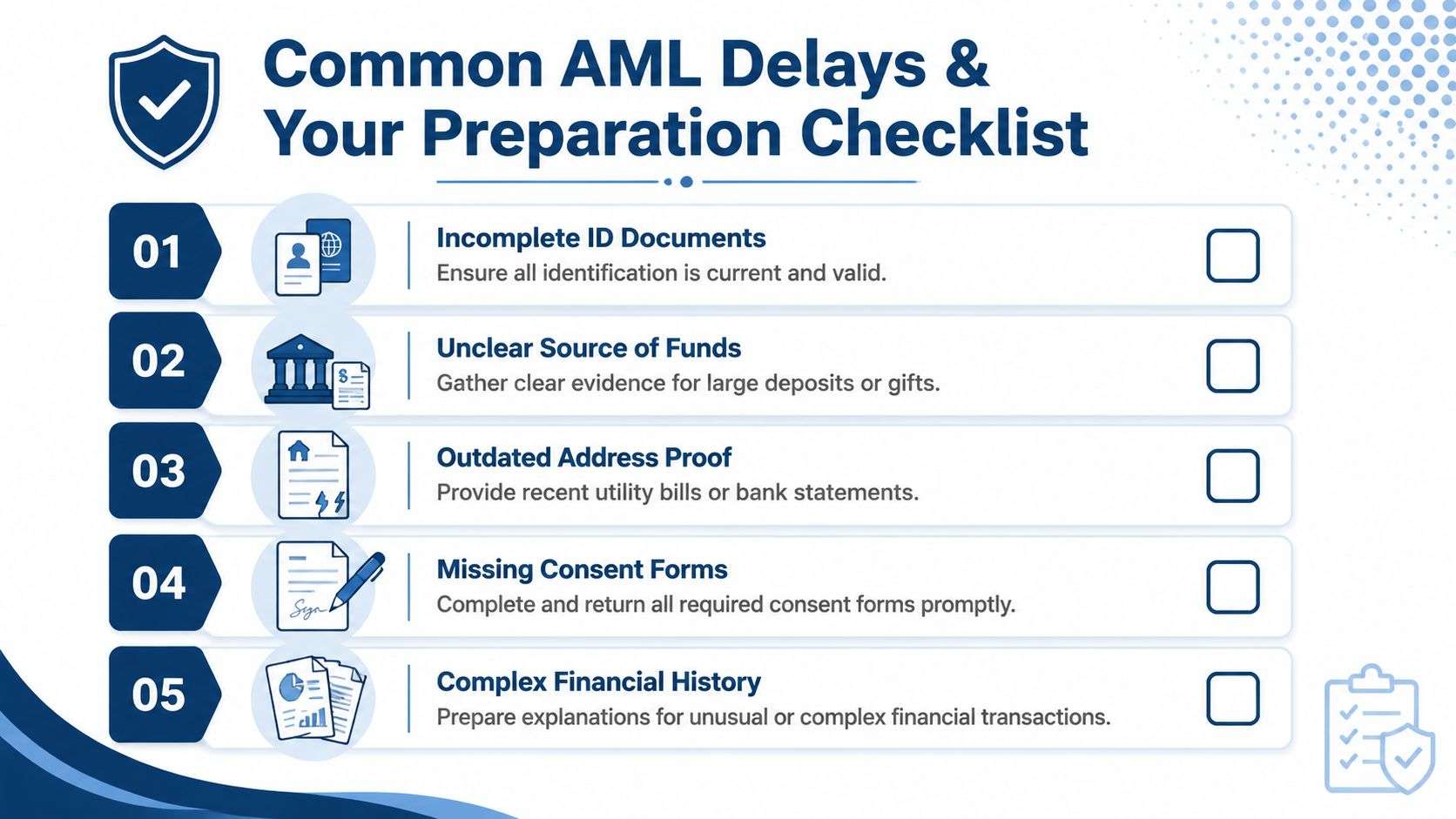
Common AML Delays and Your Preparation Checklist
The delay I see most often is simple. A borrower says the deposit is savings, but later it is revealed that part or all of it is a gift. That changes the evidence required and can force the case to be rechecked.
Another regular issue is multiple deposit accounts. Clients may have done nothing wrong at all, but if the deposit has been assembled from several places and some statements are hard to obtain, the trail becomes slower to prove.
AML checks can significantly delay mortgage offers where funds are gifted, transferred from business accounts, or routed across borders because those scenarios often trigger deeper scrutiny of the source of funds and wealth, as described in LSEG’s glossary entry on AML checks.
The delays that come up again and again
Deposit described incorrectly: Savings and gift are not the same thing from an AML point of view.
Money spread too widely: Several accounts mean several statement trails.
Documents don’t match: Names, addresses and dates need to be consistent.
Business funds lack explanation: Transfers from company accounts need context.
Late disclosure: A problem found early is usually manageable. A problem found after submission is harder.
“Just be clear about the deposit source – we can work with the truth, it is far harder to back-track with the lender.”
– EHF Mortgages
That advice is worth taking seriously. Brokers and lenders can usually address a genuine issue if they are aware of it early. What causes pain is having to unwind a story after the case has already moved on.
For borrowers who are wondering what happens once the lender is happy, this guide on what happens after a mortgage offer is a helpful next read.
A short video can also help make the process feel less abstract.
Your preparation checklist
Before you apply, get these basics in order:
Check your ID now: Make sure your passport or driving licence is valid and readable.
Use recent address evidence: Pick a bank statement or utility bill that matches your current details.
Map your deposit trail: Know exactly where every part of the money came from.
Speak to family early: If any part is gifted, say so at the start.
Gather full statements: Don’t rely on app screenshots if full account records are needed.
Keep explanations simple: If funds moved between accounts, write out the sequence clearly for yourself first.
Separate personal and business evidence: If you’re self-employed, be ready to explain transfers cleanly.
If you do that, AML becomes much less stressful. It may still be detailed, but it won’t feel chaotic.
If you’re ready to move forward and want clear, practical help with your mortgage application, speak to EHF Mortgages. Their team can help you prepare properly, avoid common AML delays, and keep your case moving with the right evidence from the start.





