
Saving a deposit while paying Essex rents can feel like trying to fill a bucket with a hole in the bottom.
 Top tip: if your income is high enough for the monthly payments but your deposit is the problem, a family springboard mortgage can be worth a serious look. I’ll explain exactly why later, including where families in Chelmsford, Braintree and Colchester often get caught out.
For many first-time buyers, the challenge isn’t ambition. It’s the gap between being able to afford the mortgage each month and being able to produce the upfront cash a lender wants. That’s where this type of mortgage comes in. It gives families a structured way to help without handing over money outright, as with a traditional gifted deposit.
Before you go further, it helps to understand the language lenders and brokers use. If you want a simple primer on property jargon, this guide to essential real estate investment vocabulary is a useful starting point.
Introduction
A family springboard mortgage suits a very specific kind of buyer. Usually, it’s someone who has the income to support a mortgage but hasn’t yet built up a full deposit. In Essex, that often includes younger buyers who are renting locally while trying to stay close to work links to London or buying near family support.
The attraction is simple. Instead of waiting years to save a larger deposit, a relative can help create the security a lender needs. In practice, that can open the door to buying far sooner than would be possible through savings alone.
Practical rule: A family springboard mortgage works best when the buyer can comfortably afford the mortgage on their own income and the family support is solving the deposit issue, not masking an affordability problem.
It’s also important to understand what this product is not. It isn’t just “mum and dad helping out” in the informal sense. It’s a lender-led structure with fixed rules, a defined timescale, and obligations for both the buyer and the family helper.
Families around Chelmsford often like the idea because it can feel cleaner than a private family loan. But the product only works well when everyone understands the risks, how long money may be tied up, and what happens if plans change.
What matters most before you apply
Family agreement: Everyone needs to be clear on why this route is being used and what each person is committing to.
Exit thinking: You should know in advance what the hoped-for outcome is, whether that means staying put, remortgaging later, or waiting for the helper’s funds to be released.
Property choice: Some lenders are more cautious about certain property types, so the right home on Rightmove isn’t always the right home for the mortgage product.
How a Family Springboard Mortgage Works
A family springboard mortgage is best thought of as a family-backed safety net for the lender. The buyer takes the mortgage in their own name, but a relative supports the deal by providing security.
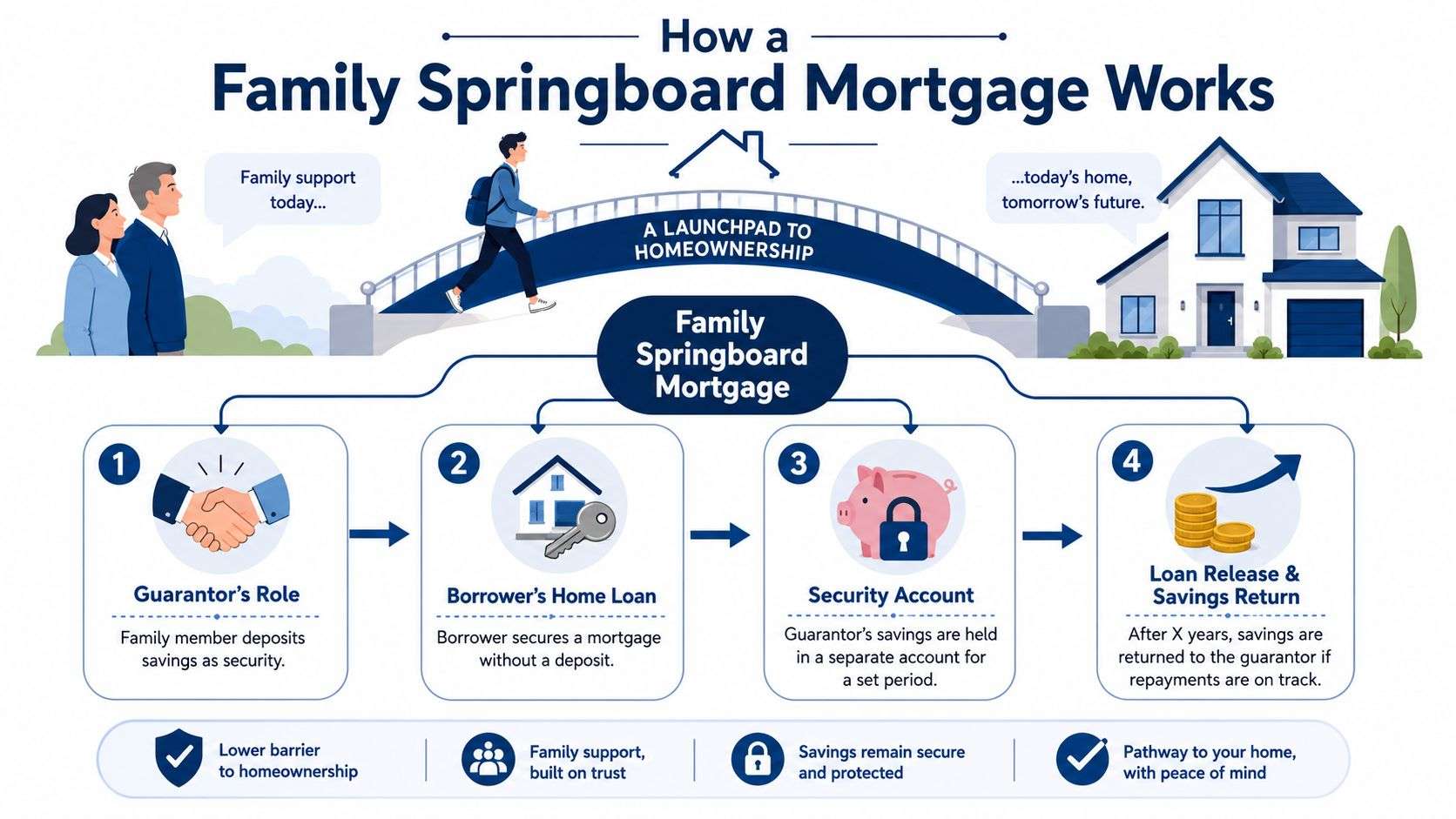
The practical structure is quite specific. A UK family springboard mortgage is technically structured as a 95% loan-to-value or, in some lender variants, a 100% loan-to-value arrangement supported by a helper’s restricted cash deposit. Barclays-style springboard products commonly require the helper to place 10% of the purchase price into a linked savings account for a fixed term, usually five years. In comparison, the borrower may contribute up to 5% of their own deposit or none at all, as outlined by Legal & General’s explanation of springboard mortgages.
The simple version
The buyer buys the property.
The helper doesn’t usually go on the deeds just because they are helping.
The helper’s money sits in a separate account linked to the mortgage, acting as security for the bank.
If the mortgage is maintained in line with the lender’s terms, the helper’s money is released at the end of the agreed period.
That structure is why many first-time buyers prefer it to a straightforward cash gift. The helper is supporting the purchase, but they are not unconditionally giving the money away permanently from day one.
A short explainer can make the concept easier to visualise.
Who it tends to suit
This product is often a good fit for buyers who are financially stable month to month but haven’t yet built enough savings. In practical broker terms, that usually means:
Steady income: The buyer can show that the monthly repayments are realistic.
Limited deposit: Savings are small, or there’s no meaningful deposit available from the buyer.
Family support available: A parent or close family member has cash savings or, in some lender structures, other acceptable security.
A springboard mortgage can solve a deposit shortfall. It doesn’t solve weak affordability.
That distinction matters. If the buyer can’t afford the mortgage under the lender’s checks, this isn’t the right product. If the buyer can afford it but needs a structured family boost to get over the deposit hurdle, it can work very well.

The Helper’s Role and Savings Explained
For the helper, this is not a casual favour. It’s a real financial commitment that needs proper thought. The key point is that the money is usually security, not a gift.
In the UK, a family springboard mortgage is typically structured so the borrower can access up to 95% loan-to-value. The helper’s funds are generally tied up for a fixed term of five years, after which the capital is returned if mortgage payments are maintained, according to this guide from Mortgage Professional on family springboard mortgage structure.
What the helper is really agreeing to
The helper is agreeing to put money out of reach for a meaningful period. That money may sit in a lender-linked account and can’t usually be treated as an emergency fund while the arrangement is live.
That’s why I always suggest families talk through the helper’s wider finances first. If a parent may need access to those funds for retirement planning, care costs, home repairs, or peace of mind, locking the money away can create pressure later.
A useful comparison point is renting. In the tenancy market, guarantors often underestimate the scope of their commitment until a problem arises. This overview of tenant guarantors illustrates the broader principle that supporting someone financially always carries real responsibility.
What happens to the money
The helper’s funds are usually held with the lender for the agreed term. The broad intention is that the capital comes back if the mortgage has been conducted properly.
Some lender examples in the UK market have also offered interest while the money is tied up. One Barclays-linked example reported an AER of 1.61% on the helper’s account. At the same time, funds were held for five years, after which the capital was returned if repayments were maintained, as noted by Wayhome’s summary of springboard mortgage features.
Key point for helpers: You still own the money, but you lose access to it for the agreed period and it is tied to someone else’s mortgage conduct.
Questions helpers should ask before agreeing.
Could I cope without this money for the full term?
Would I still be comfortable if the buyer wanted to move or remortgage before the term ends?
Am I helping because I want to, or because I feel pressured?
Have I taken legal advice and understood the lender paperwork?
The families who handle this best are the ones who talk plainly at the start. Awkward conversations before completion are much cheaper than strained relationships later.
Who Is Eligible and What Lenders Look For
A buyer in Chelmsford might have a steady salary, supportive parents, and enough confidence to start viewing homes. Then the lender starts checking the details. That is usually the point where a family springboard mortgage becomes less about the headline idea and more about whether the buyer, the helper, and the property all fit the lender’s rules.

These cases are assessed more carefully than many families expect. Lenders are not only asking whether the buyer can afford the monthly payment. They also want to know whether the helper can part with the savings for the agreed period without causing problems in their own finances, and whether the property is straightforward enough to accept as security.
What lenders want from the buyer
The buyer still has to qualify in their own right under the lender’s affordability model. Regular income, sensible spending, and a credit profile that does not raise avoidable concerns all matter.
In practice, lenders usually focus on:
Income they can verify: Payslips, SA302s, accounts, or contract evidence need to match the application.
Credit history that fits policy: Minor blips may be manageable, but recent missed payments, defaults, or heavy unsecured debt can quickly reduce options.
Bank statements that make sense: Gambling, repeated overdrafts, returned payments, or buy-now-pay-later commitments can all affect the decision.
A realistic loan size: The fact that family support is in place does not mean a lender will stretch beyond what the income can support.
I often tell first-time buyers that a springboard mortgage does not rescue a weak application. It supports a good one.
What lenders want from the helper
The helper is not just a name on a form. The lender will want evidence of where the savings are held, confirmation that the money is genuinely available, and reassurance that tying it up will not leave the helper short of cash for their own plans or emergencies.
Family dynamics become particularly important. Parents in Essex often want to help because they can see how hard it is to buy locally, especially in places such as Brentwood, Colchester, or Chelmsford. That support can work well, but only if everyone is honest about the knock-on effects. If the helper may need that money for retirement, care costs, home repairs, or to support another child later, those issues should be discussed before the application goes in.
Some families are better suited to a different arrangement. If you want to compare how a helper’s role changes under another structure, this guide on getting a mortgage with a guarantor clearly explains the differences.
Strong cases usually have clean paperwork, a buyer with stable income, a helper with provable funds, and no confusion over who is taking which risk.
Property restrictions that catch buyers out
The property can still stop the case. I see this regularly with first-time buyers who get emotionally committed to a flat or a new-build home before checking whether the lender will accept it on this type of scheme.
Some lenders are cautious about new-builds, certain flats, short leases, unusual construction, or anything they think may be harder to value and sell later. That matters in parts of Essex where flats are often the obvious starting point for first-time buyers. A property that looks affordable on Rightmove can still fall outside the lender’s criteria.
The practical lesson is simple. Check the product rules before paying valuation fees, legal costs, or reservation fees. It saves money and avoids difficult conversations at home if the chosen property turns out to be the problem.
Weighing the Benefits Against the Risks
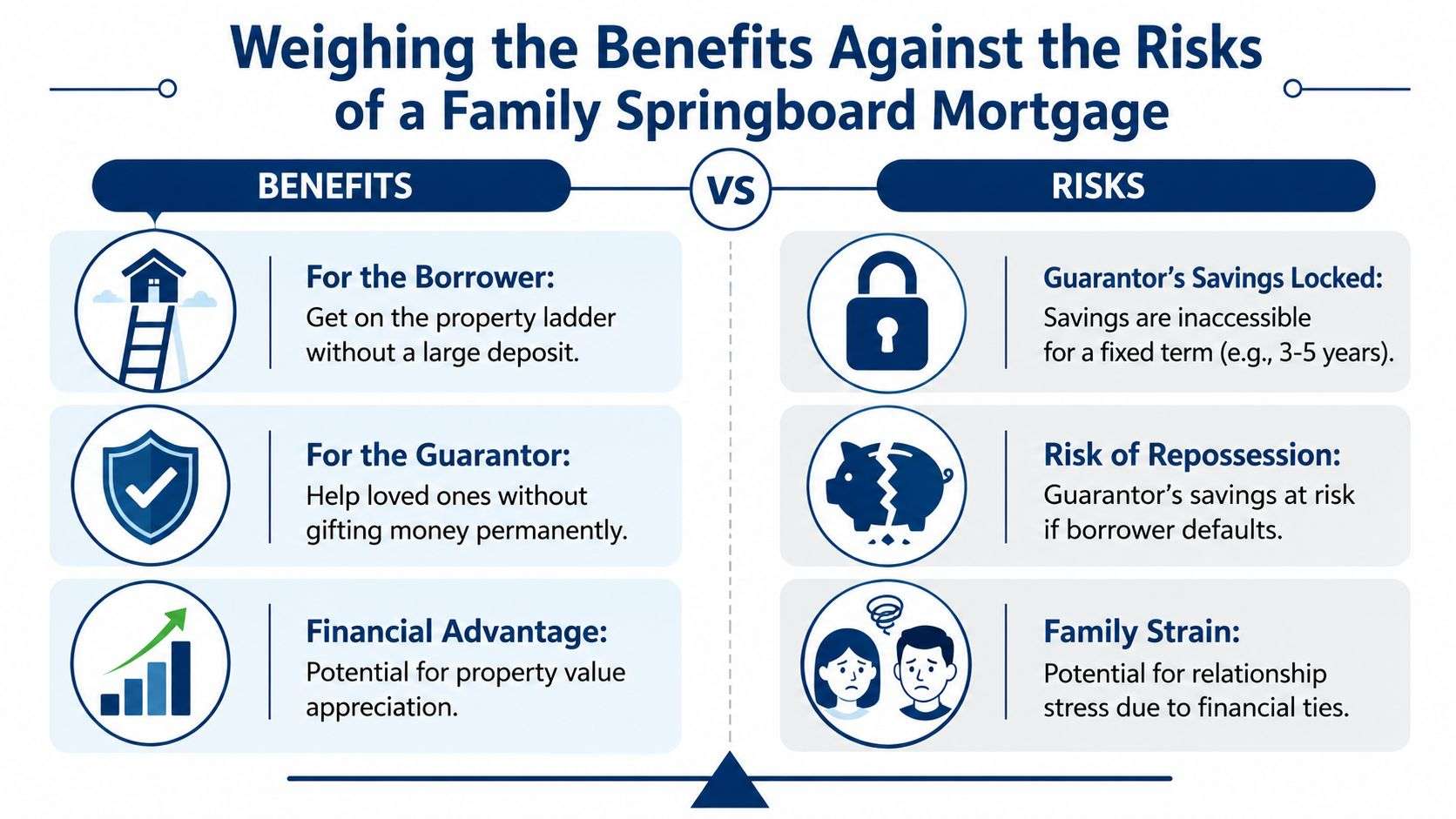
A springboard mortgage can solve a very real problem for Essex families. The buyer is ready for home ownership in every practical sense, but the deposit gap is holding them back. Used in the right case, family support can bring that purchase forward by years.
The part families need to respect is the shared commitment. The buyer gets into the property sooner, but the helper accepts that their savings are tied up for a set period and may not be available if plans change.
What works well
At its best, this type of mortgage gives a first-time buyer a controlled way to buy earlier without asking parents to hand over a deposit outright. That can suit families in Essex who want to help, but are not comfortable making a permanent gift.
It can also keep ownership clean. The buyer owns the property, the helper supports the deal through savings, and that separation can avoid some of the complications that come with adding a parent to the title.
I have seen it work well where the buyer is sensible with money, secure in their job, and likely to earn more over time. In those cases, the support is often temporary in practice, even if the lender sets a fixed savings period.
Where problems start
The biggest risk for the helper is not usually the headline risk people mention first. It is access to their own money.
That sounds manageable at the start. Then life happens. A parent wants to help another child, replace a car, cover a period off work, or deal with a change in health. If the funds are locked away, the springboard arrangement can start to feel far less comfortable than it did on day one.
The buyer has pressure too. If mortgage payments become a stretch, the emotional strain at home can build quickly. Parents may say they are happy to help, but missed payments or a forced sale can test even close families.
There is also property risk. If values fall or the buyer needs to sell earlier than planned, the exit may not be as tidy as everyone expected. That is one reason I tell families to treat this as a risk-sharing arrangement, not just a shortcut for deposits.
A practical balance sheet
| Benefit | Why it helps | Risk | Why it matters |
|---|---|---|---|
| Earlier purchase | Buyer does not need to wait years to build a full deposit | The helper’s savings are tied up | Cash may be unavailable when family circumstances change |
| Cleaner ownership structure | Parents can help without automatically owning part of the home | Family expectations can drift | One person may see it as temporary support, while another may see it as a sacrifice that should be repaid. |
| Formal lender arrangement | Clearer than informal family lending | A sale or remortgage may be harder than expected | Problems often appear when the buyer wants to exit before the support period ends. |
| A route for buyers with good income but limited savings | Useful for buyers who can manage payments but have not built a deposit yet | Stress if affordability tightens | A change in rates, income, or outgoings can affect the whole family relationship. |
“Typically, any cash gift is not repayable in the future, and would be documented within the estate of the donor to show how much, and what date the gift was provided, for inheritance tax purposes.”
That quote is important because families often blur three different ideas together. A gift, a loan, and springboard security are not the same. If the family has not agreed on which one they are using, confusion tends to surface later, usually when someone wants their money back or the buyer wants to remortgage. If you want to compare that option properly, it helps to understand how a gifted deposit mortgage works.
Before applying, ask one awkward question and answer it honestly. If the buyer lost their job, split up with a partner, or needed to sell sooner than planned, would the helper still feel comfortable with the arrangement?
Exploring Alternatives to a Springboard Mortgage
A family springboard mortgage isn’t the only route when parents or relatives want to help. Sometimes it is the neatest option. Sometimes it isn’t.
The better choice depends on one central question. Is the family trying to solve a deposit problem, an affordability problem, or both? Once that’s clear, the alternatives become easier to sort through.
The main alternatives
Some families prefer a gifted deposit because it is simpler. The money is given to the buyer, the lender checks the source and confirms it is not repayable, and the purchase moves forward without the helper’s savings being tied into a linked security account. If you want the basics of that route, this guide to a gifted deposit mortgage is a useful reference.
Others may look at a guarantor mortgage or a joint borrower, sole proprietor arrangement where family income supports the application. Those routes can help where affordability is the bigger issue.
There are also cases where a family may use property equity rather than cash savings, depending on lender criteria and the specific structure available at the time. That can help buyers who have no deposit funds at all, but it changes the helper’s risk profile and requires careful review.
Family Support Mortgage Options Compared
| Option | Helper’s Financial Risk | Ownership & Tax | Deposit Requirement | Best For |
|---|---|---|---|---|
| Family springboard mortgage | Savings or security tied up with a lender for a fixed period | The buyer usually owns the property outright | Often low or none from the buyer, depending on the product | Buyers with income but limited savings |
| Gifted deposit | Helper parts with money permanently | Buyer owns the property; the gift should be documented properly | The buyer uses a family gift as a deposit | Families are comfortable making an outright gift |
| Guarantor mortgage | The helper supports the debt position rather than placing cash in a linked savings model. | Ownership depends on structure, and needs careful advice | Varies by lender and case | Buyers are short on affordability rather than just the deposit |
| Joint borrower, sole proprietor | Supporting family income may strengthen borrowing power | Not all borrowers necessarily appear on title in the same way | Varies by lender and product | Cases where affordability needs a boost |
| Family offset style support | Family savings can help reducthe e interest impact or support the case | Ownership stays with the buyer under the lender’s structure | Deposit needs vary | Families with savings who want a different support model |
When Springboard is the wrong choice
The helper may need the money soon: A fixed lock-in can create stress.
The buyer’s affordability is weak: Deposit support alone won’t fix the case.
The property is outside the product criteria: some homes will not meet the lender’s rules.
The family wants flexibility: A gifted deposit can sometimes be cleaner if everyone is comfortable with that decision.
Your Step-by-Step Application Checklist
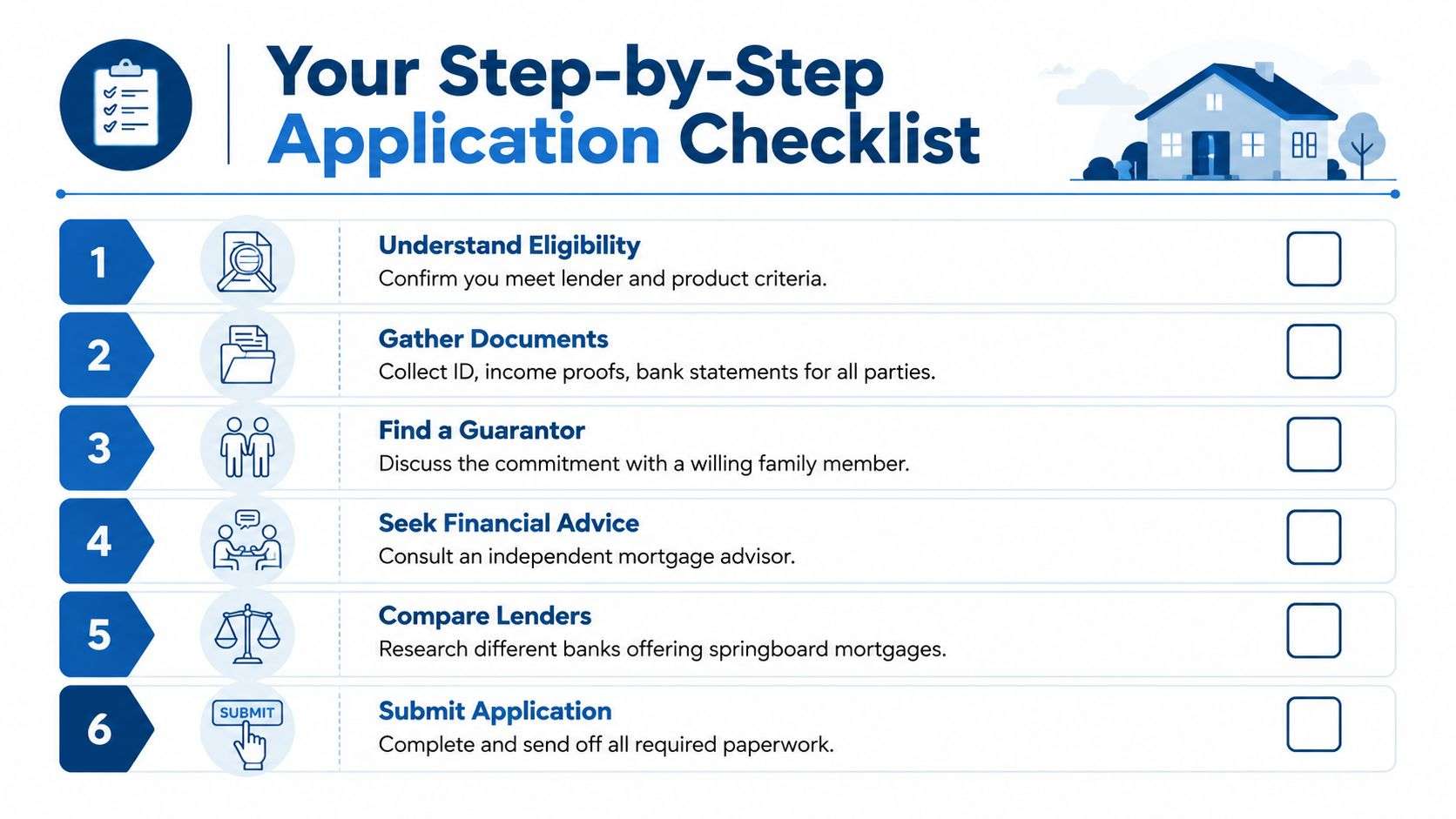
The smoothest applications usually start with a frank family conversation, not a lender decision in principle. When everyone is honest about money, timescales and risk tolerance, the mortgage process becomes much easier.
The checklist
Agree on the family plan.
Decide who is helping, what form the support will take, and how long everyone is comfortable being tied in.Check the buyer’s affordability.
Review income, outgoings, credit profile and likely lender appetite before looking at properties too seriously.Review the helper’s position.
Make sure the helper can afford to set aside the funds or security without creating future pressure.Gather documents early.
ID, proof of income, bank statements, and supporting paperwork for all parties should be organised before submission.Check product fit against the property.
The mortgage and the property need to match. That matters with flats, unusual homes and new-build restrictions.Read the paperwork carefully.
Buyers should understand the mortgage terms, and helpers should understand the security commitment in full. It also helps to understand key lender paperwork, such as a mortgage illustration.
Buyers in Chelmsford, Colchester and across Essex usually get the best outcome when they choose the mortgage route after reviewing the family’s full picture, not before.
A family springboard mortgage can be an excellent solution, but only when the structure matches the people involved. The right case feels sustainable, transparent and realistic from day one.
If you’re weighing up a family springboard mortgage and want specific guidance from EHF Mortgages, the next step is a proper conversation about your income, the helper’s position, and which lenders are a fit for your circumstances. If you’re ready to move forward, use the button below to get in touch.





