
💡 Top Tip: The older your credit issues are, the more options you’ll have with an adverse credit mortgage lender. We’ll explain exactly why that is later in this guide.
Having a bumpy credit history can feel like a solid brick wall when you’re trying to get a mortgage, especially in areas like Chelmsford or Colchester. It’s a common story: you approach a high-street lender, their computer system flags a past issue, and the application is instantly rejected. But that is absolutely not the end of the story.
Table of Contents
The Advantage of a Specialist Adverse Credit Mortgage Lender
From High Rates to Home Improvements: An Essex Success Story
Your Fresh Start to a Mortgage with Adverse Credit for 2026
This is where an adverse credit mortgage lender comes in. These are specialist lenders that do not rely solely on automated credit scores. Instead of seeing a “problem,” they look for a person and their story, focusing on your current financial stability.
Understanding the Specialist Approach
Past financial hiccups do not have to derail your property ambitions for good. A specialist adverse credit lender works differently from the big banks, and it is all about putting your current situation in the spotlight.
They Look at the Whole Picture: A specialist lender wants to understand your entire financial profile, your income, your outgoings, and the real story behind any credit blips.
A Human Reviews Your Case: Forget the “computer says no” response. Your application is reviewed by a person, a real underwriter who can apply common sense and see the context behind the numbers.
They Focus on Now, Not Just Then: The goal is to see if you can comfortably afford the mortgage today and moving forward. They are not there to penalise you for old problems that you have since put right.
This visual shows how these key elements come together to create a path to homeownership.
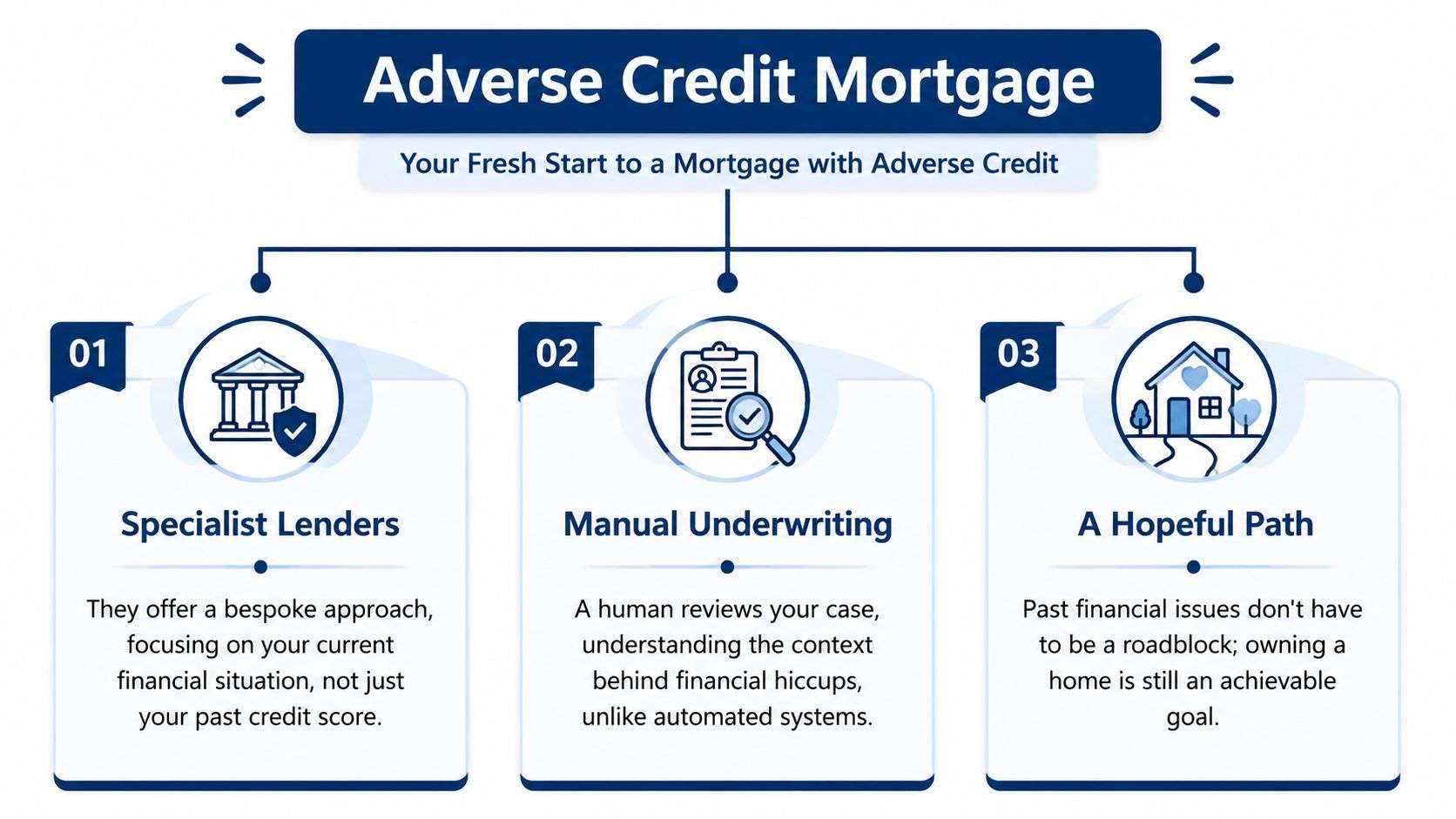
It really comes down to this: specialist lenders use manual underwriting to focus on your current stability. This creates a realistic route to getting a mortgage, even if your credit file is not perfect.
What This Means for You
This tailored approach can open doors that you might have thought were firmly closed. Whether you are looking to buy in Braintree or anywhere else in Essex, getting the right mortgage is entirely possible with the right advice.
A specialist lender wants to see that you have turned a corner and are now a reliable borrower. They get that life happens, redundancy, illness, or divorce can throw anyone’s finances off track temporarily.
By working with an expert broker who has strong relationships with these lenders, you get to present your case properly. This dramatically improves your chances of hearing “yes.”

How Lenders Assess Different Types of Adverse Credit
When it comes to getting a mortgage with a history of credit problems, it is crucial to understand that not all issues are created equal. An adverse credit mortgage lender does not just see a “bad” credit file; they look at the specifics. They operate on what you might call a ‘severity scale’, where the type of issue and, most importantly, its age, play a massive role.
Think of it this way: a single missed phone bill from three years ago is a world away from a recent bankruptcy. Lenders are trying to build a picture of your reliability, and an old, resolved issue often just looks like a temporary blip that’s firmly in the past. A more recent or severe event, however, might raise more questions about your current financial stability.
The Importance of Time
If you have adverse credit, time is your greatest ally. As financial hiccups fade into the past, their impact on a mortgage application shrinks significantly. Lenders are far more interested in your recent financial behaviour than in something that happened five or six years ago.
For specialist lenders, minor issues like a few missed payments on a mobile phone or utility bill are often overlooked. Even more serious events, like defaults and County Court Judgements (CCJs), become much less of a hurdle once they are at least 12 months old. The fundamental rule is this: the older the problem, the more willing a lender will be to help.

A Lender’s View on Different Credit Events
To give you a clearer picture, it helps to see how specialist lenders typically view different credit issues and the timeframes they work with. Here is a general guide to how these events are often perceived.
How Lenders View Different Adverse Credit Events
| Adverse Credit Event | Typical Lender View | Minimum Time Since Event (Guideline) | Potential Impact on Application |
|---|---|---|---|
| Missed Payments | A minor issue, often overlooked if few in number and historic. | 6+ months | Minimal to low |
| Default | Depends on the value and date. Older, settled defaults are seen more favourably. | 12+ months | Moderate |
| CCJ (County Court Judgement) | A settled CCJ is much better than an outstanding one. Its age is crucial. | 12-24+ months | Moderate to high |
| IVA (Individual Voluntary Arrangement) | Must be successfully completed. Some lenders consider applications during an IVA. | 12+ months post-completion | High |
| Bankruptcy / Sequestration | Considered the most severe type of adverse credit. Must be discharged. | 3-6 years post-discharge | Very High |
It is really important to remember that this table is just a guideline. Every single lender has its own unique criteria, which is precisely why getting expert advice is so valuable.
A great first step is understanding your own credit report, and you can learn more by checking out our guide on the minimum credit score needed for a mortgage in the UK. From there, an experienced broker can match your specific circumstances to the right lender, giving you the best chance of success.
The Advantage of a Specialist Adverse Credit Mortgage Lender
When your high street bank uses automated software that flags your application for instant rejection, it is easy to feel like the door has slammed shut. But this is exactly where a specialist adverse credit mortgage lender can completely change the picture. They operate on a different set of principles from the big banks.
Their biggest advantage is a process called manual underwriting. Instead of your details being fed into a rigid computer algorithm, a real person, a human underwriter, will sit down and review your entire application. Their job is not just to look at a credit score; it is to understand your individual story.
This human-led approach allows for a much more rounded and fair assessment of your affordability. The underwriter looks at the context behind any credit issues, what caused them, and the steps you have taken since to get your finances back on solid ground.
The Power of a Human Review
The difference between a computer saying ‘no’ and a person taking the time to understand your circumstances is huge. It is the single biggest benefit you get when working with a specialist lender.
Context is Everything: They can see that a past redundancy or a period of illness does not define your current ability to manage mortgage payments.
A Holistic View: They consider your current income, stability, and overall financial health today, rather than fixating on a single past blip.
A Bespoke Assessment: Every case is judged on its own merits. It is a world away from the one-size-fits-all model used by automated systems.
“Instead of a computer saying ‘no’, a human underwriter reviews your entire application, including the story and context behind your credit issues.”
Managing Timescales and Expectations
Because a person is manually reviewing every detail of your file, the process naturally takes a little more time than an automated decision from a high street bank. It is common for it to take an extra week or two, but this is nothing to be scared of. This slightly longer wait is a small price to pay for a successful application. It is the time needed for a proper, thoughtful review.
As brokers, we have built strong relationships with these niche lenders. We understand what they are looking for and know how to present your application in the best possible light, which significantly boosts your chances of getting that all-important ‘yes’. You can learn more about how we work with a specialist mortgage lender to get the right deal for you.
Building a Stronger Mortgage Application
When you are applying for an adverse credit mortgage, preparation is everything. Presenting a well-organised and honest application does not just help your case; it can dramatically increase your chances of getting approved. Think of this section as your pre-application checklist, designed to give you the confidence to put your best foot forward.
The first step on this journey is getting to grips with your credit report. You will want to get the full picture by requesting your report from all three main UK credit reference agencies: Experian, Equifax, and TransUnion. Each one might contain slightly different information, and you need to see exactly what a lender sees.

Explaining Your Financial Story
Once you have your reports, comb through them for any mistakes. If you spot something that is not right, dispute it immediately with the agency. Correcting errors is one of the fastest ways to give your credit profile a boost.
More importantly, these reports help you build an honest story. Do not try to hide past financial blips; explain them. A well-presented case with a clear explanation of what the historic problems were, what has been done to rectify them, and evidence to back it up will always help to obtain a better deal.
Getting Your Paperwork in Order
Your story needs to be backed up by clear evidence. A tidy, well-presented application will always make a better impression and could even help you secure a better rate. Start gathering all the paperwork you will need, which typically includes:
Proof of Income: Recent payslips, P60s, or a few years of accounts if you are self-employed.
Bank Statements: Usually the last 3 to 6 months for all your current accounts.
Proof of Deposit: A clear paper trail showing where your deposit funds originated.
Identification: A valid passport or driving licence.
Having all this ready to go shows lenders you are organised and serious about your application. It also allows a broker to present your case to a specialist lender in the strongest possible light. You can find out more about the process in our article on getting a mortgage with bad credit.
By taking these proactive steps, you are no longer just an applicant; you are an active partner in securing your new home.
From High Rates to Home Improvements: An Essex Success Story
It is one thing to talk about the theory of adverse credit mortgages, but seeing how a specialist broker makes a real-world difference truly shows what is possible. This recent success story is not just about securing a mortgage; it is about turning a stressful financial burden into a life-changing opportunity.
We recently worked with a client in Essex who felt trapped. They were stuck on a legacy mortgage from the old Northern Rock, paying a painful interest rate of over 8%. To complicate things further, their credit file showed an old County Court Judgement (CCJ) and a few missed payments from the past. At first glance, it looked like a challenging situation.
A Specialist Solution in Practice – Example
But a tricky history does not mean you are out of options. We worked with a specialist lender, Loughborough Building Society, which is known for its common-sense, personal approach to underwriting. Instead of letting a computer say no, we presented a complete picture of our client’s circumstances, demonstrating that the credit issues were firmly in the past and their financial footing was now solid.
The result was a huge success. We secured them a new mortgage with a rate almost 3% cheaper than their old one.
This massive rate reduction allowed us to achieve several key goals all at once:
Borrow More: We unlocked the extra funds they needed for essential home improvements.
Shorten the Term: The new, lower rate allowed them to pay off their mortgage much faster.
Keep Payments Steady: Best of all, we managed this while keeping their monthly payments exactly the same.

This powerful example from right here in the Canvey Island area proves that with the right advice and the right lender, a challenging credit history need not be a barrier. A much better financial future is often entirely possible.
Your Next Steps to Securing a Mortgage
Getting your head around adverse credit mortgages can feel overwhelming, but hopefully, this guide has shown you that it is not a closed door to your homeownership plans. The path might be a little different from the high street, but it is one that many people successfully walk.
If there is one thing to take away from all this, it is that adverse credit is not a life sentence for your property ambitions. A whole corner of the mortgage market exists just for this. Specialist lenders look beyond the raw data, using manual underwriting to understand the story behind your credit file.
How EHF Mortgages Can Help
Preparation is everything. When you gather your credit reports, get your documents in order, and understand your financial history, you are taking control. This proactive approach, combined with expert advice, is what turns a difficult situation into a successful mortgage application.
For those of us in Braintree, Colchester, and across Essex, having a local partner who gets both the property market and the specialist lending landscape is a huge advantage. We know the area and the lenders who work here.
The journey forward always starts with a simple conversation. At EHF Mortgages, our job is to give you clear, honest advice. We will take your prepared application and present your case to the right adverse-credit mortgage lender, ensuring they see the full picture and get you a great result.
Frequently Asked Questions About Adverse Credit Mortgages
When you are dealing with credit issues, the world of mortgages can feel full of questions and uncertainty. Here are some straightforward answers to the questions we hear most often from our clients in Chelmsford, Braintree, and across Essex.
How Much Deposit Will I Need?
It is a common myth that you will need a huge deposit. While high street banks might ask for one, specialist lenders are often far more flexible. The exact amount will depend on how recent and severe your credit problems are, but it is not unusual to secure a mortgage with a deposit as low as 15% (an 85% Loan-to-Value, or LTV).
That said, a larger deposit always strengthens your application. It shows the lender you are a lower risk and usually opens the door to more competitive interest rates.
Will an Adverse Credit Mortgage Affect My Future Borrowing?
Quite the opposite, actually. Getting an adverse credit mortgage and managing it well is one of the best ways to rebuild your credit score. It is your chance to prove you can handle financial commitments responsibly.
After a few years of consistent, on-time payments, usually two to three years, you will be in a great position to remortgage. This often means moving to a mainstream lender with a much better rate, leaving the ‘adverse credit’ label firmly in the past.
Can I Get an Adverse Credit Mortgage If I Am Self-employed?
Yes, absolutely. Specialist lenders are used to working with self-employed people and other complex income structures. Their process is not run by automated computer systems, which often reject anything outside a standard payslip.
Instead, they use manual underwriting, which means a real person will review your finances holistically. They will look at your company accounts, SA302s, and bank statements to get a true picture of what you can afford, rather than just ticking boxes.
Specialist lenders are a vital part of the UK mortgage market. With around 15% of mortgage applications being rejected due to credit history, these lenders provide a crucial lifeline. Some even offer up to 85% LTV for those with recent defaults. You can explore more about the wider mortgage market trends.
If you are ready to get clear answers tailored to your unique situation, EHF Mortgages can help. Our team provides expert advice to help you find the right lender for an adverse credit mortgage.





