
💡 Top Tip: Porting your mortgage could save you thousands in early repayment charges if you find yourself moving house during a fixed-rate period. We’ll explain exactly how this works later in the article.
Found a great mortgage deal, but now you’re thinking of moving house? You might not have to leave it behind. Porting a mortgage is a powerful but often misunderstood option for UK homeowners that lets you take your current mortgage product with you to a new property.
Table of Contents
Think of it like changing your mobile phone but keeping your existing number and contract. When you port your mortgage, you transfer the same interest rate, terms, and remaining balance from your old home to your new one. It’s become a popular strategy for movers, especially when interest rates are rising.
This guide breaks down everything you need to know about porting a mortgage. We’ll cover how the process works, the pros and cons, and the potential pitfalls to help you make a well-informed decision.
“Porting preserves favourable rates and provides stability. With UK Finance data showing home movers making up a significant market share, the ability to port a deal provides financial resilience.”
Before diving into the specifics of porting, it helps to understand how it fits into the bigger picture of buying and selling. For a complete overview of that journey, this comprehensive Ultimate Moving House Guide UK is a great place to start.
It’s crucial to realise that porting isn’t an automatic right. You’ll need to submit a new mortgage application to your existing lender, who will reassess your situation against their current lending criteria. This means they will conduct:
A full affordability check: Reviewing your latest income and outgoings.
Credit checks: Re-evaluating your credit history to ensure you still meet their standards.
Property valuation: The lender must be happy with the new property you intend to buy.
How Does Porting a Mortgage Actually Work?
So, you’ve got a great mortgage rate, and you don’t want to let it go just because you’re moving house. That’s where porting comes in. But what does the process actually look like on the ground?
It’s easy to think of porting as simply picking up your mortgage and dropping it onto a new property. In reality, it’s a bit more involved. The best way to think about it is applying for a brand-new mortgage with your current lender, but with the huge advantage of keeping your existing interest rate.
Your first port of call is to check your mortgage is actually portable. Dig out your original mortgage offer document and look for a specific clause on portability. If you can’t spot it, don’t worry – a quick call to your lender or mortgage broker will give you a definite answer.
The Application and Assessment Stage
Once you’ve confirmed you can port, the real work begins. This isn’t just a case of updating your address on a form. Your lender will treat this as a completely fresh application, and they’ll need to be happy with your financial situation and the new property you want to buy.
This means you’ll go through a full reassessment, which includes:
Affordability Checks: Your lender will take a fine-toothed comb to your latest income and outgoings. It’s a strict regulatory requirement, so they have to make sure you can comfortably afford the repayments today, not just when you first took out the loan.
Credit Score Review: They will run a new credit check to ensure your credit history meets their standards.
Property Valuation: The new house, whether it’s in Chelmsford or Colchester, will need a valuation to confirm it’s suitable security for the loan they’re providing.
The diagram below gives you a simple visual of how your existing deal essentially moves with you from one home to the next.
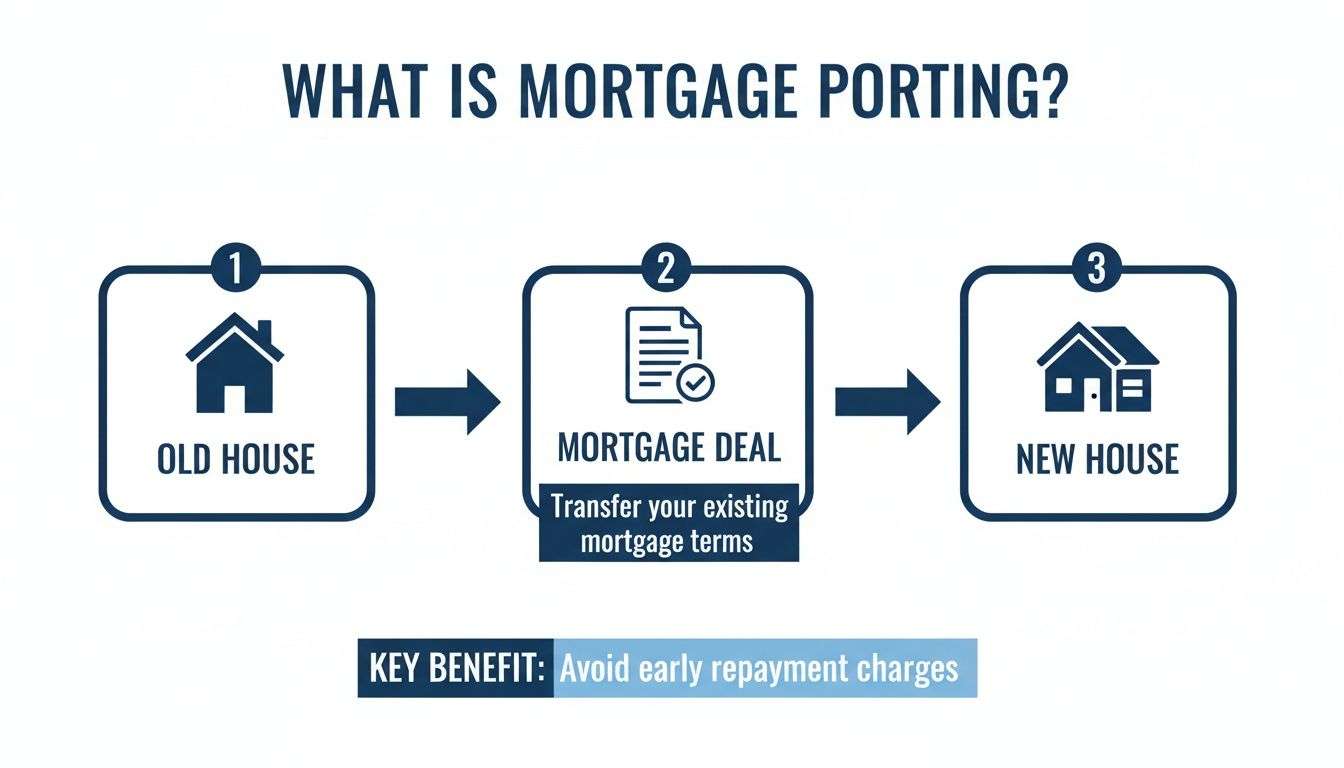
It’s a helpful way to see that the core mortgage product is the one that gets transferred. But remember, the process itself is a full re-application built around holding onto that deal.
Handling Changes in Loan Size
It’s rare for your new home to cost the same as your old one. If you’re upsizing and need to borrow more, you’ll typically apply for a ‘top-up’ loan in addition to the ported amount. Be aware that this extra borrowing will almost certainly be on a different interest rate from your main mortgage.
On the other hand, if you’re downsizing and need a smaller loan, your lender will handle that, but you may have to pay an Early Repayment Charge on the portion of the mortgage you’re paying off.
The legal side of things also needs to sync up perfectly, with the sale and purchase happening simultaneously. It can be a delicate balancing act. To get a better sense of the timelines involved, you might find our guide on how long conveyancing takes in the UK useful.
With interest rates fluctuating, porting has become a go-to strategy for home movers. Projections suggest we could see around 717,588 mortgage completions in 2026, a significant figure that shows just how active the market is and why porting is such a valuable option. For our clients across Essex, this kind of flexibility is often key to maintaining financial stability during a house move.
The Pros and Cons of Porting Your Mortgage
So, is porting your mortgage always the best move? While it can be a fantastic way to keep a great deal, it’s not a one-size-fits-all solution. Before you commit, it’s crucial to weigh up the advantages against the potential drawbacks.
The biggest win for most people is avoiding Early Repayment Charges (ERCs). These penalties, often a percentage of your outstanding loan, can run into thousands of pounds if you leave a fixed-rate deal early. By porting, you neatly sidestep this hefty cost, which is a major financial relief for many movers.
Porting also lets you hang onto a great interest rate. If you locked in a low rate a few years ago and the market has since seen rates climb, keeping your deal could save you a small fortune over the term. This is especially true in a rising-rate environment, giving you the payment stability and peace of mind you need.
The Drawbacks to Consider
However, porting a mortgage isn’t always a smooth ride. One of the main limitations is that you’re tied to your current lender. If you need to borrow more for your new home, they might not offer the most competitive rates for that ‘top-up’ loan. You could end up with a blended mortgage that isn’t as good as a new deal you could get on the open market.
It’s also vital to remember that porting is not guaranteed. You’ll have to go through a full mortgage application again, which means passing your lender’s current affordability and credit checks. If your financial situation has changed – maybe a new job, a drop in income, or new dependents – you might find you no longer qualify to take your deal with you.
“Understanding whether to port or remortgage requires a careful calculation. It involves comparing the ERC you’d pay to leave against the potential savings from a better interest rate on the open market.”
Think about it this way: a homeowner in Colchester with a stable income, moving to a similarly priced house in Braintree, will probably find porting straightforward. But if they need to borrow a lot more, a completely new deal from another lender might offer better value overall, even after paying an ERC. This is where getting a clear picture of how much remortgaging costs becomes so important.
Porting a Mortgage Pros vs Cons
To help you see the full picture, here’s a simple breakdown of the main points to consider when deciding if porting your mortgage is right for your move.
| Feature | Advantages of Porting | Disadvantages of Porting |
|---|---|---|
| Costs | Avoid hefty Early Repayment Charges (ERCs). | Additional borrowing may come with uncompetitive rates. |
| Rates | Keep your existing competitive interest rate. | You could miss out on better deals from other lenders. |
| Flexibility | Provides continuity with a familiar lender and product. | You are locked in with your current lender’s products. |
| Application | The process is familiar as you are staying with your lender. | Requires a full re-application and passing new affordability checks. |
Ultimately, whether to port or not comes down to your personal finances, the specifics of your current mortgage, and what’s happening in the wider market.
Porting vs A New Mortgage : Which Is Right for You?

When you move home, you’ll find yourself at a crossroads with your mortgage. Do you take your existing deal with you when you port, or do you start fresh with a new lender when you need a new mortgage? There’s no single right answer – it all comes down to your personal finances and, crucially, the numbers.
At its core, the difference is straightforward. Porting means staying with your current lender and moving your mortgage product to your new home. A new Mortgage means switching to a completely new lender. This choice will have a major impact on your costs, the interest rate you pay, and your long-term flexibility.
The Core Financial Calculation
Making the call between porting and a new mortgage really boils down to one key bit of maths: will the savings from a better interest rate elsewhere outweigh the cost of your Early Repayment Charge (ERC)? If you have a hefty ERC but the rates on the open market aren’t much better than your current one, porting is almost certainly your best bet.
On the other hand, if your ERC is small (or you’re no longer in a fixed-rate period), the freedom to shop around could save you a significant amount of money. A new lender might be offering a much lower rate, and those long-term savings could easily dwarf the cost of the ERC and any new arrangement fees.
“The decision to port or take a brand new mortgage deal isn’t just about avoiding a penalty. It’s a strategic move that requires a full market comparison to ensure your mortgage continues to serve your financial goals.”
Questions to Ask Yourself
To figure out the best path forward, you need to step back and look at the bigger picture. Whether you’re a first-time mover in Braintree or a seasoned property owner in Colchester, ask yourself these questions:
How much is my Early Repayment Charge?
What interest rates could I get from a new lender right now?
Do I need to borrow more money, and what rates are available for that top-up?
Have my financial or personal circumstances changed since I first took out my mortgage?
The answers will start to point you in the right direction. This is where working with a mortgage broker becomes invaluable. A good broker can run these calculations for you, compare products from the entire market, and give you a clear, unbiased view of which option genuinely makes the most financial sense for your move.
Navigating Complex Porting Scenarios
Life rarely moves in a straight line, and neither do property sales. Mortgage porting is often straightforward, but what happens when things get complicated? From gaps between moves to unusual income, lenders can be more flexible than you might think, as long as you know how to present your case.
A common worry is having a gap between selling your old home and buying the new one. Most lenders prefer you to complete both transactions on the same day, but this isn’t always practical. Some will offer a ‘porting window‘ of 30, 60, or even 90 days, giving you some much-needed breathing room. It’s vital to check your lender’s specific policy on this before you exchange contracts.
Porting with Unique Circumstances
What if your personal situation isn’t standard? Many people assume that being self-employed, having a minor blip on their credit file, or buying a non-standard property will immediately rule out porting. That’s not always true.
You will still need to pass the lender’s affordability checks, which can be tougher now than when you first took out your mortgage. This is where a whole-of-market broker proves invaluable. They can package your application to highlight its strengths, whether that’s properly evidencing fluctuating income for a self-employed contractor in Braintree or finding a niche lender happy with an unconventional build in the Essex countryside.
Porting for Investors and Later Life Borrowers
Complex porting isn’t just about tricky property chains. It’s also a key strategy for different types of borrowers. Buy-to-let landlords, for example, can port existing mortgage deals to new rental properties when reconfiguring their portfolios. This allows them to sidestep hefty Early Repayment Charges and keep hold of great rates.
It’s also a useful tool for homeowners over 55 who are looking to downsize. Porting an existing mortgage can work alongside other later-life products, like a Retirement Interest-Only (RIO) mortgage, to help fund the next chapter.
The key is always expert advice. With home movers expected to account for 34.9% of mortgage advances for house purchases in Q1 2026, porting is a critical option. According to the Bank of England’s mortgage lending trends, navigating the market is more important than ever, especially for those with unique needs.
“In complex cases, porting is less about a simple transfer and more about a strategic negotiation. A broker’s expertise is what turns a potential ‘no’ from a lender into a successful ‘yes’.”
Successfully handling these challenges comes down to a deep understanding of lender criteria and the wider market. With the right guidance, even the most unconventional application can result in a successful mortgage port.
Common Pitfalls and How to Avoid Them
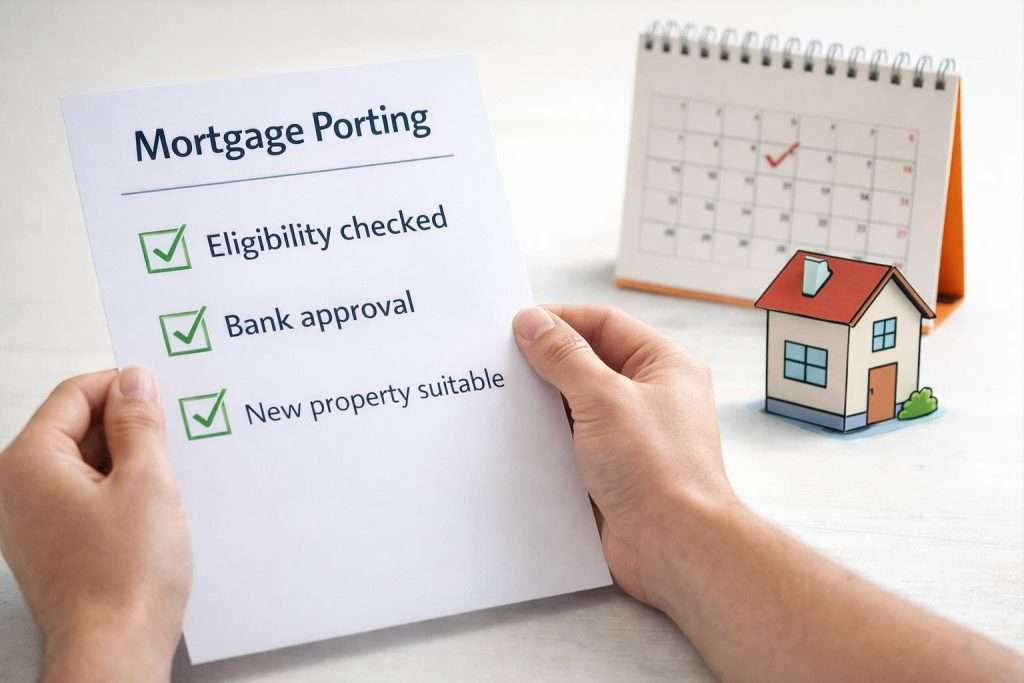
Porting your mortgage can feel like a smart shortcut, but it’s a path with a few potential tripwires. Understanding where things can go wrong is the best way to keep your house move on track and avoid unnecessary stress. A handful of common oversights can quickly derail an application, turning a great idea into a real headache.
The first hurdle often comes as a surprise: assuming your mortgage is portable without actually checking. It’s easy to assume you can take your deal with you, but you absolutely have to check the small print first. Dig out your original mortgage offer and look for that specific clause – if it’s not there, porting isn’t an option.
Another big one that catches people out is the full new affordability assessment. This is non-negotiable. Your lender will put your current finances under the microscope using today’s lending criteria, which are often much stricter than when you first applied. Any change in your circumstances – like becoming self-employed or having a new baby – could mean you no longer qualify to borrow the same amount.
Property and Timing Issues
The new property you’re hoping to buy can also throw a spanner in the works. Your lender will want to value your potential new home in Chelmsford, and if their valuation comes in below the agreed purchase price, it will affect your loan-to-value (LTV) ratio. This can sometimes put the whole deal at risk or leave you scrambling to find a bigger deposit.
“Underestimating the timeline is a classic mistake. Porting isn’t instant; it requires the same care and coordination as a new mortgage application.”
Finally, it’s crucial not to underestimate how long it all takes. The process can last several weeks, and you have the added pressure of perfectly synchronising the sale of your old home with the purchase of your new one. Any delay can have a serious knock-on effect.
To sidestep these issues, here’s what we recommend:
Get organised early: Before you do anything else, pull together all your financial documents. This means recent payslips, bank statements, and proof of your deposit.
Check your contract: Confirm your mortgage is portable with your lender right at the very beginning.
Speak to a broker: An experienced broker can provide a proper assessment of your situation from the start, manage your application, and spot potential red flags before they become major problems.
A little bit of preparation and forward planning is what makes the difference between a smooth porting process and a stressful one.
Frequently Asked Questions About Porting a Mortgage
Porting a mortgage can feel like a bit of a minefield, and we get plenty of questions about the finer details. To give you the clarity you need, we’ve put together answers to the most common queries we hear from homeowners across Essex.
Can I Port My Mortgage If I Am Borrowing Less Money?
Yes, absolutely. This is a very common scenario, especially for people downsizing to a smaller property in areas like Colchester or Braintree. Your lender will adjust your mortgage to the new, lower amount.
It’s worth noting, however, that some lenders may apply a partial Early Repayment Charge (ERC). This charge is calculated on the amount of the loan you’re paying back early, so it’s vital to dig out your original mortgage offer and check the small print.
How Long Does the Mortgage Porting Process Take?
On average, you can expect the porting process to take anywhere from 8 to 12 weeks. This timeline is very similar to a standard new mortgage application, and for good reason – it involves many of the same steps. Your lender will need to run a full affordability and credit check, plus arrange a valuation on the new property.
Because it isn’t an instant switch, it’s a good idea to start the conversation with your lender or a mortgage broker as soon as you decide to move. This gives everyone plenty of breathing room to get the paperwork sorted and keep your house move on track.
“While not mandatory, using a broker is highly recommended. A broker confirms if porting is your best financial option by comparing it to new deals on the market, managing the application and navigating complexities on your behalf.”
Do I Need a Mortgage Broker to Port My Mortgage?
You can always go directly to your lender, but we strongly recommend working with a whole-of-market mortgage broker. A broker’s job is to work for you, not the lender. Their first step is to assess whether sticking with your current deal is genuinely the best financial move.
They’ll weigh up the cost of porting against paying an ERC and taking out a brand-new mortgage with a different provider. A good broker handles all the paperwork, chases the lender for you, and can be a lifesaver when it comes to navigating any tricky parts of your application, saving you a huge amount of time and stress.
Deciding whether to port your mortgage can be complex, but you don’t have to figure it out alone. The expert team at EHF Mortgages has years of experience helping homeowners across Chelmsford, Essex, and beyond make the right financial decision for their move.
For clear, no-obligation advice on your specific situation, get in touch with us today.





