
💡 Top Tip: A specialist mortgage broker can often use your company’s retained profits to increase your borrowing power, a powerful tool we will unpack fully later in this guide.
The journey to buying a home often feels like it is on a completely different track when you are self-employed. You have built a thriving business from the ground up, yet when you approach mainstream lenders, they often struggle to understand your income – a mortgage broker for self-employed applicants bridges that gap. Think of us as a translator, turning your hard-earned business success into a language that lenders can finally understand.
In This Guide You Will Learn
- Why Getting a Mortgage Is Harder When You Are Self- Employed
- Proving Your Income: The Essential Paperwork
- How a Specialist Mortgage Broker Makes the Difference
- Actionable Steps to Strengthen Your Mortgage Application
- Begin Your Mortgage Journey with Our Expert Team
- Frequently Asked Questions
Why Getting a Mortgage Is Harder When You Are Self-Employed

This guide is for every entrepreneur who has felt that frustration. We are here to provide a clear path forward. Together, we will break down why the standard mortgage process so often falls short for business owners and show you how a specialist approach, one we have refined over 35 years of helping clients in Chelmsford and across Essex, can completely transform your chances of success.
For anyone on a standard PAYE salary, proving your income is as simple as handing over a few recent payslips and your P60. Job done. But for entrepreneurs, freelancers, and business owners, it’s a different story entirely.
The problem is not that your income is lower; it is that it is variable. And to a high street lender, variability can look a lot like risk.
At the end of the day, a lender’s main concern is affordability and consistency. They need to be certain you can meet your mortgage repayments every single month, year after year. A steady salary slip provides that comfort blanket, whereas the natural ups and downs of running a business can make their underwriters a bit nervous.
This is why showing them a healthy profit and loss statement is often not enough. Lenders are trained to look for a sustained, reliable income history, usually digging back at least two or three years. They are trying to build a picture of your financial stability, and your success as a business owner needs to be translated into a language their risk models can understand.
The Lender’s View on Different Business Structures
Lenders view income very differently depending on how your business is structured. This can lead to some frustratingly inconsistent answers if you approach them directly, and it’s where knowing the nuances really pays off.
- Sole Traders: Most lenders will want to see your SA302 tax calculations and typically average your net profit over the last two to three years. A sudden drop in profit in your most recent year can be a major red flag for many of them.
- Limited Company Directors: This is where it gets particularly tricky. Many high-street banks will only consider your personal salary and any dividends you have drawn. They often completely ignore any retained profit you have wisely left in the business for growth, which can massively slash your borrowing power.
- Contractors: Day rate contractors can also find themselves jumping through hoops. Some lenders assess you as a limited company. In contrast, more clued-up, specialist lenders use a much more favourable calculation (e.g., your day rate x 5 days x 46 weeks), which gives a far more realistic picture of your earning potential.
The difference in approach is stark. Research shows that self-employed applicants are almost twice as likely to be rejected for a mortgage compared to their employed friends. In fact, nearly 23% of self-employed people have been turned down for a mortgage in the past, compared to just 12% of PAYE workers.
Understanding the Perceived Risk
From a lender’s perspective, every unknown is a potential risk. An employee in a stable job is a known quantity, a safe bet. A self-employed person, however successful, brings a few more variables into the equation that an underwriter has to account for.
They will be asking questions you might not have even thought about:
- How much does your business rely on one or two major clients?
- What industry do you work in? Is it considered volatile?
- Have your profits been climbing steadily, or are they a bit all over the place?
Answering these questions correctly is where a good broker proves their worth. For instance, market analysis shows that company directors can borrow an average of £42,000 more simply by choosing a lender that includes retained profits in its calculations. It is a perfect example of how a broker’s inside knowledge directly impacts how much you can borrow. We know which lenders in the Essex market are genuinely business-friendly.
Ultimately, the challenge is presenting your complex financial reality in a simple, compelling, and low-risk way. Without specialist guidance, many self-employed professionals find their applications are judged against criteria that were never designed for them, leading to unfair rejections. Our job is to bridge that gap.
Proving Your Income: The Essential Paperwork
When you are self-employed, your paperwork is your power. Unlike a PAYE employee who can hand over a few recent payslips, you need to build a complete financial story that gives a lender the confidence to say “yes”. Think of it as creating a business plan for your home loan, where every document adds another layer of proof to your success and stability.
The goal is to gather specific evidence that proves your income is both consistent and sustainable. Lenders want to see the official figures you have reported to HMRC, as this gives them a verifiable and trusted baseline for working out what you can afford to borrow. Getting these documents ready in advance not only speeds things up; it also shows you are an organised and reliable borrower from the get-go.
This diagram shows the typical journey for different income types, highlighting why the self-employed path needs a bit more careful navigation.
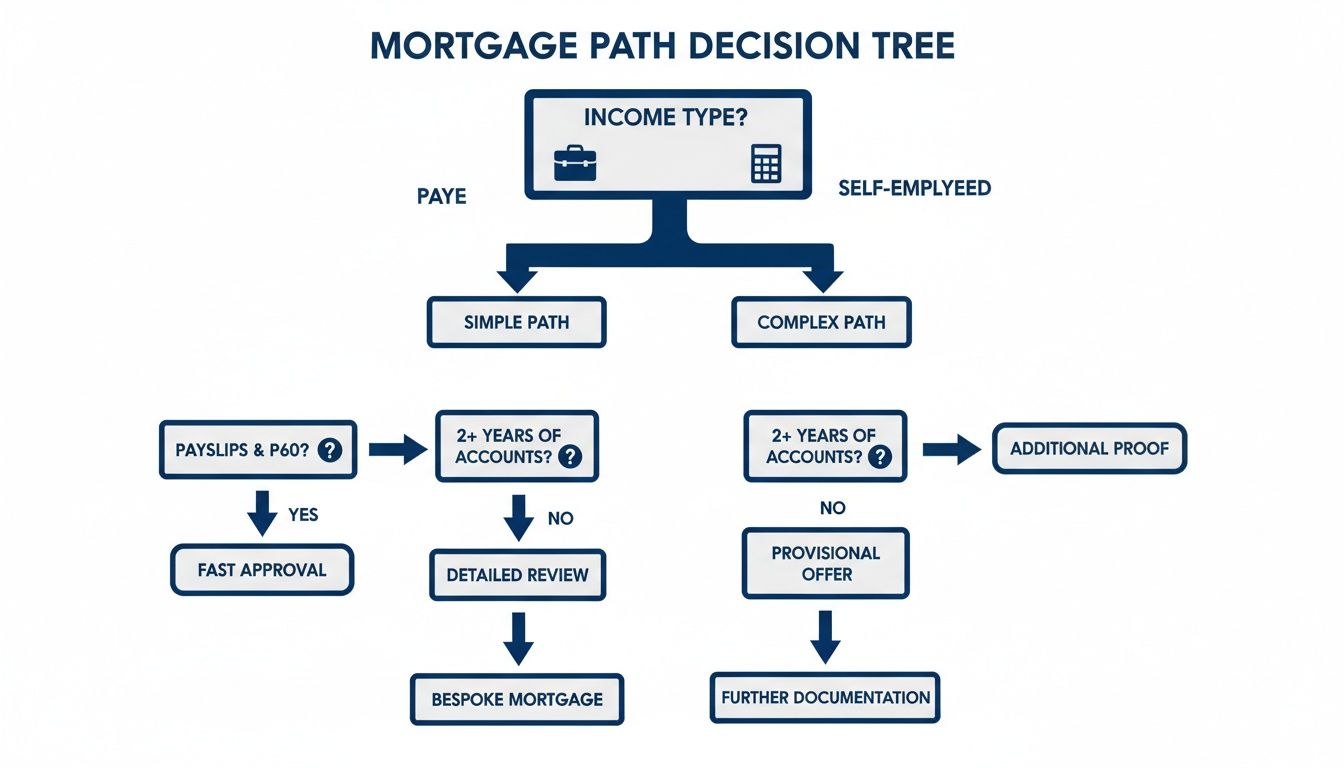
As you can see, the route for the self-employed is more complex, which is exactly why working with a specialist mortgage broker is so important to manage the extra steps effectively.
Core Documents for All Self-Employed Applicants
No matter how your business is set up, there are a few universal documents that most lenders will ask for. Sorting these out first will put you in a really strong position.
- SA302 Forms: These are your official tax calculations from HMRC, summarising the total income you have declared for a tax year. Lenders typically ask for the last two or three years of earnings history to see a consistent pattern.
- Tax Year Overviews: This document goes hand in hand with your SA302 and proves that the tax you declared has been paid. It’s a crucial piece of evidence that confirms the figures on your SA302 are accurate and finalised.
- Personal and Business Bank Statements: Expect lenders to ask for three to six months of statements for all your accounts. They are looking for consistent income, good financial management, and any large, unexplained transactions.
To make sure your financial records are lender-ready, it’s vital to avoid common bookkeeping mistakes that could trip you up. Meticulous records truly are the foundation of a successful mortgage application.
Evidence Specific to Your Business Structure
Beyond the essentials, the paperwork you need depends on whether you are a sole trader, a partner, or a limited company director. A good mortgage broker, especially one familiar with the market in areas like Braintree, knows precisely what each type of lender is looking for.
When you are pulling your application together, the documents you need will vary based on your business type. Here’s a quick summary of what lenders typically require.
Document | Sole Trader | Partnership | Limited Company Director | Why It Is Needed |
Certified Accounts | Recommended | Essential | Essential | Provides a detailed breakdown of business turnover, costs and profit |
HMRC SA302s | Essential | Essential | Essential | Confirms personal income declared to HMRC for tax purposes |
Tax Year Overviews | Essential | Essential | Essential | Proves the tax liability shown on the SA302 has been settled |
Business Bank Statements | Essential | Essential | Essential | Shows the cash flow and day to day financial health of the business |
Evidence of Dividend Income | Not Applicable | Not Applicable | Essential | Verifies dividend payments, a key part of a director’s income |
This table gives you a clear checklist to get started. For limited company directors, the split between salary, dividends, and retained profit is absolutely crucial.
While many high-street banks will only consider your salary and dividends, a specialist mortgage broker for the self-employed can connect you with lenders who are willing to assess the retained profit left in the business. This one factor can dramatically increase your borrowing capacity, turning a potential rejection into an approval. This is where professional advice becomes invaluable, especially for business owners in competitive markets like Colchester and across Essex.
How a Specialist Mortgage Broker Makes the Difference

Trying to get a mortgage when you are self-employed can feel like you are speaking a different language to the lenders. You know your business is solid and profitable, but the banks do not seem to get it. This is exactly where a specialist mortgage broker for the self-employed becomes your greatest ally.
Think of us less as an intermediary and more as your financial translator. We are fluent in the language of both entrepreneurs and underwriters, and our job is to bridge the gap between your unique income streams and a lender’s rigid tick-box criteria. We take your financial story and present it in a way that makes perfect sense to them, ensuring your application gets the attention it deserves.
This kind of expert support is more critical than ever. While large firms now handle nearly 40% of the UK mortgage market, smaller, specialist brokers like us have carved out a vital niche. We thrive on the complex cases that larger companies often overlook, providing self-employed clients with the focused expertise they need.
Access to the Right Lenders
One of the biggest hurdles for self-employed applicants is simply knowing whom to contact. The high street banks are only the tip of the iceberg. Below the surface, there is a huge market of specialist lenders who have built their entire business around understanding entrepreneurial finance, and many of them only work with brokers.
A specialist broker knows exactly which lenders are the right fit. We have direct access to those who:
- Will look at retained company profits, not just your salary and dividends.
- We are happy to work with just one or two years of accounts.
- Offer favourable income calculations for contractors on a day rate.
- Take a more understanding view of fluctuating profits from year to year.
Trying to find these lenders on your own is a minefield. You could waste weeks applying to the wrong banks, racking up rejections and potentially harming your credit score. We cut through all that noise by taking you straight to the right people from day one. To see how this compares to going direct, check out our guide on mortgage brokers vs banks.
A Case Study from Colchester
The impact of this specialist knowledge is huge. We recently worked with an IT contractor from Colchester who was paid a day rate. He had gone to his own high street bank, a big, well-known name, but they could not get their heads around his income structure. The mortgage they offered him was nowhere near what he needed.
He came to us feeling completely stuck. We took one look at his situation and immediately knew which two specialist lenders would be perfect. They have a reputation for being contractor-friendly. We then packaged his application to showcase his strong day rate and consistent contract history.
The result? We secured him a mortgage offer £95,000 higher than his own bank had made. It was enough for him to buy the family home he’d set his heart on. This was not luck; it was the direct outcome of applying deep market knowledge and industry connections. That is the difference a specialist broker makes.
Actionable Steps to Strengthen Your Mortgage Application
Taking a few proactive steps before you even pick up the phone to a mortgage broker can make a world of difference to your chances of success. When you present yourself as a low-risk, well-prepared applicant, you make it far easier for lenders to say yes.
Think of it like preparing your business for an important investment pitch; the groundwork you put in now will pay dividends later.
Here are five key actions you can take to put your application in the strongest possible position.
1. Optimise Your Accounts With a Professional
Long before you start looking at properties, have a sit-down with your accountant. Their main job is often to minimise your tax bill by maximising expenses. While that’s fantastic for your annual tax return, it can shrink the net profit figure that lenders use to work out what you can afford.
Be upfront and tell them you’re planning to apply for a mortgage. A good accountant can help you strike the right balance, ensuring your declared income for the past one to two years properly reflects your earning power without creating an unnecessary tax burden. To get a head start, you could also explore common tax-saving strategies for freelancers and small business owners.
2. Cultivate an Impeccable Credit History
For any self-employed applicant, your credit report is a vital piece of the puzzle. A strong credit history is proof of your reliability and shows that you can manage your finances responsibly.
Before you apply, make sure you:
- Check your report: Get copies from all three main credit reference agencies, Experian, Equifax, and TransUnion and scan them for any errors.
- Settle outstanding debts: If you can, pay down credit card balances and other short-term loans. This will help reduce your overall debt-to-income ratio.
- Ensure timely payments: Make sure every payment, from utility bills to supplier invoices, is made on time, every time.
Even a seemingly minor blip can cause delays. If your situation is a bit more complex, our guide on securing a home loan for the self-employed with bad credit has more detailed advice.
3. Save a Larger Deposit
While it’s possible to get a mortgage with a smaller deposit, saving more can seriously strengthen your application. A larger deposit reduces the lender’s risk by lowering the Loan-to-Value (LTV) ratio, which is the percentage of the property’s value you borrow.
A lower LTV does not just improve your chances of approval; it often unlocks more competitive interest rates, which could save you a huge amount of money over the life of the loan. Aiming for a deposit of at least 15% can make a real difference and show lenders that you have strong financial discipline.
4. Separate Business and Personal Finances
Mixing your personal spending with business expenses is a massive red flag for underwriters. It muddies the waters and makes it incredibly difficult for them to verify your true disposable income.
Keep things clean and simple. Maintain separate bank accounts and use them strictly for their intended purpose.
5. Tidy Up Your Bank Statements
In the three to six months before you apply, be mindful of what’s going in and out of your accounts. Try to avoid large, unusual payments or cash withdrawals that you cannot easily explain.
Consistent, regular income and sensible spending habits tell a story of stability, and that’s a story every lender wants to see.
Begin Your Mortgage Journey with Our Expert Team
Taking that first step towards a mortgage can feel like a massive leap of faith, especially when you are self-employed. But with our team by your side, it’s less of a leap and more of a clear, structured journey. We have fine-tuned our process to give you clarity and confidence at every single stage, turning what feels complex into a straightforward path to getting your keys.
This is all about partnership and transparency. We do not just find you a mortgage; we build a lasting relationship. Our goal is to ensure you feel fully supported, from our first chat through to completion day and beyond.
Our Step-by-Step Client Process
We believe in keeping things simple and effective. Your journey with us is divided into a few clear stages, ensuring no detail is missed, and you are always in the loop.
Free, No-Obligation Consultation: Everything starts with a chat. We will sit down with you to properly understand your business, how your income works, and what you are looking for in a property here in Essex. This first meeting is completely free and is all about us getting a full picture of your situation.
Document Gathering: Based on our conversation, we will provide you with a simple checklist of the exact documents you need. As a specialist mortgage broker for the self-employed, we know precisely what lenders are looking for, so you will not waste any time digging out unnecessary paperwork.
Lender Sourcing and Strategy: This is where our market knowledge really comes into play. We will tap into our network of lenders, including those who genuinely understand and welcome self-employed applicants, to find the best options for you. We will then present a clear strategy that explains exactly why we believe a particular lender and product are the right fit for you.
Application Submission and Management: Leave the heavy lifting to us. We handle the entire application process professionally, packaging your information to highlight your strengths as a borrower. This gives you the best possible chance of a quick, positive decision. If you are wondering about timelines, you can learn more about how long a mortgage application typically takes in our detailed guide.
Dedicated Support to Completion: Our job does not stop once the application is in. We will be the ones chasing the lender, solicitors, and valuers, and we will give you regular updates every step of the way until your mortgage is fully approved and you are ready to complete your purchase.
Local Expertise in Chelmsford and Essex
Navigating the property market is much easier with someone who knows the local patch. With years of experience across Chelmsford, Braintree, and Colchester, we have a deep understanding of the Essex market dynamics. This local insight means our advice is not just financially sound, it’s genuinely relevant to your property search right here.
Your Questions Answered
As you would expect, we get a lot of questions from entrepreneurs, contractors, and business owners across Essex about getting a mortgage. It is a common worry, but the answers are often more straightforward than you think. Here are a few of the most common queries we tackle day-to-day.
Can I Get a Mortgage with Only One Year of Accounts?
It’s a classic question. While it’s true that most high street lenders want to see two or three years of accounts, getting a mortgage with just one year’s trading history is absolutely possible.
This is where specialist lenders come in. They are often more willing to look at the bigger picture, especially if you have a strong track record in the same industry or can show them solid proof of upcoming contracts. A good broker for the self-employed knows exactly who these lenders are and how to package your application to catch their eye.
How Do Lenders View Government Support Loans?
The Bounce Back Loan is a frequent topic. Lenders will definitely look at this, but their view varies. Some see it as a red flag, a sign of financial difficulty, while others are far more pragmatic and understand the unique pressures of the time.
The worst thing you can do is hide it. Being upfront is key. We can help you frame the situation clearly, explain why the loan was taken, and highlight your business’s underlying profitability. It is all about finding a lender with a common-sense approach.
How Is My Income Calculated as a Day-Rate Contractor?
This is a game-changer for contractors. Instead of just taking your salary and dividends, many specialist lenders use a much smarter calculation. They will typically take your daily rate, multiply it by the number of days you work a week, and then multiply that by 46 or 48 weeks to get an annual figure.
Why does this matter? Because this method almost always yields a much higher affordability figure that reflects what you actually earn. An experienced broker will have a list of contractor-friendly lenders who use this calculation as standard.
Your journey to owning a home does not need to be an uphill battle. With the right advice in your corner, your hard work and business success can absolutely help you get the keys to your new property.
At EHF Mortgages, we specialise in helping self-employed professionals across Chelmsford, Braintree, and Colchester get the mortgage they deserve. Your journey towards owning a home doesn’t have to be an uphill battle. With the right advice and a clear strategy, your hard work and business success can translate directly into getting the keys to your new property. If you are ready to explore your options and see how we can help, our expert team is here to guide you.





