
 Top Tip: Getting your financial documents in order before you even start looking is one of the best ways to speed up your mortgage journey.
We’ll explain more about this later in the article.
Table of Contents
- Your 2026 Guide to the UK Mortgage Application Timeline
- The Four Key Stages of Your Mortgage Journey
- What Speeds Up or Slows Down Your Application
- Navigating the Post-Offer Conveyancing Timeline
- How a Mortgage Broker Streamlines Every Stage
- Your Mortgage Timeline Questions Answered
Your 2026 Guide to the UK Mortgage Application Timeline
Trying to get your head around the mortgage process can feel like you’re staring at a giant puzzle. But understanding the timeline is the first step to seeing how all the pieces fit together.
This guide will give you a clear, no-nonsense overview of the journey, from those first checks right through to getting the keys in your hand. While the average time from submitting your application to receiving a formal offer is between three and six weeks, this can vary widely depending on your personal situation and the lender’s workload.
We’ll walk you through each key stage, demystifying the roles of underwriters, valuers, and conveyancers, who all play a part. Knowing what’s coming next makes the whole thing feel far less daunting.
Breaking Down the Journey
The mortgage timeline isn’t just one long, frustrating wait; it’s a series of smaller steps. Each stage has its own job to do and its own average duration.
Here are the key phases you can expect:
- Initial Checks & Agreement in Principle: This is where you pull your paperwork together, and a lender gives you an early indication of how much they might be willing to lend.
- Complete Application & Underwriting: The lender’s team does a deep dive into your finances to make their final decision.
- Property Valuation & Formal Offer: Before committing, the lender confirms the property’s value and then issues your binding mortgage offer.
- Legal Work & Completion: Solicitors handle all the final legal bits and pieces to transfer ownership to you officially.
Before you get stuck into the application itself, using a reliable online mortgage calculator can give you a solid idea of what your repayments might look like and what you can afford. This guide sets the stage, showing that with the proper preparation and guidance from a good broker, you can successfully navigate your way to homeownership in places like Chelmsford and across Essex.
Ready to start your journey with an expert in your corner? Get in touch with our friendly team through our Contact Us page.
The Four Key Stages of Your Mortgage Journey
To get a handle on how long a mortgage application really takes, think of it as a journey with four distinct stages. When you understand what’s happening behind the scenes at each stop, you get a much clearer picture of where you are and what’s coming next. The whole process is designed to ensure both you and the lender make a solid financial decision.
It all kicks off with an initial assessment and wraps up when that formal offer lands in your inbox, giving you the green light to buy your property. Each part has its own timeline and purpose, building on the one before it.
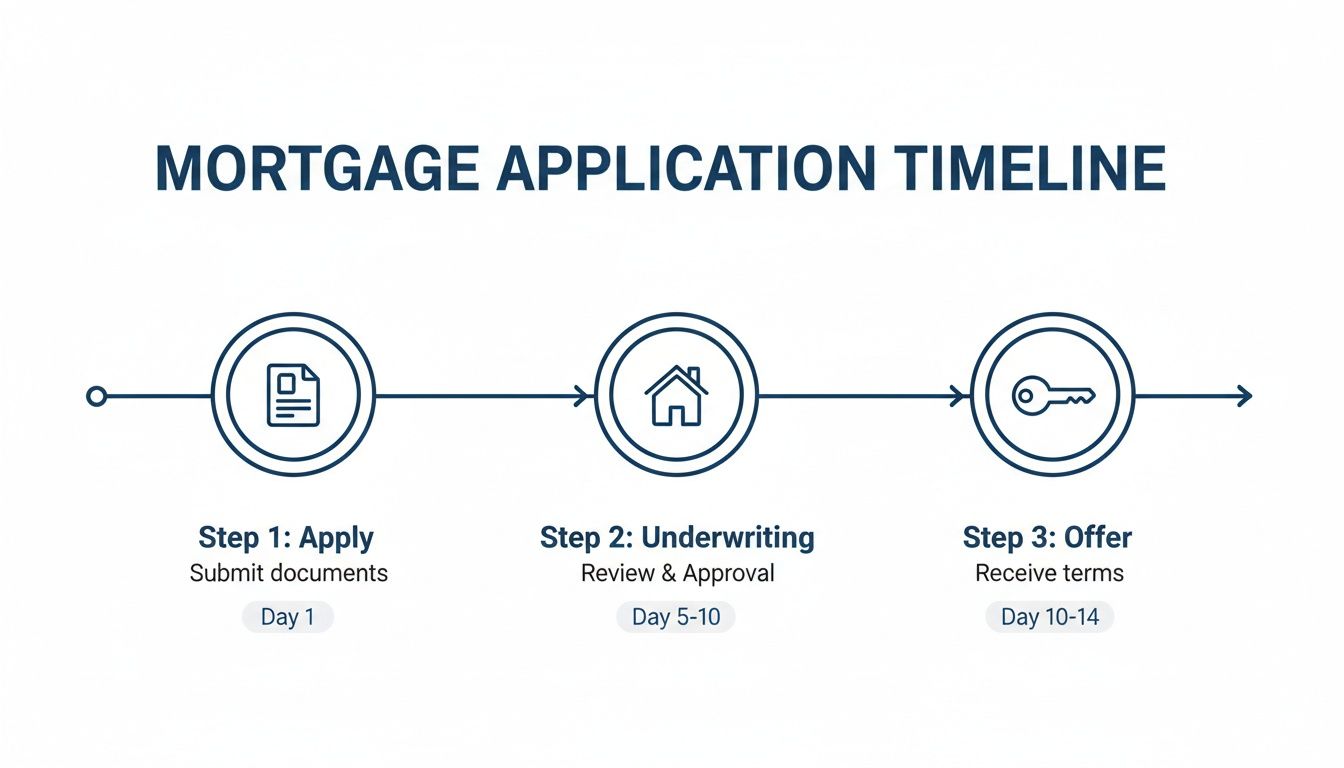
This simple timeline shows the main steps in a nutshell – from submitting the application to getting that final offer. It’s a structured sequence where one completed stage unlocks the next, moving you logically toward your goal.
Stage 1: Decision in Principle
The first step is to obtain a Decision in Principle (DIP), sometimes called an Agreement in Principle (AIP). This is basically a preliminary thumbs-up from a lender, giving you a good idea of how much they’d be willing to lend based on a quick look at your income, outgoings, and credit history.
Think of it as a trial run. It involves a quick fact-find and usually just a soft credit check, which won’t leave a mark on your credit score. An AIP is a powerful tool to have in your back pocket when making offers, as it shows estate agents you’re a serious, credible buyer. This stage is usually rapid, often taking just 24 to 48 hours.
Of course, before you even get to this stage, it’s a good idea to know what you might be able to borrow. A Mortgage Affordability Calculator is a great starting point.
Stage 2: Full Application and Underwriting
Once you’ve had an offer accepted on a property, we move on to the main event: the full mortgage application. This is where things get serious. We’ll submit all your detailed financial documents to the lender, where their underwriting team will go through everything with a fine-tooth comb.
Underwriters are like financial detectives. It’s their job to verify your income, double-check that the mortgage is affordable for you, and look for any potential red flags. They’ll scrutinise everything from bank statements to your employment history to make sure you tick all their boxes. On average, the mortgage application approval timeline in the UK is anywhere from 3 to 6 weeks. For a straightforward case, it can be as quick as a week or two, but more complex situations will naturally take longer.
Stage 3: Property Valuation
While the underwriters are busy with your finances, the lender will arrange for a valuation of the property you want to buy. This is absolutely crucial for the lender. They need to be sure that the property is actually worth the amount they’re lending you. At the end of the day, the property is their security for the loan.
A surveyor will pop round to the property to assess its condition and work out its current market value. If the valuation comes back lower than your offer price (what we call a down-valuation), it can cause a bit of a hiccup, and we might need to renegotiate with the seller or figure out a way to cover the shortfall. This stage usually takes about one to two weeks for the survey to be completed and the report to be returned to the lender. If you’d like to learn more, we have a helpful guide on understanding your borrowing potential.
Stage 4: The Mortgage Offer
This is the moment you’ve been waiting for! Once the underwriter is happy with your application and the property valuation is all squared away, the lender will issue your formal mortgage offer. This is the official, legally binding document that confirms they’re ready to provide the loan.
Receiving your offer is a huge milestone. It means you’ve passed all the checks and the funds are officially secured. The document is then sent to both you and your solicitor, allowing the final legal work (the conveyancing) to begin. The offer itself is typically issued within a week of a successful valuation and final sign-off from the underwriters.
What Speeds Up or Slows Down Your Application
Ever wondered why one person’s mortgage application seems to fly through, while another gets stuck in the mud? It’s all down to a few key factors that can either give your application a turbo-boost or act like a speed bump.
Think of your application as a story you’re telling a lender about your financial life. The more transparent and straightforward that story is, the faster they can give you a “yes”. But if there are complicated chapters or missing details, they’ll naturally need to pause and ask a few more questions.

Factors That Accelerate Your Application
Some situations make a lender’s job easier, which is fantastic news for your timeline. These are the green lights that help your application sail through the system.
A large deposit is probably the biggest accelerator of them all. It lowers the lender’s risk (this is what’s known as a lower Loan-to-Value or LTV), which often means fewer checks and a quicker decision. Simple.
Next up, a strong and clean credit history is a huge plus. If your credit report shows you’ve always been a responsible borrower, lenders can approve your case with confidence and without too much fuss.
Finally, stable employment really helps. If you’re in a permanent, salaried (PAYE) role, your income is a piece of cake for underwriters to verify. It’s much faster than trying to make sense of fluctuating earnings.
Common Causes of Delays
On the flip side, some things will naturally need a closer look from the lender, which will extend the time it takes to get that offer. Knowing about these potential hurdles in advance is half the battle.
Complex income streams are a classic reason for a slowdown. If you’re self-employed, a contractor, or juggling multiple sources of income, underwriters will need to do a much deeper dive into your finances. You can find more details in our guide on mortgages for the self-employed in the UK.
A history of adverse credit, such as missed payments or defaults, will also slow you down. In these cases, your application is passed to a specialist underwriter who needs to understand the story behind the blips, which takes more time.
Issues with the property itself can cause major hold-ups. A valuation coming in lower than expected, structural problems flagged in the survey, or legal complications with the title can all stop the process in its tracks while everyone figures out a solution.
And of course, being part of a long property chain is a famous cause of delays. Your purchase is tied to several other people completing their own sales. One hiccup anywhere along that chain can have a domino effect on everyone’s timeline.
Understanding these factors from the start helps you set realistic expectations. A proactive approach, especially with an expert guide on your side, can make navigating these challenges much smoother.
If you have questions about your circumstances or want to ensure your application is as watertight as possible, our team is here to help. Just get in touch with us for a friendly, no-obligation chat.
Navigating the Post-Offer Conveyancing Timeline
Getting that mortgage offer in your hands is a huge milestone, but it’s not quite time to break out the champagne. You’re now entering the final leg of the race: the legal process known as conveyancing. Honestly, this is often the stage that really determines how long it’ll be before you’re finally holding the keys to your new home.
This is where your solicitor steps up to the plate. They’ll handle all the intricate legal work needed to transfer ownership of the property from the seller to you. It’s a critical phase with detailed checks, and everyone must complete their tasks correctly to protect your investment.

What Happens During Conveyancing
While your mortgage application focused on your finances, conveyancing focuses on the property itself. Your solicitor or conveyancer will be juggling several key tasks to ensure the purchase is secure and above board.
You can expect them to be busy with:
- Conducting Searches: They’ll carry out local authority searches to dig up any potential planning issues, restrictions, or other skeletons in the closet that could affect the property.
- Reviewing the Title: This is a deep dive into the property’s legal title to confirm the seller actually has the right to sell it and that no nasty surprises are lurking.
- Managing Contracts: Your solicitor handles the exchange of contracts, the nail-biting moment when the deal becomes legally binding for both you and the seller.
- Transferring Funds: On completion day, they orchestrate the transfer of funds from your lender and your deposit to the seller’s solicitor.
On paper, this process should take around 8 to 12 weeks. But in the real world, delays are common, especially if you’re stuck in a long property chain or buying a unique property in an area like Colchester.
Why Timelines Can Be Unpredictable
The very last step after completion is registering the property in your name with HM Land Registry, and this is where things can get a bit wild. While most straightforward updates are done quickly, more complex registrations can drag on for what feels like an eternity.
According to HM Land Registry’s own data, while a whopping 80.4% of simple updates are processed in a day, 55.9% of complex applications, like for new builds or splitting a property title, can take up to 12 months. You can get the complete picture by checking the HM Land Registry processing times on GOV.UK.
This is precisely why having a proactive team in your corner is so important. A good mortgage broker doesn’t just vanish once the offer is issued. We stick around, chasing solicitors and estate agents to keep things moving and help you navigate any bumps in the road on your way to completion.
If you’re ready to start your property journey with a team that has your back from start to finish, get in touch via our Contact Us page.
How a Mortgage Broker Streamlines Every Stage
Trying to get a mortgage on your own can feel a bit like project managing a massive construction job without a blueprint. That’s where a dedicated broker like EHF Mortgages comes in. Think of us as your personal project manager; we keep every stage on track and address potential hiccups before they become major roadblocks.
Our whole job is to orchestrate a smoother, faster process from the very beginning. We know the ins and outs of each stage, which means we can proactively manage your application and make a real difference in answering the question of how long a mortgage application takes.
From Pre-Application to Full Submission
Right from the initial pre-application stage, our expertise is crucial. Instead of you firing off applications and just hoping for the best, we use our whole-of-market knowledge to match you with the right lender from day one. This simple step helps you sidestep the disaster of applying to a lender whose criteria you don’t meet, saving you precious time and protecting your credit score.
When it’s time for the whole application, our meticulous approach really shines. We package your case to anticipate underwriters’ questions before they’re asked. By presenting a clear, comprehensive, and well-organised file, we reduce the frustrating back-and-forth that often delays your application and keeps it moving forward.
Beyond the Offer to Final Completion
Once your application progresses to the valuation and offer stage, our job is far from over. We keep a close eye on its progress, chasing for updates and helping you navigate any tricky situations that might pop up, like a potential down-valuation.
Crucially, our support doesn’t stop when the mortgage offer lands. We know the legal stage is often where momentum is lost. That’s why we stay in the loop, actively liaising with solicitors and estate agents across Colchester and Essex to help your purchase reach a swift and successful completion. This end-to-end management is all part of our commitment to a seamless experience for you.
Ready to see how we can make your mortgage journey smoother? You can easily book an appointment with our expert team to discuss your needs.
To ensure your financial future is protected, it’s wise to have a strong plan in place. We can assist with everything from life insurance to income protection, helping you feel secure in your new home. For a no-obligation chat about how we can support you, please visit our Contact Us page.
Your Mortgage Timeline Questions Answered
Every home buyer’s journey is different, and it’s entirely normal for specific circumstances to extend the mortgage timeline. Here, we’ll tackle some of the most common questions we get from clients with non-straightforward circumstances.
Getting a clear picture of what to expect from the start helps keep the process moving and stress-free.
How Long Does a Mortgage Application Take If I Am Self-Employed?
If you’re self-employed, lenders will want to take a much closer look at your income. Instead of simple payslips, they’ll typically ask for two or three years of accounts or tax returns (SA302s) to get a complete picture of your earnings.
Because of this, the underwriting process is more hands-on and detailed than it is for a PAYE applicant. It’s wise to plan for a timeline closer to the six-week mark, as a human underwriter will need to assess your business’s stability and income manually.
What Happens If I Have Bad Credit?
A history of bad credit doesn’t automatically close the door on getting a mortgage, but it will almost certainly add time to the process. Your application will likely require a specialist lender and will definitely undergo manual underwriting.
This is where a person, not a computer algorithm, reviews your entire case. They’ll naturally ask for more information to understand the story behind any past credit issues, which slows the process.
Does Buying a New-Build Property Change the Timeline?
Yes, buying a new-build property in a location like Braintree can definitely affect your timeline, but often in a different way. The main issue is that standard mortgage offers are only valid for six months, which can be a problem if your new home won’t be finished by then.
You might need a mortgage offer with a more extended validity period, or you may have to reapply closer to the completion date. This is where a good broker is absolutely vital; they know which lenders offer flexible extensions that line up with the developer’s schedule.
How Long Is a Mortgage Offer Valid For?
A standard UK mortgage offer is valid for six months from the day it’s issued. For most property purchases, this is more than enough time to get all the legal work and the conveyancing sorted without any hiccups.
But if your purchase is delayed, perhaps due to delays in the property chain or construction setbacks on a new build, that six-month window can start to look a bit tight. You may need to ask the lender for an extension or, in some cases, submit a completely new application.
Navigating the twists and turns of a mortgage application can feel overwhelming, but you don’t have to figure it out on your own.
The team at EHF Mortgages has the experience to guide you through every stage, keeping your application on track and making it as smooth as possible.
For expert, friendly advice tailored to your situation, please visit our Contact Us page.





