
You’re weighing a tracker against a fixed rate, and the wrong choice can cost you flexibility when life changes.
Lightbulb tip: don’t choose a tracker just because it looks cheaper this month, choose it because you can live with the payment moving and still get out cleanly later. I’ll show you where that matters most, because the win is often not the headline rate, it’s the exit plan.
If you’re a homeowner in Chelmsford, Braintree, Colchester, or elsewhere in Essex, you’ve probably seen tracker deals pitched as the sensible middle ground. That can be true, but only if you understand how the rate moves, what the lender charges for the privilege, and whether you’re buying short-term savings or genuine flexibility. If you’re also reviewing cover for the mortgage, decreasing term life insurance options are worth a look alongside the loan choice, because the debt and the protection should work together.
For anyone who likes to see the repayment side in plain terms, it’s worth comparing the structure with a standard repayment loan first, and you can do that through this guide on how a repayment mortgage works. That matters because tracker decisions make more sense when you already know how capital and interest are moving month by month.
What a Tracker Mortgage Means for Your Monthly Payments
A tracker follows the Bank of England base rate, then the lender adds its fixed margin on top. If the base rate moves, your mortgage rate usually moves by the same amount, while the margin stays fixed for the deal term. That is the appeal, and that is the risk.
For a buyer or remortgagor in Essex, that structure matters most when the timing is tight, a purchase, a remortgage, or a move that needs clean numbers. The value of a tracker is transparency, because you can see what drives the payment and what stays locked in. That still leaves you exposed to rate rises, so you need to be comfortable with movement before you sign.
Practical rule: if you need payment certainty, a tracker is the wrong product. If you want a chance to benefit from cuts and you can absorb rises, it deserves a serious look.
The Bank of England’s Monetary Policy Committee meets 8 times a year, as noted in tracker guidance, so the benchmark can move several times across a year. Tracker deals are usually sold as 2-year or 5-year products, then they commonly roll onto a lender’s standard variable rate unless you arrange a new deal. That reversion point catches people out, because the monthly payment can jump again when the initial tracker ends.
The monthly cost is not just about the headline rate. Product fees, early repayment charges, and the timing of your exit all affect whether the tracker saves money or gives you more movement for the same borrowing cost. If you are comparing repayment structure before you commit, the mortgage type matters as much as the rate, which is why this topic sits close to interest rates and mortgage mechanics and how a repayment mortgage works. A tracker can work well as a bridge to a later fixed deal, but only if the numbers and the exit terms suit the plan.
How Tracker Mortgages Work and Why Rates Move
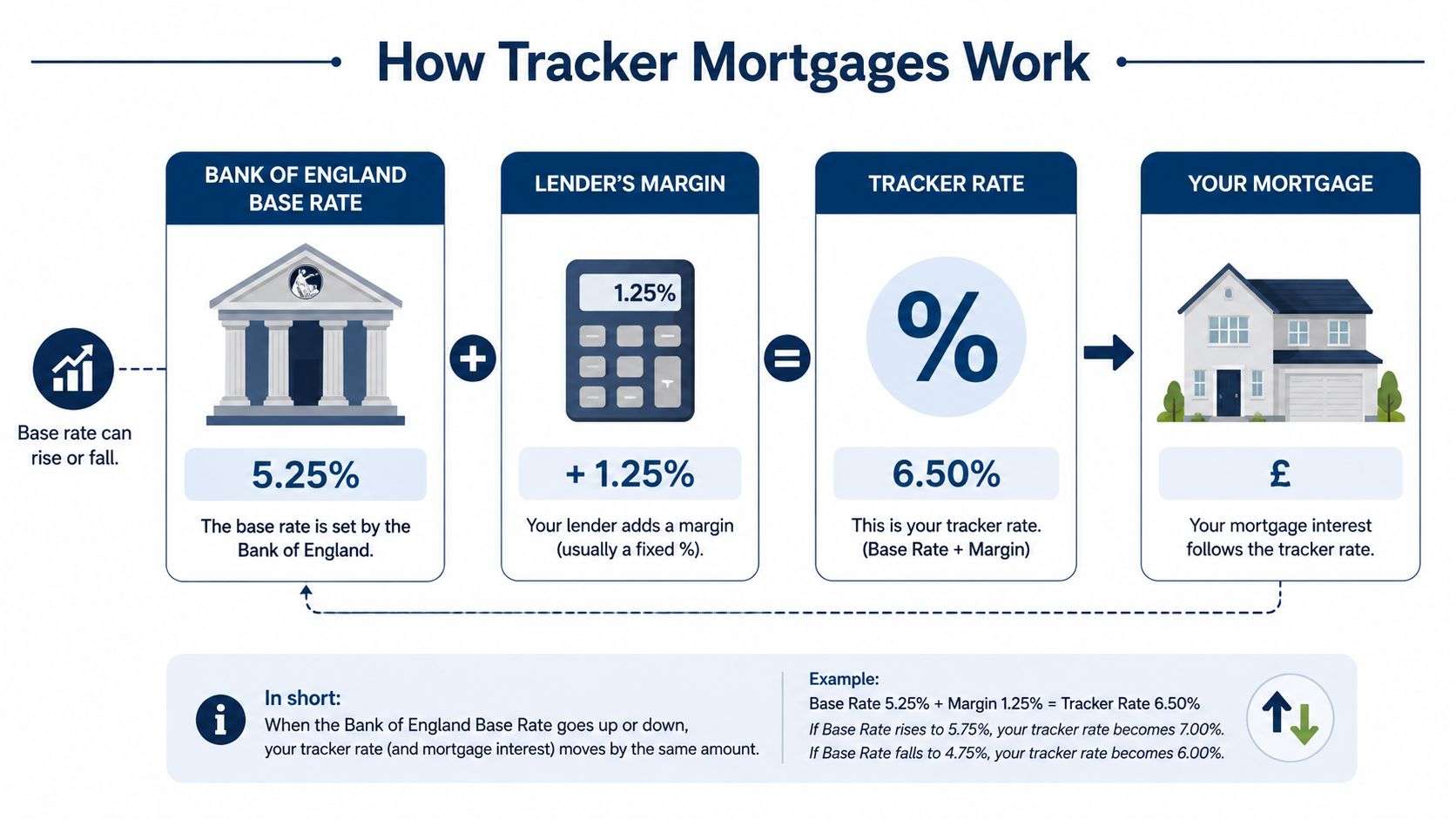
A tracker mortgage is straightforward once you strip out the sales patter. Your rate follows the Bank of England base rate plus a fixed lender margin, so the lender is setting the spread above the benchmark and the base rate is doing the moving. As noted in tracker mortgage guidance, tracker margins have been seen from base +0.3% to base +1.5%, with initial tracker rates around 4.8% to 5.4% when the base rate was 4.5%.
Why the rate moves the way it does
If the base rate rises, your tracker rate usually rises with it. If the base rate falls, your monthly payment normally eases. HSBC says repayments fall when the base rate falls and rise when it increases, while Barclays says the payment can move either way if the base rate changes. That is the whole point of the product, and it suits borrowers who want to benefit from rate cuts without pretending the market will stay still.
The base rate is the engine, but the lender margin is the part that matters to you. That margin is fixed for the deal term, so the lender cannot rewrite it halfway through. The only moving piece is the benchmark it tracks.
The margin is fixed during the deal term, so don’t let anyone pretend the lender can rewrite the rules halfway through.
Timing matters as much as direction. Mortgage rate changes do not happen in isolation, they follow Bank of England decisions and the lender’s own product rules. If you want the wider context on how base rate shifts feed through to mortgage pricing, this guide to interest rates and mortgage mechanics is useful because it keeps the link between the benchmark and the loan clear.
A tracker often makes sense if you expect rates to drift lower or you want to avoid tying yourself into a longer fixed term too soon. It is also useful when you want flexibility now and plan to move onto a fixed deal later, which is why the exit terms and product fees matter just as much as the headline rate. That matters for borrowers comparing options in the same way when seniors qualify for reverse mortgages forces a hard look at timing, access, and the cost of changing direction.
Tracker vs Fixed vs Standard Variable Mortgages Compared
| Feature | Tracker Mortgage | Fixed-Rate Mortgage | Standard Variable Rate |
|---|---|---|---|
| Rate movement | Moves with the base rate | Stays the same for the deal term | Can move at the lender’s discretion |
| Payment certainty | Lower | Higher | Lower |
| Flexibility | Can be strong, but depends on ERCs | Often limited by ERCs | Usually flexible, but pricing is often weaker |
| Short-term appeal | Useful if you expect rates to fall | Useful if you want certainty | Usually a fallback, not a first choice |
| Best fit | Borrowers who can handle change | Borrowers who want predictability | Borrowers who are waiting for a new deal |
The choice is not tracker versus fixed in the abstract. It’s whether you want to pay for certainty now or pay for optionality. In Chelmsford and the wider Essex market, I see borrowers get this wrong when they focus only on the first monthly payment and ignore what happens if they move house or want to remortgage before the term ends.
A fixed rate buys calm. A tracker buys movement and often a lower entry point. A standard variable rate is different again, because it can change without giving you the same predictability you get from a fix, and it’s often where people end up if they do nothing at the end of a product term.
For borrowers comparing these structures more formally, fixed versus variable mortgage guidance is a sensible companion piece because it keeps the trade-offs visible. And if you’re also thinking about later-life borrowing or planning around a parent or relative, the question of when seniors qualify for reverse mortgages shows how age and timing can alter the product conversation completely.
The clean recommendation is this, if you want certainty, choose the fix. If you want flexibility and can tolerate volatility, a tracker may be the sharper tool. If you land on an SVR by default, you’ve probably missed the proper decision.
The Real Risks and Benefits You Need to Consider
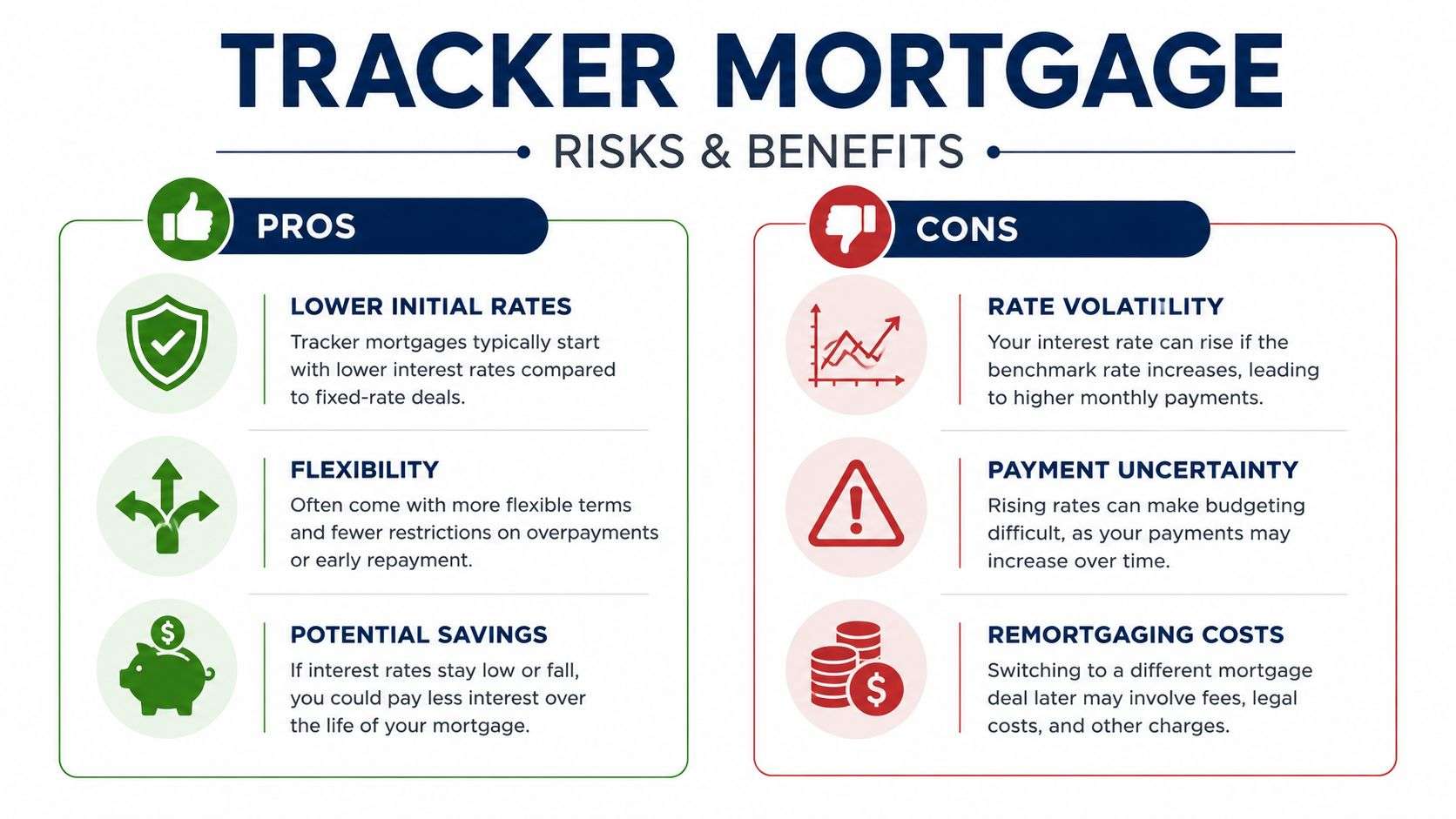
The biggest benefit of a tracker is that it tells the truth in real time. You see the mortgage react when the base rate changes, which makes it easier to understand than some products that hide the cost inside a longer fixed period or a sharp reversion later on. The downside is equally plain, your budget has to be able to breathe.
What can hurt you
A rate rise lands immediately in the monthly payment, and that’s where affordability gets tested after completion. Existing explainers often stop at the mechanism, but the practical question is harsher, how much could the payment change next month, and would your lender still pass you if rates rise? That matters most for borrowers whose budgets are already tight or whose deal is close to reversion.
The Bank of England cut Bank Rate to 5.00% in August 2024, but that still left it far above the 0.10% era that made trackers look easy to love tracker risk context. That is why the product still carries genuine rate risk, even when borrowers are tempted by lower starting pricing.
What can help you
The upside is not just cheaper money, it’s immediate participation in base rate cuts and far clearer pricing logic. You know what’s moving your payment, and that makes planning easier if you are disciplined. In Braintree and Chelmsford, I’d only push a tracker where the household has enough slack to absorb a rise without scrambling.
If a modest increase would force you to use overdrafts, credit cards, or personal loans, the tracker is too sharp for your situation.
The other thing to watch is resilience, not just the deal itself. FCA-style suitability should look at whether a borrower can keep paying if the market turns again, not just whether the starting rate looks neat. That is the part too many sales conversations miss, and it’s exactly where a good broker earns their keep.
Why Trackers Can Be a Smart Bridge to Future Fixed Deals

A tracker can be a bridge, not a destination. That’s the part most guides miss, because they frame the product as a bet on rates rather than a way to buy time until a better fixed deal appears. If a borrower wants movement now and certainty later, the right tracker can do both jobs.
Some tracker deals are priced lower than equivalent fixed-rate deals, and in the current market that difference can be meaningful. Some are by as much as 0.5%, which can mean around £100pm saving on a typical-sized mortgage, and that saving comes with the option to move to a fixed deal later without Early Repayment Charges if you choose the right product. That’s not a small detail, it’s the whole strategy.
The broker view
Broker rule of thumb: I’d rather place a client into a tracker with no ERCs than trap them in the cheapest-looking deal if they expect to switch again soon.
That approach matters if you expect to move, refinance, or remortgage within the next 12 to 24 months. You’re not just asking whether base rate falls, you’re asking whether you’ll need to exit before the term ends and whether the product lets you do that cleanly. If the answer is yes, the product fee and ERC structure matter as much as the headline margin.
For the record, the best rates often carry a product fee, typically £995, and some of the very cheapest tracker or discounted deals do come with Early Repayment Charges. That is the trade-off, lower monthly cost today versus less freedom tomorrow.
I’d only recommend a tracker as a bridge if the maths, the exit plan, and the likely remortgage window all point in the same direction. If they don’t, the product’s flexibility is an illusion and you should look elsewhere.
“Choose the tracker if you want the option to move later, not because you fancy guessing the market.”
If you want to look at the timing side of that decision, when to remortgage is the other half of the conversation, because exit timing decides whether the tracker saves you money or just postpones the decision.
How to Decide if a Tracker Mortgage Is Right for You
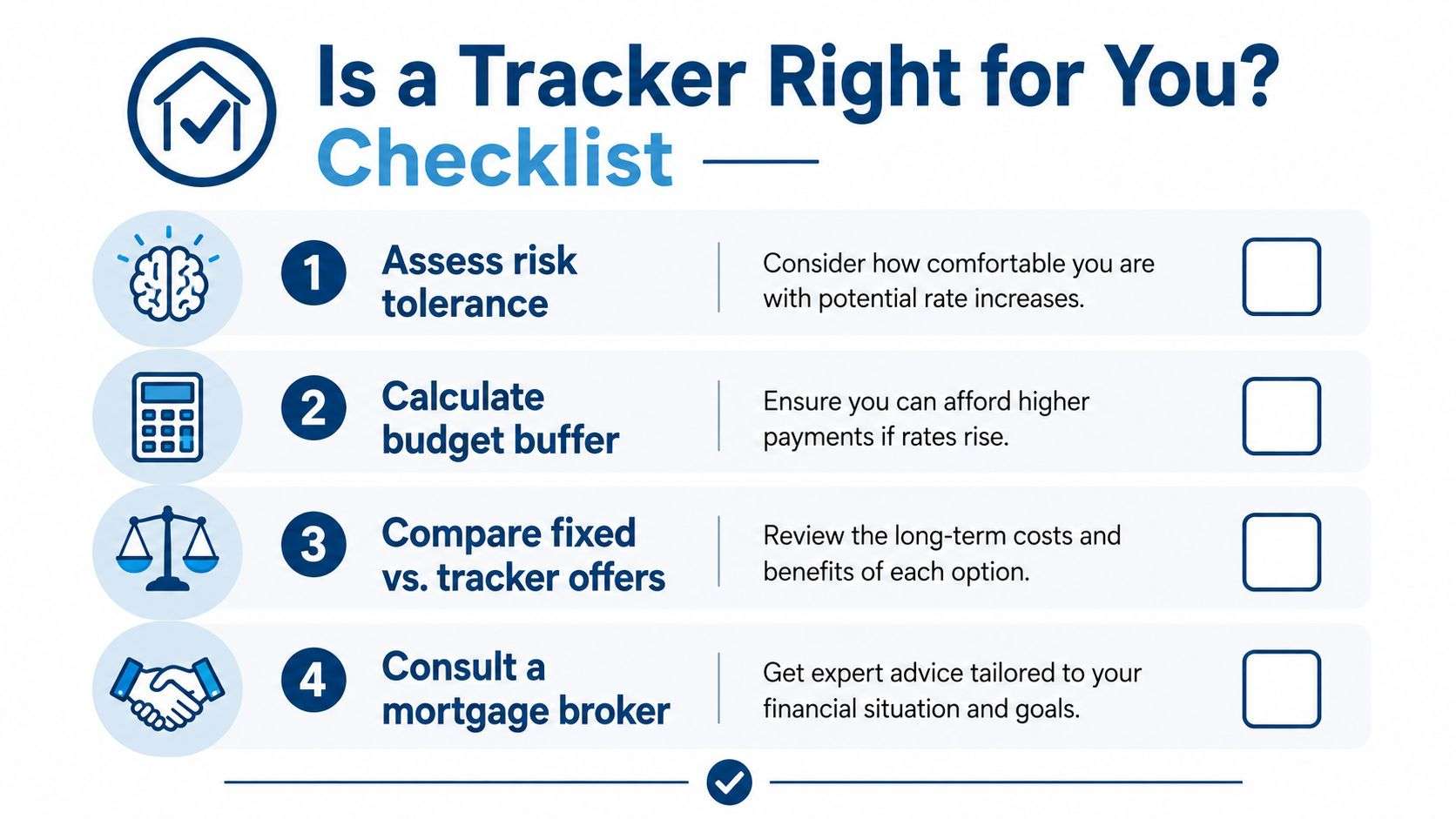
Start with your exit plan. If you expect to move, remortgage, or switch again in the next couple of years, a tracker can make sense as a bridge into a future fixed deal. You are not buying certainty, you are buying flexibility, so the main question is whether that flexibility is worth the moving parts.
Then test the payment against your budget. If a base rate rise would make the monthly cost uncomfortable, the tracker is the wrong fit, even if the starting rate looks attractive. Check the product fee as well, because a lower headline rate can still cost more once fees are added. If the deal carries Early Repayment Charges, you need to know exactly how expensive it will be to leave.
The questions I’d ask before recommending one
What is the lender margin? A tighter margin can help, but only if the overall structure suits the way you plan to use the loan.
Is there a product fee? Stronger tracker deals often come with a fee, and a common figure to expect is around £995.
Are there ERCs? If there are, you need to know what you lose when you want to repay or refinance.
How does it stack up against a fixed deal over the same period? Compare like with like, not a short tracker against a long fix and pretend that settles it.
That is where a proper broker adds value. EHF Mortgages can compare tracker, fixed, and variable options through its mortgage comparison service, and that is the sensible way to judge the trade-offs, because the cheapest payment today is not always the cheapest mortgage over the time you keep it.
Bring clean documents if you want a proper answer, income proof, existing mortgage details, and anything that shows how your living costs may change. A tracker decision is about rate and resilience together, so the paperwork should show both.
Your Next Steps and How EHF Mortgages Can Help
You do not choose a tracker mortgage because it feels tidy. You choose it when you want room to move, you can cope with the payment changing, and you care as much about the exit as the starting rate. If you want certainty above all else, pick a fixed rate instead.
For some borrowers, a tracker is a sensible bridge. It can suit a short hold before a remortgage, a planned move, or a future switch into a fixed deal once the timing is right. The key is to look at the monthly payment, the product fee, and any Early Repayment Charges together, because a low headline rate can still be poor value if the exit is expensive.
EHF Mortgages is based in Chelmsford, Essex, with whole-of-market access and more than 35 years of industry experience. That matters because the right answer may be a tracker, a fixed rate, or a cleaner short-term structure depending on how soon you will move, remortgage, or need to lock in stability. You can also use the site’s calculators and appointment tools to test the numbers before you commit.
If you want a straight view of your own options, speak to a broker who will compare the rate, the fee, and the exit risk in one conversation. For a quick look across product types, the mortgage comparison page is a sensible place to start.
If you want proper advice on whether a tracker suits your plans in Chelmsford, Braintree, Colchester, or anywhere else in Essex, speak to EHF Mortgages and base the decision on your timeframe, not just the headline rate. Visit EHF Mortgages to compare your options and make the next move with clarity.





