
 Top tip: if a business pays for the right type of life cover, the effective cost to the company can be lower than the headline premium because of the way business expenses and tax treatment can work in practice. I’ll explain the detail later, because this is one of the most misunderstood parts of life insurance for business owners.
If you run a company in Essex, whether you’re in Chelmsford, Braintree or Colchester, you’ve probably already insured the obvious risks. Premises. Vehicles. Public liability. Professional indemnity. Cyber cover, perhaps. The risk many owners leave untouched is the one that causes the fastest and most personal damage. What happens if the owner, founder or key decision-maker dies unexpectedly?
That’s rarely just a family issue. It can become a payroll issue, a lender issue, a shareholder issue and, in some firms, a survival issue. The gap is bigger than many people realise. According to the FCA’s Financial Lives survey, 32% of UK adults had life insurance in 2022, while 39% held at least one of life insurance, critical illness cover or income protection, which means many households still had no formal protection cover at all, as noted in this summary of the FCA figures. For an owner-managed company, that lack of planning can hit both the home and the business at the same time.
I also see business owners looking for guidance beyond generic UK explainers. If you want to compare how succession planning is approached in another legal setting, this overview of Texas business succession planning is a useful contrast because it shows how ownership transfer, estate planning and business continuity are often tackled together rather than in isolation.
Introduction Protecting Your Business Legacy
Contents
Business life cover works best when it is arranged before anyone is under pressure. Once there’s a death, nobody wants to start arguing over who owns the shares, who pays the loan, or whether the deceased owner’s family should now receive income from a company they can’t run.
Practical rule: if your business depends heavily on one person’s borrowing power, contacts, technical knowledge or authority to make decisions, protection is part of your business plan, not a bolt-on.
The right policy doesn’t just pay out. It needs to pay the right person, at the right time, under the right legal structure. That’s the part many business owners miss.
Why Business Life Insurance is Not an Optional Extra
A lot of firms only arrange cover when a lender asks for it as a loan condition. That’s better than nothing, but it’s still reactive. It protects one pressure point and ignores the rest.
In the UK, business life insurance is already a standard succession-planning tool. The wider context matters because the UK business base is overwhelmingly made up of smaller firms. At the start of 2024, there were about 5.5 million private-sector businesses, and 99.9% were small or medium-sized enterprises, according to this UK business statistics summary. In owner-managed companies, the death of a director, partner or sole trader can create an immediate financial shock.
The three problems it solves
The reason life insurance for business owners matters so much is that it usually deals with three separate risks at once.
Debt pressure
If the owner has signed borrowing personally, supported lending with a guarantee, or been the person a lender trusted, their death can trigger a refinancing problem very quickly.Ownership disruption
In a multi-owner business, the deceased person’s shares don’t just vanish. They pass into their estate. That can leave the surviving owners in business with a spouse, adult child or other beneficiary who may want value from the company but have no wish or ability to run it.Trading continuity
Even when the business remains open, cash can tighten fast. A firm may need time to recruit, retain staff, reassure clients and keep working capital in place.
What works and what doesn’t
What works is planning around the actual legal and financial structure of the business. That means asking direct questions.
Who would need cash first if an owner died?
The answer might be a lender, the deceased’s family, the remaining shareholders, or all three.What document controls the transfer of ownership?
A will on its own usually isn’t enough for a business succession problem.Would the payout land where it needs to land?
A good policy set up badly can still create a mess.
What doesn’t work is treating business protection like personal cover with a company logo on it. I’ve seen firms focus only on the cheapest premium, with no agreement between shareholders and no thought given to who receives the proceeds. That saves money right up until the day it doesn’t.
A policy without a matching legal agreement is often just an expensive intention.
Why owner-managed firms are exposed
When a listed company loses one executive, the business may absorb the shock. Many smaller companies can’t. One person might hold the lender relationship, know the systems, control the client base and sign off payroll. That concentration of responsibility is common across Essex businesses.
That’s why life insurance for business owners should sit alongside wills, shareholder agreements, partnership agreements and borrowing arrangements. If one of those pieces is missing, the whole plan can wobble.

Understanding the Key Types of Business Life Insurance
Different policies solve different problems. This difference often leads to confusion for many owners, who hear terms like key person, shareholder protection and relevant life used as if they all do the same job. They don’t.
Business Life Insurance Options at a Glance
| Policy Type | Primary Purpose | Who is Covered? | Who Receives the Payout? | Key Benefit |
|---|---|---|---|---|
| Key Person Insurance | Protect business trading after the loss of a crucial person | Owner, director or key employee | The business | Helps stabilise cash flow and continuity |
| Shareholder Protection | Fund purchase of a deceased owner’s shares | Shareholders or directors | Usually surviving owners or an agreed structure linked to the buyout | Avoids ownership deadlock |
| Relevant Life Cover | Provide individual death-in-service style cover tax-efficiently | Employee or director | Usually trustees for beneficiaries | Personal protection through the business |
| Group Life Insurance | Offer employee death benefit across a workforce | Employees as a group | Scheme trustees for beneficiaries | Useful staff benefit and retention tool |
Key person insurance
This cover is for the business itself. The company owns the policy, pays the premiums and receives the payout. It is designed to cushion the commercial impact of losing someone whose absence would hit turnover, profit, lender confidence or operations.
For many SMEs, that key person is the owner. In others, it may be a sales director, technical lead or specialist employee. The question isn’t job title. The question is whether the business would struggle financially without that person.
Shareholder protection
This is the one too many businesses ignore until it is too late. It’s built to fund the purchase of a deceased owner’s shares so the surviving owners can keep control and the deceased’s estate can receive fair value.
The legal agreement matters as much as the policy. Without proper drafting, the family may inherit the shares but have no practical role. The remaining owners may want control but have no liquid funds. Shareholder protection is what turns a paper agreement into something usable.
Relevant life cover
Relevant life is often suitable where a company wants to provide personal death-in-service style cover for an individual, commonly a director or employee, in a tax-aware structure. It isn’t the same as shareholder protection or key person insurance because the aim is family protection rather than a business continuity payout.
If you want a more detailed breakdown of how this type of cover works, this guide to relevant life insurance is a helpful next read.
Group life and employee benefits
Group life is broader. It’s usually about staff benefits rather than owner succession. It can still be valuable, especially for firms trying to retain good people, but it won’t replace a properly arranged ownership or loan protection plan.
If you’re comparing broader workplace benefit design with optional cover for staff, these notes on employee supplemental life insurance options give a useful outside perspective on how employers think about top-up protection.
The best policy isn’t the one with the most features. It’s the one that matches the specific risk you need to solve.
A Real-World Example How Protection Saved an Essex Business
One of the clearest examples came from a business in Braintree. The company was worth around £500k and had two owners, each holding a 50% share. One of the owners died.
On paper, the shareholding passed in line with the will. In practice, that created a problem. The deceased owner’s wife inherited the shares, but she had no experience of running the business. The surviving owner wanted to carry on trading, but couldn’t afford to pay £250k to buy the estate’s half of the company.

The problem without protection
This is the sort of situation that turns a successful business into a dispute.
The family wants value
Quite rightly, the estate expects the deceased owner’s share to mean something in cash terms.The surviving owner wants control
They need to make decisions, run the business and avoid bringing in someone who didn’t choose to be there.The company often has no spare cash
Even profitable firms don’t usually hold enough liquid funds to buy out a major shareholding at short notice.
The policy that changed the outcome
Shareholder protection had been put in place a few years earlier. That meant there was money available when it was needed. The surviving owner used the insurance proceeds to buy the shares, became sole owner of the company, and the estate received the value of the deceased’s share.
“Luckily, we had put some shareholder protection in place a few years earlier, so the surviving owner was able to use the insurance proceeds to buy those shares and become the sole owner of the business, whilst the estate received the value of the deceased’s share.”
That’s exactly what good planning should do. It doesn’t remove the shock of a death, but it does stop grief turning into a funding crisis.
How to Calculate the Right Amount of Cover
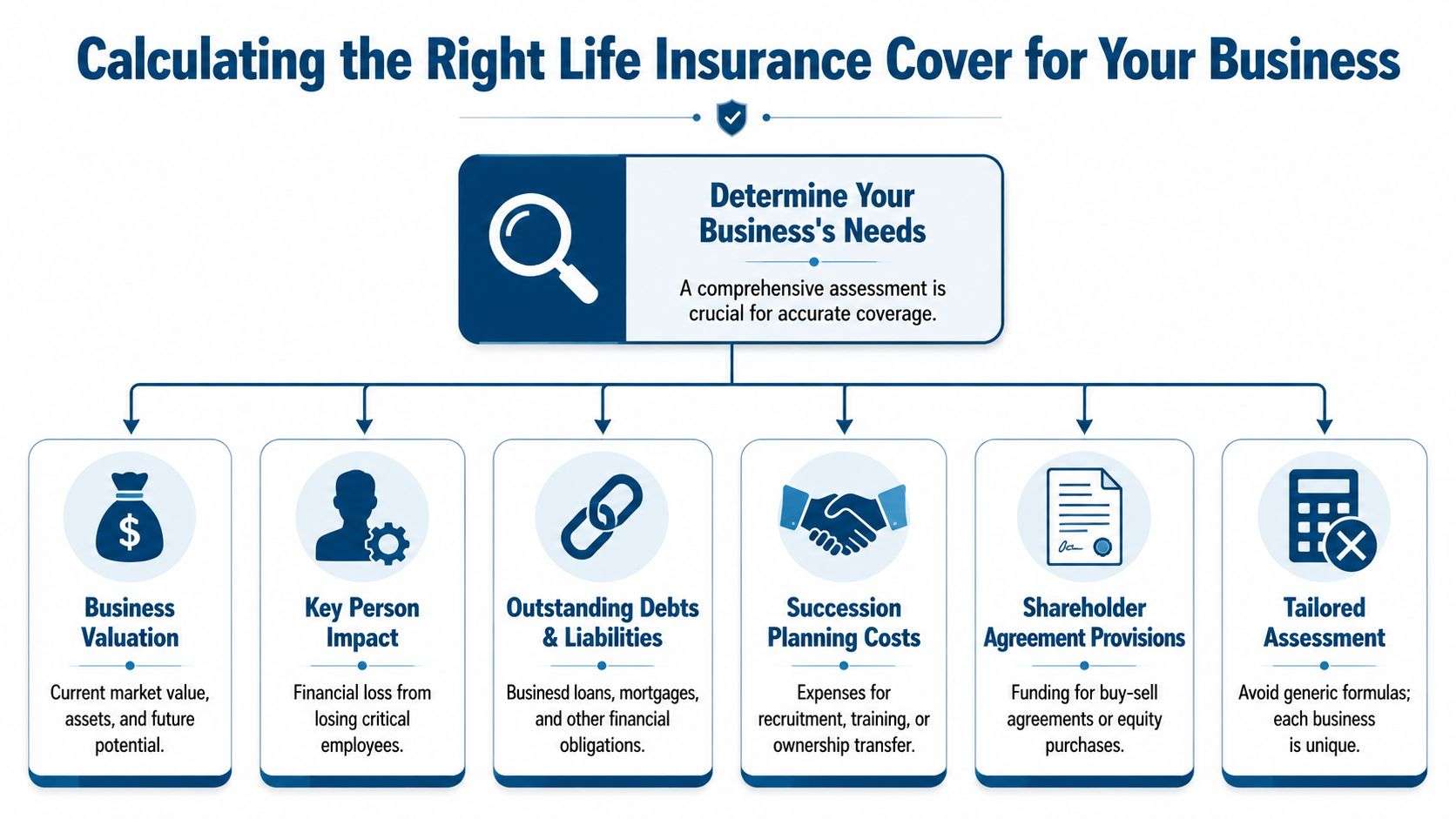
One of the worst ways to set business cover is to pick a round number or use a simple multiple of salary. That can be miles away from the actual exposure, especially for owner-managed companies where income, dividends, retained profits and debt obligations don’t fit a neat formula.
A better method is to work from the financial risks the business would face. Around half of UK SMEs use external finance, and advisers often calculate cover by modelling three key risks: repaying business borrowing, funding shareholder buyouts and replacing lost profit. This approach is outlined in this guide on life insurance for business owners.
Start with borrowing and guarantees
Look at every business debt first. That includes obvious borrowing such as loans and commercial mortgages, but also overdrafts, director-backed facilities and any personal guarantees tied to the owner.
If the owner dies, ask two questions. Does the debt need to be repaid quickly, and would the lender still support the business on the same terms? Those answers often drive the minimum cover required.
Then value the ownership stake
In a multi-owner business, the next step is the amount needed to buy the deceased person’s shares. That should be based on a sensible business valuation, not guesswork and not whatever figure feels affordable.
A proper discussion here can be uncomfortable, but it saves arguments later. If nobody agrees the share value now, they almost certainly won’t agree it after a death.
Allow for transition capital
Most firms also need a third pot. This is the money that keeps the business steady during the handover period.
Consider costs such as:
Temporary cash flow strain
Revenue may dip while clients and suppliers adjust.Replacement costs
Recruitment, handover support and management time all carry a price.Working capital pressure
Payroll, stock and regular supplier commitments don’t pause because an owner has died.
A practical way to approach the figure
A useful planning conversation usually covers these points in order:
List every liability linked to the owner
Include business debts and any personal guarantee exposure.Confirm the current value of the owner’s stake
Use a defensible number, not a hopeful one.Estimate the short-term trading cushion needed
This is often the part owners forget.Check whether one policy or separate policies make more sense
Different risks often need different ownership structures.
For owners who are also reviewing personal family protection, this guide on how much life insurance is needed is useful for the household side of the calculation.
Key check: if your current amount of cover was chosen because it sounded reasonable rather than because it matched debt, ownership value and transition costs, it probably needs reviewing.
Advanced Planning Tax Efficiency Trusts and Loan Agreements
Business protection stops being a generic product and instead becomes proper planning. The structure matters just as much as the policy itself.
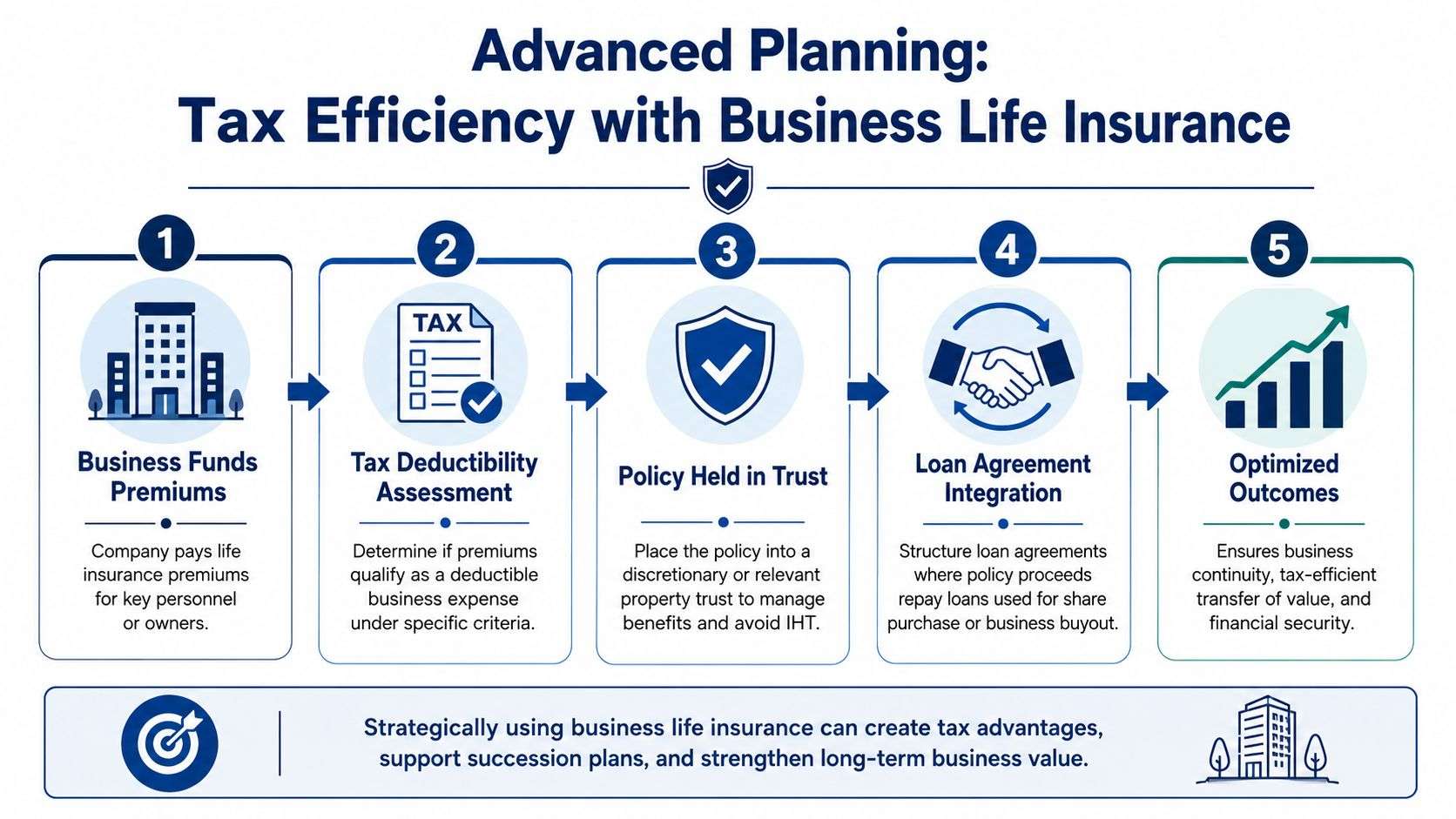
A common example is premium funding. In practice, the basic cost of cover can be similar whether it is arranged personally or through a business. The difference is that, in the right circumstances, the premium can potentially be treated as a business cost. That can reduce the company’s Corporation Tax bill, which means a £50 per month premium may cost the business as little as £37.50 per month in real terms. That doesn’t apply automatically to every policy, but it is a major reason business owners shouldn’t assume personal and business cover should always be arranged the same way.
Trusts decide speed and control
Trusts sound more complicated than they are. In simple terms, a trust is a legal wrapper that helps direct the policy proceeds to the intended people without them becoming tangled up in the estate in the wrong way.
That matters because a death claim is only useful if the money gets to the right place quickly. A trust can help reduce probate friction and support the intended succession outcome. If the cover is meant to fund a buyout, poor ownership or poor trust drafting can undo the whole plan.
This is why many advisers treat the policy, trust and legal agreement as one package. If one piece is missing, the payout may arrive too late or in the wrong hands. For a practical overview of this side of planning, see this guide to trusts.
Loans and shareholder agreements must match the cover
One of the biggest planning gaps is poor coordination between insurance, borrowing and ownership documents. It isn’t enough to say the policy will “cover the debt” or “fund the buyout”. You need to know who receives the payout, whether a lender has priority, and how the policy works alongside the shareholder or cross-option agreement.
That issue matters because business borrowing remains an active concern for smaller firms, and inheritance tax planning also remains relevant where wealth is tied up in a company or property. This summary of the issue explains that using trusts and correct policy ownership is vital to avoid avoidable tax or probate friction.
What usually works best
In practice, the cleaner arrangements tend to have these features:
The purpose of each policy is clear
Debt repayment, shareholder buyout and family provision are treated separately where needed.The ownership matches the intended payout
The business, trustees or individuals own the policy for a reason.The legal documents speak to each other
Loan terms, trusts and shareholder agreements aren’t drafted in isolation.
If a lender, accountant and solicitor would each describe your protection plan differently, it probably hasn’t been joined up properly.
Securing Your Policy and Answering Your Questions
Getting cover doesn’t need to be painful, but it does need to be structured properly. For a business owner in Chelmsford or Colchester, the process should be straightforward if the groundwork is done in the right order.
How to put cover in place
Identify the risk
Decide whether the main issue is debt, loss of a key person, ownership succession, family protection, or a mix of all four.Gather the commercial facts
Have the borrowing details, shareholder split, business value and any guarantees ready.Choose the right policy type
Key person, shareholder protection, and relevant life policies need clear separation.Underwrite properly
Insurer choice often depends as much on medical underwriting limits and process as on premium. Aviva, Legal & General and Zurich are important names in this market, while providers such as The Exeter and National Friendly can be useful in some medical cases.Align the legal paperwork
This is the stage many firms skip. Most business owners fail to coordinate life insurance with personal guarantees and shareholder agreements, and with refinancing pressure still affecting UK SMEs, it is important to clarify whether a lender is the first loss payee and how the policy is reflected in the loan documents, as discussed in this overview of business-owner life cover and borrowing coordination.
Common questions from business owners
Are business policies more expensive than personal ones
Not necessarily in basic pricing terms. The starting cost of cover can be similar. The primary difference is often in how the premium is paid and whether the business may benefit from tax treatment that changes the net cost.
Which insurer is best
There isn’t one universal answer. Price matters, but underwriting matters just as much. Some insurers are more straightforward for certain medical histories, occupations or cover structures.
What mistake do owners make most often
They have no cover at all, or they only arrange enough to satisfy a lender. That leaves major gaps around share ownership, family liquidity and continuity planning.
Get the documents right, not just the premium. Cheap cover with the wrong ownership structure is still bad cover.
If your business would face disruption, debt pressure or an ownership problem after your death, now is the right time to fix it.
If you’re ready to protect your company, your family and your succession plan, speak to EHF Mortgages for personalised advice on business protection, trusts and life insurance planning.





