
Buying a home as a key worker in Essex can feel backwards. You’re in a stable profession, you may work long hours, and yet the mortgage maths still doesn’t neatly fit. That’s especially true in places like Chelmsford, Braintree and Colchester, where affordability pressure is real.
💡 Top Tip: Have your last three months’ payslips, bank statements, and valid ID ready before you even start viewing properties. That one step can remove avoidable delays later. I’ll explain why in more detail below.
For many key workers, the issue isn’t a lack of commitment or even a lack of income. It’s that mortgage lending rarely fits neatly around overtime, shift patterns, pension deductions and premium pay. That’s why key worker home loans are often less about finding one special mortgage and more about finding a lender whose criteria match how you’re paid.
Your Path to Homeownership as a Key Worker
A nurse finishing a late shift in Chelmsford, a police officer based in Essex, or a teacher commuting across Colchester can all hit the same wall. On paper, the job looks secure. In practice, the deposit, the monthly payment, and the lender’s affordability model don’t always line up.

Why the pressure feels so sharp
The current market explains a lot. Uswitch’s UK mortgage statistics report that the average UK mortgage was £184,445 in Q1 2024, with average repayments of about £1,176 per month based on a 25-year loan at a 2-year fixed rate of 5.89%. For key workers, those aren’t abstract numbers. They are the kind of figures that decide whether a purchase is comfortable, stretched, or out of reach.
That’s why broad advice like “check if you qualify as a key worker” usually isn’t enough. In practice, the key questions are more practical. Will a lender count your overtime? Will they reduce affordability because of pension deductions? Will they treat your shift pattern as stable income or variable income?
Practical rule: The lender that looks cheapest at first glance isn’t always the lender that will lend enough.
What usually helps first
Before rates, products and property searches, get the basics lined up:
Payslips ready: Lenders and brokers need to see how your income is built, not just your basic salary.
Bank statements organised: These help show salary credits, regular commitments and address consistency.
ID and address details accurate: Small mismatches slow applications more often than most buyers expect.
That admin matters because key worker cases often need a closer look at income structure. If your documents are complete from day one, it’s much easier to place the case properly and avoid going to a lender that was never likely to assess your income in the right way.

What Exactly Are Key Worker Home Loans
The term key worker home loans sounds as if there should be one dedicated mortgage sitting on a shelf, ready for NHS staff, police officers or teachers. That usually isn’t how it works.
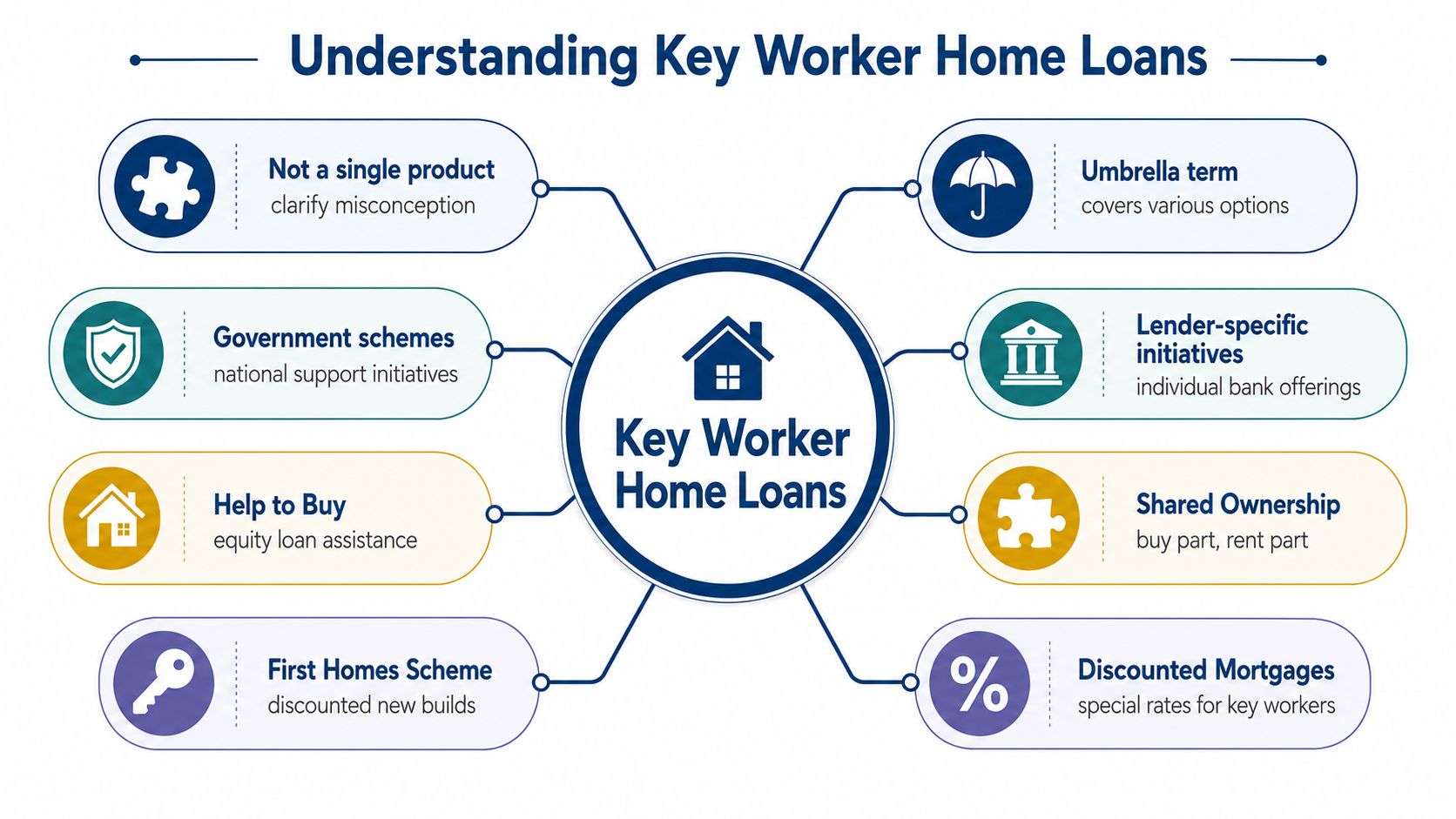
In practice, this phrase covers a mix of older government support models, current housing schemes, and lender-specific approaches that may suit public-sector income better than others. The first thing to understand is simple. It’s an umbrella term, not one universal product.
The historical idea behind them
There has been a long-running policy logic in the UK around helping essential workers access homeownership. HMRC’s guidance on the Key Worker Living arrangement shows that an equity loan of up to £50,000 could be made, and some London teachers could access up to £100,000. Repayment could be deferred until the property was sold or the worker stopped being a key worker, and the support could involve an equity stake linked to the property’s value.
That matters because it shows what key worker support has historically been about. Not a gimmick. Not just a cheaper headline rate. It was targeted affordability help.
What the phrase usually means today
Today, when people ask about key worker home loans, they are often really asking one of these questions:
Are there any schemes I can use? Some buyers may have access to scheme-based support depending on location, property type and eligibility.
Will a lender treat my income fairly? This is often the bigger issue for police and NHS applicants.
Can I borrow enough to buy where I work? That’s the question that decides whether a purchase is possible.
A lot of public-sector borrowers are better served by lender selection than by chasing a supposed key worker discount. Some lenders are more comfortable with complex payslips, allowances and structured overtime than others. That’s why it often makes sense to look at specialist mortgages for professionals rather than assuming there’s one dedicated “key worker mortgage” product.
“The label matters less than the lender’s criteria. If the lender understands your pay structure, that’s where the difference is made.”
What doesn’t work
A common mistake is assuming your profession alone provides better terms. Sometimes it helps. Often it doesn’t.
What usually fails is:
Relying on a generic online calculator: It may ignore the parts of your income that make the case workable.
Assuming every bank views public-sector pay the same way: They don’t.
Focusing only on rate: If the lender won’t use enough of your income, the cheapest deal may be irrelevant.
Checking Your Eligibility as a Key Worker
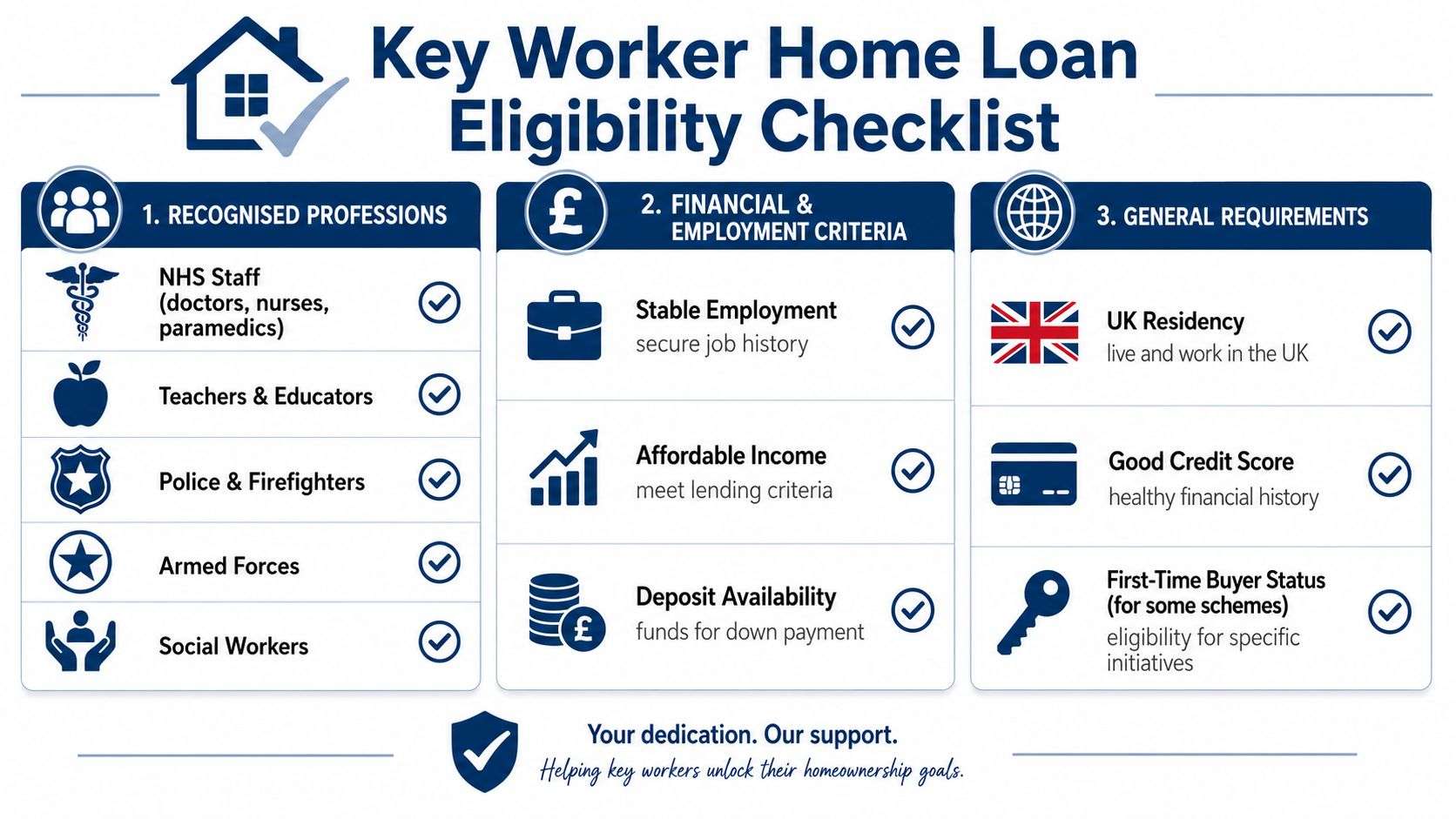
Eligibility has two parts. The first is whether your profession is likely to be recognised as a key worker. The second, and usually more important part, is whether you still meet normal mortgage rules on income, credit profile, deposit and affordability.
Roles commonly treated as key worker professions
Lenders and schemes often focus on essential public-facing professions such as:
NHS staff: including nurses, doctors, paramedics and other clinical workers
Teachers and education staff: especially those employed in established roles
Police and firefighters: shift-based income is common here, so lender criteria matters
Armed forces personnel: some lenders have specific policies for service applicants
Social workers and similar public-service roles: often included depending on the lender or scheme
That said, the job title alone doesn’t approve the mortgage.
A simple self-check before you apply
Use this checklist before speaking to a broker or lender:
Employment is stable: You can show consistent income and a clear employment position.
Credit history is clean enough for mainstream lending: Minor issues may still be workable, but they need handling carefully.
Deposit is available: It needs to be evidenced clearly.
Documents match your current circumstances: Names, addresses and account details should all line up.
Your income can be explained clearly: This is especially important if overtime or allowances form part of your monthly pay.
A short video can help if you want a quick overview before getting into lender detail.
The part many buyers miss
Being a key worker may help direct the search. It doesn’t remove normal underwriting.
Lenders still want to know whether the mortgage is affordable on their terms. That’s why some applicants who look strong on paper get disappointing borrowing figures. The issue is often not the profession, but how the lender interprets the income behind it.
How Lenders Assess Your Income and Affordability
Most key worker mortgage cases are won or lost here.
A police officer may earn a strong salary once overtime and premium payments are included. An NHS worker may have a reliable pattern of enhancements for nights, weekends or bank work. Yet a lender can still reduce the usable income if they don’t like the way it’s evidenced or if their policy only accepts part of it.
The practical affordability problem highlighted here represents the core challenge. The key question isn’t whether you qualify as a key worker. It’s whether the lender materially changes your purchase options. That matters in a market where the median UK house price was 8.4 times median full-time earnings in 2023, and 12.3 times in London.
Over time, allowances and premium pay
This is the issue I see most often with key worker borrowers in Essex. The basic salary may be fine, but actual affordability comes from income beyond that.
Some lenders are comfortable with regular overtime if it’s clearly established. Others want a longer track record. Some are more generous with shift allowances or unsociable-hours payments. Others take a much harder line.
Broker view: A strong income isn’t enough on its own. It has to be income the lender is prepared to use.
For police and NHS staff, consistency matters. If overtime swings wildly, some lenders will trim it. If it’s stable and visible across payslips and bank statements, the case becomes much easier to place.
Pension deductions can reduce borrowing
A second issue is public-sector pension contributions. They are often larger and more structured than in many private-sector roles.
Some lenders give those deductions greater weight in affordability calculations. That can reduce the maximum loan even when the salary looks solid. This catches buyers out because they focus on gross pay, while the lender is paying close attention to what leaves the account each month.
Here’s a practical comparison of how lender thinking can differ:
| Lender Type | View on Basic Salary | View on Overtime and Allowances | Pension Contribution Impact | Example |
|---|---|---|---|---|
| High street lender with standard policy | Usually straightforward | May only use part of variable income | May reduce affordability where deductions are higher | Applicant with strong basic pay but limited use of enhancements |
| High street lender with flexible public-sector approach | Usually straightforward | More open to regular, evidenced overtime | Can be more pragmatic depending on policy | NHS worker with consistent shift income |
| Building society approach | Can be case-specific | Often depends on underwriter view and proof | May look closely at net disposable income | Teacher with stable salary and modest extras |
| Lender comfortable with complex income | Strong if employment is established | Better for layered income where consistency is clear | Reviews deductions in wider affordability context | Police applicant with regular premium payments |
The point isn’t that one category is always best. It’s that lender fit matters more than the label on the product.
What tends to work best
In many key worker cases, mainstream names are still in the frame. Nationwide BS and NatWest are often among the lenders considered when the income profile fits their criteria. But the right choice depends on the exact payslip, not the profession alone.
If you want to understand the mechanics behind borrowing limits, this guide to mortgage affordability is useful background. Once you understand how lenders read income, the decisions start to make more sense.
Your Step-by-Step Mortgage Application Guide
The buyers who move quickest are rarely the ones who rush. They are the ones who prepare properly.
That top tip at the start matters because mortgage applications slow down when key documents are missing, addresses don’t match, or income can’t be explained clearly. For key workers with variable pay, preparation is even more important because the lender may ask extra questions about how earnings are built.

Get your paperwork right first
Start here:
Payslips: Have recent payslips ready, especially if they show overtime, enhancements or allowances.
Bank statements: Make sure salary credits are visible and spending is easy to follow.
Proof of ID: Use valid identification and check the details are current.
Proof of deposit: Keep the source clear if funds are coming from savings or family support.
Address history: Make sure every document reflects the right current home and matches the application.
That last point matters more than people expect. A simple address mismatch can trigger avoidable back-and-forth.
The application path that tends to run smoothly
Initial advice
During this stage, income is reviewed properly. If you’re in the NHS or police and your earnings include extras, this stage matters because it shapes lender choice from the start.Agreement in Principle
An AIP helps show you’re a credible buyer. It also flushes out obvious affordability issues before you commit to a property.Property search with the right budget
A realistic borrowing figure is better than an optimistic one. It saves wasted viewings and failed offers.Full application
Underwriters examine documents in detail. Clear payslips and consistent statements make a major difference.Valuation and underwriting
The property has to satisfy the lender, and so does the applicant profile. If income is variable, expect a closer review.Offer, legal work and completion
Once the mortgage offer is issued, the legal side takes over. Delays here are common, but the mortgage part is usually easier if the case was packaged correctly at the start.
Keep every document exactly as issued. Don’t crop PDFs, rename files carelessly, or send screenshots unless asked. Underwriters want clean evidence.
What causes avoidable delays
Three things come up repeatedly:
Inconsistent address information
Unclear salary structure on payslips
Missing pages from statements or ID documents
None of these is dramatic, but they waste time. For a buyer trying to secure a property in a competitive Essex market, that time matters.
Finding Your Key Worker Mortgage in Essex
The national picture only gets you so far. The actual decision is local.
A key worker looking in Chelmsford may have a different set of options from someone buying in Braintree or Colchester. Commute, property type, deposit strength and income structure all change what’s realistic. Two buyers on similar salaries can end up with very different results if one lender uses overtime well and another doesn’t.
Why local knowledge matters
In Essex, practicality beats theory. Buyers often need to balance where they work against what they can sensibly borrow and what sort of property a lender will support.
That’s why local mortgage advice can be useful. It isn’t just about rates. It’s about understanding the lender’s appetite for your income type, your profession, and the kind of property you’re trying to buy in your target area. If you’re house hunting around Colchester, a broker with local knowledge can also help you think clearly about budget versus commute, rather than stretching for the wrong purchase. Readers looking specifically in that area may also find this mortgage adviser Colchester page helpful.
What usually works in practice
The strongest key worker applications tend to have three things in common:
The income story is clear: especially where payslips include enhancements
The lender choice is deliberate: chosen for criteria, not just branding
The budget is grounded in real affordability: not just what an online tool suggested
That’s the reality of key worker home loans. There usually isn’t one magic scheme that fixes everything. The true win comes from matching the case to the right lender and presenting the income properly.
If you’re an NHS worker, police officer, teacher, or other key worker in Chelmsford, Braintree, Colchester, or across Essex, your next move should be practical. Get your paperwork together, have your income properly reviewed, and make sure the lender is chosen based on how you’re paid.
If you’re ready to find out what your options really look like, speak to EHF Mortgages and get advice specific to your income, deposit, and target area in Essex.





