
A healthy 35-year-old non-smoker looking for £1,500 a month of income protection could be quoted £35.81 a month, while the average Brit expected £58.43, which means many people overestimate the cost by 63%. That gap matters because it stops plenty of homeowners and borrowers from even asking for a quote.
💡 Top tip: income protection is often cheaper than people assume, but the price only makes sense once you understand what you’re buying. I’ll explain that properly as we go, because the monthly figure on its own never tells the full story.
For clients across Chelmsford, Braintree, Colchester and wider Essex, I find the same pattern again and again. People worry that the cover will be expensive, then discover that the key consideration isn’t cost alone. It’s whether the policy fits their income, mortgage, sick pay, and job properly.
Your Guide to Income Protection Costs
A 2025 pricing example found that a healthy 35-year-old non-smoker seeking £1,500 a month of cover could be quoted £35.81 a month, while the average Brit expected £58.43, according to Drewberry’s 2025 income protection pricing example. That gap matters because it shows why broad price assumptions are so misleading.

The monthly premium only makes sense once you tie it to the choices behind it. In practice, the price changes when you alter the deferred period, the monthly benefit amount, the end date, and the definition of incapacity. Two policies can fall under the same label and produce very different outcomes if you need to make a claim.
That is the part clients usually care about once we get past the headline figure. A lower premium can be sensible if you have strong employer sick pay or a healthy emergency fund. It can also be a false economy if the policy does not start paying soon enough to protect your mortgage, rent, or regular household bills.
Why the headline price can mislead
One quote can look cheap because it pays out under narrower terms or because it is set up with a longer wait before benefits begin. Another can cost more because it gives broader protection and a better fit for your income pattern. The question is what your money is buying each month.
For example, a policy priced at £56 a month can be perfectly reasonable if it is covering a stronger benefit structure than a cheaper alternative. That is why I tell clients in Chelmsford to compare the claim trigger, the waiting period, and the duration the insurer would continue paying. Monthly cost matters, but value matters more.
Practical rule: compare income protection by what it would do for your household if you were off work for six months, not by the premium in isolation.
If you are still weighing up whether this type of cover belongs in your budget, you can explore My Policy Quote’s disability guide for added context. For a plain-English UK explanation of the cover itself, this guide on what income protection insurance is and how it safeguards your income is useful.
What clients usually want to know first
The first questions are usually practical.
Can the premium fit a normal monthly budget? Often yes, if the benefit and deferred period are set sensibly.
Will it cover all outgoings? It can cover a meaningful share of them, but the right benefit level needs to be chosen.
Can the cost be reduced? Yes, usually by adjusting the policy design, though each adjustment gives something up.
Is the cheapest policy good enough? Sometimes. Often, it is only cheap because the protection is weaker where it counts.
A policy should match real life. If your employer pays six months of sick pay, you may not need benefits to start quickly. If you are self-employed with little cash reserve, waiting too long for the policy to pay can leave a serious gap. That is why income protection costs are best judged case by case, based on the trade-offs you are willing to make.
The Key Factors That Influence Your Premium
Insurers don’t price everyone the same way. They look at the likelihood of a claim being made and how long that claim might last. In practice, advisers often benchmark premiums at about 1% to 3% of annual salary, and that range is wide because design choices can materially change the insurer’s risk, as explained in Policygenius’ overview of income protection pricing factors.
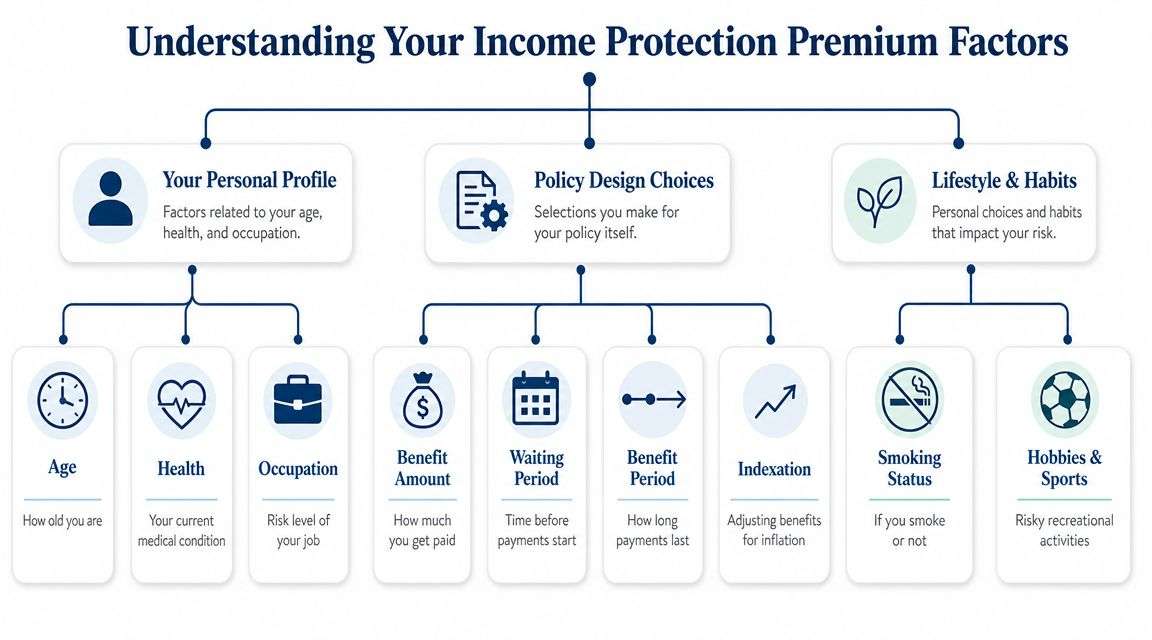
Your personal profile
A few parts of the application are about you rather than the policy itself.
Age: older applicants usually pay more than younger applicants because the insurer assesses a different level of risk.
Health: medical history can affect whether the policy is offered on standard terms, with exclusions, or at a higher cost.
Occupation: this is a big one. A desk-based role in Colchester is often seen differently from a manual trade, where injury risk and time off work may be more likely.
Smoking status: smokers usually face higher premiums because the insurer prices for increased health risk.
Your policy design choices
Many people have more control than they realise.
A deferred period is the waiting time between being unable to work and the insurer starting payments. Think of it a bit like choosing how long you can self-fund before the policy steps in. A longer deferred period often lowers the premium because the insurer is not pricing for the earliest short-term absences.
A benefit period is the length of time the insurer will continue paying once a valid claim is in force. A longer benefit term usually costs more because the insurer may be at risk for a longer period.
A 90-day deferment is often cheaper than a 30-day deferment because the insurer isn’t covering those earliest, more frequent short absences.
The amount you want to protect
The more monthly benefits you ask for, the more the policy is likely to cost. That sounds obvious, but a better way to think about it is affordability relative to essential spending.
If your mortgage, household bills and core commitments could still be met with a lower monthly benefit, there’s no need to over-insure. On the other hand, cutting the benefit too far can leave the policy looking affordable on paper but weak when life goes wrong.
Small choices that change the quote
Here are the decisions that most often move a premium up or down:
Shorter waiting period: usually costs more, because the insurer may start paying sooner.
Longer claim duration: usually costs more, because support could continue for much longer.
Broader incapacity wording: stronger cover often costs more, but can be far better value.
Inflation-linked increases: can help the cover keep pace over time, though it may raise the cost.

Real World Scenarios and Example Quotes
The best way to understand cost is to look at how the same type of cover behaves for different people. The exact premium always depends on underwriting and product choice, but the quote structure follows the same logic.
One of the most important points, especially for self-employed clients and borrowers with large housing costs, is that UK income protection is typically designed to replace around 50% to 70% of gross income, with some consumer guidance noting cover can go as high as 85% depending on policy structure, as discussed in Western & Southern’s guide to income protection cover levels.
Example Income Protection Monthly Premiums 2026
| Scenario Profile | Monthly Benefit | Deferred Period | Occupation Type | Example Premium |
|---|---|---|---|---|
| Healthy 35-year-old non-smoker | £1,500 | Not specified in the source example | Lower-risk example profile | £35.81 per month |
| Healthy 35-year-old non-smoker with more comprehensive policy | Not specified in the source example | Policy includes £250 excess | Lower-risk example profile | £56 per month |
| Self-employed applicant with irregular earnings | Tailored to provable gross income | Can be adjusted to manage cost | Depends on trade or profession | Varies by underwriting and policy design |
| Homeowner wanting cover aligned to mortgage-heavy spending | Tailored to budget and income limits | Shorter deferment usually increases cost | Depends on job and health | Varies by underwriting and policy design |
What these scenarios mean in practice
For a younger employed professional in Chelmsford, the key issue is often value rather than access. If they have good employer sick pay, a longer deferred period may make sense and can reduce the monthly cost. If they have little savings, a shorter waiting period may be worth paying more for.
For a self-employed tradesperson in Braintree, the conversation is different. The insurer will still focus on occupation, health and benefit level, but the proof of income becomes more important because cover is usually linked to earnings rather than to the size of the mortgage alone. That catches some people out. A household can have high monthly commitments while declared income looks modest on paper.
For an older homeowner in Colchester who is remortgaging, the question is often how to keep core bills covered if illness or injury stops work. That may mean accepting a slightly different policy design to balance affordability against proper protection.
What works and what doesn’t
What usually works well:
Matching the deferred period to sick pay or savings
Setting the benefit around essential spending rather than every possible outgoing
Using realistic income figures for self-employed applications
Checking the occupation definition carefully before choosing the cheapest quote
What tends not to work:
Buying on premium alone
Asking for the maximum benefit without considering affordability
Ignoring how long payments would last
Assuming a policy will fit mortgage needs just because the monthly benefit looks large enough
The strongest policy isn’t always the most expensive one. It’s the one that fits your real cash flow when work stops.
Practical Ways to Reduce Your Monthly Cost
You can often bring the premium down without stripping the policy of its value. The trick is to adjust the right levers, not just cut cover blindly.

Start with the waiting period
The most effective cost-saving option is often the deferred period. If your employer gives generous sick pay, or you’ve built enough savings to cover the early months, choosing a longer wait before benefits start can make the policy more affordable.
That only works if the gap is realistic. If your money runs short after a few weeks, pushing the deferment too far just to shave the premium can create a dangerous hole in your planning.
Adjust the benefit with care
Many people try to cut the premium by reducing the monthly benefit. That can work, but only if you first separate essential costs from flexible spending.
A sensible review normally includes:
Mortgage or rent: the payment that must still be made every month
Household bills: energy, council tax, food, transport and insurance
Debt commitments: anything you can’t easily pause
Family costs: childcare or other regular obligations
If the revised benefit still covers the basics, that can be a sound compromise. If it leaves you relying on credit cards, it isn’t a saving – It’s a problem delayed.
Don’t chase the cheapest wording
One risk is saving money in a disadvantageous manner. A narrower policy definition can reduce the premium but also make claiming harder in practice.
“A cheaper policy only saves money if it still does the job when your income stops.”
Think in terms of long-term value
A policy is there to protect income over time, not just to hit a price point this month. That’s why quality matters. UK insurers paid £734 million in income protection claims in 2021, which underlines that this cover exists for a very real financial risk, as noted in Gen Re’s discussion of the growing need for income protection.
I’d also keep these practical cost controls in mind:
Review your smoking status: if you stop smoking and remain eligible under the insurer’s rules, it may improve future pricing.
Avoid overcomplicating the policy: only add options that matter to your household.
Check your existing safety nets: employer benefits and emergency savings should shape the design.
Get the structure right first time: changing a poor-fit policy later can be more hassle than setting it up properly at the start.
Comparing Policies The Smart Way Not Just by Price
A cheap premium can be attractive. A weak policy can be costly when you need to make a claim.
The most important point of comparison is usually the definition of incapacity. In plain terms, this is the rule that decides whether the insurer accepts that you’re unable to do your job. The stronger versions tend to be more valuable because they focus on your own work rather than on whether you could do some other job.
Questions worth asking before you compare quotes
Instead of asking only “what’s the monthly premium?”, ask:
What definition of incapacity does this policy use?
How long would it pay for if I couldn’t work?
Does the cover keep pace with inflation if I’m off for a long time?
Are the premiums guaranteed, or can they change?
Does this suit my actual role and income pattern?
That approach often changes the shortlist very quickly. A lower premium with weaker wording may not be the better deal at all.
For a broader look at how protection products differ, Life Cover Plans’ guide to protection is a useful companion read. If you’re actively reviewing options, this page on comparing income protection policies is a practical next step.
Featured Quote
“The right policy is the one you can afford to keep and would trust to pay when your earnings stop.”
Why tailored advice matters
Two people with the same salary can still need very different policy structures. One may have strong employer sick pay and no children. Another may be self-employed with a large mortgage and little room for missed income.
That’s why a proper recommendation should fit the household, not just the pay slip. In practice, some borrowers use a broker such as EHF Mortgages to compare protection options alongside their mortgage planning, especially where self-employed income or remortgaging changes the level of cover needed.
Frequently Asked Questions About Income Protection
Is income protection worth it if I already have some savings?
It can be. Savings are useful, but they can disappear faster than anticipated when a mortgage, food, utilities, and insurance still need to be paid every month. Income protection is there to support a longer interruption to earnings, not just a short gap.
A savings pot and an income protection policy do different jobs. One buys time. The other provides ongoing support if recovery takes longer.
Is it better to judge the cost monthly or over the life of the policy?
Monthly affordability matters, but it shouldn’t be the only lens. A policy may look inexpensive or expensive in isolation, yet the better test is whether it gives the right support for the years you may keep it and the circumstances in which you’d rely on it.
Can self-employed people get good cover?
Yes, but the setup needs care. The key issue is proving income in a way the insurer can use, then matching the benefit to what the policy is designed to replace. That matters a lot for borrowers whose outgoings are driven by a mortgage while their taxable income may fluctuate.
Does income protection cover my full salary?
Usually not. Insurers generally cap cover as a proportion of income, so the policy replaces part of your earnings rather than every pound you normally receive. That’s why budgeting the benefit around essentials is so important. Any benefit is paid tax-free, so you may find your income protection is close to your normal net pay.
Should I choose the cheapest quote online?
Not automatically. The cheapest policy may have a longer waiting period than you can cope with, weaker definitions, or features that don’t suit your job. Price matters, but it only matters after the structure is right.
What if I have a medical condition
You should still ask. A pre-existing condition doesn’t always mean a decline. The insurer may offer standard terms, an exclusion for that condition, or a different premium. The best approach is to disclose everything clearly at the application stage so the quote reflects your actual circumstances.
Your Next Steps to Secure the Right Cover
By this point, the main thing should be clear. The cost of income protection insurance is personal. There isn’t one universal premium that applies to everyone in Essex, and the cheapest quote is rarely the most useful benchmark.
A sensible next step is to properly gather the details that shape the quote. Your job, income, smoking status, sick pay, monthly essentials and how long you could manage before a policy starts paying all matter. Once those pieces are in place, the options become much easier to judge.
If you want a broader UK view of product selection, this guide to the best income protection insurance in the UK is a helpful place to continue your research. And if you’re wondering how applications are often handled more efficiently today, this article on paperless solutions for insurance gives useful background on modern digital processes.
The right result isn’t just a low premium. It’s a policy you understand, can afford, and would be glad to have if illness or injury stopped your income.
If you’re ready to talk through your options, get personalised guidance from EHF Mortgages by contacting the team via the link below.





