
A flat above a shop can look like a smart buy. The price is often sharper than a similar flat on a purely residential street, the location can be excellent in places like Chelmsford or Colchester, and for landlords, the rental appeal can be strong.
The hesitation usually arrives a few minutes later. Can you really get a mortgage on it?
💡 Top Tip: Don’t fall in love with the property before a broker has assessed the shop below. That single check can save you time, wasted survey costs, and a nasty surprise on deposit requirements. I’ll explain why later.
If you’re comparing a high-street flat over a salon, office, shop, takeaway or pub, the mortgage side needs more care than a standard purchase. Lenders don’t just look at you. They look closely at the commercial unit, the lease, the access arrangements, the insurance position, and how easy it would be to resell the flat if they ever had to repossess it.

That matters whether you’re buying to live in the property, buying as a landlord, or weighing up a broader investment strategy such as mastering the BRRRR method. The numbers can work, but only if the finances are realistic from the start.
Introduction
A flat above a shop mortgage is often possible. It just isn’t as straightforward as a mortgage on a standard flat.
The main reason is simple. Lenders treat these properties as non-standard security. In practice, that means fewer lenders, more detailed underwriting, and a bigger gap between an easy case and a difficult one. Two flats in the same Essex town can have completely different outcomes purely because one sits above a quiet retail unit and the other sits above a late-opening food business.
Practical rule: Judge the property by the business underneath before you judge it by the kitchen, bathroom, or asking price.
For buyers in Chelmsford, Braintree and Colchester, this catches people out all the time. They assume the challenge is their income, deposit, or credit profile. Often it isn’t. The first hurdle is the unit below and how the lender sees the risk.
A workable purchase usually comes down to a handful of issues:
Commercial use below: Quiet daytime businesses tend to be easier than food, drink, or high-footfall premises.
Title and access: Lenders usually want a clear residential title and proper separate access.
Lease quality: Restrictive clauses, short lease terms, or odd repairing obligations can derail the case.
Insurance and valuation: If either becomes awkward, the mortgage can slow down or stop.
Handled properly, these cases are very achievable. Handled casually, they can become expensive and frustrating very quickly.
What Exactly Is a Flat Above a Shop Mortgage
A flat above a shop mortgage isn’t a special branded mortgage product. It’s usually a standard residential or buy-to-let mortgage applied to a property that lenders consider more complex.
Buying a car with an unusual service history presents a similar situation. It may still be a perfectly good vehicle, but the buyer needs more checks before they’re comfortable. Lenders do the same with shop-top flats.
Why lenders treat them differently
In the UK, flats above shops are generally treated as non-standard security because the commercial unit can affect resale value, insurability and lender appetite. Industry guidance also shows that deposit expectations can vary by business type. Quiet retail can sometimes mean deposits around 10% to 15%, while properties above restaurants or pubs can push deposits to about 20% to 40%, according to Manor Mortgages guidance on flats above shops.
That doesn’t mean the property is un-mortgageable. It means the lender wants to know how saleable it will be later.
What this means for you as a borrower
The practical difference is felt in four places.
Lender choice narrows: Not every high-street lender wants this type of security.
Terms can tighten: A stronger deposit may be needed, even when your own profile is solid.
The property gets underwritten harder: The lease, access, title setup and use below matter more.
The valuation carries more weight: A valuer’s comments on smell, noise, footfall or marketability can shape the whole case.
A flat above a shop can be a good purchase. It just needs to pass a property test as well as a borrower test.
The details that usually matter most
For borrowers in England and Wales, a mortgage tends to be more viable when the flat has a separate residential title and the lender is content with the lease, access, and commercial use beneath it. If any one of those is weak, the case becomes more specialist and sometimes more expensive.
That’s why a flat over a beauty salon in Chelmsford city centre can be a very different proposition from a flat over a takeaway, even if both look attractive on paper.

Lender Criteria and High-Risk Commercial Properties
The business below the flat is usually the first thing a lender wants to understand. Before they worry about décor, your plans for the property, or even the postcode, they want to know what trades downstairs.
“Flats above shops need to be in desirable and popular areas, and not near the normal perils, the smellies. Restaurants, takeaways, dry cleaners, nail bars, to name a few. Flats above these types of shops are not popular with lenders.”
Lower-risk and higher-risk shop uses
Older users of class language still come up in property conversations because it gives people a simple shorthand.
A1 or standard retail style uses: newsagents, convenience retail, clothing shops
A2 or professional services style uses: estate agencies, offices, financial services
A3 to A5 style uses: cafés, restaurants, pubs, bars, hot food takeaways
Lenders don’t all use the same labels internally, but the practical split is clear. Quiet, daytime, low-odour businesses are easier. Food, drink and late-night uses are harder.
Why do some businesses worry lenders?
Lenders are looking at future saleability and building risk. They know certain businesses create recurring concerns:
Noise: Late closing or delivery activity can make the flat harder to sell.
Odours: Food premises are the obvious issue, but other trades can also affect desirability.
Hours of operation: A business that runs into the evening or night changes the lender’s view.
Fire and claims risk: Cooking equipment and heavier commercial use can complicate insurance.
Neighbour and anti-social concerns: Pubs and similar venues can trigger underwriting caution.
For a UK residential mortgage, a high-risk commercial use, such as a takeaway, can reduce the maximum loan-to-value ratio to around 75%, meaning a 25% deposit may be needed, as explained in Charcol’s guide to mortgages for flats above shops.
Lender risk profile by shop type
| Shop Category | Example Businesses | Lender Risk Level | Typical Deposit Range |
|---|---|---|---|
| Quiet professional | Office, agency, similar daytime use | Lower | Case by case |
| Standard retail | Shop with normal daytime trade | Medium | 10% to 15% in some cases |
| Personal services | Hairdresser, beauty salon, nail bar | Medium to higher | Case by case |
| Food and drink | Restaurant, café, takeaway | Higher | 20% to 40% can apply |
| Late-night leisure | Pub or similar venue | Higher | 20% to 40% can apply |
Where clients are buying both the commercial and residential parts, the structure may move away from a normal residential or buy-to-let route and into semi-commercial mortgage territory.
Which lenders may be relevant
For owner-occupiers, lenders such as NatWest can be worth considering on the right type of property. For landlords, specialist names such as Foundation and Kensington often come into the conversation, depending on the use below and the overall case.
The strongest applications don’t try to argue a risky property into a mainstream box. They start by matching the property to the right lender appetite.
Navigating Valuation, Leasehol,d and Insurance Hurdles
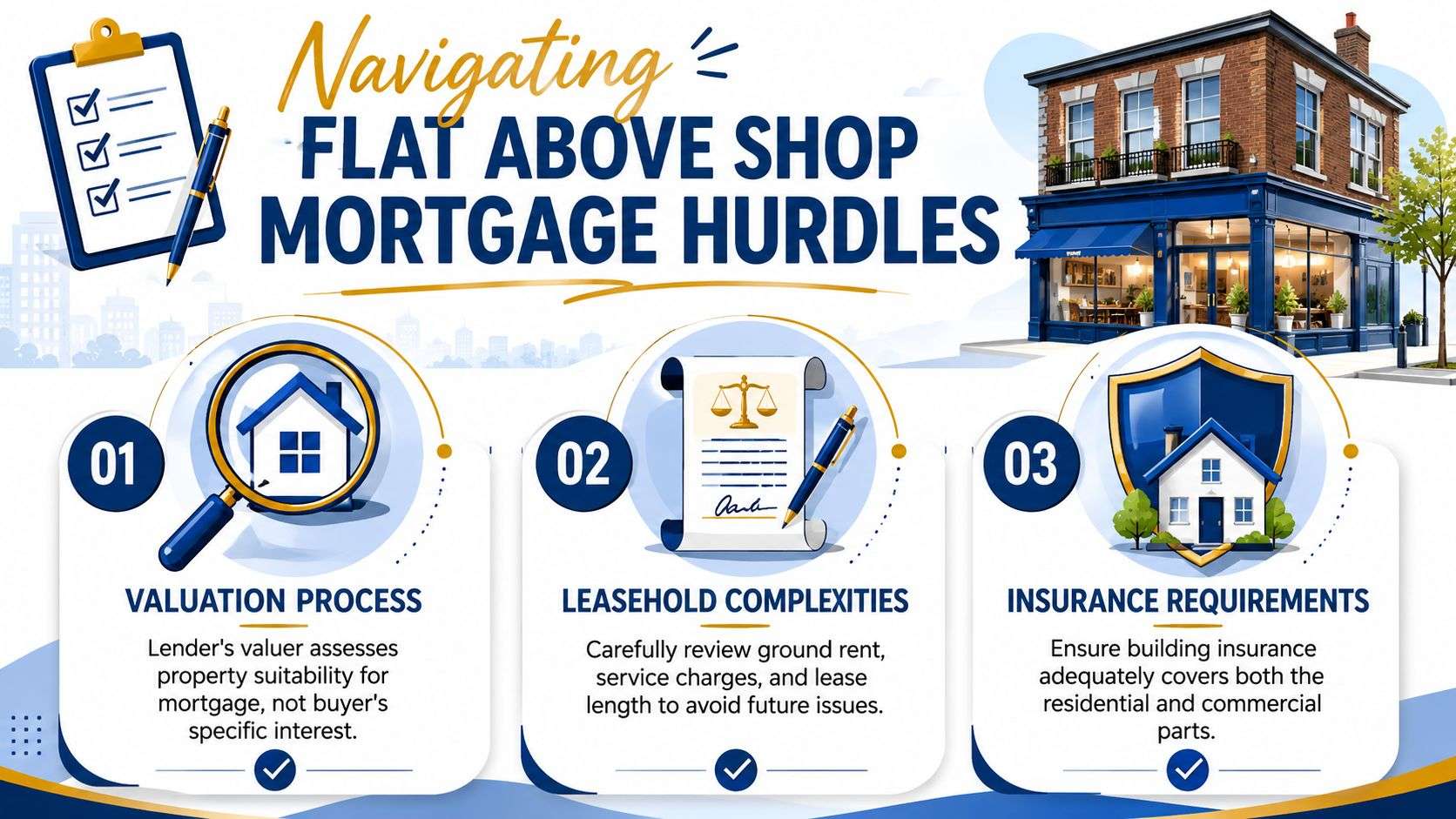
Most failed or delayed shop-top cases run into one of three technical issues. Not all three have to be perfect, but none of them can be ignored.
Valuation comes first in practice
The valuer works for the lender, not for you. Their job is to judge suitability as mortgage security and comment on anything that could affect resale.
That is why paying for your own survey too early can be a mistake. A sensible approach is to let the lender make its initial property assessment first. If the lender doesn’t like the type of flat or the use below, spending money on a survey before that point may be wasted.
Wait for the lender’s initial green light before ordering extras. On this type of property, timing matters.
Leasehold can make or break the case
Most flats above shops are leasehold, and their leases require close attention. A lender will want the solicitor to confirm that the lease is workable, the repairing obligations are clear, and there are no clauses that create obvious problems.
The points I’d expect to be checked early are:
Lease term: A shorter lease narrows options and can affect value.
Rights of access: The flat should have clear legal access that doesn’t depend on the shop opening.
Use restrictions: The commercial lease or freehold setup shouldn’t allow problematic changes without scrutiny.
Service charge and maintenance: Shared responsibility needs to be clear and sensible.
For landlords, basic compliance also matters. If you’re preparing a rental unit, a practical resource like this 2026 EICR guide for landlords helps frame the electrical safety considerations before tenancy planning gets too far ahead of the mortgage.
Insurance is often the quiet blocker
Insurance can become awkward faster than many buyers expect. If the building sits above a business with cooking equipment, late-night activity, or a heavier claims profile, some insurers become cautious. Lenders notice that immediately because building insurance is part of the risk picture.
Where a buyer wants both the flat and the shop, the whole case may need a semi-commercial mortgage rather than a standard residential route. That distinction matters because guidance in this area notes a 12% increase in mixed-use property transactions in Essex, and many guides still don’t explain that deposit requirements can be 30% or more and may affect later-life lending options.
Insurance planning should be part of the finance conversation, not left to the end. Buyers who need cover alongside the mortgage can review the protection side through home and contents insurance options.
Your Mortgage Application Process Step by Step
A lot of buyers assume the mortgage process is the same as any other flat purchase. The basic stages are similar. The difference is that a flat above a shop mortgage requires the property to be properly inspected before anyone spends money.

One reason this matters is the risk of rejection. Data on non-standard property types shows that flats above takeaways can face a 35% higher rejection rate, and buyers are sometimes shocked after valuation when a lender asks for a 40% deposit. That’s exactly why the early stages matter so much.
Step 1 starts before the Decision in Principle
The first stage is a proper broker assessment of the property itself. Not just your income and deposit.
Bring the full address, details of the business below, whether the flat has separate access, and anything you already know about title or lease. A quick early review can often spot whether the case should go to a mainstream lender, a specialist lender, or not be pursued at all.
The core stages
Initial assessment
The property and your circumstances are checked together. Obvious issues are filtered out at this stage.Decision in Principle
A DIP can show whether a lender is happy with you as a borrower, but on this kind of property, it isn’t the final word on the flat itself.Full application
The lender reviews documents and property details in more depth.Valuation
The valuer comments on marketability, risks and suitability.Offer
If the underwriting, valuation, and legal work align, the lender issues the mortgage offer.
Documents to prepare
Proof of income: Payslips, accounts, or tax documents, depending on employment type.
Bank statements: Recent statements that support affordability and conduct.
Proof of deposit: Savings evidence, gifted deposit paperwork if relevant.
Property details: Sales particulars, tenure information, and commercial use below.
ID and address evidence: Standard anti-money laundering documents.
Landlord figures where relevant: Expected rent and any existing portfolio details.
A short explainer can also help if you want a visual overview before applying:
Where buyers usually trip up
They treat the DIP as confirmation that the property is fine. It isn’t. On a shop-top flat, the lender still has to sign off the actual security.
That’s why speed matters less than accuracy. A clean application with the right lender is better than a rushed one to a lender that was never likely to accept the property.
Common Pitfalls and How to Avoid Them
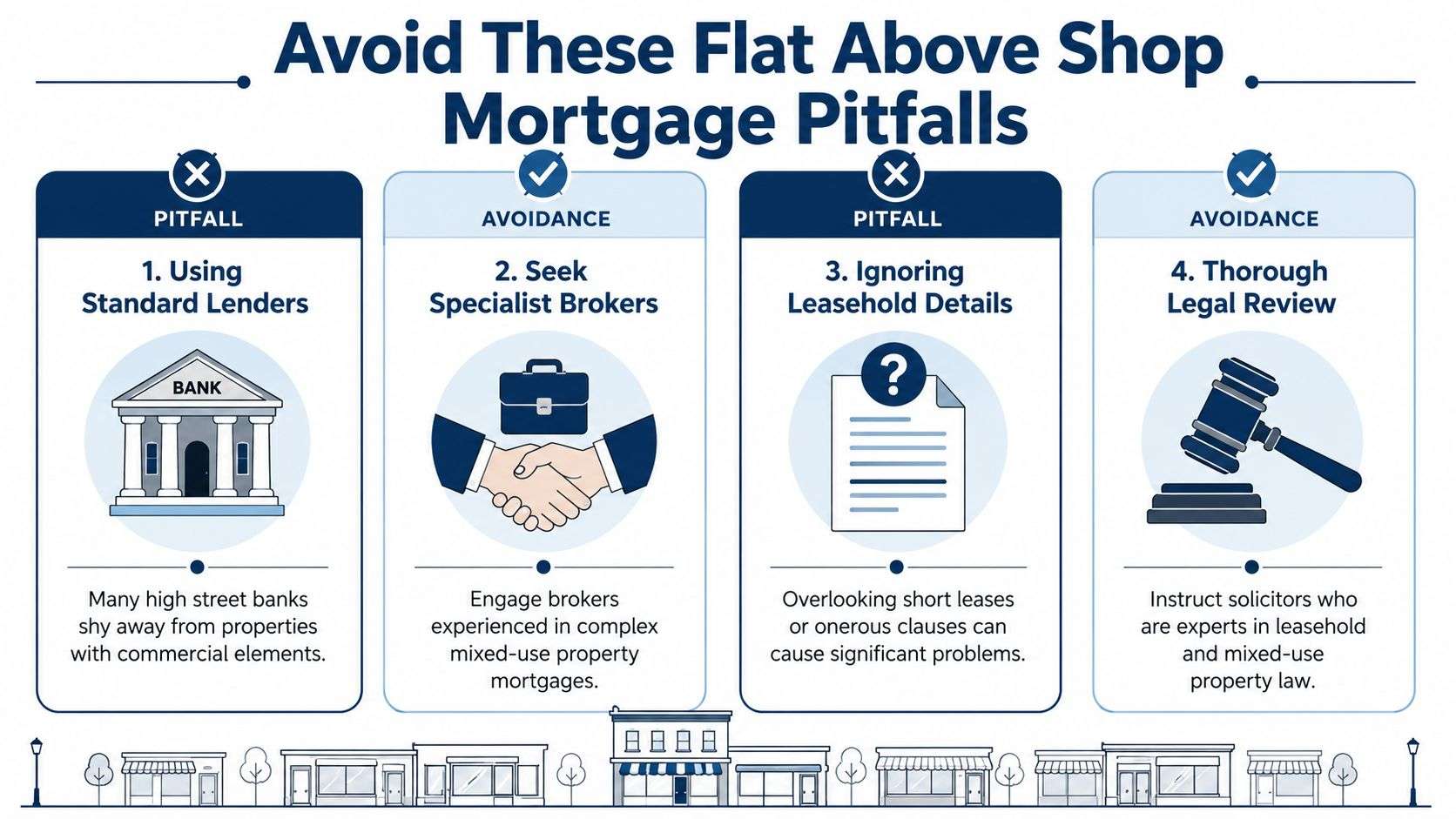
Most problems with a flat above shop mortgage are predictable. The issue isn’t that buyers do something reckless. It’s that they miss one or two specialist checks that don’t come up on standard purchases.
Pitfall one: using the wrong lender route
A standard bank branch approach can work for some properties, but many shop-top flats require a lender with a clear appetite for the specific commercial use below. If the unit is higher risk, a generic application can fail late.
How to avoid it:
Match the lender to the shop type: Don’t assume all retail is treated the same.
Flag the business use immediately: Hiding awkward details only causes delays later.
Use specialist placement where needed: Some cases need a narrower lender shortlist.
Pitfall two: underestimating the deposit
Buyers often get caught emotionally and financially. Generic advice often says these properties are just “a bit harder” to mortgage. That doesn’t prepare someone for a very different deposit requirement once the valuer and underwriter review the shop use.
Data cited for these non-standard cases shows that flats above takeaways face a 35% higher mortgage rejection rate, and that some buyers in places such as Chelmsford only discover after the survey that the lender wants a 40% deposit.
Pitfall three: missing practical property issues
Even when the business below is acceptable, smaller details can still cause trouble.
Separate entrance: Lenders are more comfortable when the flat has its own entrance.
Lease problems: Onerous clauses and weak rights can unsettle underwriting.
Insurance costs: Premiums or restrictions can affect lender comfort.
Future commercial changes: A currently quiet unit may not remain quiet if the lease later allows a more problematic use.
Good due diligence isn’t pessimistic. It’s what makes a complex purchase safe and financeable.
A short pre-offer checklist
Before spending heavily on legal work and surveys, I’d want these answers:
What exactly is the business below?
Does the flat have a separate legal title and access?
Has the lease been checked for obvious issues?
Is the building insurable on normal terms?
Is your deposit realistic for this type of unit?
If you can answer those early, the purchase becomes far more manageable.
Why a Specialist Broker Is Your Greatest Asset
The value of a specialist broker on this type of purchase isn’t just rate shopping. It’s knowing which cases are workable, which lenders are realistic, and which properties are likely to waste your time.
A recent example was a landlord purchase involving two flats over a beauty salon in Chelmsford city centre. The location was excellent, only minutes from the station, bus depot, shops and restaurants. On the surface, it looked straightforward. In reality, the lender’s choice still depended on the exact setup, the title arrangement, and whether the flats fit the lender’s comfort level for a city-centre commercial location.
What a broker actually does in these cases
A specialist broker helps by:
Filtering lenders properly: Some lenders may suit owner-occupiers, while specialist lenders are often more relevant for landlords.
Presenting the property accurately: The business below needs to be described clearly and correctly.
Managing timing: That includes not encouraging unnecessary spending before the lender has given an early indication.
Linking affordability to property type: For buy-to-let, the deal often hinges on rent rather than employed income.
For a UK buy-to-let mortgage on a flat above a shop, lenders typically want the projected rent to cover the interest-only payment by 125% to 145%, which is why rental yield becomes central to loan size and lender appetite, as outlined in JB Mortgages’ guide to flat above shop buy-to-let lending.
Why does that matter in Essex?
In Chelmsford, Braintree and Colchester, these properties can look attractive because of location and price. But the deals that complete smoothly are usually the ones where someone has assessed the commercial risk early, chosen the right lender route, and kept the legal and valuation side tightly organised.
If you’re weighing up whether specialist advice is worth it, this guide on how to choose a mortgage broker is a useful starting point.
Conclusion: Your Next Steps to Securing Your Mortgage
A flat above shop mortgage isn’t unusual in Essex, but it does need a more careful approach than a standard flat purchase. The key issue is rarely just your income. It’s the overall package of shop type, title, access, lease and insurance.
Quiet commercial uses are usually easier. Higher-risk uses can still be mortgageable, but the lender pool may narrow, and the deposit may need to be stronger. For landlords, rent coverage becomes central. For owner-occupiers, valuation and saleability tend to carry more weight.
The best next move is simple. Get the property assessed early, before you commit money or emotion to the purchase. If the flat stacks up and the shop below is acceptable to the right lender, these cases can absolutely go through.
Take the next step with clear advice before you apply.
If you’re ready to discuss a flat above shop mortgage with EHF Mortgages, get in touch for personalised guidance on your options in Chelmsford, Braintree, Colchester and across Essex.





