
💡 Top tip: Actively monitoring rates even after you apply can save you real money. A recent deal switch saved one of our clients £90 per month. We’ll explain how this works later in the article.
Quick answer: First-time buyer mortgage rates in the UK in 2026 typically start around 4% for buyers with larger deposits and sit near 5% for those with smaller deposits, largely influenced by recent geopolitical pressure on markets.
Table of Contents
Current First-Time Buyer Mortgage Rates UK Snapshot
Jumping straight in, here is what matters now for buyers in Chelmsford, Braintree and Colchester.
Lenders price deals based on loan-to-value (LTV) and the borrower’s profile.
Recent Bank of England commentary suggests little immediate change to base rate expectations.
Individual lender pricing still varies widely, so quotes matter.
Rate Snapshot and Why It Matters
Current averages directly affect monthly budgets and borrowing capacity in local markets across Essex.
A small change in the rate noticeably affects monthly payments.
For example, a 0.5% move on a typical mortgage can change payments by tens of pounds each month.
This matters more where local house prices are higher, or incomes are constrained.
For practical comparisons, see the infographic and table below, which show typical fixed rates by LTV.
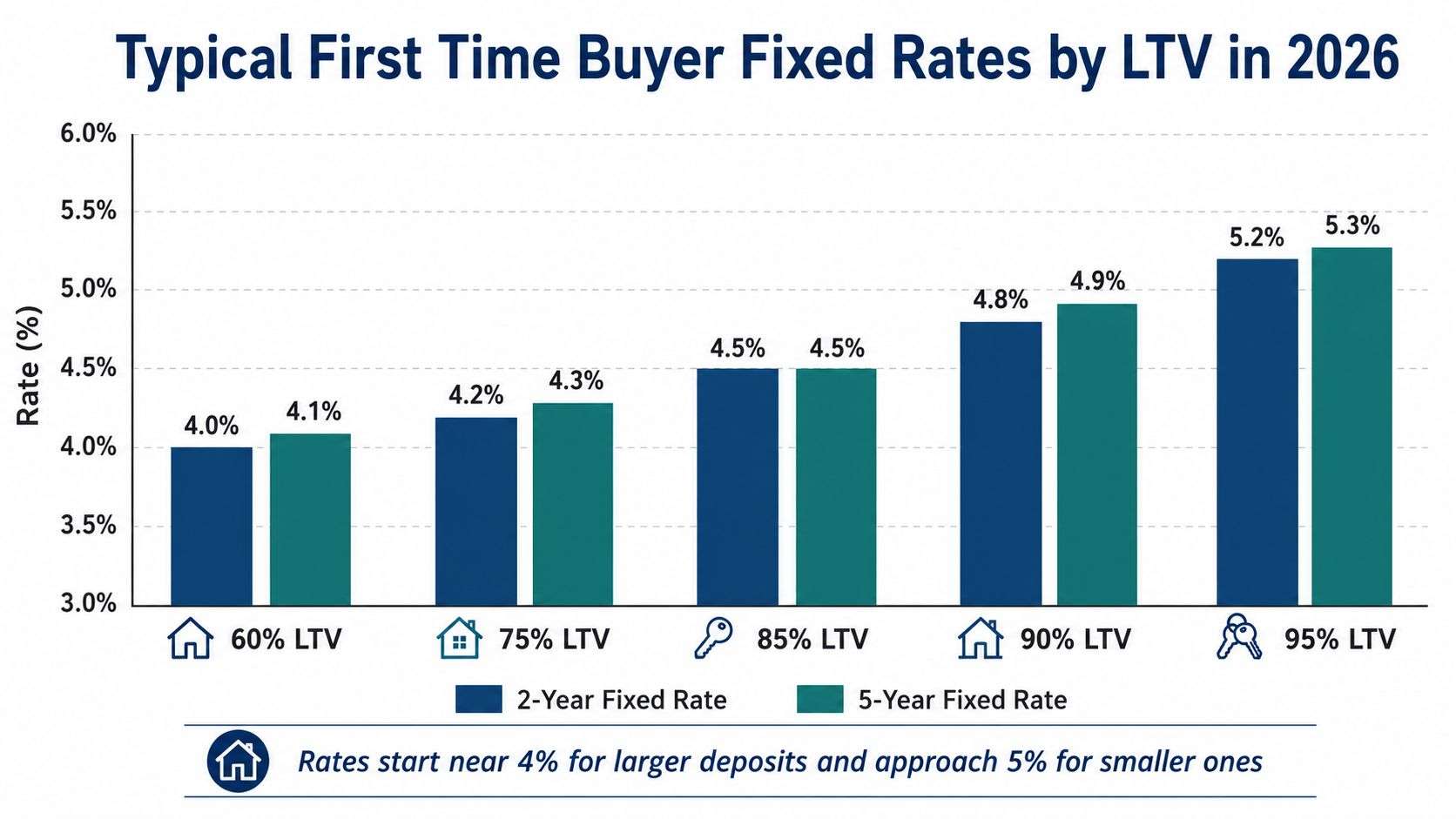
The infographic shows grouped 2-year and 5-year fixed rates across LTV bands, so you can visualise how rates rise as deposit size falls.
This visual tells us that rates start near 4% for larger deposits and approach 5% for smaller ones, so increasing your deposit can quickly improve your quoted rate.
Five-Column Rate Comparison Table
Here is a summary of average fixed rates across the main loan-to-value bands for first-time buyers in 2026. These figures are indicative and will vary by lender and individual circumstances.
| LTV Band | 2-Year Fixed Rate | 5-Year Fixed Rate | Monthly Repayment | Typical Use Case |
|---|---|---|---|---|
| 60% | 4.0% | 4.1% | Indicative lower cost | Buyers with large deposit |
| 75% | 4.2% | 4.3% | Moderate payments | Standard savers |
| 85% | 4.5% | 4.5% | Mid-range cost | Most FTBs with 15% deposit |
| 90% | 4.8% | 4.9% | Higher monthly cost | Smaller deposit buyers |
| 95% | 5.2% | 5.3% | Highest typical cost | Minimum deposit cases |
As you can see, the jump from a 60% LTV to a 95% LTV adds roughly 1.2% to your rate, which translates to a meaningful difference in monthly repayments over the term.
Read also: Learn more about mortgage product differences in our mortgage comparison guide
Bank commentary points to stability, but remember each lender reacts differently, so a broker can find the best match for your circumstances.

Understanding Rate Shifts Since 2022

If you have been watching the mortgage market since 2022, it probably felt like climbing a steep hill. Now, things have levelled out onto something more like a plateau. It is still elevated, but at least the footing feels steadier.
Before 2022, many borrowers were securing rates around 2.2%. Monthly payments felt manageable, almost like a gentle downhill stroll. Then everything changed. Rates surged to roughly 5.6%, and that sharp climb hit borrowing power hard. Multiples dropped from 5 to 4 times income.
For buyers across Chelmsford, Braintree, and Colchester, the maths suddenly looked very different. A household that qualified for a comfortable mortgage at 3.8 times income found their available borrowing cut by around 13% overnight.
That kind of shift does not just tweak a spreadsheet. It means smaller mortgages, larger deposits, or both, just to keep monthly payments within reach.
Grasping what happened during that jump helps you separate short-term noise from the bigger picture when you compare first-time buyer mortgage rates in the UK today.
Historical Effects on Monthly Budgets
A move from 2.2% to 5.6% is not just a number on a screen. It directly increases monthly payments and raises deposit requirements.
Some buyers respond by delaying their move. Others look for schemes that stretch borrowing sensibly without overcommitting.
For real families, the difference often comes down to location and lifestyle. That might mean choosing a commuter flat in Colchester over a house further out, or waiting another year to build a bigger deposit.
Larger deposits lower your loan-to-value ratio and typically unlock rates closer to 4% in 2026.
Smaller deposits tend to sit nearer 5%, which adds noticeably to your ongoing costs.
What you have to consider is the time it would take to increase (or save) for the deposit, versus the property price inflation. Is it better to pay a higher mortgage rate ‘now’ to secure a property, or wait, save more, but then find that same property is now £20-30k more expensive?
Why Stabilisation Matters for 2026 Buyers
Rates are still higher than the pre-2022 days, but they have started to settle. That stability gives you something invaluable: a clearer foundation for planning your budget and passing affordability checks.
It also makes active rate monitoring worthwhile. Even small movements can save meaningful amounts each month, especially over a 25 or 30-year term.
“When clients apply, we use clever software to monitor each case, and when mortgage rates fall, we immediately switch clients to better rates. One deal switch saved around £90 per month on a £300k mortgage in the last few weeks.”
What This Means for Your Application
Once you understand the trajectory, the practical steps become clearer.
Focus on realistic borrowing multiples. Prepare a larger deposit if you can. And use whole-of-market advice to find lenders that price favourably for your specific profile, because not every lender treats first-time buyers the same way.
Learn more about how interest rate history affects product choice in our detailed guide on interest rates in the UK.
Read also: Interest Rates UK Everything You Need to Know
Key Factors Influencing Your Personal Rate
💡 Top tip: Boosting your deposit by a single percentage point can move you into a lower rate band; more on timing and locks later.
Loan-to-Value: Your Slice of the Property Pie
Think of loan-to-value as your share of the property. The bigger your deposit, the smaller the lender’s exposure, and the better the rate you’ll typically be offered. It is one of the most powerful levers you have as a first-time buyer.
The difference shows up clearly in real numbers. Rightmove’s calculations for an average first-time buyer home priced at £227,538 illustrate this well. At 90% LTV, monthly payments were £1,203. Drop to 80% LTV and that figure falls to £1,069. That is a meaningful saving from day one, and it only grows over the life of the mortgage.
How Deposit Size Affects Monthly Repayments
The table below shows how increasing your deposit, and therefore lowering your LTV, can reduce monthly costs on a typical first-time buyer property. The indicative rates reflect the kind of pricing you might expect at each tier, though actual offers will depend on your full circumstances.
| Deposit Size | LTV Percentage | Indicative Rate | Monthly Repayment | Monthly Saving |
|---|---|---|---|---|
| £22,754 | 90% | 5.50% | £1,203 | £0 |
| £34,131 | 85% | 5.10% | £1,149 | £54 |
| £45,508 | 80% | 4.75% | £1,069 | £134 |
| £56,885 | 75% | 4.45% | £1,001 | £202 |
| £68,261 | 70% | 4.20% | £942 | £261 |
| £79,638 | 65% | 4.00% | £891 | £312 |
Figures based on a £227,538 property over a 25-year term. Monthly savings are calculated against the 90% LTV starting point. Actual rates and repayments will vary.
Even moving from 90% to 85% LTV saves over £50 a month. Push further to 75%, and you are looking at more than £200 monthly back in your pocket compared with the highest LTV tier.
Your Credit Profile: A School Report for Your Finances
Lenders look at your credit history much like a report card. A clean track record of on-time payments, limited existing borrowing, and no recent credit applications all work in your favour. Those with spotless files tend to access the best deals, while even minor blemishes can nudge your rate upward.
The good news? Small improvements before applying can make a difference. Correcting errors on your credit file, paying down existing balances, and avoiding new credit searches in the months leading up to your application all help.
Income Consistency Matters More Than You Might Think
Salaried employees with steady employment and clear payslips generally find it straightforward to secure competitive offers. Lenders like certainty, and a stable employment history provides exactly that.
Self-employed borrowers are not at a disadvantage, but they do need to prepare more thoroughly. Two to three years of certified accounts, along with a clear trading history, puts you in a strong position. Contractors and freelancers should gather evidence of ongoing work and consistent earnings.
Product Choice: Fixed, Tracker, or Variable?
The type of mortgage you choose affects both the headline rate and the predictability of your payments. Fixed-rate deals lock in your interest rate for a set period, typically two, five, or ten years, giving you complete certainty over your monthly outgoings. This suits buyers who want to budget without surprises.
Tracker mortgages follow the Bank of England base rate plus a set margin, so your payments move up and down with the market. Variable rates are set by the lender and can change at any time. These flexible options work well if you expect rates to fall or if you are comfortable with some uncertainty.
Your choice should reflect your plans. A five-year fix makes sense if stability is your priority. A tracker could be the smarter move if you believe base rates are heading downward in the near term. Just think about how much change there could be in anyone’s life over a number of years; if there is a need to sell due to a breakup or a change of employment, there could be penalties (Early Repayment Charge) on those longer-term products in particular.
Lender-Specific Criteria: Why Two Applicants Can Get Different Offers
Not all lenders assess risk the same way. Some favour particular employment sectors or property types. Others apply stricter affordability calculations or have different attitudes toward factors such as self-employed income or credit history.
This is exactly why whole-of-market advice carries so much value. In areas like Chelmsford and Braintree, local affordability patterns and lender appetite can vary significantly. A broker who understands which lenders are actively competing for business in your area can find opportunities that a single-lender approach would miss.
Examples of How These Factors Interact
Deposit shifts: A 1% improvement in your LTV can move you between rate bands, reducing monthly payments by tens or even hundreds of pounds depending on the property value.
Credit improvements: Clearing a small default or reducing your credit utilisation before applying often results in a noticeably better rate.
Income documentation: Having clear payslips ready, or two years of accounts prepared for contractors, gives lenders confidence and speeds up the process.
Practical Steps to Improve Your Quote
Check your credit file with all three reference agencies and dispute any errors.
Build a larger deposit where possible; even small increases can unlock better bands.
Gather clear evidence of income before you start applying.
Consider your product choice carefully in light of your future plans.
Use whole-of-market advice so you do not miss lender-specific opportunities.
Read also: Learn more about loan-to-value in our guide on what is loan to value ratio
If you are ready to explore your personal rate and want help finding the best options in Essex, speak to an adviser who understands local lenders and specialist schemes.
Choosing Between Fixed and Variable Products

At its core, picking between a fixed and variable mortgage comes down to one question: how much certainty do you need in your monthly budget, and how much movement can you live with?
Fixed rates lock your payments in for a set period, so you know exactly what is leaving your account each month. For many first-time buyers, a 5-year fixed deal provides a solid foundation and enhanced lending limits from many lenders. This is the kind of stability that makes planning for life’s bigger moments (starting a family, furnishing your place, booking a holiday) feel genuinely achievable rather than stressful.
The numbers back this up too. Connells reported in January 2026 that 93% of first-time buyers secured a sub-5% rate, with the average new fixed rate at 4.41%, down from 4.86%. That drop shows just how much timing matters when you are ready to lock something in.
Variable products, on the other hand, move with the market. Your payments can come down if base rates fall, but they can also climb. A tracker mortgage typically follows the Bank of England base rate plus a set margin, which works well if you expect rate cuts in the near future and can handle some short-term fluctuations. Then there is the offset mortgage, which lets you use your savings to reduce the balance on which you are charged interest. This is handy if you have built up a cash cushion but want to keep it accessible.
“Locking in certainty can protect your monthly budget when broader markets feel uncertain.”
When to Pick Each Product
Go for a 5-year fix if payment stability matters more than chasing a slightly better rate down the line.
A 2-year fix makes sense if you are likely to remortgage or move in the near future and just want a short window of protection.
Consider a tracker if you are confident base rates are heading lower, and you can absorb some movement in the meantime.
An offset mortgage could be the right fit if you are sitting on meaningful savings and want to reduce your interest bill without locking that money away.
Practical Examples
If you have managed to save a decent deposit and predictability is what you are after, a 5-year fix lets you lock in a rate close to current averages and forget about it for a while.
With a smaller deposit and a belief that rates are easing, a tracker might save you money, though you would need to be comfortable with the risk that payments could rise instead.
If you have savings but your income is irregular, an offset mortgage gives you the flexibility to reduce your effective interest rate while still accessing your cash when you need it.
Quick Comparison Table
| Product | Main Benefit | Main Risk | Typical Buyer | When It Works Best |
|---|---|---|---|---|
| 5-Year Fixed | Budget certainty | Can miss falls | Families, planners | When stability is priority |
| 2-Year Fixed | Short-term certainty | Frequent remortgage costs | Movers | If moving soon |
| Tracker | Potential savings | Payments can rise | Rate speculators | Expect base rate cuts |
| Offset | Interest saved via savings | Requires cash reserves | Savers with equity | If you hold spare cash |
Read also: Learn more about fixed and variable mortgages in our guide on Fixed Rate vs Variable Rate Mortgage
Specialist Schemes and Budget Stretching Tools

Joint Borrower Sole Proprietor (JBSP) arrangements let a parent help with affordability without being on the property deeds. This can reduce your required deposit or income multiple while keeping ownership solely yours. For many first-time buyers in Chelmsford, Braintree and Colchester, this is a practical way to bridge the gap to approval.
Specialist first-time buyer schemes extend eligibility beyond standard high street rules. They can allow a slightly higher loan-to-value or accept non-standard income evidence. We have access to schemes that allow borrowers to stretch a little further than normal with their mortgage approval. Independent brokers with whole-of-market access often find these niche products first-time buyers cannot see on high street sites.
How These Tools Work in Practice
JBSP explained simply
A parent guarantees affordability without holding title. This means lenders treat the income boost when approving affordability, but the parent does not appear on the deeds.
Specialist FTB products explained
These may include lower-deposit pathways, lender-specific incentives, or underwriting flexibility for certain professions. They are useful where first-time buyer mortgage rates in the UK sit around 4% to 5% and every saving in deposit or rate helps.
“For first-time buyers who are also parents, understanding free childcare hours can help stretch their budget when choosing between mortgage products.” Free childcare hours by nation
How Brokers Add Value
Independent FCA-authorised advisers search across the market to match you with suitable schemes. A local presence in Essex offers the benefit of face-to-face trust and knowledge of lenders who favour nearby borrowers. EHF Mortgages combine whole-of-market access with FCA authorisation for peace of mind.
Practical Examples
A parent helps via JBSP so a borrower with a 10% deposit is assessed as affordable for a 5% deposit product.
A specialist scheme accepts atypical income, enabling approval where a high street lender declined.
Active monitoring switches clients when rates improve, saving up to around £90 per month on a typical mortgage.
Always check long-term implications for the guarantor and borrower
Ensure affordability is sensible given current first-time buyer mortgage rates in the UK
Read also: Learn more about family support options in our guide on Family Springboard Mortgage
If you are ready to discuss how JBSP or specialist FTB schemes could work for you in Chelmsford or across Essex, speak to an adviser who knows the local market and lender appetite today.
Actionable Steps to Secure the Lowest Rate
Getting the best deal is not just about luck; it is about preparation. A little groundwork before you apply can genuinely move the needle on the rate you are offered.
Start by pulling your credit reports from all three reference agencies. It is a quick job, but fixing even a small error can unlock noticeably better rates when a lender assesses your application. A clean file also speeds things up and avoids nasty surprises down the line.
Next, get your paperwork in order. If you are employed, that means you need recent payslips, bank statements, and a photo ID. For the self-employed, you will want two years’ worth of accounts and a clear picture of your profits. Having everything ready to go shortens processing time and helps lenders put forward their best offer.
Before you commit to a decision in principle, run an honest affordability check on yourself. Factor in your monthly bills, lifestyle costs, and any future plans that might change things. This helps you pick the right product first time around, avoiding multiple applications that can leave marks on your credit score.
Use whole-of-market advice and a decision in principle to test the waters. A good broker can compare what different lenders are willing to offer without triggering multiple hard searches on your file. This is especially handy in competitive local markets such as Chelmsford, Braintree, and Colchester, where lenders’ appetite can vary.
“When clients apply, we use monitoring software and switch deals when rates fall, saving clients up to around £90 per month on a £300,000 mortgage.”
Prepare for Active Rate Monitoring
Where possible, sign up for rate monitoring and agree a locking strategy with your adviser. We recently switched a client’s deal when a lender repriced downwards, saving them about £90 each month on a £300,000 mortgage. That kind of saving comes from acting at the right moment, and it shows the real value of having a broker in your corner.
Choose the Right Product for Your Plans
Think about whether certainty or flexibility matters more to you. If you want stability, a longer fixed term might be the answer. If you expect rates to drop soon, a tracker could suit you better. Your deposit size, credit profile, and how long you plan to stay in the property all play a part in this decision.
Practical checklist to act now:
Check your credit reports with Experian, Equifax, and TransUnion, and correct any errors.
Compile your payslips, bank statements, and ID into one simple folder.
Run affordability models for different rate scenarios.
Speak to a whole-of-market adviser to get a realistic decision-in-principle and a monitoring plan.
Keep an Eye on Bank of England Commentary
Watch what the Bank of England is signalling, but do not wait around forever. Current commentary suggests little change in the near term, so acting on the deals available now often pays off more than holding out indefinitely. Timing your rate lock to even small falls can save you hundreds over the first few years of your mortgage.
If you would like help turning this checklist into a concrete plan and finding the best available deals in Essex, professional guidance will make the process straightforward. It also reduces the risk of missing savings due to paperwork delays or outdated information.
Frequently Asked Questions About Buyer Rates

What Do Headline Rates Actually Tell You About True Cost for First-Time Buyers in 2026?
Headline rates are a starting point, not the full story. Fees, product incentives and your exact LTV all change the effective cost in ways you might not expect.
For example, a 4.5% headline rate with a £995 fee can work out worse than a 4.9% no-fee deal over the first few years, especially if your mortgage is smaller than average. But for those, say, with a £200k mortgage, or more, the lower rate and fee combination will probably work out cheaper. That is why comparing the total cost across the period you plan to hold the deal matters more than chasing the lowest rate on paper. A broker can run that side-by-side comparison for you, showing which option actually fits your budget if you are buying in Chelmsford or Colchester.
How Quickly Can Rates Change After I Submit an Application?
Rates can move within hours or take weeks, depending on how lenders reprice. If your application is already live, some lenders will honour the quoted rate for a set window.
That said, if a lender reprice happens before completion, you may be offered the new rate unless you have a product lock in place. Active monitoring makes a real difference here. Our tracking software recently switched a client to a better deal, saving around £90 per month on a £300,000 mortgage.
What Happens If a Valuation Comes In Lower Than the Purchase Price?
If the lender’s valuation falls short, you will usually need to put down a larger deposit or accept a reduced loan amount. Either way, you could end up in a higher LTV band, which means a higher rate.
The practical options are to renegotiate the purchase price with the seller, find extra cash for the deposit, or approach a different lender willing to accept the valuation. This is where specialist first-time-buyer schemes and local lenders’ knowledge across Braintree and the wider Essex area really count.
Are There Quick Checks I Can Do Now to Avoid Nasty Surprises?
Absolutely. Start by checking your credit file, gathering payslips and bank statements, and running affordability scenarios with different rate assumptions.
It is also worth ordering a survey if you have concerns about the property. A HomeBuyer Report can uncover issues that might drag down the valuation. Taking advantage of free resources helps first-time buyers get a clearer picture of what they are walking into. See this helpful free virtual tour uk for remote viewing and research ideas.
“Personalised advice always beats a generic online quote when securing a competitive first-time buyer mortgage rate in the UK.”
If you want guidance built around your circumstances in Chelmsford, Braintree or Colchester, speak to an adviser who can check whole-of-market options and set up rate monitoring for you.





