
💡 Top tip: the cheapest critical illness quote is rarely the best one. A lower monthly premium can come with tighter definitions, tougher exclusions, or a survival period that makes the policy far less useful when you need to claim. I’ll show you exactly how to spot that later in the article.
People in Chelmsford, Braintree, Colchester and across Essex often start the same way. They type in a few details, get a list of prices, and assume the cheapest option has done the job. That’s understandable, but it’s also where people go wrong.
Critical illness cover matters because it isn’t some fringe product that never pays out. In the UK, the ABI reported that insurers paid £797 million in critical illness claims in 2023, with an average payout of £42,300 and a 93.1% claims acceptance rate by amount, according to ABI critical illness claims data. Those figures are a good reminder that this cover is claimed on regularly, and the payout can make a real difference to a mortgage, household bills, or time off work.
If you want a plain-English primer before getting into quotes, this guide on what critical illness insurance cover is is a useful starting point.
Your Guide to Critical Illness Insurance Quotes
A good quote isn’t just a price. It’s a combination of what conditions are covered, how those conditions are defined, when the policy pays, and whether the amount insured is enough for your life.
That’s why comparison sites can be frustrating. They make things look simple, but two policies with similar prices can work very differently at the claim stage. One may cover a broader range of conditions. Another may use a stricter definition for a heart attack or cancer claim. Another may pay only if you survive for a set period after diagnosis.
Quick navigation
What a sensible approach looks like
When I talk clients through critical illness insurance quotes, I keep it practical:
Check what you already have through a mortgage, life policy, or work benefits.
Work out the right lump sum before looking at premiums.
Compare definitions and exclusions before comparing cost.
Be completely accurate with medical and lifestyle details.
Choose cover that would still make sense at claim stage, not just at quote stage.
Practical rule: If a quote looks surprisingly cheap, there’s usually a reason. Find that reason before you buy.
What You Need Before Getting Quotes
The quality of the quote depends on the quality of the information going in. If you guess, rush, or leave bits out, the price can change later, the underwriting can drag on, and the policy you choose may not match what you were trying to protect in the first place.
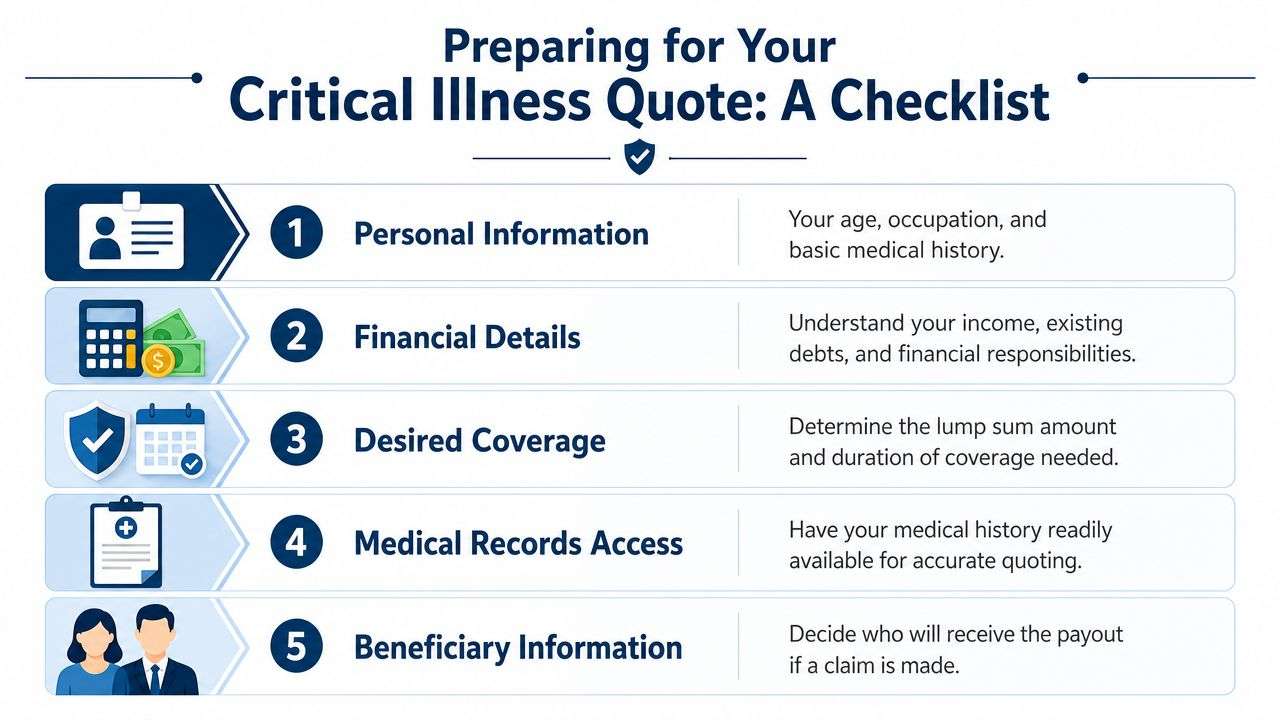
A good starting point is checking what cover you already have. Clients are often surprised to find a small amount of protection through work benefits, an older life policy, or mortgage paperwork. That does not mean it is enough, but it stops you from pricing from scratch or paying twice for the same job.
Personal details that affect the quote
Insurers price around risk, so they need a clear and accurate picture of you. Before you start comparing quotes, have these ready:
Your age and date of birth
Your occupation, including whether the work is office-based, manual, self-employed, or a mix
Smoker status
Your medical history, including symptoms, referrals, tests, medication, and ongoing treatment
Family medical history, if the insurer asks for it
Accuracy matters here. A client might describe themselves as a non-smoker because they only smoke socially, or say a past investigation was “nothing serious” and leave it off. Those are the details that can trigger follow-up questions later.
Financial details people often forget
The quote is only useful if the payout would solve a problem.
Work out what the lump sum needs to do before you look at monthly cost. That usually means gathering:
Your mortgage balance, if clearing it is the priority
Monthly household spending
Other debts, such as loans, car finance, or credit cards
Income details, especially if your earnings change month to month
Existing protection, including sick pay, death in service, life cover, or income protection
For some households, the target is clearing the mortgage. For others, it is buying time off work, paying for childcare, or covering a drop in income during treatment and recovery. If you are comparing this alongside mortgage protection insurance quotes, it helps to distinguish which policy is meant to clear debt and which is meant to support day-to-day living.
A cheap quote for the wrong amount of cover is still the wrong quote.
Decide the shape of the policy
Before asking for prices, get clear on the broad setup. Small choices here can change both cost and how the policy works in real life.
| Question | Why it matters | Common mistake |
|---|---|---|
| How much cover do you want? | Sets the lump sum available at claim | Choosing a low amount purely to reduce the premium |
| How long should it last? | Needs to match your mortgage term or the years your family depends on your income | Picking a term that ends before the risk does |
| Single or joint policy? | Affects who is covered and what happens after a claim | Assuming joint cover is automatically better value |
| Stand-alone or linked to life cover? | Changes whether one claim affects the other benefit | Missing how linked plans can reduce flexibility later |
Joint cover is a common sticking point. It can look cheaper on screen, but if one person claims, the policy usually ends. A pair of single policies can cost more, yet they often give better long-term protection. That is the sort of trade-off that does not show clearly on a comparison table.
If you get these points straight before applying, the quotes you receive are more useful and far easier to compare. That matters even more if you are self-employed, have a medical history, or you are arranging cover around a house move in Essex.
How Critical Illness Quotes Are Calculated
Insurers don’t pull a price out of thin air. They price around the likelihood of a claim and the structure of the policy you’re asking for.
The main factors are usually straightforward. Your age, smoker status, medical history, occupation, policy term, and sum assured all feed into the final premium. If two people ask for the same cover, they still won’t necessarily get the same quote.
What pushes a premium up or down
A younger applicant requesting a modest lump sum over a shorter term will often see a different price than an older applicant requesting a larger benefit over a longer period. The same applies where there’s a history of medical treatment, more manual work, or a smoking declaration.
Men also make slightly more claims than women, which Citizens Advice highlights as a factor that can contribute to pricing differences. Insurers may rely on what you say at the application stage, so if later information contradicts that statement, problems can arise at claim time.
A simple way to think about price
There isn’t one “normal” premium because every insurer has its own underwriting rules and product design. A quote is a risk assessment wrapped inside a product specification.
That’s why people shopping only on price often get caught out. They compare the monthly cost but not what that cost buys.
“Many people focus only on the monthly cost, but the real value is in the policy details. A quote is just the starting point of the conversation, not the end.”
Illustration only
The table below is a non-priced illustration to show how insurers tend to segment risk. It is not a rate guide and it should not be treated as a live market quote.
| Age | Non-smoker premium | Smoker premium |
|---|---|---|
| Younger applicant | Usually lower | Usually higher |
| Mid-life applicant | Often moderate | Often noticeably higher |
| Older applicant | Usually higher | Often highest |
If you’re comparing protection options around a remortgage, this page on mortgage protection insurance quotes helps put critical illness cover into the wider picture.

Looking Beyond Price When Comparing Quotes
The cheapest critical illness quote is often the easiest one to regret.
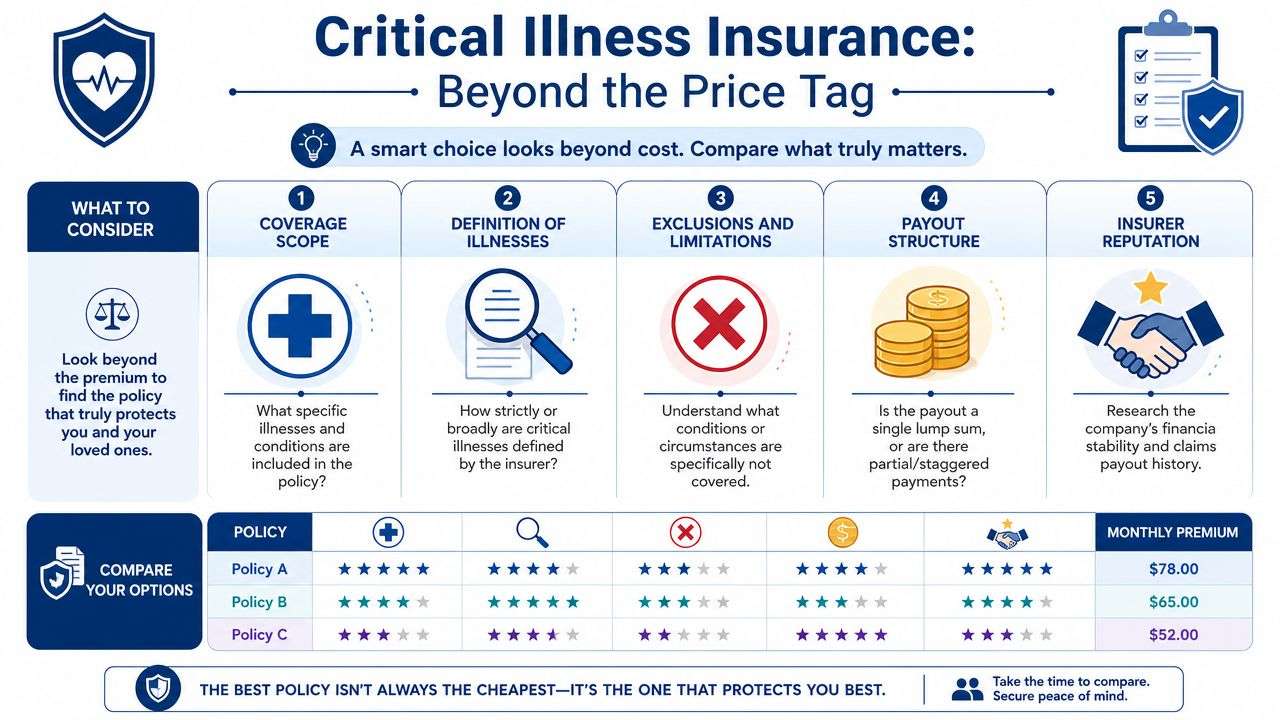
A low premium can look attractive on a comparison screen, but the real question is whether the policy would pay out on the diagnosis you are worried about. That comes down to the wording. I often find that two quotes that look similar in price cover quite different levels of risk.
Definitions decide whether a claim fits
Critical illness cover pays against the insurer’s definition of an illness, not the name of the condition on its own. That is the part many people miss when they compare quotes without advice.
Cancer is the clearest example. One policy may cover a wider range of cancer diagnoses, while another may exclude early-stage cases unless they meet stricter medical criteria. The same issue comes up with heart attack, stroke, multiple sclerosis, and children’s coverage. A policy with more generous wording can be a better value than a cheaper one that is harder to claim on.
What to compare properly
When reviewing quotes, slow down and check these points side by side:
Covered conditions. Check the illnesses that matter most to you, not just the total number listed.
Claim definitions. Read the actual wording for core conditions such as cancer, heart attack, and stroke.
Additional and partial payments. Some plans pay a smaller lump sum for less severe conditions or earlier-stage diagnoses.
Exclusions. Look for anything that limits coverage, including insurer-specific restrictions or medical exclusions added after underwriting.
Survival period. Some policies only pay if you survive for a set period after diagnosis.
Underwriting outcome. A quote with a low starting price can change once the insurer reviews your health, smoking status, family history, or occupation.
A good comparison is slower, but it is far more useful than sorting a list by monthly premium.
Here’s a useful explainer to watch before you choose:
Survival periods deserve more attention
Survival periods catch people out because they are easy to miss and only become important at claim stage. If a policy says the life assured must survive for a set period after diagnosis, the lump sum is only paid if that condition is met. The difference between one insurer’s approach and another’s can matter a great deal to a family already under pressure.
That does not mean a policy with a survival period is poor value. It means the quote needs context. Price, definitions, exclusions, and claim conditions all need to be weighed together.
Business owners should apply the same discipline when assessing their company’s insurance needs. The principle is identical. Cheap cover that fails on the small print can be expensive in practice.
Key point: A lower premium is only better value if the policy would still pay in the circumstances you want cover for.
If you want a wider benchmark for comparing product features, this guide to what to look for in the best critical illness cover in the UK is a useful next read.
Common Mistakes When Choosing Cover
The biggest mistakes happen before a claim is ever made. I see them when people compare quotes on their own, focus on the monthly cost, and assume every policy will respond in the same way if they become seriously ill. It will not.

Mistakes that cause the most trouble
The first is non-disclosure. If an application omits a medical condition, previous investigations, smoking history, or other relevant details, the insurer may later question the claim or change the terms once the omission comes to light. People often leave things out because they are guessing what matters. Guessing is risky. Full disclosure gives you a firmer policy.
The second is choosing based on price alone. Cheap quotes often look good until you examine the policy wording. One insurer may define a condition more tightly than another. Another may apply an exclusion that limits the value of the cover. As noted earlier, claim conditions such as survival periods can also make a lower premium less attractive than it first appears.
The third is underinsuring yourself. I have spoken to plenty of clients who picked a figure that felt affordable rather than one that would have helped. If the lump sum would only cover a few months of bills, or leave most of the mortgage untouched, the policy may not solve the problem it was meant to solve.
A fourth mistake is failing to match the policy to the reason for its issuance. A cover for a young family, a single applicant with a mortgage, and a company director will usually not look the same. The quote needs to fit the job.
A better way to pressure test a quote
Before you commit, ask practical questions:
Would this payout meaningfully change my situation if I were unable to work for an extended period?
What exactly counts as a valid claim for the illnesses I am most concerned about?
Are there any exclusions or special terms due to my medical history, job, or hobbies?
Have I checked whether I already have similar cover through work or an older policy?
Would my family understand how this policy works if they had to claim without me?
Those questions sound simple, but they get to the heart of value. A policy is only worth paying for if it would do what you need it to do on a very bad day.
For business owners and directors, protection decisions often sit alongside wider financial planning. If that applies to you, Stewart Accounting Services has a useful piece on assessing your company’s insurance needs that helps frame protection more broadly.
Buy a policy for claim day, not quote day.
Why an Independent Broker Adds Value
The hard part of critical illness cover isn’t finding a quote. It’s judging whether the quote is suitable, whether the policy wording fits your risks, and whether the amount of insurance is sufficient to do the job.
That’s where an independent broker can add value. A broker can check for overlap with existing policies, spot restrictive wording, explain underwriting decisions, and help match policy design to real life rather than to a price filter.
Where DIY comparison falls short
Online comparison tools are quick, but they don’t usually explain the trade-offs very well. They won’t always tell you why one policy costs less, whether the definitions are tighter, or whether a special exclusion has changed the value of the policy.
That matters even more for:
Self-employed applicants with variable income
Older borrowers protecting a mortgage later in life
People with past medical issues
Households needing cover that fits both mortgage and income needs
The Financial Conduct Authority’s research shows many UK adults have limited financial resilience. That’s why the amount of cover matters as much as the existence of cover, as explained in this discussion of financial resilience and critical illness protection.
Local advice has practical advantages
For clients in Chelmsford, Braintree, Colchester, and the wider Essex area, local advice often leads to better conversations. The issues are familiar. Remortgages, moving house, self-employed income, and family protection all overlap.
One option people use is EHF Mortgages, an FCA-authorised broker in Chelmsford that advises on mortgages and protection, including critical illness cover as part of wider mortgage protection planning. The practical value is in comparing policy details, not just producing a quote list.
Your Next Steps and Frequently Asked Questions
The main takeaway is simple. Critical illness insurance quotes should be judged on usefulness, not just price. A policy that looks cheap but pays under narrower conditions can be poor value.
A sensible next step is to review what cover you already have, work out the lump sum you’d need, and then compare wording before premium.
Frequently asked questions
Can I get coverage with a pre-existing medical condition
Sometimes yes, but it depends on the insurer and the condition. In practice, the insurer may offer standard terms, add an exclusion, increase the premium, or decline cover. The key is full and accurate disclosure.
What is a survival period in simple terms
It’s the period you must survive after diagnosis before the policy pays out. This is one of the details that can make two similar-looking quotes very different in practice.
Is a joint policy a good idea for my partner and me
It can be, but it isn’t always the right answer. Joint cover may look tidy, but the structure of the benefits matters. You need to understand who is covered, what happens after a claim, and whether two separate policies would better fit your needs.
If you’re ready to compare critical illness insurance quotes properly, with the small print translated into plain English, the next move is to get personalised advice based on your mortgage, health disclosures and budget.





