
💡 Top Tip: Before you even think about applying for a bridging loan, make sure you have a rock-solid exit strategy. Lenders care more about how you’ll repay the loan than almost anything else. We’ll explain exactly what makes a strong exit strategy later in this article.
Found your dream home in Chelmsford, but find yourself stuck in a frustrating property chain? It’s a common problem, but there’s a powerful financial tool that can help: a bridging loan for property purchase. This type of loan can effectively break that chain, allowing you to buy your next home before your current one is sold.
Table of Contents
A bridging loan is a fast, short-term finance option perfect for securing a new home quickly. It’s a go-to solution for winning at a property auction in Colchester, snapping up a great deal before it’s gone, or simply stopping a purchase from collapsing due to delays elsewhere.
This guide will walk you through how this flexible finance works for savvy buyers and investors across Essex.
Once your bridging loan is in place and you’ve secured your new property, the next big step is planning the move itself. To keep things organised and as stress-free as possible, we recommend using this ultimate UK moving checklist.
What Is a Bridging Loan and How Does It Work?
A bridging loan is a specialist, short-term financial tool for buying property. Think of it as a purpose-built link that lets you get from your current property situation to your next one, without the long wait for a traditional sale or mortgage to complete.
It’s designed for speed, giving you fast access to funds so you can make a decisive move. This is incredibly useful in fast-moving property markets like those across Essex, where the best opportunities can vanish in a matter of days.

The Core Mechanics of a Bridging Loan
Unlike a standard mortgage, which can take months to arrange, a bridging loan can often be arranged in just a few weeks. The lender’s main focus is the value of the property used as collateral and, crucially, your plan to repay the loan. This is known in the industry as your exit strategy.
The loan quite literally “bridges” a temporary funding gap. It could, for example, allow you to buy a new house in Colchester before you’ve managed to sell your current one. This turns you into a chain-free cash buyer, which is a huge advantage. Once your old house sells, you use the proceeds to pay off the bridge.
This speed is exactly why bridging finance is perfect for time-sensitive deals. Property auctions, for instance, usually require completion within 28 days, a deadline that’s nearly impossible to meet with a high street mortgage. A bridging loan is built for these tight turnarounds.
Closed Bridge vs Open Bridge Loans
Bridging loans aren’t a one-size-fits-all product. They generally fall into two main types: ‘closed’ and ‘open’, which are determined by how certain your exit strategy is.
Closed Bridging Loans: You’d use this when you have a definite, legally binding repayment date. A classic example is when you have already exchanged contracts for the sale of your current property but need funds to secure your new home before the sale proceeds come through. Because the exit is clear, lenders see these as lower risk and often offer better interest rates.
Open Bridging Loans: An open bridge is more flexible. It’s for situations where you don’t have a fixed repayment date. This is common for buyers who’ve found their dream home but haven’t yet found a buyer for their old one. While they offer much-needed flexibility, the added uncertainty can mean they carry slightly higher costs. Lenders will still demand a believable exit strategy, but it does not need to be contractually agreed upon from day one.
The table below breaks down the key differences, helping you see which might suit your circumstances.
| Feature | Closed Bridging Loan | Open Bridging Loan | Best For |
|---|---|---|---|
| Exit Strategy | Confirmed and legally binding | Plausible but not yet finalised | Buyers with a definite sale date. |
| Risk for Lender | Lower | Higher | Buyers need flexibility. |
| Typical Cost | Generally, lower interest rates | Can have higher interest rates | Investors need to act fast. |
| Common Use Case | Bridging the gap between completion and purchase. | Buying a new home before the old one is sold. | Property investors are moving quickly. |
“A bridging loan empowers you to become a ‘cash buyer’, giving you a significant advantage in competitive property negotiations and allowing you to seize opportunities that would otherwise be missed.”
Ultimately, whether you’re a homeowner in Braintree trying to avoid losing your next home or an investor needing to complete an auction purchase swiftly, understanding these concepts is the first step. The right type of bridging loan for you will depend entirely on your personal circumstances and timeline.
Who Can Benefit From a Bridging Loan
A bridging loan isn’t your everyday financial product. Think of it more as a specialist tool, designed for very specific situations where speed and certainty are everything. The people who use them range from determined homeowners to sharp property investors, but they all share one thing: a need to seize a property opportunity, fast.
For homeowners, the most common scenario is getting stuck in a frustrating property chain. You’ve found the perfect home, but your own sale is dragging its feet. A bridging loan lets you break free from that chain, secure your new property, and makes you a much more attractive, chain-free buyer in the process.
Property investors also rely heavily on bridging finance. Imagine an investor spots an undervalued property in Braintree that’s ripe for modernisation. A bridging loan can provide the cash to snap it up and cover the refurbishment costs, all to sell it for a profit within a few months, a classic “flip.”
The Lender’s Primary Focus: The Exit Strategy
When you apply for a bridging loan, the lender’s mindset is quite different from that of a typical mortgage provider. Of course, your financial standing matters, but it is not their number one concern. Instead, they zoom in on two critical things: the value of the property being used as security, and, most importantly, how solid your exit strategy is.
Your exit strategy is just a clear, credible plan for how you’ll repay the loan. Since these loans are short-term, usually for 12 months or less, lenders need to be completely confident that you have a viable way to pay them back on time.
A fuzzy or unrealistic plan won’t cut it. Your exit is the absolute bedrock of a successful application.
“The single most important part of any bridging loan application is a credible exit strategy. Lenders need to see a clear and achievable plan for how the loan will be repaid. A well-prepared exit is the foundation of a successful application.”
Here are some of the most common exit strategies we see.
| Exit Strategy | Best Suited For | Key Consideration |
|---|---|---|
| Sale of Current Property | Homeowners breaking a property chain. | The property must be realistically priced and on the market. |
| Sale of New Property | Property developers and investors. | Your plan must account for all refurbishment costs. |
| Refinancing to a Mortgage | Buyers of unmortgageable properties. | The property must be mortgageable after the works are done. |
| Using Other Assets | Individuals with diverse investment portfolios. | The sale must be reliable and fit the loan’s timeframe. |
Accessibility for Complex Circumstances
One of the biggest strengths of bridging finance is its flexibility. It can be a lifeline for borrowers whose circumstances might make high-street lenders hesitate. Because the loan is secured against property and prioritises the exit plan, things like being self-employed or having minor credit blips are not automatic deal-breakers.
This adaptability is a key reason the UK bridging loan market has seen such strong growth. Recent data show a surge in investment purchases, underscoring just how vital this finance has become for investors acting on opportunities. You can learn about the market’s projected growth and see the trend for yourself.
Ultimately, whether you’re a homeowner in Colchester needing to secure your next move or an investor with a complex income structure, it all comes down to having a viable plan. A strong application demonstrates exactly how you’ll deliver on your exit strategy, clearing the path to your property goals.
Understanding the Costs of a Bridging Loan
So, let’s talk numbers. When you’re looking at bridging finance, it’s essential to understand that the costs work very differently from a standard mortgage. Because these loans are designed to be short-term solutions, all the associated costs are packed into a much shorter period, rather than being spread out over decades.
The main cost you’ll see is interest, calculated monthly. Lenders give you a couple of ways to handle this:
Serviced Interest: This works like a typical loan, where you pay the interest each month. It’s a good option if you have the monthly cash flow, as it keeps the final repayment figure down.
Rolled-Up Interest: With this, the interest is added to the loan balance every month. You then pay back the original loan plus all the accumulated interest in one go at the very end. This is a very common choice because it means no monthly payments during the loan term.
Breaking Down the Key Fees
On top of the interest, there are a few standard fees you’ll need to factor into your budget. Getting a clear picture of these from day one means no nasty surprises later on.
Arrangement Fee: This is what the lender charges for setting up the finance. It’s usually around 2% of the gross loan amount and is often just added to the loan itself.
Valuation Fee: Before lending, the lender needs to obtain an independent valuation of the property to ensure its market value. This is an upfront cost you’ll need to cover.
Legal Fees: You’ll need your own solicitor for the legal side of the purchase, and you’re usually required to cover the lender’s legal costs as well.
Exit Fee: Not all lenders charge this, but some do. An exit fee is paid when you repay the loan and is often around 1% of the loan amount. It’s vital to check if this applies to your deal.
“Transparency is non-negotiable. A good broker ensures you see a full breakdown of every potential cost, from arrangement fees to legal charges, so that you can make a fully informed decision.”
How Costs Compare to a Traditional Mortgage
It’s helpful to see how the cost structure of a bridging loan stacks up against a conventional mortgage. They are fundamentally different beasts, built for completely different purposes, one for long-term ownership, the other for short-term, decisive action.
Recent market data shows just how active this space is. Around 58% of bridging loans are regulated (used for a primary residence), with the remaining 42% being for investment purposes. The average monthly interest rate has been sitting at a competitive 0.64%, with the average loan-to-value (LTV) at 52.79%. These figures give a great snapshot of the current market.
If you’re not familiar with LTV, it’s a crucial concept to grasp. You can learn more about loan-to-value ratios in our detailed article.
To make it even clearer, let’s compare the typical fees side-by-side.
The table below gives a simple breakdown of how the costs differ between these two very different types of finance.
| Cost Component | Bridging Loan | Traditional Mortgage |
|---|---|---|
| Interest Rate | Higher, charged monthly | Lower, charged monthly |
| Arrangement Fee | Typically, 1-2% of the loan | Often, in a fixed fee |
| Loan Term | 1-24 months | 15-35 years |
| Exit Fee | Sometimes applicable (e.g., 1%) | Usually, only as an early repayment charge |
Ultimately, while the headline numbers for a bridging loan might seem higher, its real value is in the opportunities it makes possible. It could be the very thing that saves a property chain from collapsing or allows an investor to pounce on a deal that won’t be on the market for long.
Your Step-by-Step Bridging Loan Application
Figuring out how to apply for a bridging loan for a property purchase can feel like a big task, but it’s actually a very structured process built for speed. Where a standard mortgage can drag on for months, bridging finance is often wrapped up in just a few weeks. That’s a serious advantage when time is of the essence.
The whole journey kicks off with an initial chat with a specialist broker, like one of our team. This is where we get to the bottom of what you want to achieve, look at your specific situation, and map out a clear plan. It’s far quicker than you’d imagine. To put it in perspective, you can check out our guide on how long mortgage applications usually take and see the difference for yourself.
The simple infographic below breaks down the main stages of the bridging loan process.
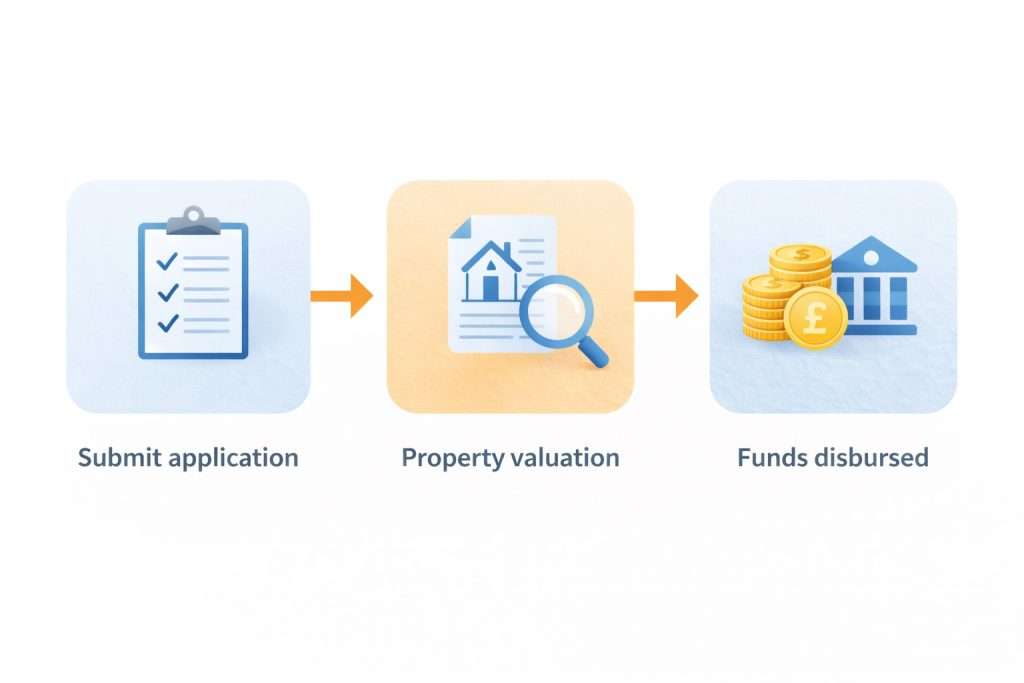
As you can see, it all boils down to the initial application, a fast property valuation, and the quick release of funds. Everything is designed to hit those tight deadlines.
The Application Timeline Unpacked
To give you a clearer picture, here’s a practical timeline of what to expect when you apply for a bridging loan through a broker:
Initial Consultation & Decision in Principle (DIP): It all starts with us understanding your needs and gathering key details about the property and your exit strategy. We then find the best lenders for your case to secure a DIP, which is their initial “yes” to lending in principle.
Formal Application & Valuation: Once you’re happy with a DIP, we push forward with the full application. The lender immediately gets a surveyor to value the property you’re buying. This valuation is absolutely crucial, as the final loan amount will be based on it.
Formal Loan Offer: Upon receipt of a positive valuation report, the lender issues a formal, legally binding loan offer. This is the document that lays out all the terms, rates, and fees for your bridging loan.
Legal Work and Completion: With the offer in hand, solicitors for both sides get cracking on the legal paperwork. Your broker is vital here, chasing everyone involved to make sure things keep moving without any hitches.
Funds Released: As soon as the legal side is sorted, the lender releases the funds straight to your solicitor. Just like that, you can complete your property purchase.
The market for bridging loans has exploded, which shows just how valuable they are for time-sensitive deals. For homeowners in Essex or around Chelmsford, this type of finance is perfect for stopping a chain from collapsing or snapping up an auction property in Colchester with a 28-day deadline. With average completion times sitting as low as 43 days from the offer, it’s a powerful tool.
“A specialist broker acts as your project manager, coordinating with lenders, valuers, and solicitors to drive your application forward and hit your deadlines. Their expertise is invaluable in ensuring a smooth and fast completion.”
This checklist approach gives you clarity and control, turning what could be a stressful scramble into a manageable, step-by-step process.
Frequently Asked Questions About Bridging Loans
Even after covering the basics of bridging loans for property purchases, it’s natural to have a few more questions. Let’s tackle some of the most common ones we hear from our clients, helping you get a clear picture before taking the next step.
How Quickly Can I Get a Bridging Loan?
Speed is really the name of the game with bridging finance. While every case has its own timeline, a well-prepared application managed by an experienced broker can see funds released in just a matter of weeks, and sometimes even a few days.
This rapid turnaround is precisely what makes them so useful for time-sensitive situations, like securing a property at auction or moving fast on a dream home before another buyer gets there first.
What Exactly Is an Exit Strategy?
Put simply, your exit strategy is your plan for paying back the bridging loan. It’s the single most important part of your application because it gives the lender total confidence in how they’ll get their money back.
A solid exit plan is usually one of these three routes:
Selling your current property after you’ve successfully moved into your new one.
Selling the property you bought with the loan, often after a quick refurbishment to boost its value.
Refinancing the bridging loan onto a standard, long-term mortgage.
“Lenders must have absolute confidence that your exit strategy is both realistic and achievable within the agreed loan term. A vague or poorly planned exit is the quickest way to have an application declined.”
Can I Get a Bridging Loan With Bad Credit?
Yes, it’s definitely possible to secure a bridging loan even if your credit history isn’t perfect. Bridging lenders tend to place more weight on the property’s value and the strength of your exit plan than on your credit score alone.
While significant recent credit problems can be a hurdle, past financial bumps in the road do not automatically rule you out. It’s one of the things that makes bridging finance such a flexible option.
Are All Bridging Loans Regulated?
No, and it’s a crucial distinction to understand. A loan is ‘regulated’ when it’s secured against a property that you or a close family member will be living in. These loans are overseen by the Financial Conduct Authority (FCA), which provides a strong layer of consumer protection.
On the other hand, a loan for a property that’s purely for investment, like a buy-to-let in Colchester, is usually ‘unregulated’. This often means the lender can be more flexible with the terms they offer.
Your Next Steps in Property Finance
So, to wrap things up, a bridging loan for a property purchase is an incredibly effective financial tool. It offers the speed and flexibility you need to act fast in a competitive market. When used correctly, it can be the key to breaking a property chain, snapping up a great investment, or simply making sure you do not lose out on your dream home in places like Chelmsford.
The secret to getting it right, though, is working with an expert who truly understands the market. We can help you structure the perfect deal for your specific circumstances, and that absolutely includes planning your exit strategy, whether that involves selling another property or exploring ways to remortgage to release equity for your long-term finance.
“A bridging loan is the key to unlocking property opportunities that would otherwise be missed. The secret is pairing this powerful tool with expert advice to ensure a seamless and successful outcome.”
If you’re looking at a property purchase in Essex and think a bridging loan might be the answer, the best next step is to get some professional, tailored advice. Our team has the experience to guide you through every stage, from the initial idea to receiving the keys in your hands.





