You’ve found a property you like, but you’re wondering whether the deposit is enough, whether the bank will approve the mortgage, and what the purchase will really cost.
Top tip 💡: don’t start with property listings. Start with the lender’s view of your finances. I’ll explain why that changes the entire buying process later in this guide.
If you’re learning how to buy a property in Chelmsford, Braintree, Colchester or elsewhere in the UK, the sensible route is to establish your budget, test the mortgage options and calculate the full cash requirement before arranging viewings. The deposit matters, but it’s only one part of the decision.
What Buying a Property in the UK Really Involves
A first-time buyer in Chelmsford may call with a 10% deposit and assume they can begin the search immediately. I would slow that down. The deposit gets you into the conversation. It does not decide whether the purchase works.
Before discussing lenders or arranging viewings, I ask every buyer three questions.
What do you actually want to buy?
A flat, new-build house, period terrace or property with unusual construction can produce very different lending outcomes. Lease length, service charges, property condition and intended future use may affect a lender’s decision as much as the purchase price.
This question prevents wasted viewings. If the service charge is unaffordable or the building falls outside a lender’s criteria, there is no benefit in becoming emotionally committed to it. I would establish the property type first, then match it against available lending.
What do you earn
I need the full income picture, not only the headline salary. That includes employed income, overtime, bonuses, commission, self-employed profits, dividends, pension income and other regular sources a lender may accept.
Existing credit commitments matter just as much. Two buyers earning the same salary can receive different affordability results because of debts, dependants and monthly financial commitments. The figures must be evidenced properly before an agreement in principle is treated as a reliable budget.
What will a lender realistically lend today?
This filter sets the search range. An online calculator offers an indication, while a lender applies its own affordability model, documentation rules and property criteria. EHF’s whole-of-market access across 100+ lenders matters here because one lender’s decline can be another lender’s workable case, particularly where income or property details are less straightforward.
The English Housing Survey 2023 to 2024 recorded around 975,000 recent first-time buyers, with 85% outside London, and an average age of 34. Buyers across Essex still need a properly tested budget before competing for a suitable home.
Once those three answers are clear, the usual journey is:
Obtain a mortgage agreement in principle.
Search within the verified budget.
Make and negotiate an offer.
Instruct a solicitor or conveyancer immediately after acceptance.
Complete the mortgage application, valuation, searches and survey.
Exchange contracts.
Complete and collect the keys.

Practical rule: Set your maximum purchase price only after calculating the deposit, taxes, legal work, surveys, lender fees and immediate property costs together.
The MHCLG How to Buy guide describes a typical journey of about 12 weeks from offer acceptance to completion, with the legal transfer often taking roughly 18 to 40 days. A chain, solicitor capacity or unusual property can alter that timing. Buyers who need a fast completion should raise the target date before making the offer, not after contracts are underway.
The purchase price is not the total budget. Confirm the full cash requirement before viewing seriously, and test your borrowing against the property you intend to buy.

Sorting Out Your Finances and True Upfront Costs
Buyers need more cash than the deposit alone. That’s where many otherwise sensible budgets fail.
The Government’s English Housing Survey 2024 to 2025 recorded an average first-time-buyer deposit of £78,131. The same data found that 59% of first-time buyers put down less than 20% of the purchase price, while 97% used repayment mortgages. Halifax reported 341,068 first-time buyers in 2024, up 19% on 2023, and said they represented 54% of mortgaged purchases, the biggest majority on record, as reported in the ONS UK House Price Index dataset.
In practical terms, a deposit may sit somewhere around 5% to 15% depending on the case and product. A larger deposit can open different loan-to-value bands, but I wouldn’t empty every account to reach a particular percentage. Retaining an emergency reserve is often more sensible than borrowing at the absolute maximum.
The cash stack
For a Chelmsford buyer considering a two-bedroom flat priced between £260,000 and £320,000, or a three-bedroom semi in Springfield or Broomfield priced between £375,000 and £450,000, the budget needs to account for more than the purchase price. Those local price examples are planning illustrations, not a substitute for a property-specific valuation.
| Cost Item | Typical Range (£) |
|---|---|
| Deposit | 5% to 15% of price |
| Solicitor fees | 900 to 1,800 |
| Local searches | 250 to 450 |
| Survey | 400 to 1,500 |
| Mortgage arrangement fee | 0 to 2,000 |
You may also need to budget for a broker fee, removals, buildings insurance, immediate repairs and any lender or Land Registry charges. The first-time buyer total cost guide highlights that a purchase in England can require roughly £19,000 to £23,000 in total cash on a £250,000 home, even where first-time buyer tax relief applies.
In England and Northern Ireland, Stamp Duty Land Tax rates are 0% up to £125,000, 2% from £125,001 to £250,000, 5% from £250,001 to £925,000, 10% from £925,001 to £1.5 million, and 12% above £1.5 million under the standard residential bands. Qualifying first-time buyers who have never owned residential property anywhere in the world, will occupy the home as their main residence and buy for under £500,000 can use relief, paying 0% up to £300,000 and 5% from £300,000 to £500,000, as explained by Rightmove’s first-time buyer tax guide.
Credit history, debt consolidation, shared ownership and Help to Buy-related considerations can change the calculation. I’d run the full figures through a cost-of-moving-home calculator before arranging viewings.
The lightbulb moment is this: the deposit starts the budget, not the budget itself.
Choosing the Right Mortgage and Whole-of-Market Advice
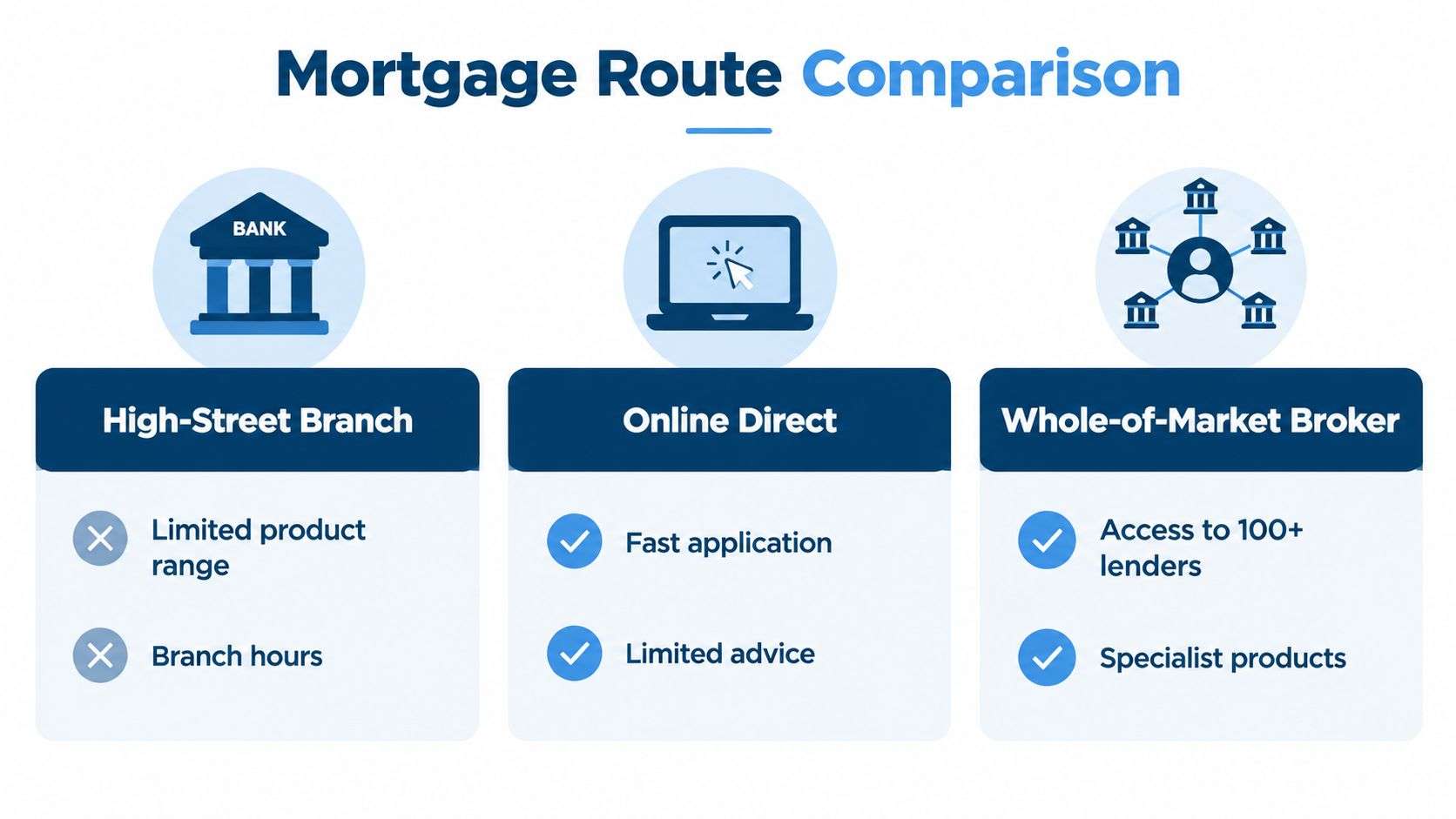
There are three common routes to a mortgage. You can visit a high-street bank, apply directly online or use a whole-of-market adviser. Each has a place, but they don’t deliver the same choice or underwriting support.
A high-street branch offers familiarity and face-to-face contact, but its adviser generally recommends from that lender’s own range. An online direct application may be quick and convenient, but you’re responsible for identifying whether the product and criteria fit your circumstances. A whole-of-market broker compares products across lenders, including specialist and regional building societies, and can help position a complicated application.
EHF Mortgages has access to over 100 lenders, according to its publisher information. That matters when your income, credit history or property doesn’t fit the standard high-street model.
What lenders are really assessing
Loan-to-value is only one part of the decision. Lenders also assess affordability under their own stress tests, check the type and reliability of income, review credit conduct and apply minimum deposit rules to different products.
An agreement in principle is useful because it indicates what a lender may be prepared to consider based on the information supplied. It isn’t a final mortgage offer and doesn’t guarantee approval, but estate agents usually take a buyer more seriously when the borrowing position has been tested.
Watch the video below for another explanation of the mortgage journey.
Complex income needs careful packaging
Self-employed buyers should prepare accounts, SA302s and year-to-date figures. The lender may focus on net profit, salary and dividends, rather than the gross turnover a business generates. Some lenders prefer a longer trading history, while specialist lenders may consider one year of accounts or limited company dividends in appropriate cases.
Adverse credit needs the same discipline. Defaults, CCJs, missed mortgage payments and previous financial arrangements each have their own lender rules and waiting periods. I’d review the dates, balances, settlement position and current conduct before making an application, then decide whether applying now or rebuilding first gives the stronger outcome.
The right adviser isn’t just finding the lowest advertised rate. The job is to identify the lender whose criteria your case fits. For a fuller explanation, read how to choose a mortgage broker.
From Offer Accepted to Completion in Chelmsford and Essex
A buyer in Chelmsford can have an accepted offer and still lose weeks if the mortgage offer isn’t ready. I recently handled a two-bedroom terrace where the chain and solicitors were prepared, but the buyers’ bank could not produce the formal offer.
We moved the case to a lender suited to the applicants and secured the offer within 48 hours. The purchase completed in just under 14 days, because every other party was ready. That was an exceptional completion, not a sensible timescale to promise every buyer.
The usual sequence
Once the buyer instructs a conveyancer, the solicitor reviews the contract pack and orders searches. These commonly cover local authority, drainage and environmental matters, with chancel searches where relevant. The lender arranges its own valuation to confirm that the property provides suitable security for the loan.
A buyer can also commission a survey. The valuation serves the lender’s purpose. It is not a detailed inspection of the building and will not identify every defect.
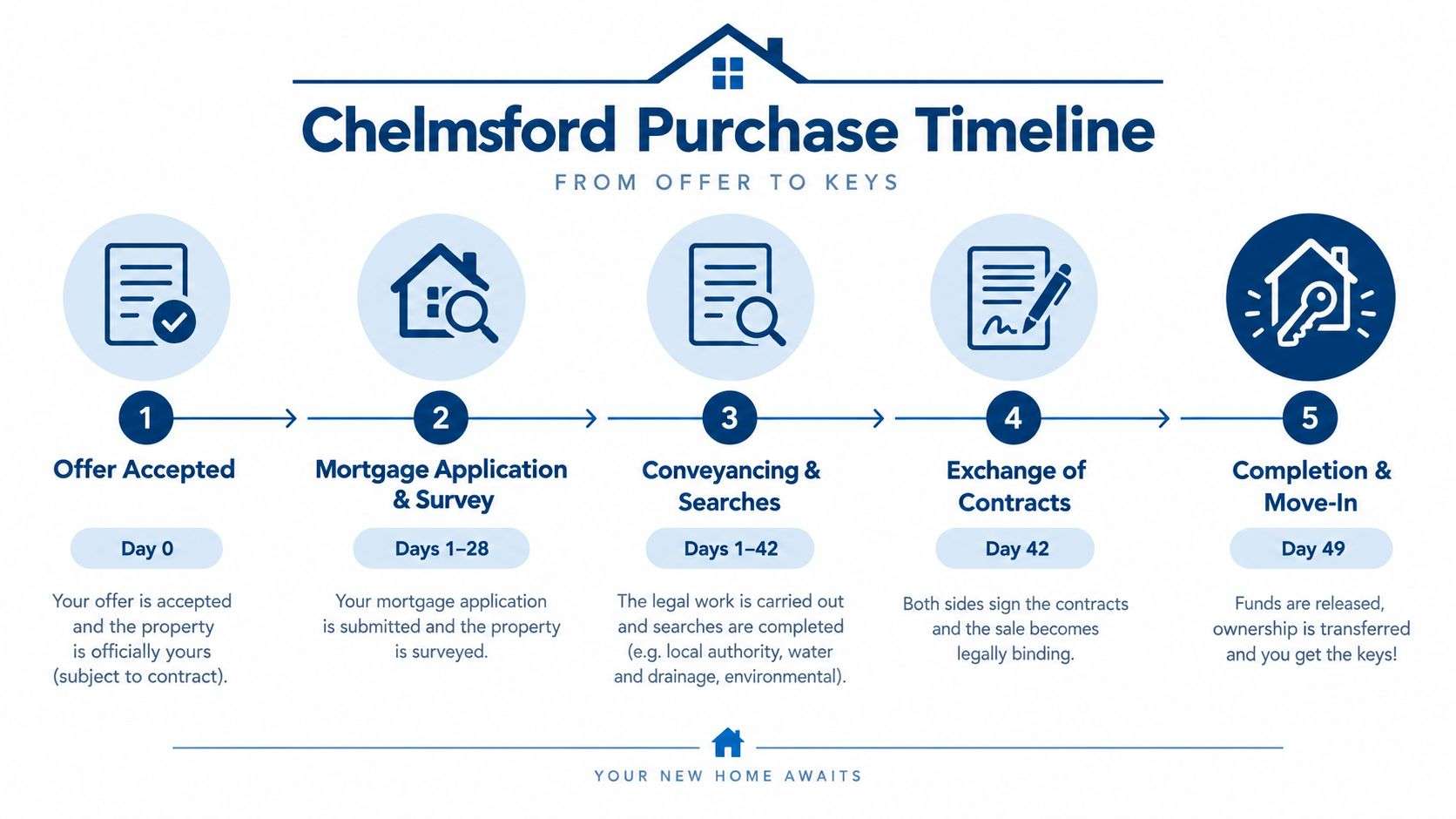
For a straightforward Essex chain, I would plan around 8 to 12 weeks from accepted offer to completion. A lease extension, slow solicitor, gifted deposit or missing paperwork can extend that period. Before exchange, I would check that the mortgage offer, searches, enquiries and source-of-funds evidence are all progressing, rather than relying on an optimistic target date.
Exchange is not completion
Exchange makes the contracts legally binding and fixes the completion date. Pulling out after exchange can have serious consequences. A 10% deposit is commonly payable then, subject to the contract and the circumstances of the purchase.
Completion happens when the buyer’s solicitor sends the remaining purchase money to the seller’s solicitor. Once the funds arrive, the seller authorises release of the keys and legal ownership transfers, as explained in MoneyHelper’s exchange and completion guidance.
Use a removals firm only after you confirm the completion timing. Buyers around Southend and Essex can order Southend house moving boxes from Storage Removal early, so packing supplies do not become a last-minute problem. For a clear breakdown of the mortgage steps after approval, read what happens after a mortgage offer.
Surveys, Hidden Costs and Buyer Protections
A lender’s valuation is not a buyer’s survey. The valuer is primarily assessing whether the property provides acceptable security for the mortgage. If the report doesn’t identify a problem, that doesn’t prove the building is sound.
For a conventional 1930s semi in Chelmsford, a Homebuyer Report may provide a sensible middle ground. A full Building Survey is the better choice for period homes, listed buildings, properties with extensions, unusual construction or obvious defects.
Match the inspection to the property
| Item | Typical Cost / Use |
|---|---|
| Lender valuation | Protects the lender’s security |
| Homebuyer Report | Suitable for many conventional homes |
| Building Survey | Detailed inspection for older or unusual properties |
| Searches | Checks local authority, drainage and environmental matters |
| Insurance | Protects the home and contents after completion |
A survey gives you the chance to make an informed decision before exchange. On a recent £320,000 Chelmsford terrace, a £600 survey identified roof and damp problems that supported a £14,000 renegotiation. That is why I treat the survey as a decision tool, not a box-ticking exercise.
Another frequent issue is the leasehold flat. Buyers often focus on the price and mortgage payment, then discover service charges, ground rent, reserve-fund contributions or restrictions on alterations and subletting. New-build flats around Beaulieu and Channels need the same scrutiny as older leasehold homes.
Costs that arrive after the excitement
Legal fees, search costs, indemnity insurance, removals, immediate repairs and the first buildings insurance payment can all affect the cash reserve. Ask the solicitor for a written estimate that separates their fee, search charges, Stamp Duty, Land Registry costs and any likely extras.
You should also ask how the solicitor will check the leasehold information. Service charge accounts, planned major works, building insurance, remaining lease term and the landlord’s management arrangements can influence both affordability and future resale.
For practical protection after moving in, buyers may also benefit from reviewing these property maintenance tips for 2026. Arrange suitable home and contents insurance before completion, because the property becomes your responsibility once ownership transfers.
Specialist Routes for Complex Property Buyers
A standard residential mortgage isn’t the right tool for every buyer. The key is to identify the case type early rather than submit an application to a lender that was never going to accept it.
| Pathway | Typical Applicant | Key Criteria |
|---|---|---|
| Buy-to-let | Landlord buying for rental income | Rental affordability, property type and ownership structure |
| Later-life lending | Older homeowner needing flexible borrowing | Retirement income, term, repayment plan and suitability |
| Self-employed lending | Business owner or contractor | Accounts, SA302s, dividends and income history |
| Adverse credit | Buyer with previous credit problems | Dates, balances, settlement and current conduct |
Buy-to-let
A landlord buying for commuter tenants in Chelmsford needs to assess rental income, property costs, void periods and the lender’s rental stress test. Limited company SPV ownership can change the tax and underwriting discussion, but it also creates additional administration and professional advice requirements.
Don’t choose a structure just because another landlord uses one. The right route depends on the property, borrowing plans, ownership objectives and tax advice.
Later-life borrowing
Later-life lending can include a lifetime mortgage or a retirement interest-only mortgage. A lifetime mortgage may release equity with repayment usually linked to a future event, while a retirement interest-only mortgage requires the interest to be paid and a credible repayment strategy for the capital.
For an older homeowner downsizing or helping family, the affordability assessment must reflect pension income, future expenditure and the effect on estate planning. A solicitor or tax adviser may need to be involved alongside the mortgage adviser.
Self-employed and contracting income
Two years of accounts and SA302s often make a mainstream application easier, but the calculation still depends on how the lender treats profits, salary and dividends. A buyer with one year of accounts, contracting income or several income streams may need a specialist lender that understands the evidence rather than rejecting it automatically.
Adverse credit
Defaults, arrears and CCJs don’t produce one universal answer. Lenders look at the type of issue, when it occurred, whether it was settled, the amount involved and the rest of the credit file. I’d rather delay an application and repair the file than create an avoidable decline that narrows the next options.
Buyers exploring unfamiliar ownership concepts can also read this Alabama lease purchase explained resource for comparison, although UK leasehold, mortgage, and conveyancing rules differ. For UK complex cases, specialist mortgage lender advice should be based on the actual documents, not a generic online category.
Your Next Step With EHF Mortgages
Return to the three questions at the beginning.
What do you want to buy? Your property choice determines whether leasehold, construction, condition and use restrictions need early attention.
What do you earn? Your income evidence determines how the lender views affordability. Salary, commission, self-employed profits, dividends, pension income and credit commitments all need to be presented accurately.
What will a lender lend? That answer comes from matching the case to lender criteria, not from assuming that the nearest bank or an advertised mortgage rate will work.
A sensible initial consultation should produce a clear working picture. EHF Mortgages describes its service as whole-of-market advice across over 100 lenders, including residential, buy-to-let, specialist and later-life options. The practical outputs should include a realistic affordability check, a deposit and costs breakdown for the intended property, and an honest view on whether the case needs a specialist route.
That route may involve self-employed income, adverse credit, shared ownership, buy-to-let, later-life borrowing or an unusual property. It may also involve protection and insurance, because a mortgage payment is only manageable if the household can withstand illness, death, loss of income and damage to the home.
I’ve worked in mortgage advice for more than 35 years, and the same mistake keeps appearing in different forms. Buyers calculate the deposit, choose a property and only then discover that the lender, legal costs, leasehold obligations or income evidence changes the answer. The lightbulb tip from the opening remains the one I’d follow myself: check what the lender will support before you emotionally commit to a home.
If you’re not ready to apply, ask for a callback or use a first-time buyer guide to organise your documents. If you are ready, book a free consultation through the EHF Mortgages contact page and bring the three answers with you.
EHF Mortgages provides whole-of-market mortgage and protection advice for residential buyers, landlords and complex cases across Chelmsford, Essex and the UK. If you want a realistic affordability assessment, a full upfront-cost calculation and a lender matched to your circumstances, visit EHF Mortgages today.